

TAP® SPINAID™ 4‑Seam & 2‑Seam – Visual Release Feedback Trainer
Ordering for a team or facility?
Get volume pricing and help choosing the right tools for your players.
About This Product
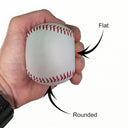
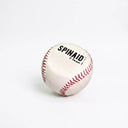
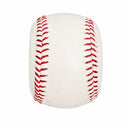
The TAP® SPINAID™ is a genuine-leather spin-feedback baseball that makes release errors visible on every throw so coaches and pitchers can actually see what the ball is doing at the point of release. It uses flattened faces and either 4-seam or 2-seam orientation to turn spin axis, wobble, and efficiency into obvious visual cues instead of invisible variables that normally require a radar unit or high-speed camera. It works in regular catch play, bullpens, and home sessions as a low-volume skill tool that supports movement quality and neuromuscular control without adding unnecessary load.
Key Features & Benefits:
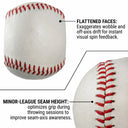
- Genuine leather, baseball-spec design: Same diameter and weight as a regulation baseball, with minor-league-style seams and flattened faces, so the hand feel is familiar while the spin pattern is easy to read.
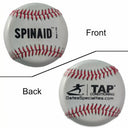
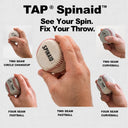
- 4-Seam and 2-Seam orientations: Two versions mirror real fastball grips — 4-Seam for standard four-seam fastballs and many breaking balls, 2-Seam for sinkers, movement-based fastballs, and 2-seam changeups.
- Immediate visual wobble feedback: Flattened sides make spin axis, wobble, and precession obvious from across the yard, so coaches and pitchers can see whether the ball is tracking clean or drifting off axis.
- Supports cleaner spin and axis awareness: Shows how grip, finger pressure, arm slot, and release direction affect spin efficiency and axis stability, supporting better movement quality without micromanaging mechanics.
- Works across fastballs, breaking balls, and changeups: Can be thrown with 4-seam, 2-seam, curveball, slider, and changeup grips to confirm whether the spin behavior matches the pitch's intent.
- Self-guided learning tool: Athletes can change grip, finger pressure, or release intent and see the result instantly, encouraging exploration, self-organization, and durable feel for efficient release.
How to Use
Where It Fits in the Year
- Off-season: Use in low-intent catch, dry-work into a net, or constraint-based bullpens to explore axis, wobble, and grip variations without heavy arm load.
- In-season: Use sparingly in catch play or early bullpen throws to confirm that spin axis and wobble look like they should, then switch back to regular baseballs.
- Post-season: Use for low-stress, skill-focused throwing when volume and intensity are down but you want to keep release feel sharp.
Basic Progression
- Start with the 4-Seam SPINAID™ for fastball work (youth and most high-school pitchers).
- Throw at submaximal effort into a net or to a partner. Watch how the flat faces spin.
- Look for stable, repeatable rotation when the release is clean; visible wobble or face flicker when finger pressure, wrist position, or axis drift.
- Make one small change at a time (grip depth, finger pressure, seam orientation) and throw again, using the ball's flight as the primary feedback.
- Alternate throws: SPINAID™ → regular baseball → SPINAID™ → regular baseball to transfer improved release feel back into game-ball work.
Safety and Guardrails
- Low volume, low intensity, high supervision for youth. SPINAID™ is a throwing tool, not a toy.
- Throws with SPINAID™ count toward total throwing for the day — do not stack extra, high-intent volume just because the ball is "a trainer."
- Do not hit it with a bat or throw it into hard walls or abrasive surfaces. Use with a net, screen, or catching partner.
- If anything in the arm, elbow, or shoulder feels sharp or unusual, stop and revert to medical or rehab guidance before resuming.
For a complete breakdown of the physics behind spin axis, wobble, and how to use the SPINAID™ across every major pitch type: TAP® SPINAID™: The Visual Feedback Tool That Makes Release Errors Visible →
Why It Works (Research-Backed)
The TAP® SPINAID™ takes three variables that normally require high-speed video — force direction, spin axis, and spin efficiency — and makes them visible in normal practice conditions. Flattened faces exaggerate wobble and precession so even a subtle off-axis release shows up as obvious oscillation in flight, while clean releases produce stable, predictable rotation.
From a motor-learning standpoint, SPINAID™ behaves like a constraint in a constraint-led approach: the unique shape and clear visual feedback change the task just enough that the athlete's neuromuscular system is nudged toward more efficient self-organization. Instead of chasing a verbal cue, the pitcher throws, sees the outcome, adjusts one variable, and throws again — an evidence-aligned way to build better neuromuscular control and movement quality over time without increasing load.
The tool also supports practical pitch design: when a pitcher can see their natural spin axis, they can align fastballs, breaking balls, and changeups off that axis more intentionally, instead of guessing at what the ball is doing at release.
Who This Is For
- Pitchers at any level who want immediate visual feedback on spin axis, wobble, and release consistency without needing a radar unit or high-speed camera.
- Coaches using constraint-led methods who want a self-guided learning tool that gives athletes clear feedback without constant verbal cueing.
- High school and college pitchers building or refining pitch arsenals who need to verify that spin behavior matches pitch intent across fastballs, breaking balls, and changeups.
- Pitching programs that pair SPINAID™ with Rapsodo or TrackMan data to connect visual on-field feedback with spin efficiency percentages and axis angle from the tracker.
- Youth athletes using the tool only under coach supervision, with low volume, low intensity, and clear guidance on appropriate pitch types.
Technical Specifications
- Type: Genuine leather spin-feedback baseball
- Size and weight: Regulation baseball dimensions and weight
- Seam specifications: Minor-league-style seams with flattened faces for visual spin feedback
- Available versions: 4-Seam (standard fastball orientation) and 2-Seam (narrow-seam / sinker orientation)
- Primary applications: Fastball spin axis feedback, breaking ball axis confirmation, changeup release consistency, arm-slot identification
- Intended use: Low-volume skill work in catch play, bullpens, net sessions, and dry-work environments — not for batting practice or hitting drills
Frequently Asked Questions
The 4-Seam version matches a traditional four-seam fastball grip and is ideal for four-seam fastballs, many curveballs, and some sliders. The 2-Seam version matches narrow-seam grips for sinkers, two-seam fastballs, 2-seam changeups, and breaking balls thrown along the narrow seams. Most athletes eventually discover a preference by throwing both and choosing the one that gives the clearest flight and strongest feel for their primary pitches.
SPINAID™ is a feedback tool, not a velocity or medical device. Its most defensible role is helping pitchers see and refine spin axis, wobble, and release consistency so they can build more efficient patterns over time within a sound overall arm-care and throwing plan. It does not replace workload management, strength training, or medical care.
Most coaches treat it as a short, focused segment inside regular catch play or bullpens — just enough reps to get clear feedback and make one or two adjustments, then switch back to regulation baseballs. In-season, that might mean a handful of throws a few times per week. Off-season work can be slightly more exploratory at lower intensity.
No. Some pitches are designed to be intentionally inefficient — for example, many sliders and certain changeups. The key is whether the wobble is stable and repeatable or random and drifting. Consistent intentional wobble can be part of a good pitch; random wobble usually points to inconsistent release.
SPINAID™ uses professional-grade materials and is built to handle repeated throws when used as intended — into nets or to partners in normal training environments. Avoid hitting it with bats or throwing into hard or abrasive surfaces to preserve the feedback quality and leather cover.