

TAP® Batting Target (JETZT 29" Durchmesser)
$39.95
Ships from Huntsville, TX
Out of Stock
Ordering for a team or facility?
Get volume pricing and help choosing the right tools for your players.
Ask me anything about this product
Sizing · use cases · technique · shipping — instant answers
Ask about TAP® Batting Target (JETZT 29" Durchmesser) — how to use it, what athletes it fits, sizing, or how it compares to other tools we make. Answers are focused on this product.
Innovating since 2003
Family-owned, Huntsville TX
Talk to the team
Real specialists, not a call center
Made for daily program use
Designed for continuous reps, every day, every season
100+ implements, organized by goal
Arm care, velocity, strength, and recovery
About This Product
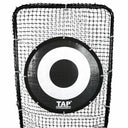
A blank cage net gives a hitter nothing to aim at and nothing to check against. The Batting Target installs a visible destination on the netting.
The TAP® Batting Target™ is a 29-inch high-contrast bull’s-eye panel for hitters, coaches, and programs that want a specific goal on every cage swing — no radar, no data subscription, and no dedicated facility required. It hangs on cage netting, hitting tunnel netting, or any equivalent rated net enclosure with the included bungee hardware, with setup in minutes and easy repositioning so the goal can change between rounds. It is a feedback tool rather than a swing-fix: it won’t tell a hitter how to move the bat, but it gives every swing a visible goal before the rep and a readable result after it.
- 29-Inch High-Contrast Bull’s-Eye — one specific visible goal on every rep; both hitter and coach see whether it got there.
- Repositionable Left/Right for Field-Zone Work — opposite-field, center, or pull-side; each placement trains the contact-point depth that lane requires.
- Repositionable Up/Down for Elevation Work — line-drive height for standard sessions, raised toward the 7-to-9-foot band for attack-angle work.
- Multi-Panel Capable — two or three panels at named positions convert a blank net into a labeled directional map.
- Mounts to Netting You Already Own — any rated cage or hitting tunnel netting qualifies; no proprietary frame, tools, or power.
- Readable Result with No Technology — the ball reached the marked destination or it did not; nothing to calibrate or interpret.
- Progressive Protocol Included — a five-stage protocol, placement rules, and youth guardrails.
- Research-Grounded Design — mechanism support comes from peer-reviewed research; no study has tested this specific product.
What Is It?
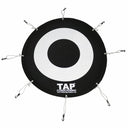
The TAP® Batting Target™ is a 29-inch circular high-contrast bull’s-eye panel constructed from durable PVC-coated fabric, held taut by a welded 6mm steel tension ring and fitted with metal bungee grommets, weighing approximately two pounds. It ships with ball bungees and mounts directly to batted-ball confinement netting, ready to hang out of the box.
Position determines what the session trains: left or right marks the field zone and contact-point depth; up or down marks the ball-flight elevation tier. Placement names are outcome-referenced training categories, not degree-level measurements — mid-cage height marks line-drive range (the trajectory tier with the highest batting average in games), a raised panel marks the elevated extra-base tier, and a lowered panel marks the ground-ball boundary a hitter should stay above.
How It Works
Three mechanisms behind the bull’s-eye
External Aim Point
Aiming at a visible point outside the body produces better swings and faster learning than focusing on body mechanics, per a review of 143 studies across ages and skill levels. The bull’s-eye provides that external aim point on every rep, without a coaching cue.
Physical Direction & Elevation Goal
Research on baseball hitters found a physical directional goal produced more opposite-field hits, better pitch selection, and greater contact-point adaptability than verbal coaching, with gains holding a month later. A physical elevation goal similarly beat verbal coaching on attack angle and exit velocity after six weeks.
Moderate Variable Practice
Moving the panel between sessions is a variable-practice design: research with skilled college players found varied practice improved real hitting performance more than blocked practice, though moderate variability outperforms both blocked and highly varied practice — three stable named positions is the dose the evidence supports.
Backed by Research
Mechanism-Level Evidence Behind the Bull’s-Eye
Every mechanism claim applies a verified sports-science finding to this design — external aim, physical directional and elevation goals, and moderate variable practice are each supported at the research level, not the product level.
29″
Panel diameter sized for real cage-distance precision
3 Positions
Pull-side, center, and opposite-field zone map
143 Studies
Reviewed on external-focus training effectiveness
Video Library
See It In Action
Click a thumbnail to play from the start — click any timestamp to jump to that moment.
Video Manual
TAP® Batting Target — Setup, External Focus Science & Drill Guide
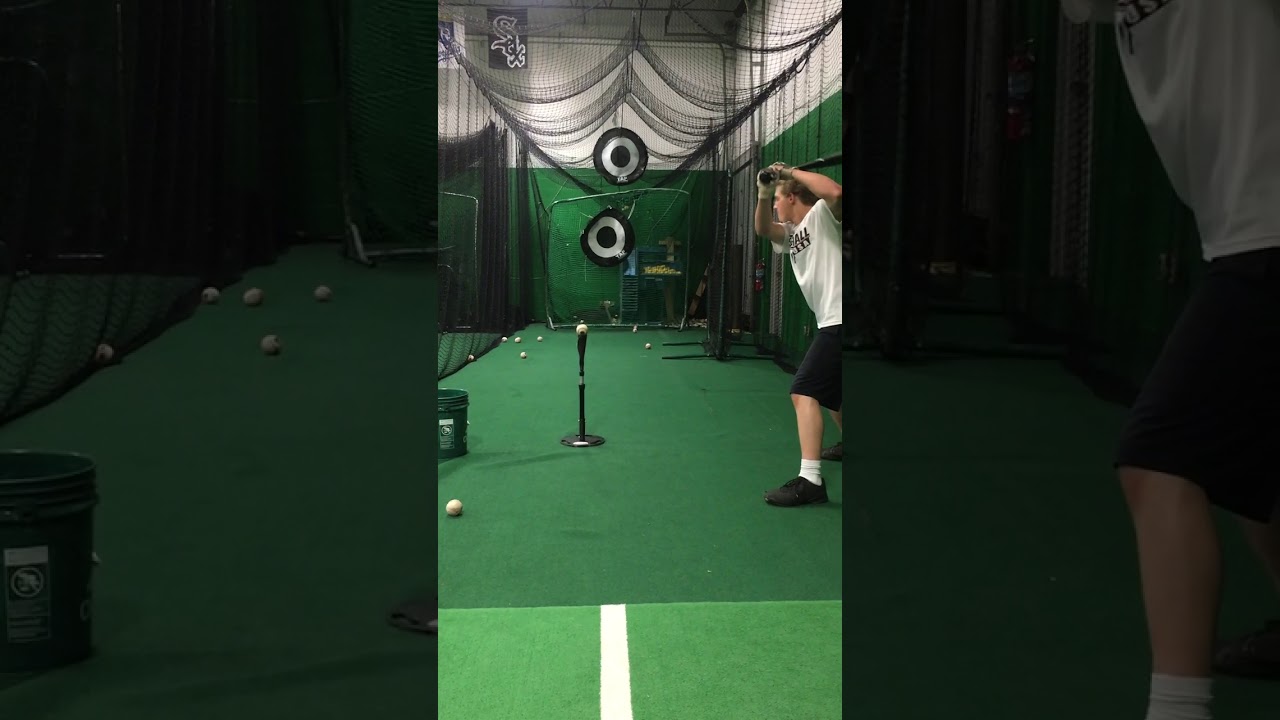
Goal-Directed Movement
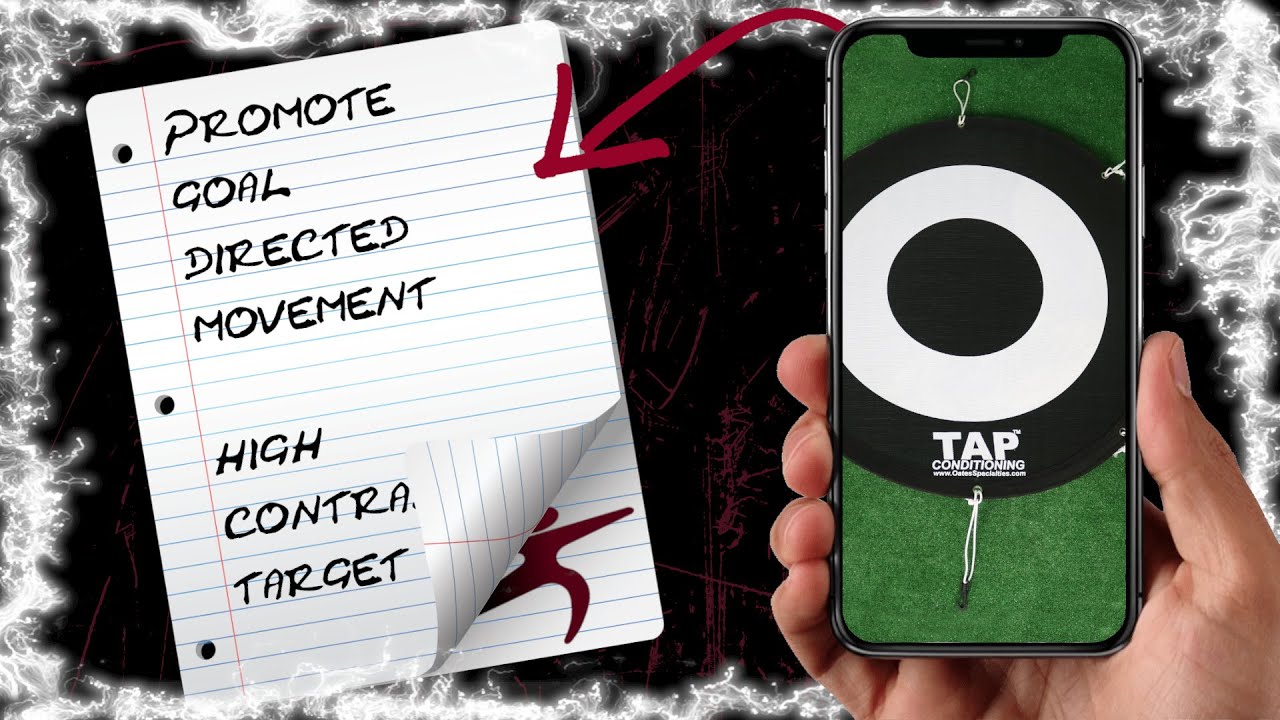
TAP™ Batting Target — Promote Goal-Directed Movement with High-Contrast Target
Chapter Guide — 7 Timestamps
| Presenter introduces the TAP® Batting Target — a circular, high-contrast black-and-white target canvas in front of a green field screen. | |
| Slim, lightweight, and highly portable — designed to transfer easily from place to place. | |
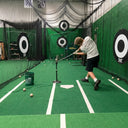
| Primary application — used in batting cages or on field screens as an explicit external visual cue for hitters. | |
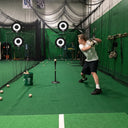
| Live action — hitter swings off a tee and launches a baseball squarely into the center of the target canvas. | |
| Rigging demonstration — perimeter ball-bungee cords loop the target into a safety screen or batting cage netting. | |
| Setup tip — bungees snug but not overwrapped or too tight, which would distort or pull the canvas unevenly. | |
| Final clip — hitter drives a ball off the tee into the center circle with a clean, balanced follow-through. |
What to Look For in a Batting Target
Not every target on the market does the same job. Before choosing any cage aim panel, consider what it actually needs to deliver for your program.
Surface Area
A cage aim point has to be readable from the box at real hitting distances, and small enough to demand real precision. A panel much under two feet across becomes a coin flip at typical cage distances; a panel that spans most of the net stops being an aim point at all.
Repositionability
Repositionability matters more than target count. A fixed aim point trains one lane, while a repositionable panel trains every lane and tier from one purchase, and lets a program build a multi-zone directional map when hitters are ready. Determine whether the target can move left, right, up, and down, and how long that takes between rounds.
Durability Against Batted-Ball Impact
Pitching targets are built for thrown-ball velocities, while hitting targets take batted-ball velocities, which produce significantly higher forces. Verify the panel is rated for the forces your hitters actually produce.
Whether a Training Progression Is Included
A target without a training protocol is just a surface to aim at. The training value lives in how sessions are structured: where to start, what the advancement criterion is, and what to hold back.
Mounting Requirements
Some targets need a specific net system or proprietary hardware, while others hang on netting a program already owns. Universal net mounting is the difference between a tool that gets used and one that waits on a purchase order.
The Research Behind the Bull’s-Eye
No direct peer-reviewed research has tested this specific product. Every mechanism claim below applies a verified sports-science finding to this design — none of it is product-specific outcome proof.
Why Visual Feedback Matters
A hitter needs to know, after every set of swings, whether the result matched the goal. Research on baseball hitters found that visual information outranked feel and sound when judging a swing. A blank net removes the visual result; the panel restores it — a goal before the swing, a result after.
The External Aim Point Effect
Aiming at a visible point outside the body produces better swings and faster learning than focusing on body mechanics, per a review of 143 studies across ages and skill levels. A 2024 Bayesian re-analysis corrected that literature for publication bias, and effect sizes in the verbal-instruction studies were negligible — an honest qualification that also sharpens the case for a physical, always-present target over a verbal cue, since the re-analysis addressed verbal cues rather than mounted targets.
OPTIMAL Theory & Starting Point Selection
OPTIMAL theory proposes that success experiences build positive expectancy alongside external focus, the reasoning behind starting each session at a reachable placement. A 2024 review found that only a minority of qualifying studies detected any motivation effect from those manipulations — starting at an achievable placement before adding difficulty remains good practice design on ordinary coaching grounds, independent of that theory.
Physical Goals vs. Verbal Coaching
The panel shapes contact through a physical goal rather than a verbal instruction. Research on baseball hitters compared a physical directional goal against prescriptive coaching: the physical-goal group produced more opposite-field hits, better pitch selection, and greater contact-point adaptability, with gains holding a month later. Separate research tested elevation the same way — a physical goal the hitter must reach beat verbal coaching on attack angle, exit velocity, and elevated contact after six weeks. Both supporting studies were run in a batting simulator; applying them to a panel on cage netting is a principled extrapolation.
Variable Practice Design
Moving the panel between sessions is a variable-practice design. Research with skilled college baseball players tested varied pitch types in practice, and that group improved substantially more on real pitched-ball hitting than a blocked-practice group. A further finding bounds the dose: moderate variability outperformed both blocked and highly varied practice, and wide dispersion reduced the benefit — three stable named positions is the structured dose the evidence supports.
Practitioner Sources (Tier 3)
Perry Husband, founder of the Effective Velocity framework, documented controlled testing with former major league infielder Jay Bell: in 30 tee swings aimed at a center-field target, Bell connected to center three times. Husband is cited here as a Tier 3 practitioner source; his framework is not peer-reviewed evidence. Publicly documented industry coaching material from Blast Motion® separately names an elevated target in a cage net as a low-tech method for developing a positive attack angle — also cited here as a Tier 3 practitioner source, not peer-reviewed evidence.
⚠ Honest Limit: Skill-Level and Complexity Dependency
These benefits are strongest for hitters who already make consistent contact. Research on baseball hitters found that less-skilled players sometimes improved more under direct mechanics coaching than under aim-based training — build contact first.
Multiple simultaneous panels add a visual and decision-making task. Start with one panel at one position and stay there until that zone is reliable.
Introduce elevated placement only after horizontal consistency is established — adding two difficulty variables in one session obscures which one the hitter is actually failing.
Product Details
Setup & Panel Configuration
The TAP® Batting Target™ is a single-SKU product (SKU: BT) — no size, weight, or material choice needed. The setup variables are placement, height, and panel count:
- One panel, repositioned session to session, builds one zone at a time — right for most programs.
- Two or three panels mounted together create the multi-zone directional map for advanced sessions.
- Vertical height adds the elevation reference at any panel count.
For most programs, start with one panel at center, line-drive height, and a make-or-miss count across 15 swings. Add a directional placement only after center consistency holds across two consecutive sessions.
How to Use It
Set-up: Hang one panel at center, line-drive height, before the session starts. Take 5–10 easy tee swings toward the bull’s-eye to calibrate the hitter’s eyes and aim before speed is added. Note where most warm-up swings land — that’s the session baseline.
Training use: Move the panel to match the day’s goal — opposite-field placement trains plate coverage and contact depth, pull-side trains front-of-plate timing, and center is the default for hitters building basic aim. Raise the panel for attack-angle and elevated-contact sessions, adding one variable at a time, never two. Every rep is taken at game-level swing intent — a steered swing that reaches the zone is a failed rep. The panel moves, but the hitter does not; stepping around the plate trains a false movement pattern. Count makes and misses across 10–15 swings, then read the set rather than the individual swing.
Light-day use: Keep one panel up at center, line-drive height, at reduced swing volume. The aim reference works at any intensity, so the habit holds without adding physical load.
Who This Is For
- Commonly used for hitters with established contact consistency who need a visible aim reference in cage work, present on every swing whether or not the coach says anything.
- Commonly used for coaches and programs building opposite-field, pull-side, or elevation sessions around a placed reference rather than repeated verbal cues.
- Commonly used for programs without advanced tracking technology that need a low-tech way to give every cage session a specific goal and a readable result.
- Commonly used for programs that already own tracking systems and still need an in-cage aim reference — a ball dying in a blank net returns no directional information at any price point.
- Commonly used for advanced hitters ready for coach-called zone sessions, using three panels at named positions as a directional map.
We are not coaches. We do not provide coaching.
What This Implement Does NOT Do
- Does not measure exit velocity, bat speed, contact quality, or launch angle in degrees — placement names are outcome-referenced tiers, not optical tracking data.
- Does not prescribe swing mechanics — the panel provides a goal and a result; the movement that reaches it comes from the hitter’s own motor system.
- Does not replace HitTrax®, Rapsodo®, or TrackMan® — those systems measure at a different level of precision, facility commitment, and cost.
- Does not train pitch recognition or timing — it develops the contact pattern that executes once a recognition decision has already been made.
- Does not improve direction or elevation on its own — reps with a clear goal and game-level swing intent build skill.
- Does not return the ball, and is not a backstop, cage liner, or net saver — mount only to rated confinement netting, never a hard or rigid surface.
- Is not a medical or rehabilitation device.
Technical Specs
| Product Family | TAP® Target System |
|---|---|
| Primary Use | Direction and elevation reference for cage-based hitting; contact-point depth training via horizontal placement; attack-angle training via vertical placement |
| Training Focus | Field-zone aim, contact-point depth, ball-flight elevation tier, attack angle, multi-panel directional map for advanced sessions |
| Construction | High-contrast circular bull’s-eye panel, durable PVC-covered fabric with metal ring tensioner, concentric ring pattern with defined center |
| Dimensions/Weight | 29 inches diameter; approximately 2 lb |
| SKU | BT (single SKU; multiple panels may be used together) |
| Included Hardware | Bungee mounting hardware |
| Environment | Batted-ball confinement netting only: batting cage, hitting tunnel, or equivalent rated enclosure. Tee, front toss, machine, and live pitching. Never a hard or rigid surface. |
Safety and Youth Guardrails
Net surface only — never a hard or rigid surface. Attach only to netting rated to stop hard-hit baseballs: a batting cage, a hitting tunnel, or an equivalent enclosure. The net’s give and the bungee attachment absorb ball impact force together; check bungee connections before every session.
Minimum age guidance: Independent use is recommended for athletes 13 and older. Younger athletes may use the panel under qualified adult supervision, with swing volume and goal complexity matched to age, size, and contact development stage. One clear aim point at one position is enough for a developing hitter. Stop and seek evaluation if a hitter reports sharp, unusual, or lasting discomfort.
- Not a toy: A supervised training aid for hitting practice only, not for climbing, hanging, or recreational use.
- Not a backstop or net saver: A feedback surface that requires a load-bearing net behind it; not a substitute for protective netting.
- Not a rehabilitation device: Not intended to diagnose, treat, or prevent injury.
Frequently Asked Questions
How is this different from the TAP® Hitting Target™?
Different tools built for different training problems. The Batting Target™ lives inside cage confinement netting and gives every cage swing one visible aim point and one clear result on direction and elevation. The Hitting Target™ mounts to any qualifying net surface and answers a broader question: at what trajectory tier did the ball arrive. A program with a cage and a second net surface can run both at the same time.
Does this require a batting cage?
It requires batted-ball confinement netting — a batting cage, a hitting tunnel, or an equivalent rated net enclosure all qualify. The netting isn’t a formality; it absorbs the impact force the panel is designed to take. If your facility has a net wall or freestanding backstop screen instead of a cage, the TAP® Hitting Target™ is the tool built for that surface.
My program doesn’t have HitTrax® or Rapsodo®. Is this a real substitute?
Honest answer: it’s a different tool rather than a full substitute. Those systems measure, while this panel sets a goal and returns a result — did the ball reach the intended lane at the intended height, on this rep. Programs that also want a power read can add a periodic exit-velocity assessment on a separate schedule.
Is it appropriate for youth hitters?
Yes, with the right progression. Start with one panel at center, line-drive height, and a simple make-or-miss count, adding nothing else at that stage. Add directional placement only after center consistency holds across two sessions, and add elevation after that. All youth use should be supervised by a qualified adult.
Can the panel measure launch angle?
No. Panel height corresponds to a ball-flight elevation tier, not a degree measurement — the relationship between panel height and launch angle depends on tee/pitch height, panel distance, and swing path. Use the raised panel to train the elevation constraint, and pair it with a launch-angle device if degrees are required.
Should coaches run one panel or three?
One panel, repositioned session to session, is right for any hitter building a specific zone — the correct default for most programs most of the time. Three panels mounted together are for hitters who already have reliable aim in each zone individually; the unpredictable zone call is the training challenge, not the zones themselves.
There are cheaper targets available. Why would I spend more?
Honest answer: a simpler, less expensive panel can tell you whether the ball went somewhere near a target. The difference here is what the panel can be asked to do over a season — it repositions across three field lanes and three elevation tiers, mounts to netting you already own, survives repeated batted-ball impact, and ships with a five-stage protocol and youth guardrails. A target without a progression is just a surface to aim at.
Questions before you buy? Call or Text Our Team at (936) 295-4459
Customer Reviews
What Customers Are Saying
Loading reviews…
No reviews yet for this product.
Be the first to review