

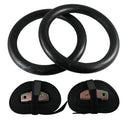
Turnkraftringe (Paar)
$49.95
Ordering for a team or facility?
Get volume pricing and help choosing the right tools for your players.
Ask me anything about this product
Sizing · use cases · technique · shipping — instant answers
Ask about Turnkraftringe (Paar) — how to use it, what athletes it fits, sizing, or how it compares to other tools we make. Answers are focused on this product.
Innovating since 2003
Family-owned, Huntsville TX
Talk to the team
Real specialists, not a call center
Made for daily program use
Designed for continuous reps, every day, every season
100+ implements, organized by goal
Arm care, velocity, strength, and recovery
About This Product
A pair of rings on adjustable straps that hang from any sturdy bar.
The Gymnastic Strength Rings are a pair of rings, each hanging from its own adjustable strap. Loop the straps over a bar, set the height with the buckles, and the rings are ready for bodyweight work — rows, push-ups, pull-ups, and dips. The rings hang free, so the grip moves during the rep and the athlete steadies the rings through the movement. When the session is done, the straps roll up and the pair packs away.
- Adjustable Straps — Each ring hangs from its own strap with a buckle, so the height sets per movement — high for pull-ups, low for rows and push-ups.
- Hangs From Any Sturdy Bar — Loop the straps over a pull-up bar, a squat rack, or a playground frame. No bolts, no mounting hardware, no permanent setup.
- A Grip That Moves — The rings hang free from the straps, so the grip is not fixed. The athlete steadies the rings through the rep instead of pressing against a fixed bar.
- One Pair, Many Movements — Rows, push-ups, pull-ups, and dips all run on the same pair — change the strap height and the foot position and the work changes.
- Portable — The straps roll up and the pair travels light, so the same rings serve the gym, the field, and the road.
What Is It?
A pair of gymnastic rings with adjustable straps for bodyweight training. Unlike a fixed bar, the rings hang from straps and move with the athlete, so each rep asks for control of the grip as well as the movement itself. Compared with a fixed pull-up bar, the rings travel — the bar stays in the gym, the rings go wherever a sturdy bar is. Compared with a suspension trainer, the rings are a simpler tool: two rings, two straps, and the athlete's own bodyweight.
How It Works
Three ideas behind a pair of rings
The Strap Sets the Height
Each strap adjusts at the buckle, so the rings sit where the movement needs them — high for hanging work, low for rows and push-ups. Set both straps to the same length before the first rep.
The Rings Move
A ring hangs from a strap, not a bolt, so it swings and turns as the athlete moves. Holding the rings steady is part of the rep — the grip work is built into the movement.
The Bar Is the Gym
The rings carry no weight of their own — the bar holds the athlete. Any sturdy overhead bar becomes the station, indoors or out, and the rings come down when the session ends.
Related Research
Research Context: What the Evidence Actually Shows
Rings are a long-standing tool in bodyweight training: hanging work on a moving grip is how gymnasts and coaches program pull-ups, dips, rows, and support holds, with the strap height and the foot position setting how the movement loads. A pair of rings exists so that work can run from any sturdy bar instead of a fixed station.
No study has tested these rings themselves, and training equipment does not produce strength or endurance gains on its own — results depend on the program, the coaching, the workload, and the athlete. This description does not claim that the rings build upper body strength, improve core stability, reduce stress on any joint, or replace a structured training program.
2 Rings
A pair, each hanging from its own adjustable strap
2 Straps
Buckle-adjusted length sets the height per movement
Any Bar
Hangs from a sturdy bar — a rack, a pull-up bar, or a playground frame
Product Details
How to Use It
Set up: Loop each strap over a sturdy overhead bar and set the height with the buckles. Match both straps to the same length, then check that the straps sit flat over the bar and the buckles hold before the first rep.
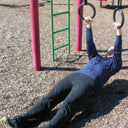
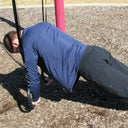
Basic movements: Start with ring rows at a height that keeps the movement controlled, and ring push-ups with the rings low. Add pull-ups and dips once the athlete holds the rings steady through the simpler movements.
Changing the work: The strap height and the foot position change how a movement loads — a more upright body makes a row easier, a more horizontal body makes it harder. Change one thing at a time and keep the movement controlled.
Groups and circuits: One pair builds a station, or one station in a bodyweight circuit. Rotate athletes through timed work and rest while other stations run.
Movement Guide
| Movement | How It Runs | Notes |
|---|---|---|
| Ring row | Lean back holding the rings, pull the chest toward the hands, lower back down | Starting movement for new athletes — the feet stay on the ground throughout |
| Ring push-up | Hands on the low rings in a plank, lower the chest, press back up | The rings move, so the hands steady them through the rep |
| Pull-up | Hang from the high rings, pull until the chin clears the rings, lower under control | The grip turns freely — the athlete finds the hand position that holds |
| Dip | Support the body on the rings at hip height, lower, press back up | Start with a support hold before adding the dip — the rings swing until the athlete steadies them |
The strap height sets the movement, so the coach picks the height and the exercise. Run each movement until it stays controlled before changing the height or moving to the next one.
Who This Is For
- Commonly used for coached bodyweight stations in gym and field sessions.
- Commonly used for athletes training pull, push, and hold work without a machine.
- Commonly used for camps and outdoor sessions that need equipment that hangs from what is already there.
- Commonly used for athletes in supervised bodyweight progressions, from ring rows to pull-ups and dips.
What These Rings Do NOT Do
- They do not guarantee strength or endurance gains — results depend on the program, the coaching, and the athlete.
- They do not reduce stress on the wrists, elbows, or shoulders, and they do not protect any joint.
- They do not coach — the rings hang and the athlete moves; the coach runs the session.
- They do not measure anything — no timer, no sensors. The coach counts the reps.
Technical Specs
| Product | Gymnastic Strength Rings (Pair) with Adjustable Straps |
| SKU | GRP |
| Contents | Two rings, two adjustable straps with buckles |
| Rings | High-impact plastic |
| Straps | Adjustable nylon, buckle-set length |
| Use | Indoor and outdoor; not weather resistant |
Safety, Compliance, and Youth Guardrails
Ring work is full-bodyweight training, suspended from a bar. It belongs inside a planned, supervised session — after a whole-body warm-up, on a clear floor with room to step off safely.
- Check the anchor first: Hang the rings only from a sturdy overhead bar that holds the athlete's full bodyweight. Check that the straps sit flat over the bar and the buckles hold before every session.
- Match the strap lengths: Set both straps to the same length before the first rep. Uneven straps load one side more than the other.
- Adult supervision: Youth athletes should use these rings only under adult supervision, starting with ring rows.
- Progress gradually: Start with the feet on the ground (rows, push-ups) before hanging work (pull-ups, dips). Fatigue ends the set — shaking rings and sloppy reps are the signal to stop.
- Inspect before every session: Check the straps for fraying, the buckles for damage, and the rings for cracks. Replace damaged parts; do not train on worn straps or cracked rings.
- Bring them in: The rings are not weather resistant. Use them outdoors and store them dry — do not leave them out in the rain.
- Not a toy: Training equipment for coached bodyweight work — not playground equipment.
- Not a rehabilitation device: Bodyweight training is not a substitute for medical evaluation, physical therapy, or a return-to-sport plan.
- Stop for symptoms: Stop for pain, dizziness, or unusual discomfort and seek professional guidance.
We are not coaches. We do not provide coaching.
Frequently Asked Questions
What is included?
Two Gymnastic Strength Rings and two adjustable straps with buckles.
What do the rings hang from?
Any sturdy overhead bar: a pull-up bar, a squat rack, or a playground frame. Loop the straps over the bar and set the height with the buckles.
How do I adjust the height?
Set the strap length with the buckle on each strap, and match both straps to the same length before the first rep.
Can they be used outdoors?
Yes, but they are not weather resistant. Use them outdoors and bring them in after the session — do not leave them out in the rain.
What exercises can I do on them?
The standard ring movements: rows, push-ups, pull-ups, and dips. The strap height and the foot position change the work.
Will rings build upper body strength?
No tool guarantees that. The rings give a moving grip for bodyweight work; results depend on the program, the coaching, and the athlete.
Questions before you buy? Call or Text Our Team at (936) 295-4459
Customer Reviews
What Customers Are Saying
Loading reviews…
No reviews yet for this product.
Be the first to review