

KHAOS® DTS Ball Set – Differential Training for Throwing Accuracy & Adaptability
No se pudo cargar la disponibilidad para recoger
Four balls with different weights, sizes, and textures — so every rep forces a different problem instead of grooving the same cookie-cutter delivery.
The Khaos® DTS Ball Set is a four-ball training system that deliberately changes ball weight, circumference, and feel from throw to throw so pitchers cannot lock into a single pattern. Instead of repeating the same 5 oz baseball endlessly, each rep forces the arm and body to solve a slightly different throwing problem, building a delivery that can adjust when the game gets messy.
- Built for Differential Learning, Not Block Practice — Traditional block training lets small mechanical errors creep in and stick. The DTS set uses constant variation in weight and size to disrupt those habits and force active problem-solving on each throw.
- Four Balls, Three Variables — Weights from ~3 oz to ~8 oz, circumferences from ~7.5 to ~12 inches, and varied surface textures create meaningful changes in how the hand grips, how the arm feels the load, and how the body organizes each delivery.
- Forces the Nervous System to Self-Organize — Because weight, diameter, and grip feel all change rep to rep, the nervous system cannot coast on a single automated motor program (a pre-set pattern the body runs without much thought) — athletes must adjust muscle timing and arm path for every new ball.
- Sharpens Release Feel in the Fingers and Wrist — Different ball diameters alter how the wrist flexes and how the finger pads interact at release, building a more sensitive feel for spin, pressure, and location when the athlete returns to a standard baseball.
- Links the Whole Kinetic Chain — Weight changes during late cocking (the phase just before acceleration when the arm reaches maximum external rotation) force athletes to drive power from the legs and hips rather than steering with the arm alone, using the full kinetic chain (the linked sequence that transfers force from the ground into the ball).
- Pairs with Target-Based Location Work — Plugs directly into throwing toward nets, screens, or strike-zone targets — especially the TAP® K Target or TAP® Precision Target — combining movement variation with specific location goals.
What Is It?
The Khaos® DTS Ball Set is a four-ball collection designed to support coach Ron Wolforth’s Differential Training System by varying ball mass, circumference, and surface feel within a single throwing session. Each ball presents a different combination of weight and size, so consecutive deliveries are never identical from the hand’s perspective.
Compared to a traditional weighted-ball set where the balls change weight but keep the same basic size, the DTS set intentionally changes both how heavy the ball is and how it fills the hand. Compared to only throwing a regular baseball, it turns throwing into a series of constrained movement experiments that help athletes learn how to adjust and still find the zone.
How It Works
Three mechanisms behind differential ball training
Disrupting Motor Creep
Throwing the same 5 oz baseball endlessly lets small mechanical errors drift in and harden into habit. Switching between ultra-light small balls and thick, heavier balls forces the nervous system to recalibrate muscle timing on every delivery — breaking that drift before it becomes a fixed pattern.
Somatosensory Re-Mapping
Every time ball size or texture shifts, touch and position receptors in the fingers, palm, and wrist send fresh data to the brain, sharpening the map of where the arm is in space. This somatosensory (touch-and-position) re-mapping translates to better spin adjustments and location control when returning to a regulation baseball.
Full-Chain Coordination
Weight shifts during late cocking and acceleration mean the arm cannot carry the delivery alone and still hit the target. To stay accurate, athletes must coordinate legs, hips, trunk, and arm as a single chain — reinforcing the ground-up power transfer that makes delivery mechanics more durable under pressure and fatigue.
Backed by Research
The Science of Differential Learning
There is no single randomized trial on the Khaos® DTS Ball Set itself; the concept is grounded in differential learning theory and broader work on variability, error-based practice, and somatosensory feedback in skill acquisition. Differential learning — using planned variation instead of perfect repetition — is supported by motor learning research showing that variable practice builds more adaptable and durable movement patterns than block repetition alone.
Video Library
See It In Action
Click the thumbnail to play from the start — click any timestamp to jump to that moment.
2022
Khaos® DTS (Differential Training System) Ball Set | Ball size/weight vary, adapt with each throw
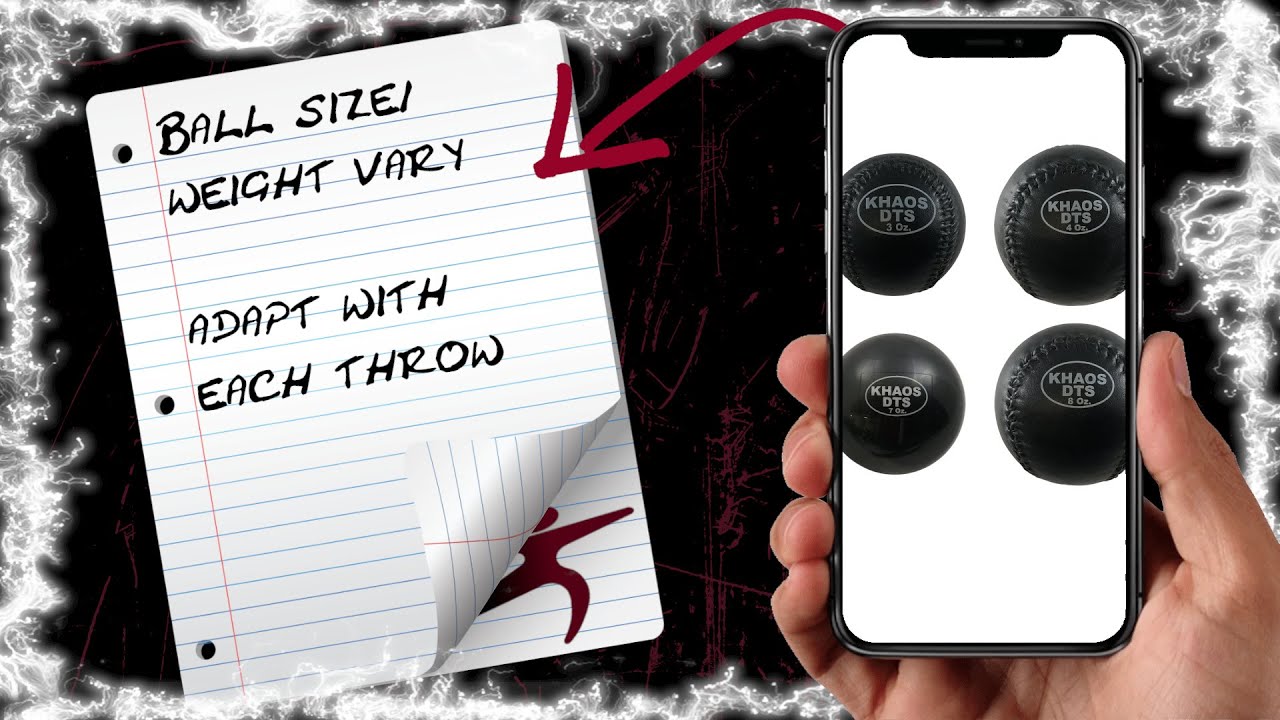
| Gunner Thompson introduces the Khaos® DTS Ball Set as an accuracy and physical adaptation training program. | |
| Product variations — how the four balls differ in weight, circumference, and surface texture to force constant adjustment. | |
| Program background — how the set was designed to fit into Ron Wolforth’s Differential Training System. | |
| Core movement philosophy — how forcing the arm to adapt to changing weights builds a more adjustable delivery pattern. | |
| Transfer to live games — how variable practice with changing ball sizes makes in-game mechanical adjustments easier. | |
| Target integration — using the ball set with single or multi-pocket targets to combine movement variation with location drill work. | |
| Catching applications part 1 — using changing weight profiles during receiving drills to build soft, strong hands. | |
| Catching applications part 2 — rapid grip exchanges and ball-to-hand transfers with unpredictable ball sizes. |
Product Details
How to Use It
Differential throwing blocks: Cycle through all four balls, changing the order so athletes cannot predict what is coming next. Focus on intent to the target and awareness of feel, not on chasing a perfect mechanical picture.
Command work into targets: Pair with strike-zone or location targets so each rep combines a new ball condition with a clear location goal. Track where misses cluster as ball properties change to guide later cueing.
Catching drills: Varying weight profiles during receiving drills force catchers to absorb and center balls that feel different on arrival. Layer in rapid glove-to-hand transfers with unpredictable ball sizes to clean up grip changes.
Blend with standard baseballs: Alternate DTS throws with normal baseball throws to test how well athletes carry adjustments back to the game ball — and to feel when old patterns are creeping back in.
Ball Set Contents & Specs
| Ball | Approx. Weight | Approx. Circumference |
|---|---|---|
| Ball 1 | ~3 oz | ~7.5 in |
| Ball 2 | ~4 oz | Intermediate (confirm before publication) |
| Ball 3 | ~7 oz | Intermediate-large (confirm before publication) |
| Ball 4 | ~8 oz | ~12 in |
Total set weight ~22 oz. Start with 8–16 total DTS reps per block, blended with regular baseball throws, and expand volume only as location and recovery stay solid.
Who This Is For
- Commonly used for high-school, college, and professional pitchers who want to improve location, adjustability, and feel for release — not just raw velocity.
- Commonly used for catchers who want softer, stronger hands and cleaner glove-to-hand transfers under changing ball conditions.
- Commonly used for throwing coaches and facilities implementing Ron Wolforth’s Differential Training System or other variability-based throwing programs.
- Commonly used in bullpens where pitchers need a compact, easy-to-deploy tool that adds variety without changing the overall structure of the throwing session.
We are not coaches. We do not provide coaching.
What This Implement Does NOT Do
- It does not replace foundational throwing programs, strength work, or assessment; it is one constraint-based tool inside a complete development process.
- It does not guarantee velocity or command gains on its own; outcomes depend on overall program design, volume, and recovery.
- It does not teach pitch design or game strategy by itself; athletes still need coaching on pitch usage, sequencing, and intent.
- It is not designed for max-effort overload throwing with poor supervision; heavier balls must be used thoughtfully within a structured progression.
Technical Specs
| Product Name | Khaos® DTS Ball Set |
|---|---|
| SKU | DTSKB |
| UPC | 608938930743 |
| Also Known As | Differential Balls, Accuracy Training Balls, Uneven Load Ball Set |
| Contents | 4 training balls — different weights, circumferences, and surface textures |
| Weight Range | ~3 oz to ~8 oz per ball |
| Circumference Range | ~7.5 in to ~12 in |
| Total Set Weight | ~22 oz |
| Materials | Synthetic leather and other durable training-ball covers, tuned for varied grip feel |
| Training Focus | Location, release-point awareness, full-chain coordination, adaptability under changing ball conditions |
| Environment | Bullpens, target nets, catch-play areas — any standard throwing environment |
Safety and Youth Guardrails
Intended for athletes with established throwing patterns under coach or adult supervision. Blend differential-learning blocks into a well-designed plan — do not stack on top of already high volumes. Stop immediately on unusual pain, especially in the elbow or shoulder.
Youth and training-age guidance: For younger or lower-training-age athletes, emphasize lighter balls, shorter bouts, and clean movement quality. Typically middle-school and older with a solid throwing foundation; very young or novice throwers should focus on basic pattern quality first.
- Not a toy: Training implements for supervised athlete and coach use only.
- Not a pitching-machine ball: Not designed for automatic pitching machines or high-impact rebound devices.
- Rehabilitation use only under supervision: Ball choice, volume, and intensity in rehab contexts should be guided by a medical or rehab professional.
Frequently Asked Questions
How often should I use the DTS balls in a week?
Many coaches integrate the set 2–4 times per week in short blocks, blended with standard baseball throws, rather than using it as an all-session replacement.
Are these for max-effort throws or mainly sub-max work?
They can be used at a range of intensities, but heavier balls should be introduced gradually within a structured plan. The focus is varied problem-solving, not constant max-effort overload.
Do I need Ron Wolforth’s program, or can I plug them into existing drills?
The set was designed for Ron Wolforth’s Differential Training System, but many coaches also plug the balls into existing target work, catch-play, and bullpen structures as variation layers.
Is this only for pitchers?
Pitchers are the primary users, but position players and catchers can also benefit from variability-based throwing and receiving drills using the set.
At what age is the DTS set appropriate?
Typically for athletes with a solid throwing foundation — often middle-school and older — with volume and intensity scaled to age and training age. Very young or novice throwers should focus on basic pattern quality first before adding ball variation.
Questions before you buy? Call or Text Our Team at (936) 295-4459
Featured Products