


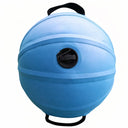

KHAOS® Water Ball – Unstable Water Resistance for Core Strength, Rotational Power & Stability
$99.95
Ships from Huntsville, TX
In Stock
60-day limited warranty
Questions? 936-295-4459
Ordering for a team or facility?
Get volume pricing and help choosing the right tools for your players.
Ask me anything about this product
Sizing · use cases · technique · shipping — instant answers
Ask about KHAOS® Water Ball – Unstable Water Resistance for Core Strength, Rotational Power & Stability — how to use it, what athletes it fits, sizing, or how it compares to other tools we make. Answers are focused on this product.
Innovating since 2003
Family-owned, Huntsville TX
Talk to the team
Real specialists, not a call center
Made for daily program use
Designed for continuous reps, every day, every season
100+ implements, organized by goal
Arm care, velocity, strength, and recovery
About This Product
A water-and-air-filled training sphere that makes every rep feel different — training the hips, trunk, and shoulders to brace against forces a fixed weight never creates.
The KHAOS® Water Ball is a heavy-duty, water-and-air-filled training sphere that uses internal fluid displacement to create an unpredictable load for full-body strength and trunk control work. By replacing a fixed center of mass with one that constantly moves, it teaches the hips, torso, and shoulders to brace against sudden changes in momentum during sport-specific carries, squats, and rotational movement patterns.
- Dynamic Fluid-Displacement Load — Internal water shifts position with every rep, forcing the trunk and hips to manage sudden force surges that fixed-weight tools cannot replicate.
- Inverse Stability Valve — One valve controls both weight and reactivity: more water for heavier, more settled work; more air for lighter, highly unpredictable coordination challenges.
- Dual-Handle Layout — Integrated handles give athletes multiple grip options for carries, squats, and rotational drills while keeping the ball close to the body.
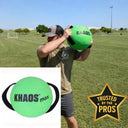
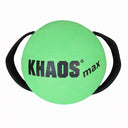
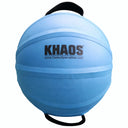
- Two Sizes for Different Loading Zones — 30 cm green MAX ball for sport-specific patterns at 8–12 lb; 40 cm blue ball for heavier 15–20 lb strength work.
- MAX Polyester-Lined Shell — The 30cm features a puncture-resistant vinyl construction backed by a 2-year warranty handles repeated rotational loading in field and gym environments.
What Is It?
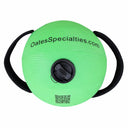
The KHAOS® Water Ball is a heavy-duty training sphere with a central filler valve that holds both water and compressed air, along with dual integrated handles for multiple grip options. As the athlete lifts, carries, or rotates the ball, the fluid lags behind and then surges into the outer wall, changing the ball’s balance in real time. No two reps feel exactly the same.
Compared to a traditional medicine ball or Atlas stone, where the weight moves along a smooth, predictable path, the Water Ball’s internal slosh forces the core musculature, hip stabilizers, and shoulder-blade muscles to contract quickly and repeatedly. Compared to fixed free weights, it emphasizes control of momentum and body position rather than purely concentric strength work (the lifting phase where the weight moves up), making it a tool for movement quality and bracing as much as force production.
How It Works
Three mechanisms behind the shifting fluid load
Sudden Inertia Management
With a traditional med ball, the load follows a smooth arc. With the Water Ball, the fluid lags and then crashes into the outer wall at the end of each turn, forcing the core musculature to contract immediately to keep the spine and posture organized.
Front-Side Brace Training
Power leaks when the front leg or trunk sags at foot plant. The Water Ball’s unpredictable load in lunges and step-behind drills challenges the hips and trunk to brace reflexively against that exact kind of sudden momentum shift.
Whole-Body Neuromuscular Demand
The wandering center of gravity prevents any single muscle group from taking over, spreading tension across the hands, forearms, arms, and shoulder-blade stabilizers simultaneously and demanding constant input from the position sensors (proprioceptors) that help the body sense and organize itself under load.
Backed by Research
The Science of Fluid-Displacement Training
This design is grounded in broader evidence on unstable resistance, perturbation-based training (using small, unpredictable forces to train balance and control), and momentum management in rotational sports. That research has found improvements in neuromuscular control and dynamic trunk stability for overhead and rotational athletes — the training objective this ball is built around.
2 Sizes
30 cm green MAX ball and 40 cm blue ball for different loading zones and athlete levels
8–20lb
Combined fill range across both variants — tunable from sport-specific patterns to heavy strength work
360°
Multi-directional fluid shift — no two reps produce the same force pattern or balance demand
Video Library
See It In Action
Click the thumbnail to play from the start — click any timestamp to jump to that moment.
Training Guide
KHAOS® Water Ball: The Ultimate Instability Workout
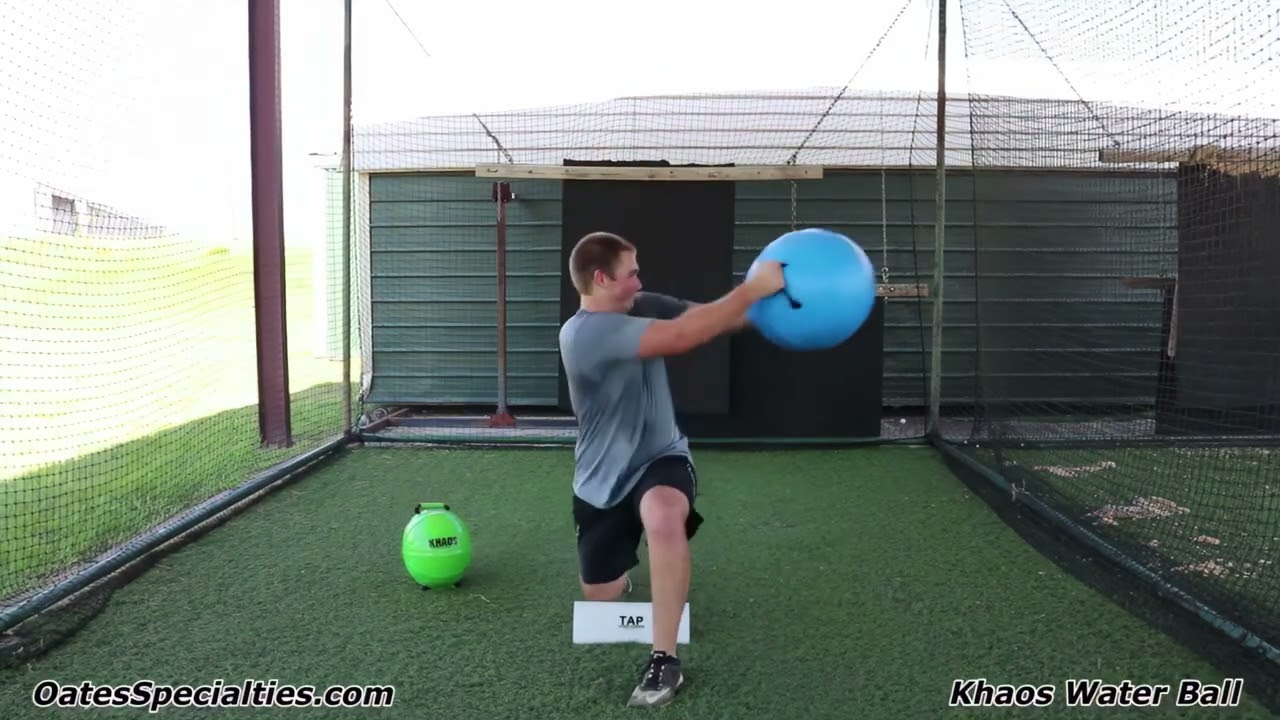
Chapter Guide — 13 Timestamps
| Bear Hug Squat to Shoulder Lift — Deep squat with the ball at chest, then driving upward while shifting it onto one shoulder. | |
| Front-Loaded Squats — Continuous chest-height reps showing how the sloshing water demands upper-body stability through front and side profiles. | |
| Straight-Arm Overhead Squats — Ball locked out overhead during full squats, placing the unstable fluid load high above the center of gravity. | |
| Forward Lunges with Chest Press — Alternating lunges pressing the ball straight out from the chest and pulling back in to challenge multi-planar balance. | |
| Side-to-Side Lateral Lunges — Wide horizontal steps at chest height showing how shifting fluid momentum challenges direction changes. | |
| Forward-Walking Lunges — Continuous forward movement with the ball held close to stabilize the lower half on the move. | |
| Overhead-Walking Lunges — Ball locked out overhead during walking lunges to maximize core and shoulder demands. | |
| Walking Lunges with Rotational Twist — Lunging while twisting the ball over the front knee, forcing the hips and core to brace against the shifting load. | |
| Static Overhead Rhythmic Shaking — Green ball held overhead while rapidly shaking it forward and back for high-frequency perturbation. | |
| Seated Russian Twists & Extended V-Sits — Rapid side-to-side rotations with feet elevated, then deep overhead extensions. | |
| Standalone Dynamic Rotational Swings — Sports stance with the ball swung aggressively from hip to hip for explosive transverse-plane power. | |
| Net-Facing Reverse Pivot Chops — Explosive rotational chops toward an impact screen. | |
| Angled Plyo Lateral Bounds — Explosive side-to-side jumps between two TAP® Lateral Plyo Angles, stabilizing body weight with the green ball on every landing. |
Product Details
How to Use It
Foundational carries and bracing patterns: Start with dual-handle or bear-hug carries using a moderate fill, walking in a straight line while keeping the trunk tall as the internal load tugs the body off center. Progress to lateral and backward carries, challenging the hips and torso to maintain alignment as the water shifts on every step.
Rotational and hitting-focused drills: Use rotational twist and pivot drills where the athlete turns with the ball and then resists the surge of fluid at the end of the motion, simulating contact and follow-through demands. Emphasize bracing the lower body and keeping the trunk strong rather than chasing speed alone.
Overhead and hitter-specific patterns (green ball): With the 30 cm green ball at moderate fills, overhead athletes can rehearse throw-like arm paths, focusing on keeping the trunk stable while the internal water tests control at the top of the motion. Hitters can hold it at the contact position, keeping the front side firm as the shifting load tries to move them off that posture.
Front-side bracing and pitching patterns: Integrate front-side squat and holding blocks where pitchers step, plant, and hold position while the ball’s weight tries to pull them forward or sideways. Focus on a firm front leg and stable trunk.
Variant & Fill Weight Guide
| Variant | Fill Range | Best For |
|---|---|---|
| 30 cm Green (MAX) | ~8–12 lb | Youth athletes, sport-specific patterns, overhead throw paths, hitter contact positions |
| 40 cm Blue (heavy-duty vinyl) | ~15–20 lb | High-school, college, and professional strength work with heavier unstable loads |
For most high-school and college athletes, start with the green ball at 8–10 lb and progress to heavier green or light blue fills only after several sessions of clean control.
Who This Is For
- Baseball and softball players — especially with the 30 cm green ball — to build rotational strength, front-side bracing, and sport-specific patterns like overhead throwing paths and firm contact positions for hitters.
- Rotational athletes in other sports, including golf, tennis, and hockey, who need to manage momentum through the hips and torso.
- Strength and conditioning staffs who want an alternative to stones or heavy medicine balls that adds an instability component to carries and squats.
- Older youth athletes with lighter fills and simple patterns, under close coach or qualified adult supervision.
We are not coaches.
What This Implement Does NOT Do
- It does not replace foundational strength work, sprinting, or skill practice; it is one instability tool inside a broader program.
- It does not guarantee velocity gains or power increases on its own; outcomes depend on full-program design, volume, and recovery.
- It does not train fine motor control or precision mechanics.
- It should not be used as a stand-alone rehabilitation solution without oversight from a qualified medical professional.
Technical Specs
| Product Name | KHAOS® Water Ball |
|---|---|
| Also Known As | Water Ball, Water Sphere, Green Ball, Blue Ball, Water Instability Trainer, Sport-Specific Movement Ball |
| Green Ball SKU | MKBM — UPC: 608938931337 |
| Blue Ball SKU | HKBB — UPC: 608938930620 |
| Green Ball | 30 cm diameter — MAX polyester-lined vinyl, puncture resistant, 2-year warranty — ~2 lb empty — 8–12 lb fill range |
| Blue Ball | 40 cm diameter — heavy-duty vinyl, dual handles — ~3 lb empty — 15–20 lb fill range |
| Training Focus | Rotational force production, front-side bracing, multi-planar torso stability, whole-upper-body engagement |
| Environment | Indoor or outdoor — turf, grass, or rubber surfaces with room for full carries, squats, and rotational work |
Safety and Youth Guardrails
Oates Specialties training tools, including the KHAOS® Water Ball, are designed for athletes roughly 13 and older training under coach or qualified adult supervision. For younger or growth-window athletes, the emphasis should be on better movement patterns, coordination, and timing rather than heavy-load work. Use in clear spaces. Stop immediately on sharp pain, loss of normal control, or unusual symptoms.
Growth-window guidance: Athletes experiencing rapid growth should use conservative loads and be cautious about soreness at growth plates or tendon sites — bone adaptation can outpace soft tissue during these periods.
- Not a toy: A training implement for supervised athlete and coach use only.
- Rehabilitation use only under supervision: Introduce only under the direct advisement of a certified medical professional or rehab coordinator.
Frequently Asked Questions
How heavy should I fill the ball to start?
Many athletes start with the green ball at roughly 8–10 lb of water, then adjust up or down as they demonstrate clean control and good next-day response.
How is this different from a regular medicine ball?
A medicine ball has a fixed center of mass and moves along a smooth arc. The KHAOS® Water Ball’s internal water lags behind movement and then crashes into the outer wall, creating sudden force changes the torso must control — no two reps feel the same.
Which ball should my athletes use, green or blue?
Younger or lighter athletes typically start with the 30 cm green MAX ball at 8–10 lb. Stronger high-school, college, and professional athletes often progress to the 40 cm blue ball for heavier, more demanding work at 15–20 lb.
How is this different from the KHAOS® Shoulder Shaker?
The KHAOS® Shoulder Shaker is a compact hand-held water ball focused on shoulder and scapular control. The KHAOS® Water Ball is larger with dual handles and is designed to challenge full-body carries, squats, and rotational drills that load the hips, trunk, and shoulders together.
Where does it fit in a weekly plan?
A practical starting plan is 1–2 sessions per week with the green MAX ball at 8–10 lb, 2–3 sets of short carries or rotational reps, after warm-up and before high-intent skill work.
Questions before you buy? Call or Text Our Team at (936) 295-4459
Customer Reviews
What Customers Are Saying
Loading reviews…
No reviews yet for this product.
Be the first to review