

TAP® Hitting Target – Visual Feedback Training Tool for Launch Angle, Swing Efficiency& Tee Work
$179.95
Ships from Huntsville, TX
In Stock
60-day limited warranty
Questions? 936-295-4459
Ordering for a team or facility?
Get volume pricing and help choosing the right tools for your players.
Ask me anything about this product
Sizing · use cases · technique · shipping — instant answers
Ask about TAP® Hitting Target – Visual Feedback Training Tool for Launch Angle, Swing Efficiency& Tee Work — how to use it, what athletes it fits, sizing, or how it compares to other tools we make. Answers are focused on this product.
Innovating since 2003
Family-owned, Huntsville TX
Talk to the team
Real specialists, not a call center
Made for daily program use
Designed for continuous reps, every day, every season
100+ implements, organized by goal
Arm care, velocity, strength, and recovery
About This Product
A blank net returns one signal: contact happened. The nine-zone grid turns every swing into a zone address, not just a sound.
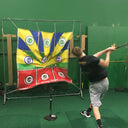
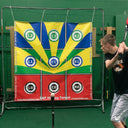
The TAP® Hitting Target™ is a 72-inch by 72-inch nine-zone vinyl panel for baseball and softball hitters, coaches, and programs that want an honest, readable result on every rep — no batting cage, data subscription, or high-tech tracking system required. It mounts to cage netting, a net wall, or a freestanding backstop screen of at least seven feet by seven feet, and runs as a parallel station on its own net surface while the cage stays free for live hitting or machine work. It is a feedback tool, not a swing-fix: it won’t tell a hitter how to move the bat, but it will show, on every rep, where the ball went.
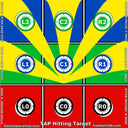
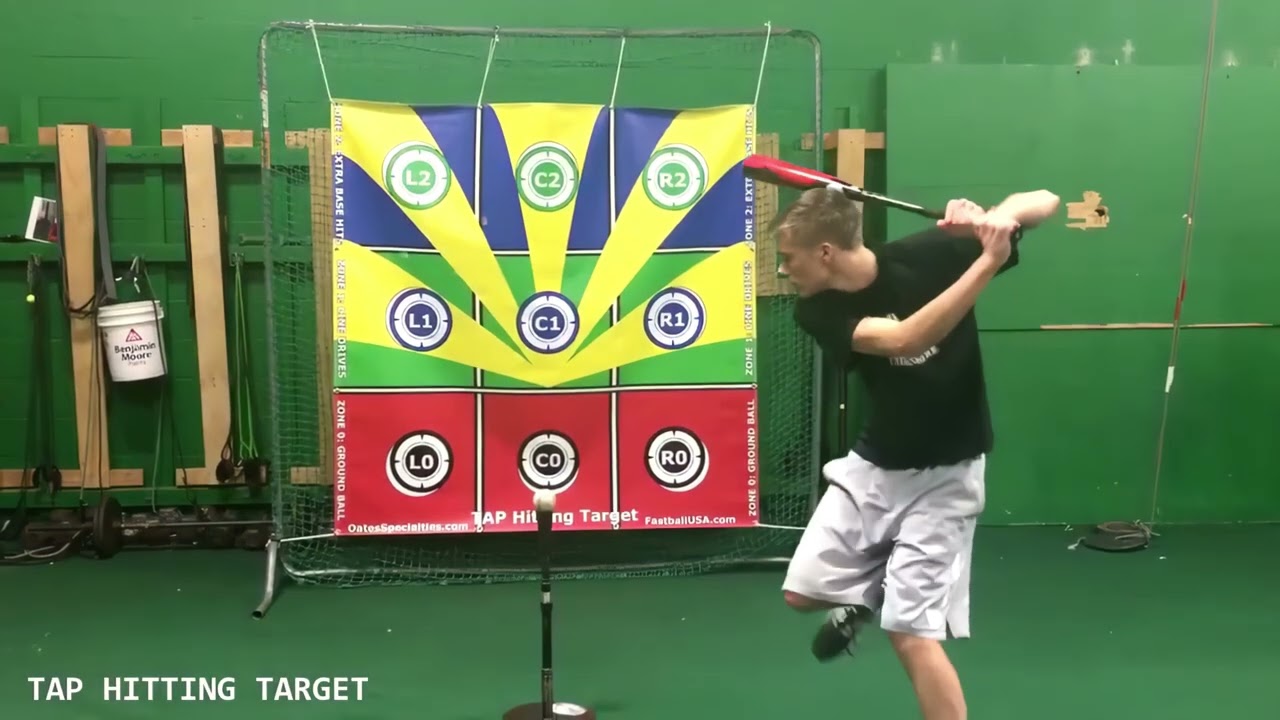
- Nine-Zone Grid — L/C/R directional columns cross Ground Balls / Line Drives / Extra Base Hits trajectory tiers, so every swing has a zone address, not just a sound.
- Circular Target Marker with Crosshair — converts the grid into a precision aim tool; the hitter aims at a circle, not a vague area.
- 72″×72″ Heavy-Duty Vinyl Panel with 12 Bungees — mounts to cage netting, a net wall, or a freestanding backstop screen at least 7’×7’, no additional hardware required.
- No Batting Cage Required — runs on any qualifying net wall or screen, freeing the cage for live hitting or machine work at the same time.
- Repositionable Session Goals — line-drive work, elevation training, opposite-field focus, and pull-side power work are each a zone call away.
- Research-Grounded Design — mechanism support for external aim, physical directional goals, and variable zone sequencing comes from peer-reviewed research; no study has tested this specific product.
What Is It?
The TAP® Hitting Target™ is a heavy-duty vinyl panel printed with a nine-zone contact-quality grid. Three trajectory tiers (Ground Balls, Line Drives, Extra Base Hits) cross three directional columns (L/C/R) to produce nine labeled zones from L0 to R2, each with a circular aim marker and crosshair at its center. The panel mounts to any qualifying net surface — cage netting, a net wall, or a freestanding backstop screen of at least seven feet by seven feet — using perimeter grommets and the 12 included ball bungees. Net backing is required; never mount to a hard or rigid surface, since the net’s give is what absorbs ball impact.
Zone names represent outcome-referenced training categories, not degree-level measurements: Zone 1 (Line Drives) carries the highest batting average of any trajectory tier, Zone 2 (Extra Base Hits) carries the most run value at adequate exit velocity, and Zone 0 (Ground Balls) typically produces infield outs. The zones build contact-quality awareness through results, not launch-angle numbers.
How It Works
Three mechanisms behind the zone grid
External Aim Point
Aiming at a visible point outside the body produces better swings and faster learning than focusing on body mechanics, according to a review of 143 studies across all ages and skill levels. The circular markers in each zone provide that external aim point on every rep, without a coaching cue.
Physical Directional Goal
Research on baseball hitters found a physical directional goal produced more opposite-field hits and better pitch selection than verbal coaching. Research on elevation training found a physical goal the hitter must reach produced better launch angle and exit velocity after six weeks — Zone 2 is that physical elevation goal.
Variable Zone Sequencing
Moderately varied practice produces better game transfer than repeating the same drill. Research with skilled college players found varying pitch type improved real hitting performance, and a separate study found varying directional goals produced more opposite-field hits than constant-goal training.
Backed by Research
Mechanism-Level Evidence Behind the Zone Grid
Every mechanism claim applies a verified sports-science finding to this design — external aim, physical directional goals, and variable zone sequencing are each supported at the research level, not the product level.
9 Zones
Three trajectory tiers × three directional columns
72″×72″
Full panel size for real hitting-distance separation
143 Studies
Reviewed on external-focus training effectiveness
Video Library
See It In Action
Click the thumbnail to play from the start — click any timestamp to jump to that moment.
2018
TAP® Hitting Target — Visual Feedback Training for Launch Angle & Swing Efficiency
Chapter Guide — 6 Timestamps
| Training for line drives — tee-work demonstration targeting the mid-belt grids (L1, C1, R1) to reinforce clean, level trajectories. | |
| Targeting extra-base fly balls — shifting focus to the higher, flared zones designed for lifting the ball safely over the infield. | |
| Swinging with purpose — how the backdrop turns standard cage work into a focused target-practice session with a defined job on every swing. | |
| Receiving instant feedback — the ball strikes a specific visual quadrant, giving the hitter immediate information to self-correct barrel path. | |
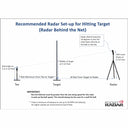
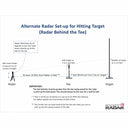
| Pocket Radar integration — placing a Pocket Radar Ball Coach behind the target to capture real-time exit velocity alongside directional accuracy. | |
| Developing proper launch angles — how the geometry of the target zones builds consistency in launch metrics. |
Not every target on the market does the same job. Before choosing any hitting panel, consider what it actually needs to deliver for your program.
Surface area matters. A panel needs to be large enough to separate trajectory tiers from directional columns at real hitting distances. At 10–15 feet from a tee, a small panel compresses zones to the point where adjacent zones are difficult to distinguish. A panel under five feet square cannot reliably separate three trajectory tiers across three directional columns at the distances where directional hitting training actually happens.
Zone architecture matters more than zone count. A numbered grid tells a hitter which square the ball landed in. A trajectory-tier grid tells a hitter what that contact would produce in a game: ground ball, line drive, or elevated contact. The zone naming should connect to outcomes the hitter and coach care about, not to abstract numbers.
The panel must survive repeated batted-ball impact. Pitching targets are designed for thrown-ball velocities. Hitting targets see batted-ball velocities, which are significantly higher. Verify the panel is rated for the forces your hitters produce.
Ask whether the product comes with a progression. A target without a training protocol is just a surface to aim at. The value of a well-designed system is in how sessions are structured: what distance to start at, when to advance, how to sequence zones, what to track, and what to avoid.
Decide whether the tool runs as a standalone station. Some targets require specific net systems or proprietary mounting hardware. For programs with limited cage access, the ability to run a hitting target as a parallel station on a separate net wall — without tying up the cage — is a meaningful operational advantage.
No direct peer-reviewed research has tested this specific product. Every mechanism claim below applies a verified sports-science finding to this design — none of it is product-specific outcome proof.
A hitter needs to know, after every set of swings, whether the result matched the goal. Without that information, a hitter can’t spot a pattern in their misses or make a real adjustment. The nine-zone grid provides that information on every rep: a zone circle sets the goal before the swing, and the zone where the ball strikes the panel gives the result after it.
Aiming at a visible point outside the body produces better swings and faster learning than focusing on body mechanics, per a review of 143 studies across all ages and skill levels. A 2024 Bayesian re-analysis found that after correcting for publication bias, effect sizes in the verbal-instruction external-focus literature were negligible — an honest qualification worth noting, though it addressed verbal cues specifically, not mounted physical targets like this one.
OPTIMAL theory proposes that success experiences build positive expectancy alongside external focus, which is the reasoning behind starting sessions at Zone 1. A 2024 review found limited evidence that these motivational manipulations reliably increase motivation or learning — starting at an achievable zone before advancing complexity remains good practice design on ordinary coaching grounds, independent of that more contested theory.
Mike Ryan of Fastball USA built his curriculum around what he calls the Ball Flight Zone: after 25 years as a hitting instructor, his principle is that hitters develop directional control by training toward a visible zone of intended outcomes, not a prescribed swing path. Perry Husband, founder of the Effective Velocity framework, documented in controlled testing with Jay Bell that directional accuracy to a specific target is genuinely difficult — in 30 swings aimed at a center-field target, Bell connected to center three times, establishing that this panel trains a trainable but non-trivial skill.
The TAP® Hitting Target™ gives coaches and hitters a simple way to make tee and front-toss sessions produce real information on every rep — no tracking technology and no batting cage required.
For most programs, the right starting point is Zone 1 across all three columns at five to seven feet from the tee: build panel contact first, establish C-column consistency next, then add directional column work with tee repositioning for each column goal. Progress distance only when column consistency holds across two sessions.
Two to three zone sessions per week is a practical starting point, with a periodic exit-velocity assessment on a four-to-six-week cycle for programs that want that additional development read. The TAP® Batting Target™ is the natural companion for programs that also want a directional aim tool on cage confinement netting.
Product Details
Setup, Distance & Progression
The TAP® Hitting Target™ is a single-SKU product (SKU: HT) — no size, weight, or variant choice needed. The main setup variable is tee-to-panel distance:
- 5–7 feet — panel-contact work for hitters new to nine-zone training.
- 7–10 feet — column-precision work at the intermediate stage.
- 10–15 feet — advanced column and full-grid sessions.
Increase distance only when column consistency is established at the current distance across two consecutive sessions. The tee moves to change the directional goal — the hitter’s stance and plate position stay fixed throughout all directional work.
How to Use It
Warm-up: Begin most sessions with 5–10 easy tee swings aimed at C1, the center-field line-drive circle, to calibrate the hitter’s eyes and timing to the grid.
Training use: Assign specific zone circles to the session goal, taken at game-level swing intent — a steered or guided swing at reduced effort doesn’t transfer to game hitting. Zone 1 (L1, C1, R1) builds line-drive contact across all three columns. To change the directional goal, move the tee: forward of the plate for pull-side (L) work, at the front edge of the plate for center (C) work, and back behind the plate for opposite-field (R) work. The hitter’s stance and plate position stay fixed — moving the hitter’s body to reach a column trains a false movement pattern that doesn’t transfer to live hitting.
Light-day use: Keep the grid up but simplify to Zone 1 across all columns at reduced swing volume. This is not a primary recovery-day tool, but the visual goal structure reinforces the aim habit without adding load.
Who This Is For
- Commonly used for hitters with established contact consistency who want objective zone-level feedback on every tee and front-toss rep.
- Commonly used for coaches and programs building contact-quality and directional pattern data from tee and front-toss sessions.
- Commonly used for programs without advanced tracking technology that need a legitimate, low-tech field feedback tool at any facility level.
- Commonly used for one-cage programs that need a second simultaneous training station on a separate net surface.
We are not coaches. We do not provide coaching.
What This Implement Does NOT Do
- Does not measure launch angle in degrees — Zone 2 identifies elevated contact in the extra-base-hit range, not an optical tracking system.
- Does not prescribe swing mechanics — the zones provide a goal and a result; the movement that reaches the zone comes from the hitter’s own motor system.
- Does not replace HitTrax®, Rapsodo®, or TrackMan® — it addresses the blank-net feedback gap, not the precision or cost level of those systems.
- Does not improve contact quality on its own — reps with a clear zone goal and game-level swing intent build skill.
- Does not return the ball, and is not a backstop or cage liner — mount only to qualifying net surfaces, never a hard or rigid surface.
- Is not a medical or rehabilitation device.
Technical Specs
| Product Family | TAP® Hitting Target™ System |
|---|---|
| Primary Use | Nine-zone contact-quality and trajectory-tier feedback for tee, front-toss, and soft-toss sessions |
| Training Focus | Contact-quality tier (Ground Balls / Line Drives / Extra Base Hits), directional control (L/C/R), session pattern analysis |
| Construction | Heavy-duty printed vinyl panel with perimeter grommets |
| Dimensions/Weight | 72″ × 72″ (6 ft × 6 ft); approximately 7 lb |
| SKU | HT (single SKU, no variants) |
| Included Hardware | 12 ball bungees for net mounting |
| Environment | Any qualifying net surface: cage netting, net wall, or freestanding backstop screen (min. 7’×7’). Never a hard or rigid surface. |
Safety and Youth Guardrails
Net surface only — never a hard or rigid surface. Mount only to rated confinement netting: cage netting, a net wall, or a freestanding backstop screen (minimum 7’×7’). The net’s give and the bungee attachment absorb ball impact force; check bungee connections before every session.
Minimum age guidance: Independent use is recommended for athletes 13 and older. Younger athletes may use the panel under qualified adult supervision, with swing volume and zone complexity matched to their age, size, and contact development stage. Zone 1 across all three columns is enough for a developing hitter. Stop and seek evaluation if a hitter reports sharp, unusual, or lasting discomfort.
- Not a toy: A supervised training aid, not for climbing, hanging, or recreational use.
- Not a backstop or cage liner: Requires a load-bearing net behind it; not a substitute for protective netting.
- Not a rehabilitation device: Not intended to diagnose, treat, or prevent injury.
Frequently Asked Questions
How is this different from the TAP® Batting Target™?
Different tools, different training problems. The Batting Target™ is a single-point directional aim tool for cage confinement netting. The Hitting Target™ mounts to any qualifying net surface and answers a broader question: not just which direction, but at what trajectory tier the ball arrived. A program with both can run directional work inside the cage and nine-zone tracking on a separate net surface at the same time.
Does this require a batting cage?
No. A qualifying net surface is all that’s needed: cage netting, a net wall, or a freestanding backstop screen of at least seven feet by seven feet. Running the panel on a separate net surface frees the cage for live hitting, machine work, or other drills at the same time.
My program doesn’t have HitTrax® or Rapsodo®. Is this a real substitute?
Honest answer: it’s a different tool, not a full substitute. Zone contact delivers two variables on every rep — trajectory tier and direction. For programs that also want ball speed tracking, a periodic exit-velocity assessment on a separate schedule adds that dimension.
Is it appropriate for youth hitters?
Yes, with the right progression. Youth hitters should build basic contact consistency with the TAP® Batting Target™ before moving to the nine-zone grid. Begin with Zone 1 aims only and add complexity once the line-drive default is established, supervised by a qualified adult.
Can the zone grid show launch angle?
The grid identifies trajectory tier from where the ball strikes the panel — Zone 2 means elevated contact in the extra-base-hit range, not a degree measurement the way optical tracking systems provide. For degree-level tracking, pair the panel with a dedicated launch-angle device.
Does a zone result predict the exact same outcome on an open field?
No. The panel measures where the ball intersects a vertical surface five to fifteen feet away. That short-distance geometry gives reliable relative feedback on direction and trajectory tier, but the absolute trajectory windows are compressed compared with full-field flight. Directional information transfers more directly than elevation information.
Does periodic exit velocity tracking add value?
Yes, selectively. Zone location tells you where the ball went; exit velocity tells you how well it was struck. Zone 2 contact at high exit velocity is a genuine extra-base-hit candidate, while Zone 2 at low exit velocity is a weakly struck pop-up. Run that assessment separately, on a four-to-six-week cycle, rather than rep-by-rep inside a zone session.
Should coaches tell hitters to aim for Zone 2 to improve power?
Yes, as a directional training goal in zone panel work. Zone 2 is a physical elevation goal — to reach it, the hitter must produce elevated contact. Periodically assess exit velocity in a separate session to confirm the elevation is productive rather than a weakly struck pop-up.
There are cheaper hitting targets available. Why would I spend more?
Honest answer: if the main training question is “did the ball go somewhere near the target,” a simpler, less expensive panel can answer that. If the question is what trajectory tier and directional column a hitter produces across 15–30 swings, the nine-zone grid returns two variables per rep instead of one — a contact-quality pattern coaches can read and act on.
Questions before you buy? Call or Text Our Team at (936) 295-4459
Customer Reviews
What Customers Are Saying
Loading reviews…
No reviews yet for this product.
Be the first to review