


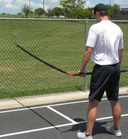
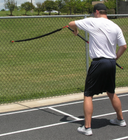

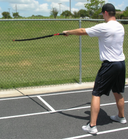
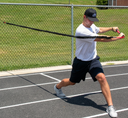
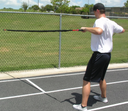
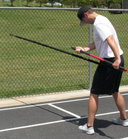
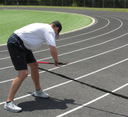
KHAOS® Pivoter – Asymmetrical Bar Training for Rotational Power and Core Control
$89.95
Ships from Huntsville, TX
In Stock
Ordering for a team or facility?
Get volume pricing and help choosing the right tools for your players.
Ask me anything about this product
Sizing · use cases · technique · shipping — instant answers
Ask about KHAOS® Pivoter – Asymmetrical Bar Training for Rotational Power and Core Control — how to use it, what athletes it fits, sizing, or how it compares to other tools we make. Answers are focused on this product.
Innovating since 2003
Family-owned, Huntsville TX
Talk to the team
Real specialists, not a call center
Made for daily program use
Designed for continuous reps, every day, every season
100+ implements, organized by goal
Arm care, velocity, strength, and recovery
About This Product
A bar tethered off-center to a bungee so resistance always pulls from one side — forcing the hips and trunk to organize against a twisting force instead of a straight, symmetrical groove.
The Khaos® Pivoter introduces Asymmetrical Bar Training (ABT) — a training method where a rigid bar is tethered off-center to an elastic bungee so resistance pulls from one side instead of directly in front of the spine. ABT simply means practicing with a bar that is loaded unevenly so the body has to organize against that side-specific pull. That uneven pull prevents the athlete from settling into a simple, symmetrical groove, forcing the hips and trunk to organize against a twisting force (torque) while building power and anti-rotation bracing in the same tool.
- Asymmetrical Bar Training Instead of Centered Resistance — The bar is tethered from an off-center point, creating an uneven twisting force (torque) that actively tries to rotate the torso toward the anchor — something a centered cable or band never does.
- Smooth Elastic Resistance for Explosive Work — The bungee ramps tension progressively as the athlete turns away from the anchor, matching the natural acceleration curve of a throw or swing without the jarring stops of weight stacks.
- Rotational Power and Anti-Rotation in One Tool — Dynamic chops and presses build power from the ground up; static and slow-tempo holds train the obliques and deep trunk muscles to resist twisting — creation and resistance of rotation in a single implement.
- Shoulder-Blade Organization Under Uneven Load — Scapular fixation (keeping the shoulder blade anchored and stable on the ribcage) is trained by the off-center pull, which demands the serratus anterior, rhomboids, and lower trapezius coordinate to give the shoulder a solid platform.
- Portable and Adjustable — Anchors to fences, racks, or posts; resistance adjusts by stepping closer or farther from the anchor; ~7 lb total system weight for easy transport.
- Progressive Load Adjustment Built In — Distance from anchor changes pre-stretch; interchangeable cords allow more precise load customization across training phases without changing the exercise structure.
What Is It?
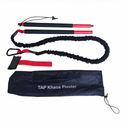
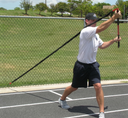
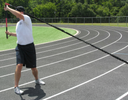
The Khaos® Pivoter is a bar-and-bungee system designed for Asymmetrical Bar Training, where one end of the bar is tethered to a resistance cord and the other end is free in the athlete’s hands. Instead of symmetrical pushes and pulls, the bar always wants to twist and tip toward the anchor point, forcing the body to stabilize and transfer force across the kinetic chain — the linked segments from the feet through the hips, trunk, and shoulders into the hands.
Compared with a band or symmetrical cable setup, the Pivoter changes leverage across the bar and introduces side-specific torque, giving the athlete a more complex power and anti-rotation challenge. Compared with heavy free weights, it emphasizes control of twisting forces and speed-friendly elastic resistance rather than maximal loading.
How It Works
Three mechanisms behind asymmetrical bar training
Managing Asymmetric Torque
Because resistance attaches to one side of the bar, every movement produces a side-specific twisting force that prevents a simple repetition groove. The internal and external obliques and transverse abdominis must co-contract — meaning muscles on both sides of a joint tighten together to stabilize it — to keep the bar path under control.
Rotational Power Transfer
In rotational sports, power is generated from the lower body and passed up through the kinetic chain to the arms. The Pivoter’s progressive elastic tension lets athletes practice driving from the ground up while matching the natural acceleration of a throw or swing — without the jarring stop of a weight stack.
Scapular Fixation Under Load
Pressing and holding an uneven bar demands that the shoulder blades stay anchored and glide well on the ribcage. The serratus anterior, rhomboids, and lower trapezius must coordinate continuously to keep the scapula stable so the arm can deliver force without the shoulder collapsing or shrugging.
Backed by Research
The Science of Asymmetrical Bar Training
The Khaos® Pivoter has not been studied as a stand-alone device in controlled trials; its use is supported by broader work on rotational training, anti-rotation core work, and perturbation-based training that emphasizes co-contraction and postural control. Research supports perturbation-based and unstable-resistance training for neuromuscular control and dynamic stability in athletic populations.
Off-Center
Side-specific torque that a centered cable or band never creates — the bar always wants to rotate the torso, forcing real-time core organization on every rep
Create & Resist
Dynamic chops build rotational power from the ground up; anti-rotation holds train the same muscles to resist twisting — both goals in one implement
In-Season
Progressive elastic resistance keeps joint stress lower than weight stacks — suitable for in-season core maintenance at 2–4 sets of 4–8 high-quality reps per pattern
Video Library
See It In Action
Click the thumbnail to play from the start — click any timestamp to jump to that moment.
2022
KHAOS® Pivoter — Asymmetrical Rotational Training
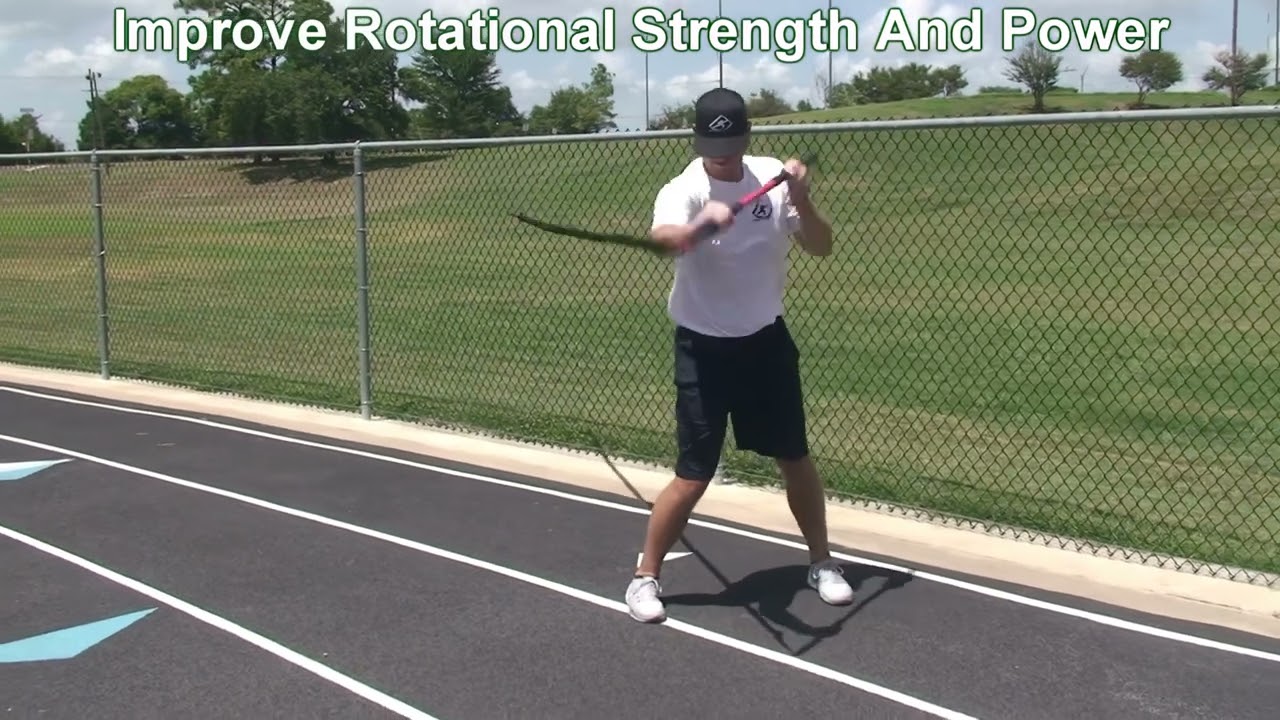
Chapter Guide — 8 Timestamps
| System Architecture & Asymmetrical Bar Concept — title cards introducing the Pivoter hardware and its foundation in Asymmetrical Bar Training (ABT) using uneven loads. | |
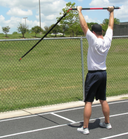
| Overhead Press & Frontal-Plane Balance — vertical overhead presses and front raises against single-sided cord tension, targeting shoulder girdle stability and anti-lateral flexion. | |
| Transverse Diagonal Chops & Rotational Drives — high-to-low and low-to-high pulls across the torso demonstrating explosive hip rotation against asymmetric resistance. | |
| Split-Stance Punch Drives & Hitting Extensions — forward pressing and punching mechanics simulating rotational throwing and hitting extensions with the core locked. | |
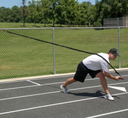
| Deep Hinge Rotational Sweeps — bar swept down toward the ground and across the body from a deep athletic hinge, challenging posterior-chain integration and ground connection. | |
| Split-Stance Lunge Presses with Rotational Holds — dynamic lunge with the bar extended from the chest, forcing glutes, hips, and obliques to stabilize against continuous offset pull. | |
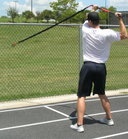
| High-Velocity Explosive Rotational Pivots — maximum-intent speed reps driving through the back hip to pivot the bar across the body, demonstrating rotational acceleration and deceleration control. | |
| Closing Brand Outro — Oates Specialties logo, web address, and contact information. |
Product Details
How to Use It
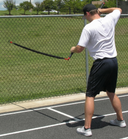
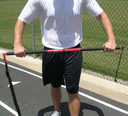
Asymmetrical presses and rows: Anchor at shoulder height, grip with two hands, and press or row while the bar tries to rotate toward the anchor. Keep ribs stacked and shoulder blades moving smoothly — avoid letting the bar tip or drift against the uneven pull.
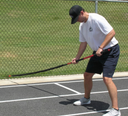
Rotational chops and lifts: Hips initiate, trunk follows, bar path stays controlled while the bungee stretches. Drive from the feet and hips, rotate through the torso, and finish with quiet arms so the bar feels like a continuation of the body’s movement.
Anti-rotation holds: Hold the bar out in front and let the bungee try to twist the body toward the anchor while the athlete resists. Slow movement or static holds build bracing capacity through the obliques and deep trunk without extra joint load.
Load adjustment: Start close to the anchor with lighter tension; step farther away as control improves. Progress from bilateral to staggered to single-leg only after clean alignment and bar-path control are confirmed under simpler conditions.
Variant & Progression Guide
The Khaos® Pivoter is a single system (TKP). All customization comes from anchor distance and cord selection.
| Level | Adjustment |
|---|---|
| Starting out | Short anchor distance, bilateral stance, lighter cord — less torque, more manageable balance demand |
| Intermediate | Step farther from anchor or use a stiffer cord; add staggered-stance patterns |
| Advanced | Single-leg stances; maximum anchor distance; full rotational chops and overhead lift patterns |
2–4 sets of 4–8 high-quality reps per pattern. Off-season: 1–2 power sessions per week. In-season: short, lower-volume maintenance blocks.
Who This Is For
- Commonly used for rotational athletes (baseball, softball, golf, tennis) who need to train power and anti-rotation control in patterns closer to their sport.
- Commonly used by strength and conditioning coaches wanting a portable cable-machine alternative for core and rotational training.
- Commonly used in off-season blocks for building power and in-season for lower-load trunk maintenance.
- Commonly used for advanced youth and older athletes who already move well in basic strength patterns and need a higher-challenge core and rotation tool under supervision.
We are not coaches.
What This Implement Does NOT Do
- It does not replace foundational strength training with barbells, free weights, or machines; it adds an asymmetrical, core-focused layer on top of basic strength.
- It is not a magic bat-speed or velocity tool; it supports power and core control that can feed into better transfer when paired with appropriate swing and throwing work.
- It does not automatically correct movement faults; athletes still need instruction on hip-to-torso sequencing and trunk alignment.
- Not designed as a general-purpose toy — must be attached to secure anchors and used with coaching on body position.
Technical Specs
| Product Name | Khaos® Pivoter |
|---|---|
| SKU | TKP |
| UPC | 608938930187 |
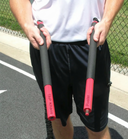
| Bar | 2-piece steel bar, ~48 inches assembled |
| Bungee | Safety-sleeved elastic cord with progressive resistance |
| System Weight | ~7 lb |
| Anchor Options | Stable fences, racks, posts — any load-rated fixture for dynamic elastic resistance |
| Anchor Safety | Load-rated structures only; avoid weak fixtures, loose hardware, or non-rated attachment points |
| Training Focus | Rotational strength, anti-rotation bracing, hip-to-torso transfer, scapular fixation, multi-planar core |
| Environment | Indoor or outdoor — clear space for full rotational patterns from the anchor |
Safety and Youth Guardrails
A training implement, not a toy — never used for swinging, hanging, or unsupervised play. All setups must use sturdy, load-rated anchors. Stop immediately on pain, dizziness, or loss of position.
Youth and growth-window guidance: Conservative loading under qualified supervision for athletes with open growth plates. Start with shorter distances, simpler stances, and lighter cord tension.
- Not a toy: A training implement for supervised athlete and coach use only.
- Anchor safety: Load-rated structures only — never improvised anchors.
- Rehabilitation use only under supervision: In rehab settings, exercise selection should be guided by a medical or rehab professional familiar with rotational sport demands.
Frequently Asked Questions
How is the Pivoter different from just using bands or cables?
Bands and cables pull from a central point. The Pivoter uses an off-center bar connection that creates side-specific torque, forcing the athlete to control the bar’s twist and tip throughout every movement — a challenge a centered pull never produces.
Is the Pivoter suitable for beginners?
Best suited for athletes with basic strength and movement control. Beginners should master simpler core patterns before progressing to asymmetrical bar work.
Will this help a baseball or softball player hit the ball harder?
It can help build the power and core control that support better rotation and energy transfer — but bat speed and exit velocity still depend on the hitter’s overall strength base, swing mechanics, contact quality, and practice against live pitching.
Can I use this in-season?
Yes. The elastic resistance and lower joint-stress profile make it useful for in-season core organization and power maintenance at appropriate loads and volume.
How do I progress the difficulty?
Step farther from the anchor to increase pre-stretch, or use a heavier cord where available. Progress from bilateral to staggered and single-leg stances as alignment and bar-path control improve under simpler conditions first.
Does it require special setup?
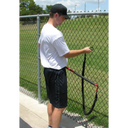
Attach the anchor loop to a stable, load-rated fixture at the desired height, connect the bungee, assemble the bar, and ensure enough clear space for full rotational movement without contact or interference.
Questions before you buy? Call or Text Our Team at (936) 295-4459
Customer Reviews
What Customers Are Saying
Loading reviews…
No reviews yet for this product.
Be the first to review