


उच्च घनत्व फोम रोलर
$16.20
Ordering for a team or facility?
Get volume pricing and help choosing the right tools for your players.
Ask me anything about this product
Sizing · use cases · technique · shipping — instant answers
Ask about उच्च घनत्व फोम रोलर — how to use it, what athletes it fits, sizing, or how it compares to other tools we make. Answers are focused on this product.
Innovating since 2003
Family-owned, Huntsville TX
Talk to the team
Real specialists, not a call center
Made for daily program use
Designed for continuous reps, every day, every season
100+ implements, organized by goal
Arm care, velocity, strength, and recovery
About This Product
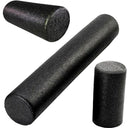
A firm black foam roller for self-myofascial release work — rolling over the quads, glutes, lats, and upper back with body weight. Three lengths, all 6 inches in diameter.
The High Density Foam Roller is a round foam cylinder for self-myofascial release (SMR) — pressing into soft tissue with a tool and body weight. The athlete sets it on the floor, rests the target muscle group on top, and rolls slowly, letting body weight set the pressure. Three lengths — 12, 18, and 36 inches, all 6 inches in diameter — cover single-region work, general use, and the training room. The smooth surface wipes clean between sessions, and the firm foam holds its round shape under load.
- Three Lengths — 12, 18, and 36 inches, all 6 inches in diameter, so the coach picks the length that fits the region and the setting.
- Firm, High-Density Foam — Black foam built to hold its round shape under body weight, session after session.
- Broad Coverage — The roller’s length covers the big muscle groups — quads, hamstrings, glutes, lats, and upper back — in a few slow passes.
- Body Weight Sets the Pressure — How much weight the athlete puts on the roller sets the pressure, so the work stays at a manageable level.
- Smooth Surface — Wipes clean between sessions.
What Is It?
A round foam cylinder for self-myofascial release work. Unlike a massage ball, which concentrates pressure into a small spot, the roller spreads pressure over a longer contact area, so it covers big muscle groups quickly and is more forgiving for beginners. The roller cannot reach small, dense spots like the pecs or the tissue between the shoulder blade and spine — that is the massage ball’s job.
How It Works
Three ideas behind a foam roller
You Set the Pressure
The athlete rests the target muscle group on the roller and lets body weight do the work. Shifting weight onto the hands or feet lightens the pressure; settling onto the roller increases it.
Slow Rolls, Tender Spots
Roll slowly over the muscle, and pause on the spots that feel most restricted instead of rushing past them. The work is measured in seconds per region, not speed.
Big Areas First
The roller covers the large muscle groups in a few passes. Smaller, denser spots — pecs, rear deltoids, the tissue around the shoulder blade — belong to a massage ball.
Related Research
Research Context: What the Evidence Actually Shows
Foam rolling is the most studied self-myofascial release tool, and programs use it as a short, consistent habit — a few minutes on the large muscle groups after throwing or training, or briefly before a session. Reviews of the research find small but reliable short-term gains in range of motion after rolling, and modest recovery benefits: less perceived soreness and smaller performance dips after hard sessions.
No study has tested this roller itself, and most of the research was done on non-baseball athletes and lower-body outcomes — no study has followed pitchers through an in-season program with rolling as the main variable. Rolling does not fix pain, eliminate soreness, or rebuild tissue, and it is not a performance enhancer: reviews consistently find no meaningful gain or loss in sprint speed or strength from rolling before activity. This description does not claim that the roller releases fascia, breaks down scar tissue or trigger points, increases blood flow, prevents injury, or replaces a structured training program.
3 Lengths
12, 18, and 36 inches — all 6 inches in diameter
60–120 sec
Per muscle group, the dose most studies used
4–6 out of 10
Working discomfort, not pain, is the target
Video Library
See It In Action
Click a thumbnail to play.
Stretching with Foam Roller 1 of 2

Stretching with Foam Roller 2 of 2

Product Details
How to Use It
Set it on a flat surface: Floor or mat, with enough room to lie out and roll. The roller does its work on the floor — it is not a wall tool.
Start light: New athletes start with less body weight on the roller — hands and feet on the floor carry part of the load — and short sessions. Add weight and time only when sessions feel manageable with no next-day increase in soreness.
Roll slowly: Move slowly over the muscle, about 60–120 seconds per region. Pause on tender spots rather than rolling aggressively over them.
Stay on muscle: Roll on the belly of the muscle, not on joints or bone. Never roll directly on the front of the knee.
Keep it brief: A full session covering several regions runs about 5–10 minutes. A short session done daily is worth more than a long session done rarely.
Stop for symptoms: Sharp pain, numbness, tingling, or soreness that grows over consecutive days means stop and reassess — and seek professional guidance if symptoms persist.
Rolling Guide
| Region | How It Runs | Notes |
|---|---|---|
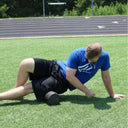
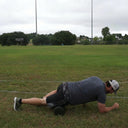
| Quads | Face down, roller under the thighs, roll from the hip to just above the knee | Keep the roller off the front of the knee |
| Glutes | Seated, roller under one side, ankle crossed over the opposite knee | Work one side at a time |
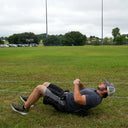
| Hamstrings | Seated, roller under the backs of the thighs, roll from the glutes to just above the knee | Lift one leg to add pressure, or keep both down to lighten it |
| Lats | On the side, roller under the armpit area, roll along the side of the rib cage | Keep the arm relaxed; stop above the lower ribs |
| Upper back | On the back, roller across the shoulder blades, roll from the top of the shoulders to the middle of the back | Keep the roller on the muscle, not on the spine |
The coach picks the regions, the order, and the time per region. Start with the regions that feel most restricted and keep the session short.
Choose Your Length
| Length | Diameter | Typically Used For | SKU |
|---|---|---|---|
| 12 inches | 6 inches | Travel and single-region work; fits in a bag or dugout space | FM12F |
| 18 inches | 6 inches | General use across most regions; the middle length for home or team use | FM18F |
| 36 inches | 6 inches | Training-room use and full-length work on the upper back and lats | FM36F |
All three are 6 inches in diameter — the length is the only difference. When in doubt, the 18-inch roller covers the most regions.
Who This Is For
- Commonly used for short post-throwing and post-training rolling sessions in baseball and softball programs.
- Commonly used for training rooms and team facilities that keep rollers on hand for a full roster.
- Commonly used for at-home daily routines, where a few minutes of rolling fits between school, practice, and the next day’s work.
- Commonly used for warm-up and prep work, with brief rolling on the regions that feel most restricted that day.
What This Roller Does NOT Do
- It does not guarantee more flexibility or range of motion — research finds small short-term gains on average, and results vary by athlete.
- It does not break down scar tissue or trigger points, or release fascia — the research points to sensory and neural effects, not physical changes to tissue.
- It does not diagnose, treat, or prevent injury, and it is not a rehabilitation device.
- It does not reach small, dense areas like the pecs or the tissue around the shoulder blade — a massage ball does that work.
- It does not coach — the coach picks the regions, the dose, and the timing.
Technical Specs
| Product | High Density Foam Roller for Myofascial Release & Flexibility |
| Diameter | 6 inches (all lengths) |
| Lengths | 12, 18, and 36 inches |
| Material | High-density foam |
| Color | Black |
| Surface | Smooth |
| SKUs | FM12F (12 in), FM18F (18 in), FM36F (36 in) |
| UPC | 608938928283 (12 in), 608938928290 (18 in), 608938928320 (36 in) |
| Contents | 1 foam roller (chosen length) |
Safety, Compliance, and Youth Guardrails
Rolling is low-intensity work, but it still belongs inside a planned, supervised session — on a flat surface, with the athlete in control of the pressure.
- Start light and short: New athletes start with less body weight on the roller and short sessions, and build up only when sessions feel manageable with no next-day increase in soreness.
- Stay on muscle: Roll on the belly of the muscle, not on joints or bone. Never roll directly on the front of the knee.
- Pause, don’t grind: Pause on tender spots rather than rolling aggressively over them.
- Watch the intensity: The work should feel like manageable discomfort — about 4 to 6 out of 10 — not pain.
- Stop for symptoms: Stop for sharp, stabbing, or shooting pain, numbness or tingling, pain that grows over consecutive days, or bruising — and seek professional guidance if symptoms persist.
- Adult supervision: Youth athletes should use the roller only under adult supervision, with less time on the roller and lighter pressure.
- Not a toy: Training equipment for coached work — not playground equipment.
- Not a rehabilitation device: Foam rolling is not a substitute for medical evaluation, physical therapy, or a return-to-sport plan.
We are not coaches. We do not provide coaching.
Frequently Asked Questions
What is included?
One foam roller in the length you pick: 12, 18, or 36 inches, all 6 inches in diameter.
Which length should I choose?
The 12-inch roller travels best and fits in a bag or dugout space. The 18-inch roller is the general-use length for most regions. The 36-inch roller suits the training room and full-length work on the upper back and lats. The Choose Your Length table lists all three.
When should athletes use a foam roller — before or after throwing?
Both have a place. A brief session before throwing can help the athlete access range of motion; a few minutes after throwing or training is the most consistent habit. Keep sessions brief either way, and let how the athlete responds decide the timing.
How long should a rolling session last?
Most studies used 60 to 120 seconds per muscle group. A full session covering several regions runs about 5 to 10 minutes. A few minutes a day beats a long session once in a while.
Where should athletes focus?
The big muscle groups: hips and glutes, quads and hamstrings, lats, and upper back. Stay on the belly of the muscle, never directly on the front of the knee, and never on joints or bone.
Is foam rolling safe for youth athletes?
Yes, when it is supervised, kept light, and used on the correct areas. Younger athletes should start with shorter sessions and less body weight on the roller, with clear stop rules for sharp pain, numbness, or soreness that lingers.
Will foam rolling make an athlete more flexible?
No tool guarantees that. Reviews of the research find small short-term gains in range of motion after rolling, but results vary by athlete, and rolling does not replace stretching, strength work, or a structured program.
Questions before you buy? Call or Text Our Team at (936) 295-4459
Customer Reviews
What Customers Are Saying
Loading reviews…
No reviews yet for this product.
Be the first to review