
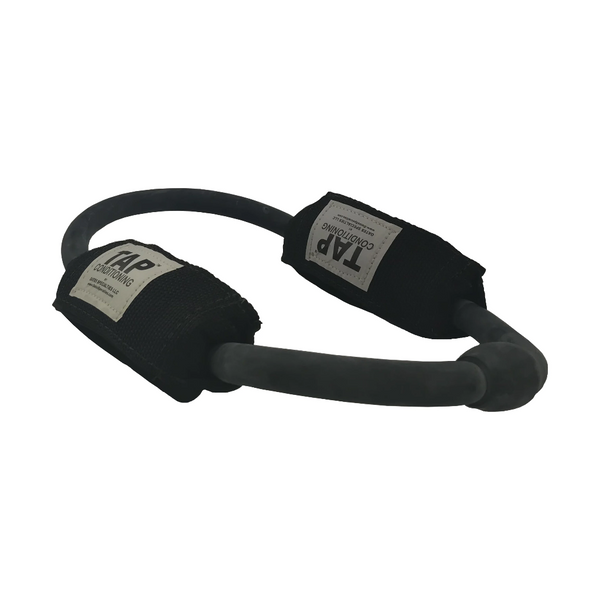
TAP® Extreme Duty Exercise Band Black (X-Heavy)
$13.95
In Stock

17 products
Hey Oates — AI Training Assistant
Ask Hey Oates — trained on our catalog and training library.
Bands and tubing are the most versatile pieces of equipment a training program can own. Unlike free weights, elastic resistance lets an athlete train through the exact patterns of throwing, hitting, and running — acceleration and deceleration, in any plane, at any tempo — while helping protect the joints at the ends of the range.
What elastic resistance actually does
Loads through the path of the movement, not just against gravity. Bands increase resistance as the athlete stretches them, which lines up with how force is produced in a throw or a swing.
How this collection is organized
Arm‑care tubing sits at the top: the TAP® Pitcher’s Friend, TAP® Ultimate Pitcher, TAP® Dynamic Arm Tubing, and TAP® Sheathed Safety Tubing are the primary tubing tools for scapular stability, cuff strength, and deceleration work. Loop bands like the TAP® Giant Flat Bands and TAP® Thigh Bands handle full‑body patterns — squat variations, hip openers, and kinetic‑chain work that ties the lower half to the upper half. Focused pieces like the TAP® First Responder target UCL protection and forearm strength, while the TAP® Finger Exercisers handle grip and finger dexterity. Movement‑specific tools like the Donley Hip Spin and the TAP® Resisted Running Flat Band add rotational and linear speed work on top of the base arm‑care patterns.
Choosing the right band
New to tubing? Start with the TAP® Exercise Bands, which offer light‑to‑medium resistance for daily arm‑care routines. Managing a full team? Bundled sets and the TAP® Bungee Cord Set give you a full resistance ladder so different athletes can plug into the right load. Rehabbing or coming back from injury? TAP® Sheathed Safety Tubing adds a protective sleeve so if a tube snaps, the athlete is shielded. Not sure where to start? Call or text our team at (936) 295‑4459 — we have been recommending arm‑care setups for baseball and other overhead athletes since 2003.
Tubing is a round cord — the standard tool for cuffed arm-care work like the Pitcher's Friend and Ultimate Pitcher. Bands are typically flat loops or continuous strips, better suited to compound patterns like squats, hip work, and pull-aparts. Most athletes need both. Tubing for the arm, bands for everything else.
Latex breaks down with UV light, heat, and use. Inspect your tubing every session — small nicks or cloudy spots are the warning sign. Under normal training use, most athletes replace tubing every 6–12 months. The Sheathed Safety Tubing lasts longer because the fabric sleeve protects the latex from abrasion and sun.
For arm-care work, always start lighter than you think you need. The cuff and scapula are small muscles — they respond to volume and quality, not weight. Most high-school and college pitchers use light-to-medium tubing for the majority of their arm-care work and only step up to heavier resistance for specific movements. If you're setting up a team, order a mix so athletes can progress.
