A practical guide to pitch location training for baseball coaches
Start with the pitch he needs to throw, not the delivery you want him to copy.
From Fall to Opening Day
Research-influenced · Practitioner-based · Outcome-oriented
November 12, 2026
For coaches of male pitchers from junior high through college. The Oates Specialties examples draw on published research and on practitioner guidance from Ron Wolforth and Randy Sullivan. Fit the work to each pitcher’s age, health, experience, and existing throwing plan.
Executive summary
Command starts with a job the pitcher needs to do. Throw the fastball to the glove side. Land the breaking ball for a strike. Locate the changeup without it flattening out. Get back to the secondary pitch after a fastball.
A target turns that job into something he can see. It marks the destination, and every throw either reaches it or does not. Targets are the first tool in this guide.
Practice order is the second tool. A pitcher learns a new task best in blocks, where one pitch and one spot repeat. As the task becomes familiar, mixing pitches, spots, and implements gives him more to solve. Research on pitchers and on novices in other sports supports that move.
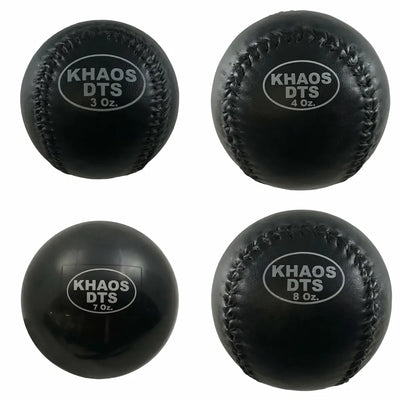
Variation in the task itself is the third tool. Changing the ball’s weight, size, and texture, and moving the target, asks for a small adjustment on every throw. That is the idea behind differential learning. Oates Specialties’ KHAOS® DTS Set is one example.
Oates Specialties’ example at the end walks through eight weeks. Weeks 1 to 4 use blocked work at targets. Weeks 5 and 6 bring in variation one ball at a time. Weeks 7 and 8 randomize. Research from baseball and related throwing sports informs each step.
Find Your Answer
Answer the question closest to what you need right now, and jump straight there.
- “What counts as a hit when a strike can still fail the call?” → Jump to: 3. Define the pitch, the spot, and its purpose
- “Why does throwing at a target help a pitcher’s command?” → Jump to: 4. Why throw at a target?
- “Does mixing pitches and spots in practice actually help?” → Jump to: 5. Blocked and random practice: what the research says
- “Do heavier or lighter baseballs sharpen command?” → Jump to: 6. Differential learning and the KHAOS® DTS Set
- “What does an eight-week command block look like?” → Jump to: 7. Oates Specialties’ example: eight weeks from blocked to random
🎧 Prefer to listen? Audio version of this article:
Quick-start: your first command session
Use this outline inside throwing that is already planned. Do not add throws to run it.
Before (about 5 minutes). Write each pitcher’s assignment on one line: the pitch, the spot, and what counts as a hit. Ask the pitcher and catcher to state the call back. Settle any disagreement before the first throw.
During. Set the target, name the pitch, and let him throw. Watch the whole group, not only the misses. Between sets, ask what he called, what happened, and whether it was the pitch he meant.
After. Write down the pitch, the intended target, and whether each throw hit or missed. Add one line on how it felt. Then choose: keep the task, simplify it, or change it.
Rules that do not move. Change one thing at a time. Give no penalty throws for a bad score. Pain, weakness, numbness, or a change in function ends the experiment and calls for a proper evaluation.
1. What pitching command actually means
Four pitchers show up for the same throwing period.
One misses arm-side with his fastball. One can bury his breaking ball but cannot land it for a strike. One hits the spot with his changeup only when it stops moving like his changeup. One throws his secondary pitch well three times, then loses it when a fastball comes first.
That is one session with four different needs. The same instruction will not serve all four.
“Work on command” names a topic. It gives the staff nothing to do. A better question: what does this pitcher need to learn to throw?
This guide defines command as throwing the intended pitch to the intended spot, reliably, for a reason. That is a working definition for coaches, not a laboratory measure.
Three terms keep the work clear. The spot is where the pitcher wants the ball to finish. The target area is the marked zone around that spot. The pitcher and catcher must agree on what counts as a hit. The aim point is what he looks at to send the ball there.
Arm-side is the throwing-arm side. Glove-side is the glove side. Neither means inside or outside to a hitter.
2. Practitioner use: Ron Wolforth and Randy Sullivan
These practitioners work in different places. Their public material points the same way. Give every throw a clear destination. Treat accuracy as one part of a larger movement problem. Keep command work going all the time. This guide uses their ideas as applied examples of how the research could be put into practice.
Ron Wolforth writes that a vague target produces vague results. Each throw needs an exact destination. He rates command by how far and in which direction a pitch missed, not by outcome alone. He names the TAP® Advanced Command Trainer as a way to see at once whether a pitch reached the spot. He also wants command practiced all the time, in catch play and drills as well as bullpens.
Randy Sullivan treats accuracy as necessary but not sufficient. For him, the pitch, the spot, the count, and the hitter form one problem. He argues that a delivery the hitter cannot read depends on movement that stays stable.
Commercial transparency: Oates Specialties sells training equipment, including every product named in this guide. Oates Specialties has working relationships with Texas Baseball Ranch and the Florida Baseball ARMory, and both use Oates products. Their frameworks are practitioner interpretation, not trial results. This guide provides equipment-provider education, not individualized coaching or medical care.
3. Define the pitch, the spot, and its purpose
A strike can fail the assignment. The catcher calls fastball away. The pitch crosses the inner half. It is a strike, but it missed the call.
A ball can pass. The pitcher wants his breaking ball below the zone, and he puts it there. That ball meets the assignment.
Before choosing any drill, finish one sentence: “We are working on this pitch so he can ______.”
| Pitcher's need | Starting assignment |
|---|---|
| Misses arm-side with the fastball | Throw the fastball to a called glove-side spot. |
| Buries the breaking ball | Land the breaking ball inside the called strike area. |
| Needs a chase pitch | Finish the breaking ball at a separate chase spot below the zone. |
| Loses the changeup at the spot | Reach the spot and keep the changeup's flight, as the catcher confirms. |
| Loses the secondary pitch after a fastball | Return to the secondary pitch right after a fastball. |
“Throw twenty pitches at the target” describes an activity. The finished sentence describes what the pitcher is learning.
Each throw needs its own job: what to throw, where to finish it, and what a good result looks like. That job can stay the same for several pitches. Nobody needs a new cue after every miss.
Watch the changeup closely. It can reach the spot only by arriving faster and flatter. That meets the location rule but not the assignment.
4. Why throw at a target?
A target does three jobs. It names the destination, so the pitcher has something outside his body to aim at. It gives a result he can see, hear, or feel on every throw. It gives the coach a fixed place to judge the miss.
Throwing research supports all three. In handball, 13 experienced players threw at four targets set 25 centimeters from the corners of the goal. Where the target sat changed both the ball’s speed and the consistency of the throw. A target is not neutral. Changing its position changes the throw.
That matters for the differential learning in Section 6, which depends on constant change. Moving the target is a simple way to make each throw a little different. In one 12-week study, 64 children threw at one distance or at two. The two-distance groups scored better at the end. The children could not see where each throw landed. They were told the result afterward.
Baseball shows the same thing. In one study, 22 male college athletes threw fastballs at three small targets from regulation distance. Half had six or more years of baseball experience. The targets were about 8 inches wide and roughly 10 to 12 inches apart. The baseball group scattered less and separated neighboring targets better.
Even the experienced group’s throws to neighboring targets overlapped by 40 to 50 percent. The practical lesson is spacing. Place targets far enough apart that a good throw to one is plainly different from a good throw to another. Close targets ask for finer adjustments. Wide targets ask for bigger ones.
The targets in this guide give different kinds of feedback:
- The TAP® Advanced Command Trainer returns a hit-or-miss result that the pitcher sees, hears, and feels.
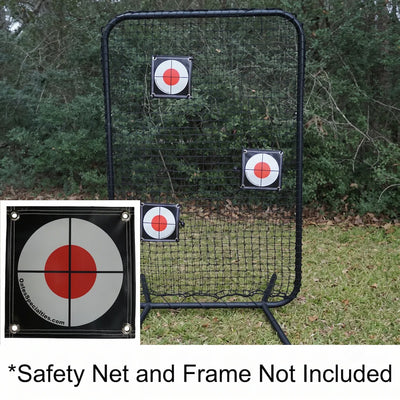
- The TAP® Precision Target is a compact 10-by-10-inch target. It sounds on a hit and stays silent on a miss.
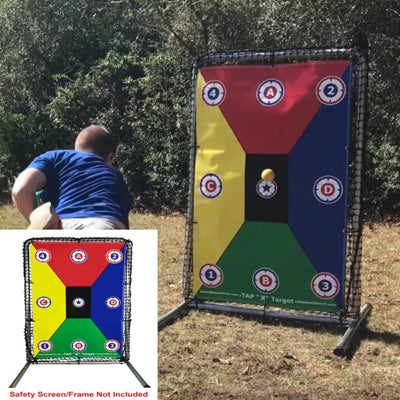
- The TAP® K Target carries red, yellow, blue, and green panels around a black center. Different colors and shapes can stand for different targets.
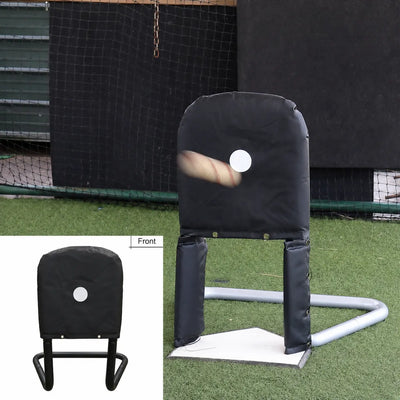
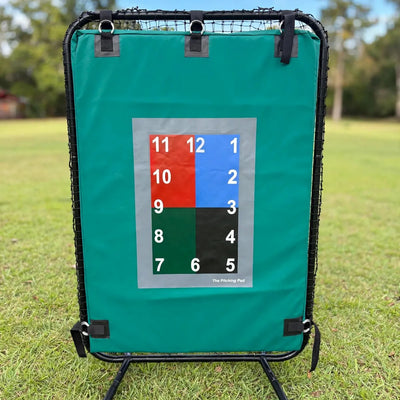
- Pitching Pad® divides the zone into four color quadrants numbered like a clock. A coach can call an exact spot.
These are examples of tasks, not requirements. Any target with a clear, agreed area serves the same purpose.
5. Blocked and random practice: what the research says
Three practice orders matter here. In a blocked set, one pitch and one spot repeat. In a serial set, pitches follow a fixed pattern, such as fastball then breaking ball. In a random set, calls arrive in an order the pitcher cannot predict. A session of several one-pitch sets is still blocked work.
Blocked work usually scores better during practice. Random work usually scores worse then, yet it often holds up better days later. Researchers call this the contextual interference effect.
Two studies set the pattern:
- Twenty male pitchers aged 15 to 22 threw fastballs and breaking balls to a low, outside target. Ten practiced in blocks and ten in random order. A day later, the higher-scoring pitchers in the random group did better than their blocked counterparts. Among lower-scoring pitchers, no difference appeared.
- Novices practiced golf putting and basketball passing. Practice that began blocked, moved to a fixed pattern, and ended random beat pure blocked and pure random practice later.
The progression in Section 7 is Oates Specialties’ example, built from these studies.
The coaching reading is simple. Start blocked until the pitcher understands the task and can find the spot. Add mixing when he can. Expect scores to dip when mixing begins. If mixing leaves him unsure of the call, step back one stage.
6. Differential learning and the KHAOS® DTS Set
Standard practice tries to repeat one movement until it is stable. Differential learning goes the other way. It adds variation on purpose, so no two throws match. The athlete keeps finding a solution instead of reproducing a feel.
Two recent studies used it with throwing and shooting tasks:
- In a six-week study, 45 male athletes practiced skills they had not mastered. The differential group improved in both of its unfamiliar skills, including a handball goal throw. It showed larger gains than a contextual interference group and a free-play group.
- In an eight-week study, 37 youth basketball players took shots from varied angles and distances. Ball types varied too, including a mini handball and a street football. They improved two-point shooting more than a group repeating standard shots. Game scoring improved in both groups.
Weight is a separate question. A review of overweight-ball training found three studies of 6 to 12 weeks. None showed a change in accuracy with a regulation ball. Heavier balls alone do not sharpen command. The variation is the point, not the ounces.
The KHAOS® DTS Set is four balls that differ in weight, size, and texture. Oates Specialties pairs it with the K Target. Each ball feels and flies differently, so the pitcher cannot repeat the same grip pressure and release. He must adjust on the next throw. A changing target adds a second adjustment.
The working idea is this: small corrections become familiar, so the correction needed between pitches feels less foreign. Keep intent and throw counts inside the existing throwing plan. The set is not an overload program.
7. Oates Specialties’ example: eight weeks from blocked to random
This is Oates Specialties’ example of how the research could be put into practice. It is not a prescription. Use throws already in the plan, such as 20 to 30 per session. Choose the pitch from the assignment table in Section 3. Move up only when the pitcher understands the task and finds the spot often enough to satisfy the coach. Otherwise, repeat the stage.
Any target from Section 4 can do the work. The target stays the same. What changes is where it sits and what the pitcher throws.
| Weeks | Practice order | Target | Ball | What changes |
|---|---|---|---|---|
| 1 to 2 | Blocked: one pitch, one spot per set | One target, one location | Regulation ball | He learns the task |
| 3 to 4 | Blocked in short sets | Same target, moved to a new location between sets | Regulation ball | The location moves; the pitch and ball do not |
| 5 to 6 | Blocked by ball; end with a fixed pattern, such as fastball then breaking ball | Target moved between sets | KHAOS® DTS Set, one ball per set | The ball changes between sets |
| 7 to 8 | Random: pitch and spot called in an order he cannot predict | Target moved often, such as every set or two | KHAOS® DTS Set, ball changing every throw or two | Everything varies |
Weeks 1 and 2. One pitch, one spot, one target. The goal is understanding. If he cannot state the call, fix the instruction before adding difficulty.
Weeks 3 and 4. Keep sets short and move the target between them. Shift it a few inches, raise it, lower it, or slide it to the other side. Where a target sits changes the throw, so moving it gives the pitcher a new problem. This stage tests whether he can send the same pitch to a new place. A sample Week 4 set: six fastballs to a glove-side spot. Move the target. Then throw six more.
Weeks 5 and 6. Bring in the DTS Set, one ball per set. Oates Specialties pairs it with the K Target, where a color or shape can name the spot. The pitch stays the same within a set. Let him learn what each ball asks of him. Close the session with a short fixed pattern, which is the first taste of mixing. Expect scores to dip. That is the planned cost.
Weeks 7 and 8. Randomize. The coach calls pitch and spot from a shuffled list. The pitcher repeats the call back before each throw. The ball changes every throw or two. The target moves every set or two. A sample set of six might run: fastball glove-side, breaking ball for a strike, changeup arm-side, in shuffled order.
End of Week 8. Return to the Week 1 setup: same target, same distance, same pitch. Compare the hit-and-miss tally with Week 1. Note whether he threw the intended pitch. One better day is worth following up, not worth celebrating.
If a stage falls apart, step back one stage. Do not skip ahead to save time.
8. Teaching pitchers to read their own results
The pitcher watches location and reports feel. The catcher confirms the finish and describes the flight. The coach reads patterns and picks the next adjustment.
After each set, ask five questions. What was I trying to throw, and where? What happened? Was it the pitch we are developing? What did I notice? What do I repeat, simplify, or try next?
Keep the long conversations between sets. During a set, he needs one clear job, not a seminar on body parts.
Give him a place to throw to. “Finish it at the called low spot” gives a destination. “Don’t leave it up” gives only a warning. If he is collecting contradictory corrections, stop and simplify.
9. Running command work for a whole pitching staff
A staff needs different assignments, not a different system for each pitcher. Name each athlete’s pitch and spot before the period. Share the setup where space allows.
The coach circulates, reads patterns, and answers questions. Not every throw needs a correction. Catchers have a narrow job: confirm the call and report the finish.
Keep the task when it is clear. Simplify it when demands collide. Change it when it is not working. An assignment describes today’s work. It does not define the pitcher.
10. Review command development before Opening Day
The fall and winter window exists so a pitcher can build a pitch before competition demands it. Start from The Audit: recent throwing, current capacity, role, and available time. Build the command work into that plan.
At the November Checkpoint, answer one question per pitcher: what can he now throw? Then name what still needs work. A pitch can look sharp at a target and still fail against hitters. The ramp and bullpen-to-game resources handle that next phase.
Pick equipment in this order: goal first, then the function you need, then the tool. No specific product is required for any task in this guide.
Look back at the four pitchers from Section 1. A good session does not make them throw alike. It sends each one home knowing his assignment. It sends the staff home knowing the next step for each arm.
The goal was never to win the drill. It is to make the intended pitch available the moment the catcher calls for it.
Where this guide fits in the series
This guide belongs to the Fall to Opening Day series. How Do Pitchers Safely Add Velocity? comes before it. Velocity matters, but a pitcher also has to get the ball where he intends. This guide builds that skill.
Bring each pitcher’s assignment and results to LAB 2: The November Checkpoint. For equipment setup, see Why Targets Work and Pitching Target System in the Education Hub.
Appendix A. What the research does and does not support
This is a focused, evidence-informed guide, not a systematic review. It is an editorial training application, not a standardized Wolforth or Sullivan program. Nothing here guarantees a result. Only qualified health professionals diagnose injuries or clear a pitcher to throw.
| Topic | What the studies found |
|---|---|
| Targets, baseball | Baseball-experienced throwers scattered less and separated neighboring targets better than inexperienced throwers. Overlap stayed at 40 to 50 percent. |
| Targets, varied distance | Children who practiced at two distances scored better after 12 weeks than children who practiced at one. |
| Targets, handball | Target location changed ball speed and consistency in 13 experienced players. |
| Practice order, pitchers | Higher-scoring pitchers practicing in random order outperformed blocked peers a day later. No difference among lower-scoring pitchers. |
| Increasing difficulty | A schedule that moved from blocked to serial to random beat both pure schedules for novices. |
| Differential learning | Gains in unfamiliar throwing and shooting skills. Varied ball types improved two-point shooting in youth players. |
| Ball weight and accuracy | Overweight-ball training did not change accuracy with a regulation ball. |
Where the evidence is thin. No trial compares pitchers throwing at a target with pitchers throwing without one. No study has tested mixed, resized, or reweighted baseballs with changing targets on pitchers’ command. No study has moved pitchers from blocked to random practice across eight weeks. Most of the target and differential learning work comes from related throwing and shooting sports, and this guide treats it as relevant to the overhead throw. The example in Section 7 joins those findings with reasoning. Group sizes are small throughout, and the bibliography notes each study’s scope.
Product descriptions come from the product pages. Descriptions of the practitioners’ views come from the sources in Appendix B and are not trial results.
Appendix B. Annotated bibliography
1. Wolforth R. Improving Command. Wolforth Throwing Mentorship, Article 51 (In-Season Course Correction, Part 2). Perfect Game. April 29, 2025. https://www.perfectgame.org/articles/View.aspx?article=23588
Review level: page text reviewed in the November 2026 audit. Why it matters: practitioner source for exact destinations, rating misses by distance and direction, and immediate feedback from the Advanced Command Trainer. Use with care: coaching writing, not research, and it describes no outcome data.
2. Sullivan R. Command Isn’t Accuracy. It’s Deception. (And That Changes How You Train It.) Florida Baseball ARMory. https://floridabaseballarmory.com/command-isnt-accuracy-its-deception-and-that-changes-how-you-train-it/
Review level: page excerpt reviewed in the November 2026 audit. Why it matters: practitioner frame that accuracy is necessary but not sufficient, and that stable movement supports a delivery the hitter cannot read. Use with care: practitioner essay with no efficacy data.
3. Tsutsui S, Satoh M, Yamamoto K. Contextual Interference Modulated by Pitcher Skill Level. International Journal of Sport and Health Science. 2013;11:68-75. DOI: 10.5432/ijshs.201211. https://www.jstage.jst.go.jp/article/ijshs/11/0/11_201211/_article
Review level: study details carried from the previous draft; database abstract record confirms the higher-skill result. Why it matters: the only direct pitching study of practice order in this guide. Use with care: 20 pitchers, four small groups, a narrow task, and a one-day retention test.
4. Kerr R, Booth B. Specific and varied practice of motor skill. Perceptual and Motor Skills. 1978;46(2):395-401. DOI: 10.1177/003151257804600201. https://doi.org/10.1177/003151257804600201
Review level: abstract and a published summary reviewed. Why it matters: in a throwing task, children who practiced at varied distances scored better at the end of 12 weeks than children who practiced at one. Use with care: 64 children aged 8 and 12, a simple task, no vision of the result, and no baseball.
5. Porter JM, Magill RA. Systematically increasing contextual interference is beneficial for learning sport skills. Journal of Sports Sciences. 2010;28(12):1277-1285. DOI: 10.1080/02640414.2010.502946. https://doi.org/10.1080/02640414.2010.502946
Review level: abstract reviewed. Why it matters: supports starting blocked, moving to a fixed pattern, and ending random. Use with care: novices practicing golf putting and basketball passing.
6. Apidogo JB, Ammar A, Salem A, Burdack J, Schöllhorn WI. Resonance Effects in Variable Practice for Handball, Basketball, and Volleyball Skills: A Study on Contextual Interference and Differential Learning. Sports. 2024;12(1):5. DOI: 10.3390/sports12010005. https://doi.org/10.3390/sports12010005
Review level: abstract and main results reviewed. Why it matters: compares differential learning, contextual interference, and free play on throwing and shooting skills. Use with care: 15 athletes per group with different sport backgrounds; no baseball.
7. Burkaitė G, Figueira B, Schöllhorn W, Coutinho D, Paulauskas R. Differential shooting training in youth basketball players: an analysis of performance effects. Frontiers in Psychology. 2025;16:1709103. DOI: 10.3389/fpsyg.2025.1709103. https://doi.org/10.3389/fpsyg.2025.1709103
Review level: abstract and exercise table reviewed. Why it matters: differential training that varied ball type improved two-point shooting accuracy in youth players. Use with care: 37 youth players, unblinded raters, and limited transfer to game scoring.
8. Escamilla RF, Speer KP, Fleisig GS, Barrentine SW, Andrews JR. Effects of throwing overweight and underweight baseballs on throwing velocity and accuracy. Sports Medicine. 2000;29(4):259-272. DOI: 10.2165/00007256-200029040-00004. https://pubmed.ncbi.nlm.nih.gov/10783901/
Review level: abstract reviewed. Why it matters: three training studies found no accuracy change with a regulation ball after overweight-ball training. Use with care: an older review that does not address mixed implements or targets.
9. Kusafuka A, Yamamoto R, Okegawa T, Kudo K. The ability to appropriately distinguish throws for different target positions. Frontiers in Sports and Active Living. 2023;5:1250938. DOI: 10.3389/fspor.2023.1250938. https://doi.org/10.3389/fspor.2023.1250938
Review level: open-access article reviewed. Why it matters: shows how well baseball-experienced and inexperienced throwers separate throws to nearby targets, which supports clear target spacing. Use with care: 11 per group, flat ground, no catcher, and a measurement study rather than a training trial.
10. van den Tillaar R. The Effects of Target Location Upon Throwing Velocity and Accuracy in Experienced Female Handball Players. Frontiers in Psychology. 2020;11:2006. DOI: 10.3389/fpsyg.2020.02006. https://doi.org/10.3389/fpsyg.2020.02006
Review level: open-access article reviewed. Why it matters: shows that target location changes ball speed and throw consistency in experienced overhead throwers. Use with care: 13 female handball players throwing from 7 meters at near-maximal effort.
About This Analysis
Created by the Oates Specialties team led by Robert Oates, M.Ed., Founder
Editorial oversight by Gunnar Thompson, BS, CSCS, General Manager
Certified Strength & Conditioning Specialist | Biomechanics Specialist
November 2026
Complete Credentials
ROBERT OATES, M.Ed., Founder: Founded Oates Specialties in 2003. Master of Education degree. Provides strategic direction for educational content and athlete development philosophy.
GUNNAR THOMPSON, General Manager: BS Kinesiology (Clinical Exercise Science). CSCS (NSCA), PES (NASM), CPPS certifications. Technical authority on biomechanics and performance science. Conducts review of all educational content for scientific accuracy.
Questions or corrections: gunnart@oatesspecialties.com
© 2026, Oates Specialties LLC