

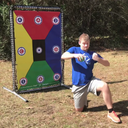
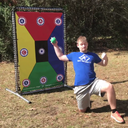
TAP® K Target – Multi‑Color Nine‑Point Pitching Target for Command, Differential Training, and Effective Velocity Work
$99.95
Ships from Huntsville, TX
In Stock
60-day limited warranty
Questions? 936-295-4459
Ordering for a team or facility?
Get volume pricing and help choosing the right tools for your players.
Ask me anything about this product
Sizing · use cases · technique · shipping — instant answers
Ask about TAP® K Target – Multi‑Color Nine‑Point Pitching Target for Command, Differential Training, and Effective Velocity Work — how to use it, what athletes it fits, sizing, or how it compares to other tools we make. Answers are focused on this product.
Innovating since 2003
Family-owned, Huntsville TX
Talk to the team
Real specialists, not a call center
Made for daily program use
Designed for continuous reps, every day, every season
100+ implements, organized by goal
Arm care, velocity, strength, and recovery
About This Product
A pitcher throwing into an open net has no goal before the throw and no verdict after it. The TAP® K-Target™ supplies both, on every rep, without anyone standing behind the plate.
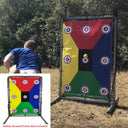
It is a vinyl panel of roughly 6 feet by 4 feet carrying nine labeled aiming points across five color zones. It is built for pitchers who already throw strikes and need to hold location when the location keeps changing. No cage is required, no radar, no subscription, and no app.
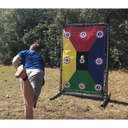
It mounts to a flexible net, a protective screen, or a TAP® Target Backstop™ with the ten included ball bungees. All nine points stay live at once, so a coach can call a different coordinate on every throw without touching the panel. One station can serve a full bullpen rotation.
It is a feedback tool, not a mechanics trainer. It tells a pitcher where the ball went. It does not tell him how to throw it.
Key Features and Benefits
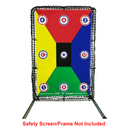
- Nine labeled points on a fixed grid. Numbers 1 through 4 mark the corners, letters A through D mark the edges, and a star marks the center. A coach calls a coordinate out loud and the pitcher has a specific goal before he starts his delivery.
- Five color zones for broader calls. Red at the top, green at the bottom, yellow left, blue right, and a black center. Calling a color gives a developing pitcher a wider goal without changing equipment.
- A center smaller than a strike zone. The black rectangle in the middle is the precision reference. It gives a skilled pitcher something tighter than the zone to work against.
- A surface larger than the aim point. Misses land on the panel instead of sailing past it. A bad throw becomes a coordinate a coach can log rather than a throw nobody learns from.
- Nothing to reconfigure between throws. All nine points stay live. A coach calling an unpredictable sequence never stops to move a bar or reposition a pad.
- Heavy-duty vinyl with ten-point bungee mounting. UV-resistant inks and a durable face built for daily cage and field use. All ten bungees spread impact across the panel and the frame behind it.
- Works with the implements you already own. Regulation baseballs and softballs, weighted training balls, and soft-shell training balls.
- Research-grounded design. Peer-reviewed research supports the mechanisms behind this tool. No study has tested this specific product; mechanism support is at the research level, not the product level.
What Is It?
The K-Target™ is a flat vinyl panel measuring approximately 6 feet by 4 feet and weighing about 4 pounds. It attaches to any flexible net or protective screen with the ten included ball bungees. There is no frame, no padding, and no hardware beyond the bungees.
The face carries two layers a coach can use separately or together. Five color zones act as location clusters. Nine labeled points sit inside those zones as precise coordinates.
The naming follows how coaches already speak rather than how a rulebook measures. A number means a corner, which is the up-and-in or down-and-away call. A letter means a cardinal edge. A color means a region. None of the three is a measured strike-zone boundary, and the panel is not built to rulebook dimensions.
The design came out of a collaboration with the Texas Baseball Ranch, and the panel carries both marks. It is the target component of the Khaos® DTS Package, which pairs it with the Khaos® DTS Ball Set and the Khaos® 101 Manual. That package was named a Best of Show winner by Collegiate Baseball Newspaper at the 2019 ABCA Convention.
Ron Wolforth of the Texas Baseball Ranch originated the Differential Training System the package is named for. His published curriculum lists the Bernstein Principle and constraint-based drills among its core modules. Wolforth is cited here as a Tier 3 practitioner source; his framework is not peer-reviewed evidence.
Perry Husband developed the Effective Velocity® framework, which observes that pitch location changes a hitter’s available reaction time even when the radar reading is identical. Husband is cited here as a Tier 3 practitioner source; his framework is not peer-reviewed evidence.
How It Works
Three mechanisms behind the grid
Unpredictable Location
Practising one spot in an unbroken block lets a pitcher reuse the same movement solution every throw. Changing the called location forces him to find a new one.
Misses Carry Information
A study of eighteen collegiate pitchers found every one of them missed in an oval rather than a circle, and the long direction of that oval tracked his own arm slot.
A Target Changes the Task
A panel is present on every throw whether anyone speaks or not, and it reports the result without an observer — unlike a verbal cue, which arrives once and depends on the athlete acting on it.
Backed by Science
Research-Grounded Design
Peer-reviewed research supports the mechanisms behind this tool. No study has tested this specific product; mechanism support is at the research level, not the product level.
9 Points
Labeled aiming points across five color zones
6′×4′
Installed panel size
~1 Meter
Width of the miss-oval found in collegiate pitcher research
Video Library
See It In Action
Click any thumbnail to play from the start — click any timestamp to jump to that moment.
2022
TAP™ ‘K’ Target — Enhance Throwing Accuracy, Develop Skill to Adjust Pitch Location
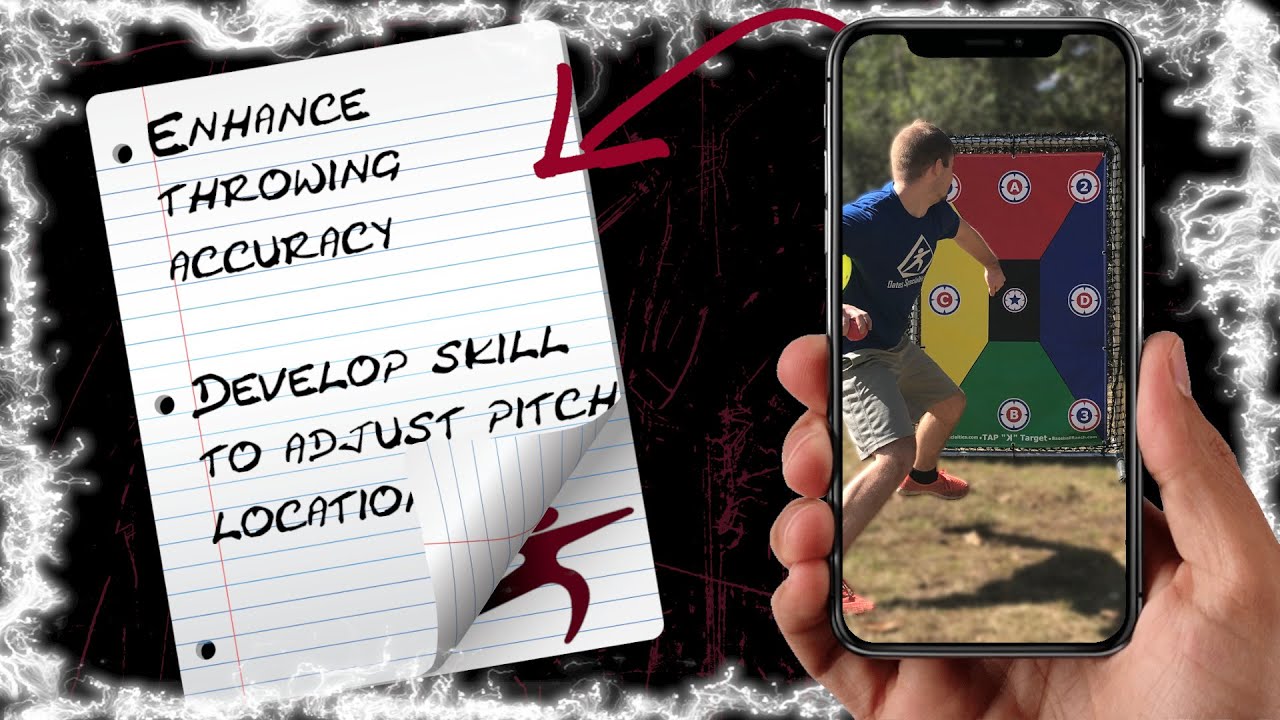
Chapter Guide — 6 Timestamps
| Introduction to the TAP™ ‘K’ Target and its durability/versatility. | |
| Target options, layout, and colors. | |
| Design philosophy — differential training and making large pitch adjustments. | |
| Pricing, portability, and UV care instructions. | |
| Proper setup using all 10 bungees for longevity. | |
| Use cases — at home vs. facilities — and screen setup. |
2022
TAP™ ‘K’ Target — Durable, Color-Coded, and Visual Targets for Elite Baseball Throwing Practice
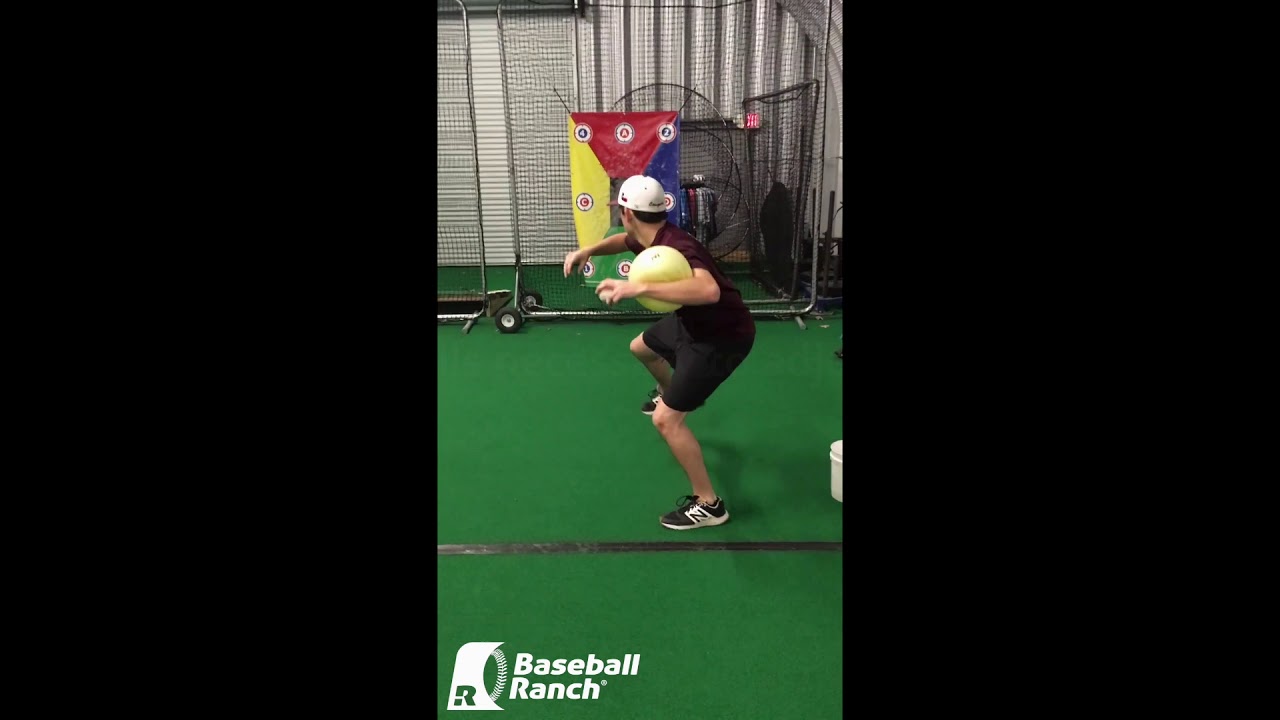
Chapter Guide — 5 Timestamps
| Accuracy Validation — an athlete executes a high-intent throw off an inclined training slope, with the segment emphasizing accuracy tracking against the brightly color-coded grid. | |
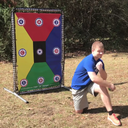
| Skill Adjustment Protocol — a player uses a weighted ball implement from a kneeling position, demonstrating target adaptability when throwing to specific numbered regions. | |
| Protocol Accommodation — quick transitions showing various athletes throwing from distinct mounds and flat-ground distances, illustrating how the face adapts to multiple training styles. | |
| Gaze Anchoring — demonstration of how the high-contrast color scheme grabs and holds an athlete’s visual focus throughout the full motion path. | |
| Structural Durability and Source Info — close-up of heavy plyometric ball impacts against the vinyl backdrop, showing how the material dampens force. |
What to Look For in a Pitching Target
These are criteria any buyer can measure a target against, including this one.
Surface area matters more than it looks. A target sized to the strike zone only reports on pitches that were close. Research on collegiate pitchers found the oval holding 95 percent of an experienced thrower’s pitches is close to a metre across, and roughly twice that for an inexperienced one. A panel narrower than that distribution loses the misses, which are the throws with the most to teach.
Grid architecture matters more than point count. Nine points arranged as corners, edges, and a center map onto coaching language. Nine points scattered without a naming logic do not. Ask whether a coach can call a location in the words he already uses, from behind the mound, without pointing.
The panel has to survive what will hit it. A target taking regulation and weighted balls at game intent needs a durable face, UV-resistant ink, and enough anchor points to spread impact rather than concentrate it at two corners. Count the mounting points before you count the targets.
Ask whether the product comes with a progression. A target with no protocol is a decoration. Ask what a coach does on day one, what changes at week four, and what tells him the athlete is ready for more.
Decide whether it runs standing alone. Some tools only work alongside tracking hardware or a subscription. Ask whether the tool still does its job in a school gym with no power outlet and no catcher.
4. How to Use It
Warm-Up Use. Open with one color zone. Five to ten throws at moderate intent. One zone is a single clear goal. It builds rhythm before complexity arrives.
Training Use. Name the target before the pitcher starts his delivery. Name one thing only. Call a color for a broad goal. Call a letter or number for a precise one. Then stop talking. The panel already carries the goal. A second cue about mechanics pulls attention back to the body. For the primary work, call a different coordinate on every throw, in an order the pitcher cannot predict. Throw at game effort. A location held at 70 percent tells a coach very little. Nothing on the panel moves during a session. The pitcher adjusts, not the target.
Light-Day Use. Drop back a stage rather than cutting the session short. One zone, reduced volume, moderate intent. That keeps the feel for location without adding workload. This is not a recovery-day tool. Recovery belongs to arm care and mobility work.
5. Variant Selection Guide
The K-Target™ is a single SKU. There is one panel and one size.
The primary setup variable is throwing distance, and the progression runs through it. Start where the pitcher lands in a called color zone consistently. Move back as that holds. Regulation distance is the destination, not the starting line.
The second variable is call precision. A color is the broadest goal and a letter or number the tightest. Move from one to the other as movement stability improves rather than on a calendar.
For most programs, start with one color zone at a comfortable flat-ground distance, then move to called coordinates before moving back to the mound.
6. Why It Works
RESEARCH STATUS STATEMENT
Every mechanism claim below applies a verified sports-science finding to this design.
For the full research picture, including contested findings, counter-evidence, and the annotated bibliography, see the mid-funnel report: “TAP® K-Target™: What It Is, What the Research Says, and How to Use It Well.”
That sits under the shared research foundation, “Why Targets Work,” in The Oates Target System Hub.
The first mechanism is unpredictable location. Practicing one spot in an unbroken block lets a pitcher reuse the same movement solution every throw. Changing the called location forces him to find a new one. A 2013 study of college and high school pitchers found that mixed-order practice helped the higher-skilled group hold location a day later, though the samples were very small.
The second is that misses carry information. A study of eighteen collegiate pitchers found that every one of them missed in an oval rather than a circle, and the long direction of that oval tracked his own arm slot. Miss direction is individual and it is readable, which is why a panel wider than the zone earns its size.
The third is that a target changes the task rather than the instruction. A verbal cue arrives once and depends on the athlete acting on it. A panel is present on every throw whether anyone speaks or not, and it reports the result without an observer. Research on baseball hitters found players more accurate under every feedback condition than under none at all.
One argument common to this product category is deliberately absent here. The claim that aiming outward at a target beats attending to the body was supported by a large 2021 review. A 2024 re-analysis of that same evidence corrected for the fact that studies finding nothing often go unpublished, and once corrected the advantage nearly disappeared. Oates content does not use that argument.
A related idea holds that letting athletes control their own practice improves learning through motivation. A 2024 review found that only about one in five studies testing that claim measured motivation at all. No such claim is made for this panel.
HONEST LIMIT: SKILL LEVEL AND AGE
The benefit of varied practice is much weaker outside a laboratory than inside one. In athletes under 18, two large reviews found a combined effect that cannot be told apart from zero.
A developing pitcher should work one color zone at a time. The nine-point sequence asks for a baseline of movement organisation that has to be built first.
Adding unpredictable location on top of an unstable delivery produces frustration rather than adaptation.
Product Details
7. Who This Is For
- Commonly used for intermediate to advanced pitchers who already throw strikes and need location to hold when it keeps changing. The question shifts from how the delivery works to where the ball goes.
- Commonly used for high school, college, and travel programs teaching Differential Training System or Effective Velocity® concepts. One panel introduces both without reconfiguring.
- Commonly used for facilities turning unsupervised bullpen time into structured command sessions. The panel gives a solo pitcher a goal and a verdict on every throw.
- Commonly used for home and garage setups where a parent wants backyard throwing to be more intentional. One color zone and a stable screen is a complete session.
- Commonly used for coaches who chart misses. The labeled coordinates turn a miss into a logged direction rather than a general impression.
8. What This Implement Does NOT Do
- Does not measure velocity in miles per hour, spin in revolutions per minute, or movement in inches. Radar and tracking systems remain necessary for numbers.
- Does not prescribe a delivery, an arm path, or a release point. It reports where the ball went and nothing about how it got there.
- Does not replace a radar unit or a ball-flight tracking system. Those are a different category of tool answering a different question.
- Does not improve command on its own. No study has tested this product, and reps built around a clear goal at game intent are what build skill.
- Does not return the ball. A solo session still requires a bucket and a plan.
- Is not a backstop, a cage liner, or a substitute for protective equipment. The net or screen behind it absorbs the ball.
- Is not a padded surface. Cushioned impact belongs to the Pitching Pad® and the Target Pad®.
- Is not a medical or rehabilitation device and makes no injury-prevention claim.
9. Technical Specifications
| Product family | TAP® Pitching Target System |
|---|---|
| Product name | TAP® K-Target™ |
| SKU / UPC | TKT / 608938930750 |
| Primary use | Command work without a catcher, on a mound or flat ground |
| Training focus | Unpredictable location calls, miss mapping, general introduction to Effective Velocity® location categories |
| Material and construction | Heavy-duty vinyl face with UV-resistant inks. Not fully waterproof and not fully UV-proof |
| Installed size | Approximately 6 ft x 4 ft. Fits inside a 6 ft x 4 ft net and frame |
| Weight | Approximately 4 lb |
| Visual layout | Five color zones (red, yellow, blue, green, black) with nine coordinates (1 to 4, A to D, star center) |
| Available variants | Single SKU |
| Included hardware | Ten ball bungees. Frame or screen sold separately |
| Compatible implements | Regulation baseballs and softballs, weighted training balls, soft-shell training balls |
| Use environment | Mounts only to a flexible net, protective screen, or TAP® Target Backstop™ rated for repeated full-velocity throws. All ten bungees required. Clear throwing lane needed |
| Care | Roll rather than crease for storage. Store indoors. Prolonged sun, pooled water, and sharp folds shorten material life |
| Shipping | Ships from Huntsville, Texas |
| Also known as | Multi-colored target, differential target, quick adjustment target, nine-point pitching target |
10. Frequently Asked Questions
How is this different from the Target Pad®?
The K-Target™ is a fixed grid built for instant sequence calls, with nothing to reconfigure between throws. The Target Pad® is a foam-padded surface with moveable bars, built to be reset from session to session, and it absorbs impact this panel does not. A program running precision Effective Velocity® work needs the Target Pad®.
How is this different from the Pitching Pad®?
The Pitching Pad® is the broad command foundation, with quartered zones and cushioned impact. It is the right first purchase when the main question is simply where the pitches are going. The K-Target™ answers the next question, which is whether location holds when it keeps changing.
Does this require a cage or a catcher?
Neither. It needs a flexible net, protective screen, or TAP® Target Backstop™ rated for repeated full-velocity throws, plus a clear throwing lane. When a catcher is available you should use one. This exists for the sessions when a catcher is not available.
My program does not have pitch tracking. Is this a real substitute?
It is not a substitute, because it answers a different question. Tracking systems tell you velocity, spin, and movement. This panel tells a pitcher whether he hit the location he was given, on every throw, with nobody watching. Most programs need the second answer more often than they can afford the first.
Is it appropriate for youth pitchers?
With adjustments, yes. Younger or less-experienced pitchers should work one color zone at a time, under supervision. The full nine-point sequence asks for a baseline of movement organisation that has to be built first, and the research support for varied practice in athletes under 18 is weak.
Can this measure my pitcher’s command?
Not as a number. It returns a location, not a score. What it does support is charting. Log twenty throws to one called point and mark each miss as high, low, arm-side, or glove-side. That pattern is readable and it is individual to the pitcher.
If he hits a coordinate here, will he hit that spot in a game?
Not reliably, and nothing here connects target training to game outcomes. Practice conditions are not game conditions, with no hitter, no count, and no consequence. What this creates is practice that resembles the game’s demand more closely than repeating one location does.
Does periodic miss charting add value?
Yes, and it costs nothing but a notepad. Chart twenty throws to one point every few weeks rather than every session. Mapping a miss pattern requires many throws to one location, which pulls against the unpredictable-sequence work, so run them in separate blocks.
Should coaches call the location or let the pitcher choose it?
Call it, when the goal is training the ability to hit a location he did not pick. Letting a pitcher choose his own coordinate is a reasonable variation. This document makes no claim that self-selected practice improves learning, because the evidence for that claim is weaker than it is usually presented.
Can it handle weighted balls?
Yes, along with regulation baseballs and softballs and soft-shell training balls. Mounting matters more than ball choice. Use all ten bungees and let impact spread across the panel and the frame behind it rather than concentrating on a few anchors.
There are cheaper pitching targets available. Why would I spend more?
Honest answer: simpler targets exist, they cost less, and they answer a simpler question well. A single-spot target tells a pitcher whether he hit one location. If that is the question your program is asking, the cheaper tool is the right tool.
What you get for the difference is information density per rep and a panel built to survive the reps. Nine named coordinates let a coach change the location demand on every throw without changing equipment. A face larger than the aim point means the misses land where they can be logged rather than sailing past. Add a durable vinyl face, ten anchor points that spread impact rather than concentrate it, and a documented progression that tells a coach what to do on day one and what changes at week four.
11. Safety, Compliance, and Youth Guardrails
Mounting surface requirement. Attach only to a flexible net, protective screen, or TAP® Target Backstop™ rated for repeated full-velocity throws. Use all ten bungees, on the top, sides, and bottom. Never mount to a wall, a fence, a door, or any rigid surface that will not give.
Not a toy. This is a supervised training aid for organised throwing sessions. It is not playground equipment and should not be used without an adult present.
Not a backstop. It is a target face, not protective equipment. The net or screen behind it stops the ball. The panel does not replace a screen, a cage, or a barrier protecting people nearby.
Not a rehabilitation device. It makes no medical claim and treats no condition. It has no role in a return-to-throw protocol except as directed by the medical professional running one.
Minimum age guidance. Recommended for athletes aged 13 and up, with qualified adult supervision at every session. Younger athletes may use it under direct instruction with a single color zone.
Youth development note. Younger athletes are building coordination rather than muscular capacity. Keep sessions short, keep the call simple, and use one zone rather than nine points. Stop and evaluate if location degrades within a session, if mechanics change noticeably, or if the athlete reports any discomfort.
12. Build a Smarter Training Routine
The K-Target™ turns an empty net into a session with a goal on every throw and a verdict after it. It does that without a cage, a radar unit, or a catcher.
Start with one color zone at a comfortable flat-ground distance. Two or three sessions a week is a reasonable default. When a pitcher lands in the called zone consistently at moderate intent, move to called coordinates. When he recovers location within a throw or two after the call changes, move back to the mound and raise the intent. Chart twenty throws to one point every few weeks to see whether his miss direction has shifted.
The natural pairing is the TAP® Precision Target™. The grid stays home as the primary station while the clip-on panel travels to the showcase, the away game, and the pregame warm-up. Two different training problems. Two different tools. Both produce a goal and a result on every rep.
Questions before you buy? Call or Text Our Team at (936) 295-4459
Customer Reviews
What Customers Are Saying
Loading reviews…
No reviews yet for this product.
Be the first to review