

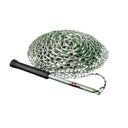
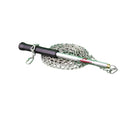
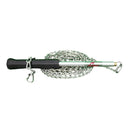
SpeedChain® | Tennis Swing Speed & Power Trainer
$49.95
Ships from Huntsville, TX
In Stock
Ships by weight — rate at checkout
Questions? 936-295-4459
Ordering for a team or facility?
Get volume pricing and help choosing the right tools for your players.
Ask me anything about this product
Sizing · use cases · technique · shipping — instant answers
Ask about SpeedChain® | Tennis Swing Speed & Power Trainer — how to use it, what athletes it fits, sizing, or how it compares to other tools we make. Answers are focused on this product.
Innovating since 2003
Family-owned, Huntsville TX
Talk to the team
Real specialists, not a call center
Made for daily program use
Designed for continuous reps, every day, every season
100+ implements, organized by goal
Arm care, velocity, strength, and recovery
About This Product
Resistance that changes as you swing — lighter links near the hand, heavier links toward the free end, so the chain loads itself as the racquet accelerates.
The SpeedChain® Tennis Swing Speed & Power Trainer is a racquet-style handle attached to a metal chain whose links grow heavier toward the free end, so resistance changes through a single swing. It is built to train racquet speed and swing power for serves, groundstrokes, and volleys by loading the swing with resistance that rises as the racquet accelerates — instead of staying uniform the way isolated strength work does.
- Graduated Chain Links That Match the Swing’s Phases — Light links near the hand let the player accelerate freely; heavier links engage only once the racquet is already moving fast.
- Serves, Groundstrokes, and Volleys — One tool for the serve, forehand, backhand, and volley, in short high-intensity bursts.
- Variable Resistance — The chain loads the swing itself, so the resistance follows the movement instead of opposing it uniformly.
- Three-Dimensional Feedback — Changing tension (feel), the chain’s observable path (visual), and the snap at peak speed (auditory) give simultaneous feedback on swing quality.
- Adjustable Chain Length — Extensions let the chain grow with the player’s skill and strength.
What Is It?
SpeedChain® Tennis Swing Speed & Power Trainer is a racquet-speed and swing-power tool that applies overload swing training through a variable, surface-coupled chain instead of a fixed weighted racquet. It is not a weighted racquet that loads every phase of the swing the same, and it is not isolated strength work that trains a muscle apart from the swing.
How It Works
Three mechanisms behind the graduated chain design
Loading the Swing, Not the Muscle
Resistance peaks as the racquet accelerates, so the swing itself carries the load. The work stays in the movement — serve, forehand, backhand, volley — instead of isolating one muscle apart from the shot.
Feedback You Can Feel, See, and Hear
Changing tension in the hands, the chain’s path through the air, and the snap at peak speed give immediate feedback on swing quality, with no screen or sensor.
Pick the Level
Four models matched to serve speed and playing level, from Strong for developing players to Pro for the fastest servers. Start with the model that matches the player’s current serve speed, and add chain extensions as strength and skill grow.
What the Research Says
Racquet Speed Work, Stated Plainly
Variable resistance is a standard way to load a swing: the chain resists the movement, so the muscles work harder through the range. Players use it in short, high-intensity bursts to train the serve, forehand, backhand, and volley with resistance that follows the swing’s own shape.
One honest limit: no study has tested this tennis trainer itself, and a tool that loads a swing has not been shown to make a player faster, more powerful, or less likely to get hurt. This tool adds resistance to a swing; it does not increase racquet speed on its own, diagnose a problem, or replace strength work, mobility work, or sleep. Judge it by what you can observe: clean swings and a chain that tracks true.
4 Models
Strong, X-Strong, Ultra, Pro — matched to serve speed
Serve to Volley
One tool for serves, groundstrokes, and volleys
Variable Load
Resistance rises with the player’s own acceleration
Video Library
See It In Action
Click a thumbnail to play from the start.
2009
C H A M P I O N

Product Details
How to Use It
Swing in short, high-intensity bursts — only as long as swings stay fast — then stop when speed drops. Train serves, forehands, backhands, and volleys in separate bursts, and count every rep and record it; personal bests become the next target. Match the model to the player’s current serve speed, and add chain extensions as strength and skill grow. Stop immediately if pain, dizziness, or unusual fatigue occurs.
Variant & Selection Guide
| Model | Serve Speed | General Skill Level | SKU |
|---|---|---|---|
| Strong | Under 80 mph | NTRP 2.0 – 4.0; juniors, seniors | TS |
| X-Strong | 80 – 90 mph | NTRP 4.0 – 5.5; tournament players | TXS |
| Ultra | 90 – 100 mph | NTRP 4.0 – 5.5; tournament players needing higher load | TU |
| Pro | Over 100 mph | NTRP 5.5 – 7.0; NCAA, WTA, ATP | TP |
Do not buy heavier to “grow into” it — match the model to the player’s current serve speed and maturity.
Who This Is For
- Commonly used for tennis players developing racquet speed and swing power for serves, groundstrokes, and volleys.
- Commonly used for coaches who already value variable-resistance swing training and want an option that loads the swing where it is strongest.
- Commonly used for stronger, more mature players (X-Strong, Ultra, Pro) who have a strength base and are ready for explosive overload work.
We are not coaches. We do not provide coaching.
What This Implement Does NOT Do
- It does not increase racquet speed on its own — any improvement depends on the overall hitting and strength program and the player’s consistency.
- It is not a racquet you take into matches or use to hit live balls; it is a training device for swing-speed and swing-quality work.
- It is not a conditioning tool for endurance or stamina; it is built for short, hard, focused bouts — not long high-rep circuits.
- It is not a diagnostic or medical device; it does not prevent injury or protect any specific body part and does not replace medical assessment.
Technical Specs
| Product Name | SpeedChain® Tennis Swing Speed & Power Trainer |
|---|---|
| Product Type | Variable-resistance racquet-speed and swing-power trainer |
| Core Components | Racquet-style handle, Universal SpeedChain® segments, and chain carrier |
| Resistance Profile | Lighter at early acceleration, concentrated load as the racquet moves fast, reduced as the swing decelerates |
| Available Models | Strong (TS), X-Strong (TXS), Ultra (TU), Pro (TP) |
| Use Environments | Court and open training spaces with sufficient clearance and stable footing |
| Instructions | No instructions are included |
Safety and Youth Guardrails
- Supervision: Younger or less-experienced players should use lighter models under close adult supervision with conservative volumes.
- Stop if pain occurs: Stop immediately if pain, dizziness, or unusual fatigue occurs.
- Not a rehabilitation device: Players dealing with pain or returning from injury should use it only as directed by a qualified professional, and it is not a substitute for medical care.
- Not for match play: It is a training device for swing-speed and swing-quality work, not a racquet for matches or hitting live balls.
Frequently Asked Questions
What does the Tennis Chain actually do?
It trains racquet speed and swing power together: lighter links allow high acceleration, heavier links engage as the racquet moves fast, so peak load lands where the swing is strongest.
Is it just a weighted racquet?
No; a weighted racquet loads every phase the same. The Tennis Chain peaks resistance as the racquet accelerates and eases at the finish.
Which shots can I train with it?
Serves, forehands, backhands, and volleys — short, high-intensity bursts for each, with the chain following the swing’s own shape.
How do I pick a model?
Match the model to the player’s current serve speed: Strong under 80 mph, X-Strong 80–90, Ultra 90–100, Pro over 100. Start with the model that matches current serve speed, not the one to grow into.
Do I hit real tennis balls with it?
No; it’s for swing-pattern and power work in dry-swing or non-contact drills, not hitting balls directly.
Does it replace weight-room work?
No; it adds a racquet-specific, variable-resistance option that complements the weight room by matching the swing’s shape, but doesn’t replace general strength and conditioning.
Questions about the Tennis Chain? Call or Text Our Team at (936) 295-4459
Customer Reviews
What Customers Are Saying
Loading reviews…
No reviews yet for this product.
Be the first to review