


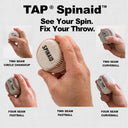
TAP® SPINAID™ 4‑Seam & 2‑Seam – Visual Release Feedback Trainer
$19.95
Ships from Huntsville, TX
In Stock
60-day limited warranty
Questions? 936-295-4459
Ordering for a team or facility?
Get volume pricing and help choosing the right tools for your players.
Ask me anything about this product
Sizing · use cases · technique · shipping — instant answers
Ask about TAP® SPINAID™ 4‑Seam & 2‑Seam – Visual Release Feedback Trainer — how to use it, what athletes it fits, sizing, or how it compares to other tools we make. Answers are focused on this product.
Innovating since 2003
Family-owned, Huntsville TX
Talk to the team
Real specialists, not a call center
Made for daily program use
Designed for continuous reps, every day, every season
100+ implements, organized by goal
Arm care, velocity, strength, and recovery
About This Product
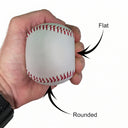
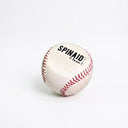
A genuine-leather baseball with flattened faces that makes off-axis releases visible on every throw — so pitchers and coaches can see spin axis and wobble instead of guessing at them.
The TAP® SPINAID™ is a genuine-leather spin-feedback baseball. It uses flattened faces and either 4-seam or 2-seam orientation to turn spin axis, wobble, and efficiency into obvious visual cues instead of invisible variables that normally require a radar unit or high-speed camera. It works in regular catch play, bullpens, and home sessions as a low-volume skill tool that gives release work visible feedback without adding unnecessary load.
- Immediate visual wobble feedback — The flattened sides make spin axis, wobble, and precession obvious from across the yard, so coaches and pitchers can see whether the ball is tracking clean or drifting off axis.
- Spin and axis awareness — It shows how grip, finger pressure, arm slot, and release direction show up in spin and axis stability, giving coaches and pitchers something visible to work from without micromanaging mechanics.
- Works across pitch types — It can be thrown with 4-seam, 2-seam, curveball, slider, and changeup grips to check whether the spin behavior matches the pitch’s intent.
- Self-guided learning tool — Athletes can change grip, finger pressure, or release intent and see the result instantly, encouraging exploration and self-organization.
What Is It?
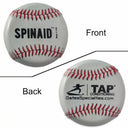
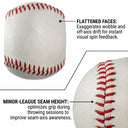
The SPINAID™ is a regulation-sized, regulation-weight baseball in genuine leather, with minor-league-style seams and flattened faces. The hand feel is familiar; the spin pattern is easy to read. Two versions mirror real fastball grips: the 4-Seam for standard four-seam fastballs and many breaking balls, and the 2-Seam for sinkers, movement-based fastballs, and 2-seam changeups.
How It Works
Three things the shape does to the training, in plain language.
Flattened faces
Wobble you can see
Flattened faces exaggerate wobble and precession, so even a subtle off-axis release shows up as obvious oscillation in flight, while clean releases produce stable, predictable rotation.
Constraint-led shape
The ball is the constraint
Coaches who use a constraint-led approach treat the ball’s shape as the constraint: the unique shape and clear visual feedback change the task just enough that the athlete adjusts from what they see. Instead of chasing a verbal cue, the pitcher throws, sees the outcome, adjusts one variable, and throws again.
Pitch design
Align off your own axis
When a pitcher can see their natural spin axis, they can align fastballs, breaking balls, and changeups off that axis more intentionally, instead of guessing at what the ball is doing at release.
Research Context
What the Research Says
The SPINAID™ gives pitchers a visible practice result: a clearer coaching conversation about what the ball did. That is the tool’s job — it makes a task easier to see and repeat, and it does not turn what you see into a verdict about the arm.
One honest limit: no study has tested the SPINAID™ itself, so nothing here claims a velocity, injury, mobility, or health outcome for this product. The constraint-led framing above is practitioner reasoning, not peer-reviewed proof, and what you see in flight is a coaching observation — not a diagnosis of a mechanical fault, not a readiness verdict, and not a predictor of injury. Programs that pair the SPINAID™ with a tracker still need the tracker for spin-efficiency percentages and axis angles; this ball shows spin, it does not measure it.
For a complete breakdown of the physics behind spin axis, wobble, and how to use the SPINAID™ across every major pitch type: TAP® SPINAID™: The Visual Feedback Tool That Makes Release Errors Visible →
2 versions
4-Seam & 2-Seam orientations mirroring real fastball grips
Regulation
Size and weight of a baseball, in genuine leather
Low-volume
Skill work in catch play, bullpens, and home sessions
Video Library
See It In Action
Click a thumbnail to play from the start — open the Chapter Guide and click any timestamp to jump to that moment.
2022
TAP Conditioning® SPINAID™ | Leather Baseball Spin Trainer | Improve Fastball, Curveball, &Change-up

Chapter Guide — 7 Timestamps
| Introduction to SPINAID™: Overview of the tool and welcome. | |
| Development Background & Hockey Puck Concept: Originating from a 2017 spring training discussion with a minor league pitching coordinator using hockey pucks to improve spin rate and spin efficiency. | |
| Designing with Real Leather & Laces: Transitioning the concept to authentic leather and stitching so it mimics the hand feel of a real baseball. | |
| Low-Seam Profile Rationale: Why low-seam stitching was selected (matching pro/minor league specs to build finger sensitivity across collegiate and high school balls). | |
| Visual Feedback & Spin Mechanics: How the puck-style design reveals spin efficiency: clean rotation indicates efficient spin, while wobble highlights inefficient release. | |
| Pitch Applications & Self-Discovery: Using the tool for standard catch play across four-seam, two-seam, changeups, and breaking balls. | |
| Care Guidelines & Pricing: Throwing into nets or playing catch (avoiding hard walls or surfaces) and price point details. |
2023
New Product! TAP® Spinaid 2-Seam!

Product Details
How to Use It
Start with the 4-Seam SPINAID™ for fastball work (youth and most high-school pitchers). Throw at submaximal effort into a net or to a partner. Watch how the flat faces spin: look for stable, repeatable rotation when the release is clean, and visible wobble or face flicker when finger pressure, wrist position, or axis drift.
Make one small change at a time (grip depth, finger pressure, seam orientation) and throw again, using the ball’s flight as the primary feedback. Alternate throws — SPINAID™, regular baseball, SPINAID™, regular baseball — to carry what you notice into game-ball work.
Where it fits in the year:
- Off-season: Use in low-intent catch, dry-work into a net, or constraint-based bullpens to explore axis, wobble, and grip variations without heavy arm load.
- In-season: Use sparingly in catch play or early bullpen throws to check that spin axis and wobble look like they should, then switch back to regular baseballs.
- Post-season: Use for low-stress, skill-focused throwing when volume and intensity are down but you want to keep release feel sharp.
Throws with SPINAID™ count toward total throwing for the day — do not stack extra, high-intent volume just because the ball is “a trainer.”
Variant & Selection Guide
| Variant | SKU | Price |
|---|---|---|
| 4-Seam | SPA | $19.95 |
| 2-Seam | SPA-2 | $19.95 |
| Package (1 - 2 Seam and 1 - 4 Seam) | SPA-B | $36.95 |
| Pack of 3 (4-Seam) 5% OFF | SPA-C | $59.85 |
| Pack of 3 (2-Seam) 5% OFF | SPA-D | $59.85 |
Start with the 4-Seam for fastball work. Most athletes eventually discover a preference by throwing both and choosing the one that gives the clearest flight and strongest feel for their primary pitches.
Who This Is For
- Pitchers at any level who want immediate visual feedback on spin axis, wobble, and release consistency without needing a radar unit or high-speed camera.
- Coaches using constraint-led methods who want a self-guided learning tool that gives athletes clear feedback without constant verbal cueing.
- High school and college pitchers building or refining pitch arsenals who need to check that spin behavior matches pitch intent across fastballs, breaking balls, and changeups.
- Pitching programs that pair SPINAID™ with Rapsodo or TrackMan data to connect visual on-field feedback with spin-efficiency percentages and axis angles from the tracker.
- Youth athletes using the tool only under coach supervision, with low volume, low intensity, and clear guidance on appropriate pitch types.
We are not coaches. We do not provide coaching.
What This Implement Does NOT Do
- Not a velocity tool: nothing here claims throwing-velocity gains. SPINAID™ is a feedback tool, not a velocity device.
- Not injury prevention: no product can promise fewer injuries, and this one doesn’t.
- Not joint protection: it makes spin visible; it does not make any joint more durable.
- Not a mobility screen or diagnosis: what you see in flight is a coaching observation. It does not identify a restriction, diagnose a mechanical fault, establish readiness, or substitute for evaluation when something hurts.
- Not a measurement device: the ball shows spin; it does not report spin-efficiency percentages or axis angles. That is the tracker’s job.
- Not rehabilitation: not for diagnosing, treating, or working around pain — arm pain means seeing a qualified medical professional.
- Not coaching: the tool supplies the feedback; the program, workload, and coaching decide the outcome.
Technical Specs
| Type | Genuine-leather spin-feedback baseball |
| Size and weight | Regulation baseball dimensions and weight |
| Seam specifications | Minor-league-style seams with flattened faces for visual spin feedback |
| Available versions | 4-Seam (standard fastball orientation) and 2-Seam (narrow-seam / sinker orientation) |
| Primary applications | Fastball spin-axis feedback, breaking-ball axis confirmation, changeup release consistency, seeing how arm slot shows up in spin |
| Intended use | Low-volume skill work in catch play, bullpens, net sessions, and dry-work environments — not for batting practice or hitting drills |
Safety and Youth Guardrails
- Low volume, low intensity, high supervision for youth.
- SPINAID™ is a throwing tool, not a toy.
- Throws with SPINAID™ count toward total throwing for the day — do not stack extra, high-intent volume just because the ball is “a trainer.”
- Do not hit it with a bat or throw it into hard walls or abrasive surfaces. Use with a net, screen, or catching partner.
- If anything in the arm, elbow, or shoulder feels sharp or unusual, stop and revert to medical or rehab guidance before resuming.
Frequently Asked Questions
What is the practical difference between the 4-Seam and 2-Seam SPINAID™?
The 4-Seam version matches a traditional four-seam fastball grip and is ideal for four-seam fastballs, many curveballs, and some sliders. The 2-Seam version matches narrow-seam grips for sinkers, two-seam fastballs, 2-seam changeups, and breaking balls thrown along the narrow seams. Most athletes eventually discover a preference by throwing both and choosing the one that gives the clearest flight and strongest feel for their primary pitches.
Can SPINAID™ improve velocity or prevent injury?
SPINAID™ is a feedback tool, not a velocity or medical device. Its most defensible role is helping pitchers see and refine spin axis, wobble, and release consistency so they can work on more efficient patterns over time within a sound overall arm-care and throwing plan. It does not replace workload management, strength training, or medical care.
How often should we use SPINAID™ in practice?
Most coaches treat it as a short, focused segment inside regular catch play or bullpens — just enough reps to get clear feedback and make one or two adjustments, then switch back to regulation baseballs. In-season, that might mean a handful of throws a few times per week. Off-season work can be slightly more exploratory at lower intensity.
Is wobble always bad when using SPINAID™?
No. Some pitches are designed to be intentionally inefficient — for example, many sliders and certain changeups. The key is whether the wobble is stable and repeatable or random and drifting. Consistent intentional wobble can be part of a good pitch; random wobble usually points to inconsistent release.
How durable is SPINAID™ for team or facility use?
SPINAID™ uses a genuine-leather cover and is made for repeated throws when used as intended — into nets or to partners in normal training environments. Avoid hitting it with bats or throwing into hard or abrasive surfaces to preserve the feedback quality and leather cover.
Questions before you buy? Call or Text Our Team at (936) 295-4459
Customer Reviews
What Customers Are Saying
Loading reviews…
No reviews yet for this product.
Be the first to review