🎧 PREFER TO LISTEN?
Experience this blog on the go, during your commute, or while training. Perfect for coaches, athletes, and parents who are always moving.
Table of Contents
-
Where We've Been: Your Ramp-Up Journey So Far
Review of foundation concepts and practical implementation covered in previous installments
-
What This Blog Covers
Overview of equipment selection and assessment framework topics
-
Functional Training Equipment That Changes Everything
Introduction to game-changing tools and timing considerations
-
The Essential Functional Training Tool Categories
Comprehensive breakdown of resistance bands, shoulder tools, rotational equipment, stability tools, and assessment devices
-
Critical Safety Protocols
Universal requirements and age-specific protocols for all equipment use
-
Baseball Athlete Self-Assessment: Your Roadmap Forward
Five-area assessment framework including daily monitoring, movement quality, performance tracking, tissue evaluation, and stress/recovery
-
Creating Your Personal Assessment Protocol
Week-by-week implementation guide and technology integration recommendations
-
The Bottom Line: Assessment Drives Everything
Final insights on combining self-monitoring with professional guidance
Where We've Been: Your Ramp-Up Journey So Far
If you've been following this series, you've built a comprehensive understanding of what it takes to prepare your arm safely and effectively for a competitive baseball season. Let's recap what we've covered:
Foundation Concepts:
- The Ramp-Up Philosophy: Why rushing into throwing is the fastest path to injury and why progressive preparation is non-negotiable
- Tissue Adaptation Science: How your muscles, tendons, and ligaments actually adapt to throwing stress and why this process can't be rushed
- Movement Literacy: The fundamental movement patterns that must be mastered before adding intensity or volume
Practical Implementation:
- Foundational Bodyweight Workouts: Fundamental exercises that build the strength, stability, and mobility required for throwing
- Age-Specific Training Considerations: Why a 13-year-old and an 18-year-old may need completely different approaches to preparation
You've done the work to understand the "why" and the "how" of intelligent preparation. But here's where theory meets reality: What tools do you actually need, and how do you know if your preparation is working?
What This Blog Covers
In this installment, we're going deeper into two critical topics that directly impact your success moving into the season:
Part 1: Equipment Selection Reimagined
We touched on equipment in previous blogs, but now we're providing a comprehensive, age-specific, constraint specific, and movement specific guide that helps you invest in the right tools at the right time.
Part 2: The Assessment Framework
Here's the truth most training programs ignore: you can't improve what you don't measure. We'll give you a systematic self-assessment framework that tells you where you are, identifies red flags before they may become serious, and ensures you're progressing safely into the demands of the competitive season.
This isn't about buying more stuff or checking more boxes. This is about making intelligent, informed decisions that protect your health and accelerate your development. Let's get into it.
Delivering on Our Promise: The Functional Training Equipment That Changes Everything
In our last blog, we promised to dive into the functional training equipment that bridges the gap between bodyweight work and full weight room training. Here's where we deliver on that promise—but with an important addition you weren't expecting.
We're covering the tools we promised:
- Resistance bands that create throwing-specific resistance patterns your body can't get from push-ups
- Medicine balls that develop rotational power in sport-specific ways
- Suspension trainers that challenge your stability in ways that closely transfer to the mound
- Shoulder-specific tools that target the rotator cuff and posterior shoulder in ways that simply cannot be replicated in any weight room
But here's what we've learned: these tools don't work the same for everyone, and timing matters more than the tools themselves.
A resistance band program that transforms an 18-year-old college pitcher can halt the progress of a 14-year-old if introduced too early. A medicine ball routine that's perfect for someone with great hip mobility can reinforce compensation patterns in someone with restrictions.
So yes, we're going to show you these game-changing tools—but we're also going to show you when to use them, how to match them to your specific constraints, and how to introduce them safely based on your individual readiness.
These tools don't replace your bodyweight foundation—they amplify it. They allow you to progressively overload movements, target your posterior chain weaknesses, develop shoulder resilience, and create sport-specific strength patterns that bodyweight training alone simply cannot provide.
The best part? Most of these tools cost less than a new glove and can fit in your equipment bag. You can use them at the field, in your garage, or even in your backyard. This is where your training really starts to accelerate—if you do it right.
The Essential Functional Training Tool Categories
Let's understand the categories of functional training equipment and what they actually do for your development:
Category 1: Resistance Bands and Tubing Systems
What They Do: Create variable resistance that matches the strength curve of throwing-specific movements, allowing you to strengthen patterns in ways that free weights and bodyweight exercises cannot replicate.
Primary Product: Oates Specialties Tubing
- Why It's Essential: Specifically designed for baseball arm care and throwing pattern strengthening
- What Makes It Different: Progressive resistance levels (Heavy Green, Extra Heavy Blue, Special Heavy Black, Super Heavy Silver, and Ultra Heavy X-Heavy Black) that match your strength development
- Key Applications: Daily arm care routines, scapular strengthening, deceleration training, movement pattern reinforcement
- Versatility: Can be used for lower body, rotational work, and total body training
- Portability: Fits in your equipment bag, attaches to fence easily
Age Considerations:
- Ages 8-12: Green resistance only, focus on movement quality
- Ages 13-15: Green to Black resistance, systematic progression
- Ages 16+: Full resistance range based on strength levels
Constraint Matching:
- Previous injury: Extended use of lighter resistance before progression
- Limited shoulder mobility: Focus on specific mobility-enhancing exercises
- Scapular weakness: Emphasized scapular stabilization protocols
- General arm care: Daily use at appropriate resistance
Category 2: Shoulder-Specific Strengthening and Pattern Development Tools
What They Do: Target the rotator cuff, posterior shoulder, and throwing-specific movement patterns with specialized tools that cannot be replicated in traditional weight room exercises or standard throwing programs.
Primary Products:
Shoulder Tube (Rotator Cuff and Posterior Shoulder Development)

- Why It's Essential: Directly addresses the small stabilizer muscles that control the shoulder in the throwing motion and mitigates injury risk
- Applications: Rotator cuff strengthening, posterior shoulder development, and scapular stabilization
- What Makes It Different: Resistance curve matches natural shoulder strength curve, unlike free weights
-
All Ages Welcome: Can be used by athletes of all ages with appropriate volume/intensity adjustments
- Ages 8-12: Very light resistance, low volume (5-10 seconds, 1-2 movements), movement quality focus
- Ages 13-15: Light to moderate resistance, moderate volume (10-15 seconds, 3-4 movements)
- Ages 16+: Full resistance range based on strength levels (10-20 seconds, 5-6 movements)
Constraint Matching:
- Critical for scapular strengthening
- Important for all overhead athletes
- Can be incorporated into daily arm care routines at any age
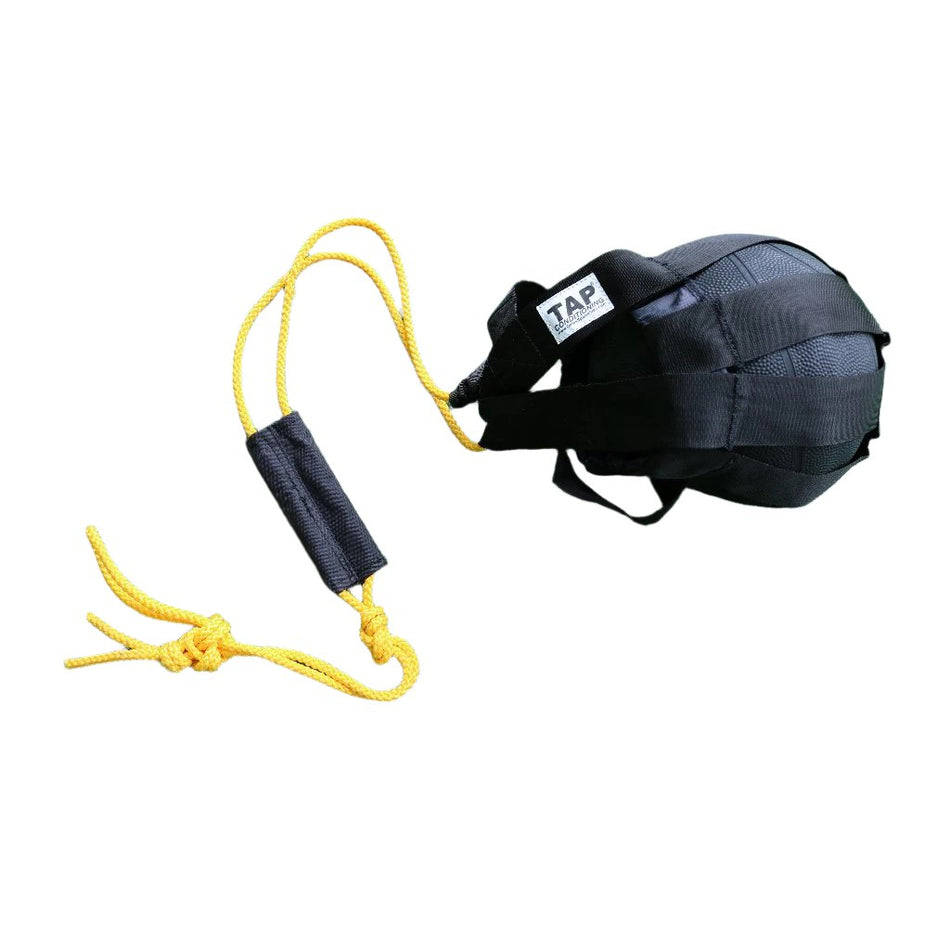
TAP® Baseball Training Sock (Shoulder-Specific Movement Pattern and Deceleration Training)

- What It Does: Allows full-intensity throwing motion in confined spaces without a partner, reinforcing proper movement patterns while building arm strength and emphasizing deceleration
-
How It Works:
- Insert a baseball or weighted ball into the sock
- Secure the adjustable strap around your wrist with a snug fit
- Perform your complete throwing motion—the ball stays in the sock upon "release"
- Why It's Revolutionary: Developed by Ron Wolforth and Randy Sullivan, it uses constraint-led learning to improve throwing efficiency without the mechanical issues of holding a weighted ball past release
-
Key Shoulder-Specific Benefits:
- Deceleration emphasis: Forces proper posterior shoulder engagement at ball release
- Pattern reinforcement: Maintains throwing mechanics while emphasizing shoulder control
- Full-intensity training: Allows max effort throws that strengthen shoulder stabilizers
-
Additional Benefits:
- Train anywhere: Full-motion throws indoors or outdoors without partner or large space
- Boost performance: Improve velocity, accuracy, and control by refining movement patterns
- Applications: Shoulder-specific pattern work, deceleration training, pre-throwing activation, travel training, confined space work, full-intensity throwing without catcher
- Age Consideration: All ages once basic mechanics established (younger athletes can use with supervision at lower intensities)
-
Constraint Matching:
- Excellent for throwing pattern reinforcement
- Essential for athletes with deceleration issues or posterior shoulder weakness
- Ideal for off-season, in-season, and in between when space/partner availability is limited
- Versatility: Also benefits tennis players (serve power/shoulder control), volleyball players (spike/serve velocity), and any overhead athlete
Category 3: Rotational Power Development Tools
What They Do: Develop optimal hip-shoulder separation, rotational explosiveness, and the ability to transfer force from the ground through the kinetic chain.
Primary Products:
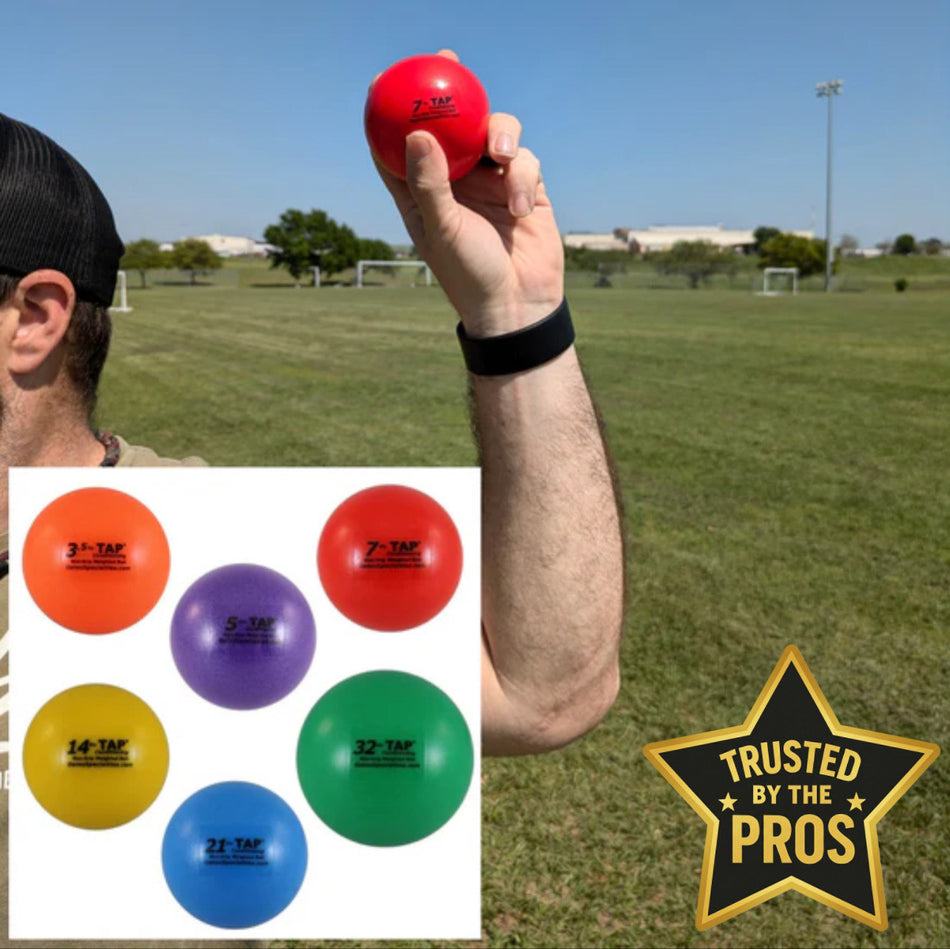
Medicine Balls (General Rotational Development)
- Applications: Rotational throws, explosive power development, core strengthening
- Weight Progression: 4-6 lbs for youth, 6-10 lbs for high school, 10-14 lbs for advanced athletes
- Key Exercises: Side throws, overhead throws, rotational slams
- Age Consideration: All ages with proper technique instruction
Donley Hip Spin (Specific Hip Mobility and Rotational Pattern Development)

- Why It's Unique: Specifically addresses hip mobility limitations that restrict rotational power
- What Makes It Essential: Passive to active hip rotation training that closely transfers to pitching mechanics
- Primary Constraint Addressed: Limited hip internal rotation, hip mobility deficits
- Critical Application: If you have limited hip mobility, this tool is non-negotiable
- Age Consideration: Ages 13+ with instruction
Khaos Water Training Tools (Advanced Rotational Power AND Core Stability)
- What They Do: Unstable water resistance creates dynamic challenges that simultaneously develop rotational explosiveness and core stability control
- Why They're Unique: Water instability forces constant stabilization while generating power—training both production AND control
-
Dual Applications:
- Rotational power development through explosive movements
- Core stability training through unpredictable resistance
- Combined training effect impossible to achieve with fixed weights
- Critical Application: Bridges the gap between pure stability training and pure power training
- Age Consideration: Ages 13+ with solid movement foundations only
- Constraint Requirement: Must have established rotational patterns AND core stability before introduction
Category 4: Stability and Movement Quality Tools
What They Do: Challenge your ability to maintain quality movement under instability, developing the neuromuscular control and foundational movement patterns essential for consistent mechanics.
Primary Products:

- What They Do: Create instability challenges that develop stabilizer strength and core control
- Applications: Upper body stability, core strength, single-leg balance work, movement quality
- Age Consideration: Ages 12+ with supervision, progressive difficulty
- Constraint Matching: Excellent for developing stability in athletes with coordination issues
Movement Mats and Balance Tools
- What They Do: Foundation for ground-based movement training and proprioceptive development
- Applications: Movement literacy, balance training
- Age Consideration: All ages
- Essential For: Foundation building, ongoing mobility work, and building coordination
Category 5: Assessment and Monitoring Tools
What They Do: Provide objective feedback that guides training decisions and identifies problems before they become injuries.
Primary Products:
Pocket Radar (Velocity and Performance Tracking)
- Why It's Essential: Objective measurement prevents guessing about intensity and tracks progress
- Applications: Baseline establishment, progression monitoring, intensity regulation, fatigue detection
- Age Consideration: Ages 13+ for meaningful use, earlier for baseline establishment
- Critical Use: Detects velocity drops that indicate fatigue or injury risk
Smartphone/Video Analysis Tools
- What They Do: Allow movement pattern analysis and comparison over time
- Applications: Mechanics analysis, constraint identification, progress tracking
- Age Consideration: All ages
- Essential Skill: Learning to analyze your own movement patterns
Movement Assessment Tools
- What They Do: Systematic evaluation of mobility, stability, and movement quality
- Applications: Baseline assessment, constraint identification, progress tracking
- Age Consideration: All ages with appropriate guidance
- Professional Integration: Results inform when professional assessment is needed
Want to find out which equipment to get first? Give us a call at 936-295-4459 to talk to one of our exercise equipment specialists to find out what fits your needs and your budget!
Critical Safety Protocols
Universal Requirements for ALL Equipment:
- Proper education before introduction
- Appropriate supervision during initial use
- Progressive implementation following established timelines
- Immediate cessation if pain or problems arise
- Regular assessment and program modification
Age-Specific Protocols:
Youth (8-12): Constant supervision, play-based introduction only, safety equipment mandatory, fun over performance
Adolescent (13-15): Educational component before each new tool, conservative progression, enhanced monitoring during growth spurts
High School (16-18): Comprehensive education on proper use, self-monitoring skill development, progressive challenge with safety focus
College (18-22): Scientific understanding of tool applications, data-driven decisions, career perspective on equipment choices
What Now? The Critical Next Step in Your Ramp-Up
We've covered a lot of ground in this series:
- ✓ The need for a proper ramp-up period
- ✓ Tissue adaptation principles
- ✓ Movement literacy development
- ✓ Foundational bodyweight workouts
- ✓ Age-specific training considerations
- ✓ Equipment selection strategies
But here's the question: How do you know if you're actually ready to move forward? How effective were you during your ramp-up? What are your specific limitations right now?
This is where most athletes hit a roadblock. They follow a program, check the boxes, and assume they're ready. But without honest self-assessment, you're flying blind.
The next step isn't more training—it's understanding exactly where you are right now. Only then can you make intelligent decisions about how to progress safely into the season and beyond.
Baseball Athlete Self-Assessment: Your Roadmap Forward
Ron Wolforth's foundational principle drives this entire process: "Knowing EXACTLY where you are now is absolutely invaluable in designing the right path forward."
Subjective feelings of readiness poorly correlate with objective measures of tissue capacity and movement quality. This disconnect creates the early season injury epidemic as athletes who "feel ready" discover their tissues weren't prepared for competitive demands.
The Five-Area Assessment Framework
1. Daily Readiness Monitoring
Purpose: Track day-to-day fluctuations in recovery and preparation
Time: 30 seconds every morning
Method: Rate each area 1-10
Sleep Quality:
- Hours of sleep: ___ (Target: 8+ for adolescents, 7+ for adults)
- Sleep interruptions: ___ (1=frequent waking, 10=uninterrupted)
- Energy upon waking: ___ (1=exhausted, 10=fully refreshed)
Physical Readiness:
- Shoulder comfort: ___ (1=significant stiffness/soreness, 10=no discomfort)
- Elbow comfort: ___ (1=significant stiffness/soreness, 10=no discomfort)
- Overall energy level: ___ (1=lethargic, 10=highly energetic)
- Motivation for training: ___ (1=reluctant, 10=eager)
Action Protocol:
- Any score below 6: Modify training intensity
- Any score below 4: Consider rest day
- Any pain scores: Stop throwing immediately
2. Weekly Movement Quality Screen
Purpose: Identify movement pattern dysfunctions before they create injury risk
Time: 15 minutes weekly
Equipment: Smartphone for video recording
Single-Leg Balance Test:
- Stand on one leg, eyes closed
- Target: 15+ seconds each leg
- Red flag: Less than 10 seconds indicates poor proprioception and kinetic chain dysfunction
Overhead Squat Assessment:
- Feet shoulder-width apart, arms overhead
- Squat to comfortable depth, hold 3 seconds
- Red flags: Knees cave inward, excessive forward lean, arms drop forward
- Video from front and side angles
Shoulder Mobility Check:
- Reach one arm over shoulder, other arm behind back
- Attempt to touch fingertips behind spine
- Test both sides
- Red flag: Cannot bring fingertips within 4 inches of each other
3. Performance Tracking Metrics
Purpose: Objective measurement of throwing capacity and progression
Frequency: Weekly during preparation, bi-weekly during season
Equipment: Pocket radar, target, measuring tape
Baseline Velocity Testing:
- 10 throws at 90% effort
- Record: maximum velocity, average velocity, standard deviation
- Tracking targets: 1-2 mph monthly increases during preparation
- Red flags: Velocity decrease >5% from recent baseline
Command Assessment:
- 20 throws at moderate to intense effort to specific target
- Record strikes vs. balls, location accuracy
- Red flags: Command deterioration despite consistent movement patterns
4. Tissue Quality Evaluation
Purpose: Early identification of overuse or preparation inadequacy
Frequency: Daily during high-intensity phases, weekly during base phases
Muscle Soreness Scale (1-10):
- Shoulder (anterior, posterior, lateral)
- Elbow (medial, lateral)
- Forearm (flexors, extensors)
- Core and legs
- Action thresholds: Soreness >6 requires modification, >8 requires rest
Range of Motion Checks:
- Shoulder internal/external rotation (lying position)
- Elbow extension/flexion
- Compare to baseline measurements
- Red flags: >10% loss of motion from baseline
5. Stress and Recovery Assessment
Purpose: Monitor non-physical factors affecting injury risk
Frequency: Weekly during preparation phases
Life Stress Evaluation (1-10):
- Academic/work pressure: ___
- Family/relationship stress: ___
- Financial concerns: ___
- Overall life satisfaction: ___
Life stress increases injury risk through altered movement patterns and delayed recovery.
Recovery Quality Indicators:
- Appetite consistency
- Mood stability
- Concentration during training
- Enthusiasm for baseball activities
What You Cannot Self-Evaluate: Know Your Limits
Complex Movement Dysfunction: Self-assessment cannot identify subtle compensatory patterns that require trained observation and specialized testing. Professional movement screens (FMS, SFMA) provide comprehensive evaluation beyond basic checks.
Tissue Quality Assessment: Manual therapy techniques for evaluating muscle tension, fascial restrictions, and joint mobility require professional expertise. Self-assessment provides warning signs but cannot replace hands-on evaluation.
Biomechanical Analysis: High-speed video analysis with force plate data and 3D motion capture provides information impossible to obtain through self-assessment.
Red Flags: When to Take Immediate Action
Stop All Throwing Activities If:
- Any pain during throwing motion
- Sharp or shooting pain in elbow/shoulder
- Numbness or tingling in arm/hand
- Significant command loss with normal effort
- Velocity drop >10% in single session
Modify Training If:
- Daily readiness scores consistently <6
- Movement quality deterioration
- Fatigue extending >48 hours
- Sleep disruption >3 consecutive nights
- Motivation scores <5 for multiple days
Seek Professional Evaluation If:
- Red flags persist >48 hours
- Multiple assessment areas show decline
- Uncertainty about training modifications
- Return from injury or extended layoff
- History of previous injury
Creating Your Personal Assessment Protocol
Week 1: Baseline Establishment
- Complete all assessments to establish starting points
- Document normal ranges for comparison
- Practice assessment techniques for consistency
Weeks 2-4: Pattern Recognition
- Focus on daily consistency in tracking
- Identify personal patterns in readiness fluctuation
- Calibrate assessment sensitivity
Ongoing: Refined Monitoring
- Adjust assessment frequency based on training phase
- Focus on metrics most relevant to your constraints
- Integrate with professional evaluations
Technology Integration
Smartphone Applications:
- Video recording for movement analysis
- Timer for balance testing
- Simple tracking apps for daily scores
- Photo documentation of measurement positions
Recommended Tools:
- Pocket radar for velocity tracking
- Measuring tape for range of motion
- Simple scale for pain/soreness rating
- Calendar app for tracking patterns
The Bottom Line: Assessment Drives Everything
Self-assessment provides valuable monitoring tools but cannot replace comprehensive professional evaluation. The goal is early identification of potential problems and tracking of preparation progress, not diagnosis or treatment of complex issues.
Wolforth's constraint-based philosophy emphasizes that assessment drives all effective programming decisions. However, the quality of your assessment determines the quality of your preparation decisions.
You now have the framework for equipment selection AND the self-assessment tools to ensure you're using that equipment safely and effectively. Your long-term health and performance depend on combining systematic self-monitoring with appropriate professional guidance.
Be honest. Be consistent. Recognize your limitations. And always prioritize long-term health over short-term gains.
The athletes who succeed aren't always the most talented—they're the ones who know themselves well enough to train smart, not just hard.