The Layer Everything Else Requires
Executive Summary
Strength is the most important physical foundation a baseball hitter can build — and the research on what actually predicts bat swing velocity points consistently toward lean body mass, back strength, grip strength, and lower-body power as the qualities that separate hitters who can generate elite force from those who cannot. Building that foundation is not just about getting in the weight room. It is about understanding which movements matter most for hitters, how to build strength progressively regardless of what equipment is available, and when the foundation is solid enough to support the layers that convert strength into elite swing speed. This article covers all of that — from the principles that govern effective strength development to the specific movement categories that matter most for hitters to a practical framework that works in a garage, a school weight room, or a fully equipped training facility. Strength raises the ceiling. Everything else in this series is about how high a hitter can actually perform within it.
🎧 Prefer to listen? Audio version of this article:
Strength Is the Starting Point
Every conversation about bat speed eventually comes back to the same place: force production. How much force can a hitter generate? How fast can they express it? How efficiently does it travel from the ground through the legs, trunk, and arms to the bat?
Muscle produces force. A larger, stronger muscle can produce more of it — and a nervous system trained to recruit more motor units simultaneously can express more of that force in a single movement. Strength training develops both: it increases the structural capacity of the muscle and improves the nervous system's ability to use it. That is what raises the ceiling.
The answer to all three questions depends first on how strong the athlete is. Strength sets the ceiling — the maximum force available to be organized and expressed. Mobility determines whether that force can move through the right positions. Rotational power converts it into speed. Loaded swing work sharpens it into a pattern. But none of those later layers produce anything without force to work with in the first place.
That is why this article comes after initial measurement but before every other training article in this series. Not because strength alone produces elite bat speed — the research is clear that it does not do that by itself — but because nothing else does either without it. The weight room is not the whole answer. It is the necessary starting point.
What the Research Actually Shows
The research on physical qualities and bat speed is consistent across multiple independent studies and different populations. Certain qualities show up as predictors of faster swing velocity again and again.
In a study of 78 collegiate players, lean body mass and back muscle strength were the two strongest independent predictors of bat swing velocity in statistical modeling. Grip strength and rotational medicine ball throw velocity also correlated significantly. Every body composition measure — height, body mass, lean mass — showed at least a weak positive relationship with bat speed.
A separate study of 22 Division I players tested a full battery of strength and power measures. Non-dominant grip strength, body mass, peak power, lean body mass, a one-arm dumbbell row, and the parallel squat all showed moderate, significant relationships with bat velocity. The researchers were careful to note that correlation is not causation — a stronger player tends to swing faster, but that does not mean strength training alone produces the velocity. The relationship is real and consistent. The mechanism requires additional layers.
Two things stand out across this body of research. First, the lower body and the trunk show up more consistently than the upper body. Bench press has a much weaker relationship with bat speed than the squat, the row, or back strength. Second, body composition — being bigger and leaner — carries independent weight. Both conclusions point in the same direction: the weight room matters, in specific and identifiable ways, and a hitter who is genuinely strong through the right movement patterns is starting from a higher floor than one who is not.
How to Build Strength for Baseball Hitters: The Governing Principles
The NSCA — the National Strength and Conditioning Association — has established a set of foundational principles that govern effective strength development across populations, training ages, and equipment levels. These principles do not change based on the facility. They apply whether a hitter is working in a garage or a Division I weight room.
Progressive overload is the primary driver of strength adaptation. The body gets stronger when it is asked to do more than it currently can — more load, more volume, more complexity — on a gradual, systematic basis. Without progressive overload, the body has no reason to adapt.
Specificity means the body adapts specifically to the demands placed on it. A hitter who only trains stable, bilateral movements will get better at stable, bilateral movements. For baseball, that specificity argument ultimately points toward rotational and single-leg work — but those come later. The foundation is building general force production capacity first.
Movement quality before intensity is the principle most commonly skipped by motivated athletes with limited time. A hitter who adds load to a broken movement pattern gets better at the broken pattern. For younger or less-trained athletes especially, earning range of motion and control before adding weight is not a slow path to strength — it is the only path to strength that transfers cleanly.
Adequate volume and frequency means that two to three strength-focused training days per week, consistently applied over time, produce meaningful adaptation for most developing athletes. More is not always better. Consistency over months and years is what builds a real strength foundation, not any single training block.
Recovery is part of the program. Strength is built during rest, not during the training session itself. A hitter who trains hard every day without adequate sleep, nutrition, and recovery between sessions is not accelerating development. They are limiting it.
These principles govern what follows. The specific exercises are applications of the principles — not the principles themselves.
The Movement Categories That Matter Most for Hitters
Not all strength is equally relevant to bat speed. The research points toward specific movement categories that matter most for hitters, and understanding those categories helps coaches and athletes make better decisions about what to emphasize regardless of what equipment is available.
Lower-body pushing and hinging — squats and hip hinge patterns — develop the legs and hips that initiate force in the swing. Research on the biomechanics of the baseball swing has found that the lead foot produces peak vertical force at roughly 159 percent of body weight at contact. That braking and force-transfer capacity is built through consistent lower-body strength work. Squats, deadlifts, split squats, lunges, Romanian deadlifts, and their variations all train this capacity.

Pulling patterns — rows and vertical pulls — develop the back and posterior chain that carry force through the trunk and into the arm. Lean body mass and back muscle strength are among the strongest predictors of bat swing velocity in the research. One-arm rows, barbell rows, pull-ups, lat pulldowns, and cable rows all contribute here. This category is consistently undertrained relative to its importance for hitters.
Core and anti-rotation work trains the trunk to transfer force rather than leak it. A trunk that cannot brace and organize will lose force between the lower body and the upper body regardless of how much the legs produce. Planks, dead bugs, pallof presses, and loaded carries all develop this quality.

Pressing patterns — bench press, overhead press, and their variations — develop general upper-body strength and shoulder health. The research shows a weaker direct relationship between pressing strength and bat speed than pulling or squatting. But pressing belongs in any complete strength program for balanced development, shoulder integrity, and long-term athletic durability.
Within each of these categories, the specific exercise matters less than the principle it applies. A goblet squat and a barbell back squat both develop lower-body pushing strength. A pull-up and a dumbbell row both develop pulling capacity. The category is the target. The exercise is the tool.
When the Weight Room Is Not Available
Strength can be built without a weight room. Every movement category above has a bodyweight equivalent that produces real adaptation, particularly for younger or less-trained athletes who are still in early stages of strength development.
Lower-body pushing and hinging: Bodyweight squats, split squats, reverse lunges, step-ups onto an elevated surface, single-leg squats to a box, and glute bridges. Progress by adding tempo, range, single-leg complexity, or light resistance through a backpack or resistance band.
Pulling patterns: Pull-ups and chin-ups are among the most effective pulling exercises available regardless of equipment level. Inverted rows under a table, a bar, or playground equipment train the same pattern horizontally. Both are legitimate strength builders, not substitutes for a real program.
Core and anti-rotation: Plank variations, dead bugs, bird dogs, hollow body holds, and side planks require no equipment and produce genuine core strength and control. Progress by adding duration, complexity, or instability.
Pressing: Push-up variations are a legitimate pressing tool, particularly for younger athletes. Incline, decline, close-grip, and single-arm variations add difficulty. A hitter who can perform controlled sets of full push-ups with a rigid body position is building real upper-body capacity.
The principle of progressive overload still applies in a bodyweight context. Tempo, range of motion, complexity, and density all create demand the body has to adapt to. When those variables are exhausted — when bodyweight squats, pull-ups, and push-ups no longer create meaningful challenge — a flat resistance band is the natural next step before weighted implements. Anchored to a fixed point, a flat band adds accommodating resistance to squats, lunges, rows, and pressing patterns, increasing load as the movement speeds up through the range. The TAP® Giant Flat Bands are one example — available in multiple resistance levels so the load can match the athlete's current capacity and progress as it improves. A hitter working with a flat band is not on a lesser path. They are applying the same progressive overload principle with a tool that travels anywhere and costs a fraction of a barbell setup.
The Diagnostic: Knowing Where You Stand
Before building a strength program, it helps to know where a hitter currently stands. A few field tests require no equipment beyond a tape measure, a bar for hanging, and a medicine ball — and they map directly to the movement categories that matter most.
The standing broad jump measures lower-body power — the ability to express leg and hip strength explosively. Two feet together, swing the arms, jump forward for distance. Three attempts, record the best.
The dead hang measures grip and posterior chain endurance. Hang from a bar with an overhand grip and hold to failure. Reliable enough to track improvement over a training block without any equipment.
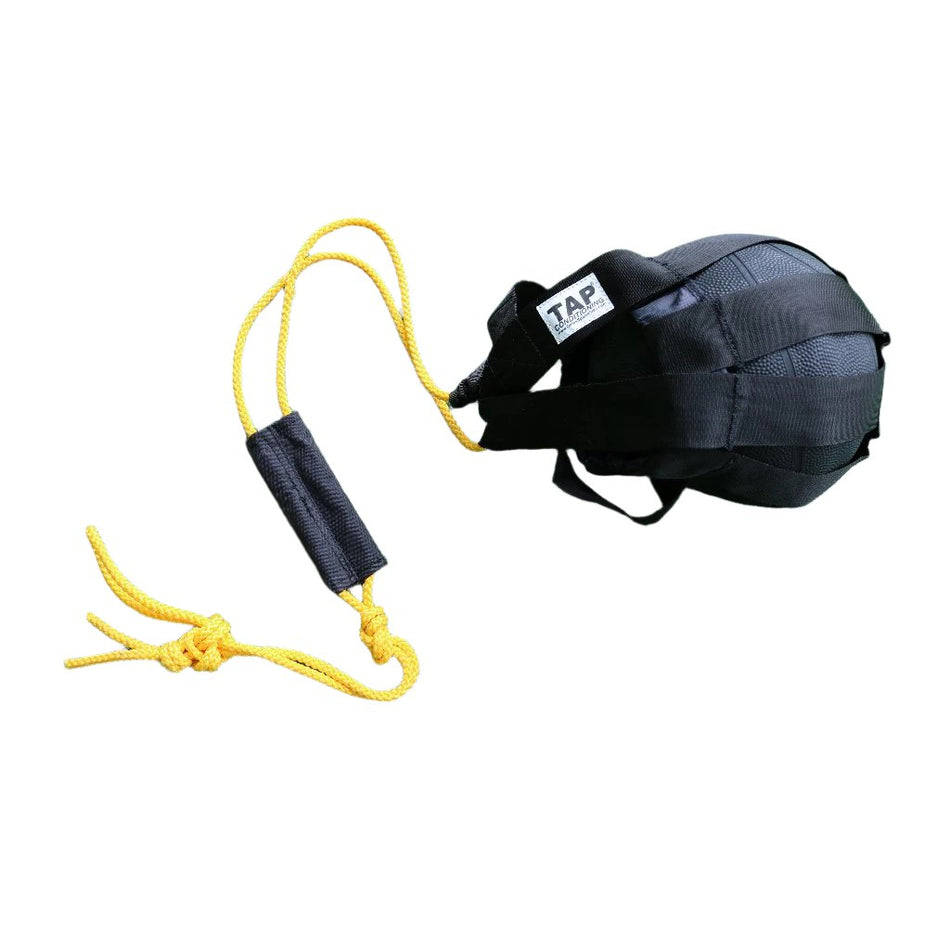
The rotational medicine ball throw measures the output of the entire strength foundation expressed rotationally — the quality the rest of this series is built around developing. Using a light medicine ball — four to six pounds — the hitter performs a baseball-style side toss for distance or, if a radar gun is available, for velocity. The TAP® Soft Medicine Ball is one option at an appropriate weight for this test. Three attempts, record the best.
A hitter who is weak across all three is a hitter who needs a strength foundation before anything else. A hitter who is reasonably strong on the jump and hang but weak on the rotational throw has built strength that is not yet transferring into rotational expression. That gap is exactly where the next articles in this series begin.
Run all three at the start of a training block and again at the end. The change in those numbers tells the story.
There is no single number that declares a hitter strong enough. Strength development is continuous, and the goal is not to reach a threshold and stop — it is to keep building while the other layers develop alongside it. When the broad jump, the dead hang, and the rotational medicine ball throw are all showing improvement and the hitter can perform the major movement patterns with control, the foundation is ready to support the next layer. Those tests do not require a lab. They require a tape measure, a bar, and a medicine ball — and they tell the story clearly enough to act on.
When Strength Alone Is Not Enough: The Bridge to Bat Speed
Strength raises the ceiling. It does not guarantee the ceiling gets reached.
One study of 25 high school players ran a 12-week offseason strength program and measured the results. Running speed improved significantly. Bat exit velocity did not — the average gain was less than half a mile per hour, not a statistically meaningful change. The athletes got stronger and faster. The strength did not show up as bat speed without something additional connecting the two.
That additional connection is what the rest of this series addresses. Mobility determines whether a hitter can access the positions the swing demands. Rotational power trains the nervous system to organize strength into a fast, usable swing pattern. Loaded swing work sharpens that pattern with resistance. Each layer depends on the strength foundation built here.
The weight room is not optional. It is not where development ends. It is where development starts — and a hitter who has genuinely built a foundation of strength through consistent, progressive, quality work in the right movement categories arrives at every subsequent layer with something real to build on.
All exercises and training applications described in this article are general educational examples. They are not prescriptive training programs. Oates Specialties does not provide individual training instruction.
Where to Go Next
This article establishes the foundation. The companion articles in this series build on it in sequence.
What Gets Measured Gets Better covers how to establish a baseline before a training block and confirm after it ends whether development carried over — using exit velocity, bat speed, and launch angle measurement without expensive tracking technology. Run that protocol before and after the strength block described here.
The next article in the development chain covers mobility — the gate that determines whether the strength built here can actually move through the positions the swing demands. A hitter who is genuinely strong but lacks the hip, thoracic, and core mobility to access good swing positions is limited regardless of what the numbers say in the weight room.
The full development framework is mapped in How to Increase Bat Speed: A Strength-First System for Power and Transfer, which establishes the sequence from strength through mobility, rotational power, and loaded swing work.
The Evidence in Summary
Strength is the foundation of bat speed development — not because it produces elite swing speed on its own, but because nothing else does without it. The research links lean body mass, back strength, grip strength, and lower-body power to faster bat velocity across multiple independent studies. The NSCA's governing principles — progressive overload, specificity, movement quality, adequate volume and frequency, and recovery — apply regardless of equipment level. The movement categories that matter most for hitters are lower-body pushing and hinging, pulling, core and anti-rotation work, and pressing — in roughly that order of priority for bat speed development. A hitter who builds a genuine foundation across those categories, at whatever equipment level is available, arrives at every subsequent development layer with something real to express.
Frequently Asked Questions
Consistent, progressive work across four movement categories — lower-body pushing and hinging, pulling, core and anti-rotation, and pressing — applied two to three days per week over a full offseason. The specific exercises matter less than the principle: each session should ask the body to do slightly more than it currently can, with full range of motion and quality movement. That combination, sustained over months rather than weeks, produces the force production capacity that everything else in bat speed development is built on.
There is no universal threshold, but movement quality and a baseline level of strength across the major categories — lower-body pushing and hinging, pulling, pressing, and core — are the relevant criteria. A hitter who cannot perform a controlled bodyweight squat, a set of pull-ups, and basic anti-rotation work is not ready to add high-velocity or loaded rotational training on top. Movement competency comes before intensity.
For younger or less-trained athletes, yes — particularly in the early stages of development. The principle of progressive overload still applies. Bodyweight training can produce genuine adaptation when load, complexity, range, and tempo are progressed systematically. As an athlete matures, external load becomes increasingly important for continued strength development, but the foundation can begin without it.
Bat speed depends more heavily on lower-body force production, trunk strength, and posterior chain capacity than on horizontal pressing strength. Bench press belongs in a complete strength program for upper-body balance and shoulder health — but a hitter who overemphasizes pressing relative to pulling and lower-body work is building the wrong end of the strength profile.
Research consistently shows that meaningful strength adaptations develop over months, not weeks. Two to three strength-focused training days per week, consistently applied over a full offseason of 12 to 16 weeks, produces genuine change in force production capacity. The athletes who build the most useful foundations are the ones who train consistently over multiple offseasons — not the ones who push hardest in a single block.
Annotated Bibliography
Haruna R., Doi T., Habu D., Yasumoto S., & Hongu N. (2023). Strength and conditioning programs to increase bat swing velocity for collegiate baseball players. Sports (Basel), 11(10), 202.
https://pmc.ncbi.nlm.nih.gov/articles/PMC10610610/
78 collegiate players. Lean body mass and back muscle strength were the only significant independent predictors of bat swing velocity in multiple regression. Grip strength and rotational medicine ball throw also correlated significantly. Primary correlational anchor for the strength-and-bat-speed relationship described in this article.
Szymanski D. J., Beiser E. J., Bassett K. E., & Till M. E. (2011). Relationships between sports performance variables and bat swing velocity of collegiate baseball players. Journal of Strength and Conditioning Research, 25, S122.
https://doi.org/10.1097/01.JSC.0000395775.89191.33
22 Division I players. Nondominant grip strength, lean body mass, parallel squat, one-arm row, and peak power all correlated significantly with bat velocity. Bench press showed a weak relationship (r = 0.21). The authors explicitly noted that correlation does not establish causation. Secondary correlational anchor supporting the movement category hierarchy in this article.
Orishimo K. F., Kremenic I. J., Modica E., Fukunaga T., McHugh M. P., & Bharam S. (2023). Lower extremity kinematic and kinetic factors associated with bat speed at ball contact during the baseball swing. Sports Biomechanics, 23(12), 3406–3417.
https://pubmed.ncbi.nlm.nih.gov/37853750/
20 collegiate players, force plates and motion capture. Lead foot peak vertical ground reaction force averaged 159 ± 29% of body weight and correlated significantly with bat speed. The authors concluded that training to improve bat speed should include both general lower-extremity strengthening and sport-specific drills targeting force production through the lead leg. Biomechanical basis for the lower-body movement category emphasis in this article.
Kraemer W. J., & Ratamess N. A. (2004). Fundamentals of resistance training: Progression and exercise prescription. Medicine & Science in Sports & Exercise, 36(4), 674–688.
https://pubmed.ncbi.nlm.nih.gov/15064596/
Authoritative review of resistance training principles including progressive overload, specificity, variation, and recovery. The foundational source for the NSCA governing principles described in this article and the primary reference for general strength development guidelines applied to the baseball population.
Faigenbaum A. D., et al. (2009). Youth resistance training: Updated position statement from the NSCA. Journal of Strength and Conditioning Research.
https://pubmed.ncbi.nlm.nih.gov/19620931/
NSCA updated position statement confirming that well-coached strength training is safe and beneficial for youth athletes when appropriately scaled and supervised. Supports the bodyweight training section and the movement quality before intensity principle described in this article.
Lloyd R. S., et al. (2014). Position statement on youth resistance training: The 2014 international consensus. British Journal of Sports Medicine.
https://pubmed.ncbi.nlm.nih.gov/24055781/
The 2014 international consensus statement supporting supervised, technique-first, age-appropriate resistance training for children and adolescents. Reinforces the movement competency threshold described in the diagnostic section and the youth application guidance throughout this article.
Spaniol F. J. (2009). Baseball Athletic Test: A baseball-specific test battery. Strength & Conditioning Journal, 31(2), 26–29.
https://doi.org/10.1519/SSC.0b013e31819d3af8
Validated field test battery published in the NSCA's practitioner journal. Recommends standing broad jump, grip strength, and rotational medicine ball throw as core measures with documented relationships to bat speed and batted-ball velocity. Primary source for the three-item diagnostic described in this article.
DeFroda S. F., et al. (2020). Effect of a 12-week off-season strength training program on athletic performance in adolescent baseball players. Herald Open Access.
https://www.heraldopenaccess.us/openaccess/effect-of-a-12-week-off-season-strength-training-program-on-athletic-performance-in-adolescent-baseball-players
25 high school players. Running speed improved significantly over a 12-week strength program. Bat exit velocity did not change meaningfully. Supports the handoff section's argument that strength alone does not automatically transfer to bat speed without additional developmental layers — and motivates the subsequent articles in this series.
Szymanski D. J., DeRenne C., & Spaniol F. J. (2009). Contributing factors for increased bat swing velocity. Journal of Strength and Conditioning Research, 23(4), 1338–1352.
https://doi.org/10.1519/JSC.0b013e318194e09c
Comprehensive review of factors contributing to bat swing velocity, including the consistently weaker relationship between bench press and bat velocity relative to other strength measures. Supports the movement category hierarchy and the FAQ answer on pressing in this article.
Oates Specialties. How to Increase Bat Speed: A Strength-First System for Power and Transfer. oatesspecialties.com.
https://oatesspecialties.com/blogs/default-blog/how-to-increase-bat-speed
Establishes the full development chain this article operates within — strength, mobility, rotational power, and loaded swing work — and maps all companion articles in the bat speed series. This article covers the strength foundation layer; the featured article maps how each subsequent layer connects to it.
About This Analysis
Created by the Oates Specialties team led by Robert Oates, M.Ed., Founder
Editorial oversight by Gunnar Thompson, BS, CSCS, General Manager
Certified Strength & Conditioning Specialist | Biomechanics Specialist
July 2026
Complete Credentials
ROBERT OATES, M.Ed., Founder: Founded Oates Specialties in 2003. Master of Education degree. Provides strategic direction for educational content and athlete development philosophy.
GUNNAR THOMPSON, General Manager: BS Kinesiology (Clinical Exercise Science). CSCS (NSCA), PES (NASM), CPPS certifications. Technical authority on biomechanics and performance science. Conducts review of all educational content for scientific accuracy.
Questions or corrections: gunnart@oatesspecialties.com
© 2026, Oates Specialties LLC