

Donley Hip Spin – Assist‑and‑Resist Hip Rotation Belt for Pelvic Speed and Power Transfer
$49.95
Ships from Huntsville, TX
In Stock
Ordering for a team or facility?
Get volume pricing and help choosing the right tools for your players.
Ask me anything about this product
Sizing · use cases · technique · shipping — instant answers
Ask about Donley Hip Spin – Assist‑and‑Resist Hip Rotation Belt for Pelvic Speed and Power Transfer — how to use it, what athletes it fits, sizing, or how it compares to other tools we make. Answers are focused on this product.
Innovating since 2003
Family-owned, Huntsville TX
Talk to the team
Real specialists, not a call center
Made for daily program use
Designed for continuous reps, every day, every season
100+ implements, organized by goal
Arm care, velocity, strength, and recovery
About This Product
Stop just saying "use your hips." Feel exactly where rotation starts — and exactly when it breaks down.
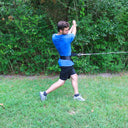
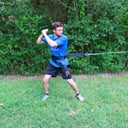
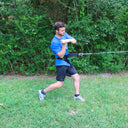
The Donley Hip Spin is a 3-inch-wide rotation belt that lets a partner assist or resist the pelvis so athletes can feel faster hip turn, build lower-half strength, and clean up hip-to-shoulder separation in rotational sports. Instead of just cueing "use your hips," the belt gives direct, tactile feedback at the pelvis so athletes experience what an explosive, ground-up hip turn actually feels like in throws and swings.
- Assist Mode to Teach Hip Speed and Direction — With the band oriented to pull the pelvis into rotation, a coach or partner can physically guide the hips through a clean path at higher-than-normal speed. That assisted overspeed helps athletes feel what a true fast hip turn is instead of guessing from verbal cues.
- Quick Switch to Resisted Mode for Strength — Crossing or reversing the band direction turns the same setup into a resistive load. This targets the gluteus medius and deep hip rotators, building the strength and control needed to drive and then decelerate hip rotation in the horizontal, rotational plane.
- Belt-Based Feedback at the Pelvis, Not the Shoulders — The 3-inch-wide strap anchors around the hips, so the athlete feels the cue exactly where rotation starts. That localized feedback teaches hip-to-shoulder separation — the pelvis opening while the torso stays back — so the core can stretch and snap like a band.
- Variable Partner Angles to Force Self-Correction — A coach can stand in front, behind, or off-angle to change the pull direction. That variability forces the nervous system to adapt, stabilize, and self-correct — helping eliminate power leaks like falling off the back leg or spinning open early.
- Multi-Sport Rotational Use at Full Intent — Built for full-intensity sport movements — throwing, hitting, golf swings, tennis groundstrokes, lacrosse shots — without redesigning the motion. Athletes train hip turn in the same planes and tempos they compete in.
- Portable and Lightweight for Partner or Solo Setups — At ~2 lb, the belt packs easily into a bag and sets up quickly on grass, turf, or indoor flooring. Clip the band to a sturdy anchor point for solo hip-rotation drills when a partner is not available.
What Is It?
The Donley Hip Spin is a lightweight, 3-inch-wide hip belt with an attached resistance band designed to either assist or resist pelvic rotation, depending on how the band is oriented. A partner holds the free end of the band and applies a controlled pull that guides or opposes the hips as the athlete loads and turns.
Compared with generic resistance bands around the waist, the Donley Hip Spin is purpose-built for rotational work, with a secure pelvic strap and an angle-friendly band connection that allow both assisted and resisted setups. Compared with cue-only coaching ("fire the hips," "separate"), it turns abstract concepts into clear physical sensations, helping athletes feel the difference between a passive turn and a powerful, ground-driven hip spin.
How It Works
Key mechanisms behind assist-and-resist hip training
Enhancing Hip-to-Shoulder Separation
To generate high throwing or bat velocity, the pelvis must begin to open while the upper torso stays back, stretching the core like a rubber band. With the belt pulling at the hips, athletes feel that lower-half turn and learn to keep the upper back stable instead of spinning everything together.
Isolating Pelvic Loading and Unloading
In assisted mode, the pull guides the hips through a clean path and faster speed than the athlete can create alone, helping them discover a quicker pelvic turn. In resisted mode, the band forces the hip rotators — especially the gluteus medius — to work harder through the same pattern.
Accelerating Motor-Unit Recruitment
Assisted overspeed pulls the hips faster than the athlete can turn them alone, encouraging the nervous system to recruit more motor units — groups of muscle fibers controlled by a single nerve — and tap into higher-threshold fast-twitch fibers that produce explosive force.
Backed by Research
A Neuromuscular Calibration Tool for the Lower Half
The Donley Hip Spin is a neuromuscular calibration tool for the lower half — it helps the body learn how to load, turn, and sequence the hips so ground-force drives more efficiently through the kinetic chain (the linked system of joints and muscles from the feet through the legs, hips, trunk, and arm that work together to transfer force into the ball or implement). Changing the partner's or anchor's pull angle, or switching between assist and resist, creates small variations the body has to solve on the fly — teaching the nervous system to stabilize the lower half under different demands.
2 Modes
Assist for overspeed feel, resist for strength — one belt covers both ends of hip-rotation training without changing tools
Multi-Sport
Baseball, softball, golf, tennis, and lacrosse — anywhere hip rotation drives power into a ball, club, racquet, or stick
~2 lb
Lightweight, adjustable belt fits youth through adult athletes and packs into any bag for partner or solo work
Video Library
See It In Action
Click the thumbnail to play from the start — click any timestamp to jump to that moment.
2022
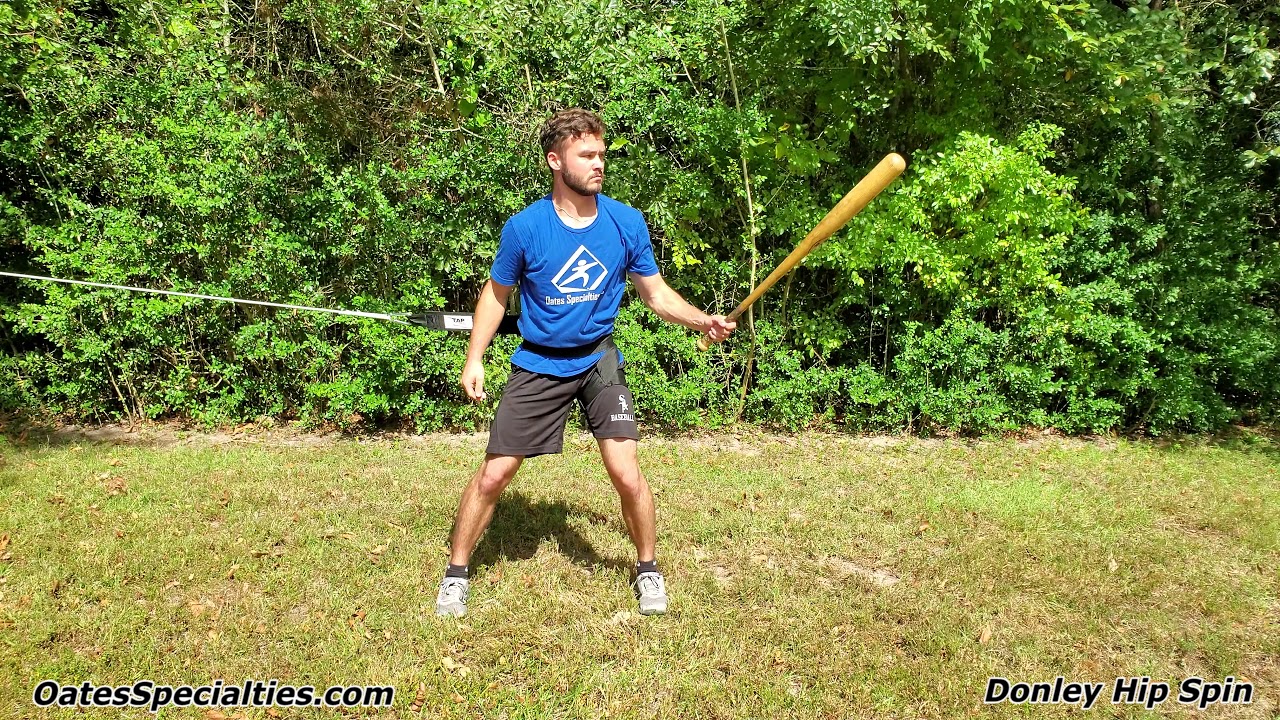
Donley Hip Spin — Setup, Assisted and Resisted Drills, and Sport Integration
Chapter Guide — 5 Timestamps
| Hardware Setup and Pelvic Positioning — a physical demonstration of the padded pelvic belt, highlighting the essential placement constraint of anchoring the strap securely over the iliac crests (hip bones) so the pulling force directly manipulates the pelvis without sliding or changing torso posture. | |
| Assisted (Overspeed) Hip Rotation — the high-grade elastic tubing is set up to pull with the direction of the turn; the coach or partner provides a timed assistance pull that fast-tracks pelvic acceleration, helping the athlete experience maximized lower-half velocity. | |
| Resisted Power and Glute Loading — crossing the band setup in the opposite direction shifts the drill into a resisted protocol, where the athlete must actively fight the elastic load to open their hips, creating a high-demand strength stimulus for the drive leg. | |
| Dynamic Angle Variations and Postural Stability — the partner alters their standing position to pull from different horizontal angles, forcing the athlete to stabilize their core segments and adapt to changing rotational forces. | |
| Sport Integration and Catalog Summary — the tool used during real-time sport execution, including full-intent baseball swings and throwing paths, demonstrating that the band does not interfere with sport-specific mechanics. |
Product Details
How to Use It
Set belt height and anchor cleanly: Wrap the belt snugly around the pelvis so it sits over the hips rather than the low back or stomach, secured so it will not slide during full-speed turns. Test tension at low speed before progressing to full intent.
Use assisted rotation: The partner stands slightly ahead of or behind the athlete and pulls in the direction of the intended hip turn, guiding the pelvis through a fuller, faster range.
Switch to resisted rotation: Reverse or cross the band so it pulls opposite the intended rotation. Perform controlled, then full-intent reps — driving the hips against the band while keeping the upper body stable.
Anchor for solo work: When a partner is not available, attach the band to a fixed anchor such as a heavy rack or fence post at roughly hip height, then clip the belt to the band and step out to create tension.
Add variability: Change partner or anchor position slightly to alter the pull angle and force the athlete to stabilize in multiple directions, layering in sport-specific swing patterns and dry throws.
Variant & Selection Guide
| Variant | Weight | SKU | UPC |
|---|---|---|---|
| Donley Hip Spin belt | ~2 lb | DHSB | 608938931139 |
Single, adjustable 3-inch belt that fits a wide range of athlete sizes. The adjustable strap allows coaches to fit youth through adult athletes within a broad waist-size range using the same belt.
Who This Is For
- Commonly used for baseball and softball athletes who need better hip-to-shoulder separation and lower-half drive for both pitching and hitting.
- Commonly used for golfers, tennis players, and lacrosse athletes who want more efficient hip turn and power transfer into club, racquet, or stick speed.
- Commonly used for strength and conditioning coaches who build rotational power blocks and want a belt-based way to coach lower-half mechanics.
- Commonly used for facilities and academies that run group rotational sessions and need a portable tool for partner-based and anchor-based hip-rotation drills.
What This Implement Does NOT Do
- It does not replace full-body strength training; it is a rotation-specific tool that works best alongside a broader strength and power program.
- It is not a magic fix for velocity; without good coaching and appropriate drills, simply wearing the belt will not automatically increase throwing or swing speed.
- It does not make rotational training risk-free; poor technique, excessive volume, or inadequate warm-up can still lead to overload, especially at the hips and low back.
- It is not a medical or rehab device; any use with injured athletes should be part of a plan designed by qualified medical or performance professionals.
Technical Specs
| Product Name | Donley Hip Spin |
|---|---|
| SKU | DHSB |
| UPC | 608938931139 |
| Also Known As | Rotation belt, assist-and-resist belt, hip spin belt, hip-load belt |
| Primary Use | Partner-driven and anchor-based assist and resist belt for hip rotation speed, strength, and control |
| Training Focus | Hip-to-shoulder separation, pelvic loading and unloading, rotational power transfer, lower-half stability |
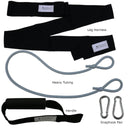
| Components | 3-inch-wide pelvic strap with adjustable closure; attached resistance band with partner-held or anchor-attached free end |
| Behavior | Configurable to assist turn (overspeed feel) or resist turn (strength and control) by changing band orientation, partner position, or anchor line |
| Sports | Baseball, softball, golf, tennis, lacrosse, and other rotational power sports |
| Weight | ~2 lb |
| Fit Range | Single adjustable belt designed to fit a broad range of youth through adult waist sizes |
Safety and Care
Not a toy — the Donley Hip Spin is a training implement and should not be used for unsupervised play or as a harness for towing or pulling. Make sure the belt is snug around the pelvis and check that the band is not frayed; start with moderate tension before progressing to higher-force pulls.
- Not a toy: Training implement only — not a harness for towing or pulling.
- Fit and tension: Belt snug around the pelvis; check the band for fraying; start with moderate tension.
- Partner and anchor handling: Partners should stand in stable positions and avoid sudden, jerky pulls; secure anchors to fixed structures that cannot tip or move.
- Volume and intensity: Introduce high-intent drills gradually, especially for youth and in-season players; stop if the athlete reports hip, groin, or low-back discomfort.
- Medical considerations: Athletes with existing hip, spine, or groin issues should only use the Hip Spin under direction of qualified medical or performance professionals.
Frequently Asked Questions
What does the Donley Hip Spin actually train?
It trains how the hips load, turn, and separate from the upper body, with the goal of improving hip speed, hip-to-shoulder separation, and rotational power transfer.
How is it different from a regular resistance band around the waist?
The Donley Hip Spin is built specifically for pelvic rotation, with a 3-inch-wide, non-slip hip strap and a setup that allows both assisted and resisted patterns rather than just generic sideways pulls.
Do I need a partner to use it?
It is designed first as a partner tool, but you can also attach the band to a fixed, sturdy anchor for solo work. A partner allows more precise, real-time adjustments, while an anchor setup is useful for self-guided drills.
Can I use it at full intent with throws and swings?
Yes. When fitted securely and used on appropriate surfaces, it can be integrated into full-speed throwing and swing-pattern drills to train hip turn in game-like patterns.
Is it only for baseball?
No. It is used across multiple rotational sports, including baseball, softball, golf, tennis, and lacrosse — anywhere hip rotation is a key driver of performance.
Will it increase velocity by itself?
The belt is a tool for improving mechanics and neuromuscular control; velocity gains depend on how it is programmed, what other training is done, and how well load is managed.
Questions before you buy? Call or Text Our Team at (936) 295-4459
Customer Reviews
What Customers Are Saying
Loading reviews…
No reviews yet for this product.
Be the first to review