

Oval Balance Pad: Improve Stability, Strength & Mobility
$34.95
Ships from Huntsville, TX
In Stock
60-day limited warranty
Questions? 936-295-4459
Ordering for a team or facility?
Get volume pricing and help choosing the right tools for your players.
Ask me anything about this product
Sizing · use cases · technique · shipping — instant answers
Ask about Oval Balance Pad: Improve Stability, Strength & Mobility — how to use it, what athletes it fits, sizing, or how it compares to other tools we make. Answers are focused on this product.
Innovating since 2003
Family-owned, Huntsville TX
Talk to the team
Real specialists, not a call center
Made for daily program use
Designed for continuous reps, every day, every season
100+ implements, organized by goal
Arm care, velocity, strength, and recovery
About This Product
A single-foot foam pad that forces the ankle, knee, and hip to stay active — building the stable front side that pitching and hitting demand.
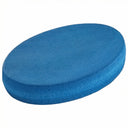
The Oval Balance Pad is a compact, high-density closed-cell foam pad sized for one foot. By narrowing the surface underfoot and using a compressible foam that resists collapse under repeated use, it forces the foot, ankle, knee, and hip to stay organized instead of resting passively on flat ground. The oval footprint limits room for error, sharpening lower-half control rather than letting the body hide in a wide stance — making it a focused tool for baseball and softball athletes who need a more reliable front side.
- Single-Foot Oval Shape — Sized for one foot to isolate and sharpen foot-and-ankle control, unlike broad mats that let athletes hide in a wide stance.
- High-Density Closed-Cell Foam — Compresses under load without breaking down, creating safe instability that challenges stabilizers without pounding joints.
- Ankle & Foot Strength — Forces intrinsic foot muscles and key ankle tendons to fire continuously, building a stronger, more resilient base over time.
- Knee & Hip Alignment Up the Chain — Instability at the foot engages VMO and gluteus medius to reinforce healthier joint positions under load.
- Warm-Up, Conditioning & Front-Side Bracing — Teaches the lead leg to brace firmly on an unstable surface, reducing power leaks in dry-land pitching and hitting drills.
What Is It?
The Oval Balance Pad is a single-foot stability pad made from high-density closed-cell foam, designed to move the lower body away from passive standing and toward active, reflex-driven joint stabilization. When an athlete stands, lunges, or strides on the pad, the surface compresses and subtly shifts underfoot, creating continuous micro-deviations that the body must correct in real time.
Unlike broad, square balance mats that allow the athlete to shift weight across a wide surface, the Oval Balance Pad’s compact footprint is sized deliberately for one foot — forcing the foot and ankle to work harder with less room to compensate, and matching the single-leg demands of planting, pivoting, and bracing.
How It Works
Three mechanisms behind every drill on the pad
Foot & Ankle Activation
Compressible foam shifts underfoot, preventing the foot from locking into a passive position. Intrinsic foot muscles and key ankle tendons — the peroneals and tibialis anterior — must fire continuously to keep the body upright.
Upward Kinetic Stabilization
Instability at the foot travels directly up the leg. VMO and gluteus medius must contract to keep joints aligned and prevent the knee from caving inward during single-leg drills, stride plants, and lunges.
Proprioceptive Sharpening
Changing foam pressure stimulates mechanoreceptors in the foot and ankle, training the nervous system to make fast, automatic micro-adjustments — building position sense and joint resilience with low impact on bones.
Backed by Research
The Science of Unstable Surface Training
The Oval Balance Pad has not been studied as a stand-alone device in controlled trials; its role is supported by broader work on foam-pad balance training and ankle-stabilization exercises, which show that unstable surfaces can improve balance and proprioception when used in structured progressions. Continuous sensory input from compressible foam stimulates mechanoreceptors, sharpening the reflexive muscle responses that protect joints during sport-specific movements like planting, pivoting, and bracing.
1 Foot
Oval shape focuses the challenge on a single foot — not a shared platform that lets the body compensate
2.5″
Thick closed-cell foam delivers meaningful instability without jarring impact on the joints
3×
Muscles from foot through hip must engage simultaneously to maintain alignment on the pad
Video Library
See It In Action
Click the thumbnail to play from the start — click any timestamp to jump to that moment.
Training Guide
Oval Balance Pad — Ankle Strength & Stability Training Guide

Chapter Guide — 6 Timestamps
| Title Card — Developing Foot & Ankle Stability-Mobility with the Foam Balance Pad. | |
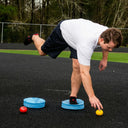
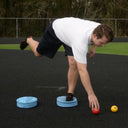
| Full-Body View — Single-Leg Balance & Semi-Circle Target Reaches: athlete stands on one foot while bending and reaching to pick up steel balls arranged in a semi-circle arc on the ground. | |
| Close-Up — Foot & Ankle Micro-Adjustments: tight shot isolating the rapid muscle twitches and foot arch reactions required to maintain balance while reaching for each target. | |
| Wide Field View — Continuous Multi-Directional Reaches: full single-leg hip hinges and reaches demonstrating total-body postural control over the compliant foam surface. | |
| Close-Up — Final Target Retrievals: high-angle tight shot on ankle eversion and inversion control as the last targets are retrieved from the outer edges of the arc. | |
| Closing Outro — Official Oates Specialties LLC branding logo and web address. |
Product Details
How to Use It
Single-leg balance and basic stability: Start barefoot or in socks on the pad with simple single-leg holds, aiming for short, crisp holds with quiet upper-body posture and level hips — rather than long, wobbly efforts. 15–30 seconds per set is a solid starting point.
Pitching stride and front-side brace drills: Place the pad where the lead foot lands in a dry-land throwing motion and practice stride-and-plant patterns without throwing a ball. Emphasize a firm, centered front leg that absorbs momentum and braces tightly even though the surface is unstable.
Hitting stance and stride control: Position the pad under the lead foot in controlled dry-stance or slow stride-and-hold drills, focusing on landing in a balanced, stable position. Keep full-speed swings and live hitting off the pad — the pad is for teaching balance and front-side organization, not for use under an active swing.
Multi-planar lunges and step-ups: Integrate the pad into forward, lateral, and diagonal lunges and step-ups to challenge knee and hip stabilizers in different directions. Keep focus on alignment — knee stacked over the middle of the foot, controlled depth, quiet trunk — rather than speed or high repetition counts.
Rehab and warm-up applications: Use shorter holds, simpler stances, and slower lunges to rebuild joint confidence and control with low impact, or slide a short series of single-leg balances into pre-game warm-ups to wake up the foot, ankle, and hip before higher-speed work.
Variant Guide
| Option | SKU | Best For |
|---|---|---|
| Single Pad | BPO | Individual athletes focused on lead-leg or single-leg stability drills |
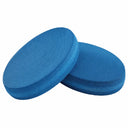
| Pair | BPOP | Coaches running group sessions or bilateral lead-leg and rear-leg drills simultaneously |
Who This Is For
- Baseball and softball players who need better single-leg stability for pitching, hitting setup, and braking mechanics.
- Athletes in cutting and jumping sports who want stronger, more reliable ankles and better control when changing direction.
- Strength and conditioning staffs who want a simple, portable tool for balance work, joint-friendly warm-ups, and proprioceptive drills.
- Rehab and return-to-play settings where the priority is regaining joint confidence and control with minimal impact.
We are not coaches. We do not provide coaching.
Does NOT Do
- It does not replace comprehensive strength training; it adds a focused stability and balance layer under the foot and ankle.
- It is not designed as a maximal power tool; it supports joint control and position sense far more than top-end force production.
- It does not automatically fix pitching or hitting mechanics; it provides a harder surface to balance on while coaches still teach stride, posture, and rotation.
- It is not intended for high-impact jumping from height; it should be used for controlled landings, balance work, and lower-amplitude drills only.
Technical Specs
| Product Family | Oval Balance Pad |
|---|---|
| Product Aliases | Oval Pad, Stability Pad, Foam Pad |
| SKU | Single — BPO Pair — BPOP |
| UPC | 608938927248 |
| Construction | High-density, super-soft closed-cell foam; textured non-slip surface |
| Dimensions | 16.5 in × 9.25 in × 2.5 in (each pad) |
| Weight | Approx. 1 lb per pad |
| Primary Use | Single-foot closed-cell foam pad for balance, ankle strength, lower-body stability, and front-side bracing work |
| Footwear | Barefoot or sock use only — turf and field shoes not recommended |
Safety Guardrails
The Oval Balance Pad is a training tool, not a toy, and should not be used for roughhousing, running jumps from height, or unsupervised play. Athletes should only use the pad on flat, non-slippery floors and position themselves near a stable support if balance is limited.
Youth and developing athletes: For athletes with a history of ankle sprains or open growth plates, loading and drill complexity should be conservative and supervised by a qualified coach or medical professional. Use simpler stances, shorter holds, and lower-amplitude lunges before progressing to more dynamic patterns. Stop immediately if the athlete feels pain, dizziness, or loss of control.
- Not a toy: A training implement for supervised athlete and coach use only.
- Rehabilitation use only under supervision: In return-to-play settings, introduce only under the direct advisement of a licensed provider familiar with ankle and lower-extremity rehab.
FAQs
How is the Oval Balance Pad different from a regular balance mat?
The oval shape is sized for one foot, so it gives a more focused challenge to the foot and ankle than larger mats that support both feet at once. The compact footprint limits room for error and makes the foot and ankle work harder to stay centered — rather than letting the body distribute load across a wide, forgiving platform.
Is it just for rehab, or can healthy athletes use it too?
Healthy athletes can use the pad in warm-ups and training to sharpen balance, foot strength, and front-side bracing mechanics. Rehab and return-to-play settings use it to rebuild joint confidence and control with low impact — the same tool serves both contexts at different intensity levels.
Can baseball or softball players use this in pitching or hitting work?
Yes — coaches often place the pad under the lead foot in dry-land pitching drills or in controlled stance and stride-and-hold work for hitters. Live swings and full-speed mound work should always be done on stable ground.
Should athletes wear shoes when using the pad?
The pad is designed for barefoot or sock use. Turf and field shoes are not recommended because they reduce sensory feedback and can damage the foam surface over time.
How long should a typical drill last?
Most athletes benefit from short sets — 15–30 second balance holds, or 6–10 controlled reps of lunges or step-ups — rather than long, fatiguing efforts that sacrifice alignment. Most coaches program 1–3 short blocks per week across 2–4 sets.
Questions before you buy? Call or Text Our Team at (936) 295-4459
Customer Reviews
What Customers Are Saying
Loading reviews…
No reviews yet for this product.
Be the first to review