

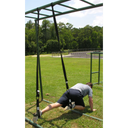
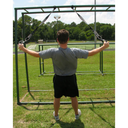
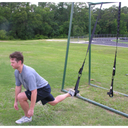
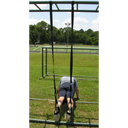
TAP® Suspension Trainer System | Full Body Bodyweight Workout Kit
$89.95
Ships from Huntsville, TX
In Stock
60-day limited warranty
Questions? 936-295-4459
Ordering for a team or facility?
Get volume pricing and help choosing the right tools for your players.
Ask me anything about this product
Sizing · use cases · technique · shipping — instant answers
Ask about TAP® Suspension Trainer System | Full Body Bodyweight Workout Kit — how to use it, what athletes it fits, sizing, or how it compares to other tools we make. Answers are focused on this product.
Innovating since 2003
Family-owned, Huntsville TX
Talk to the team
Real specialists, not a call center
Made for daily program use
Designed for continuous reps, every day, every season
100+ implements, organized by goal
Arm care, velocity, strength, and recovery
About This Product
Bodyweight strength that scales with your angle. Strap training without buckles, built for the weight room, the garage, or the road.
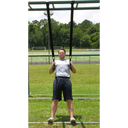
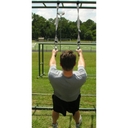
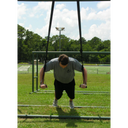
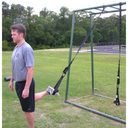
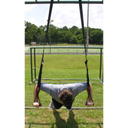
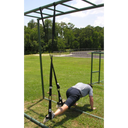
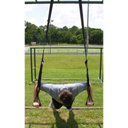
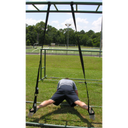
The TAP® Suspension Trainer is a pair of fixed-length bodyweight straps with direct handle and stirrup attachments — no buckles, no slides. Anchor it to a door or sturdy overhead point, and your body angle sets the load: step toward the anchor to make a row harder, step away to make it easier. It is a portable way to train strength and balance together, at the gym, at home, or on the road. The tool supplies the instability; the coach still decides the exercises, volume, and place in the program.
- No Buckles, No Slides — Fixed-length straps with direct handle and stirrup attachments; nothing to adjust, snag, or saw between exercises.
- Body Angle Sets the Load — Move toward the anchor to load more bodyweight, away to load less; intensity changes in a step, not a setup.
- Instability Raises Trunk Demand — Suspension exercises show higher trunk-muscle activation than stable counterparts in acute EMG studies (Aguilera-Castells et al. 2020) — activation is not proof of long-term gain.
- Strength and Balance Together — Twelve-week suspension programs improved strength comparably to traditional resistance training in older adults (Soligon et al. 2020); balance support is moderate.
- Portable Full-Body Kit — Straps pack down for the gym, home, or travel; one kit covers pushing, pulling, squatting, and trunk patterns.
What Is It?
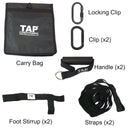
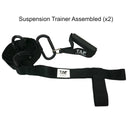
A pair of fixed-length suspension straps with handles and foot stirrups attached directly — no buckles or sliding adjusters. The straps anchor to a door or sturdy overhead point; the athlete holds the handles or hooks the feet in the stirrups and trains against bodyweight, with the angle to the anchor setting the difficulty. Compared with a cable machine, there is no weight stack — the load is the athlete’s body, and the straps move, which raises the trunk’s stabilizing demand. Compared with the KHAOS® Bungee Suspension Trainer, which adds elastic resistance, this system uses fixed straps: the challenge comes from body angle against gravity, not from stretch.
Video Library
See It In Action
Click the thumbnail to play from the start — click any timestamp to jump to that moment.
2025
TAP® Suspension Trainer — Core Strength & Functional Fitness
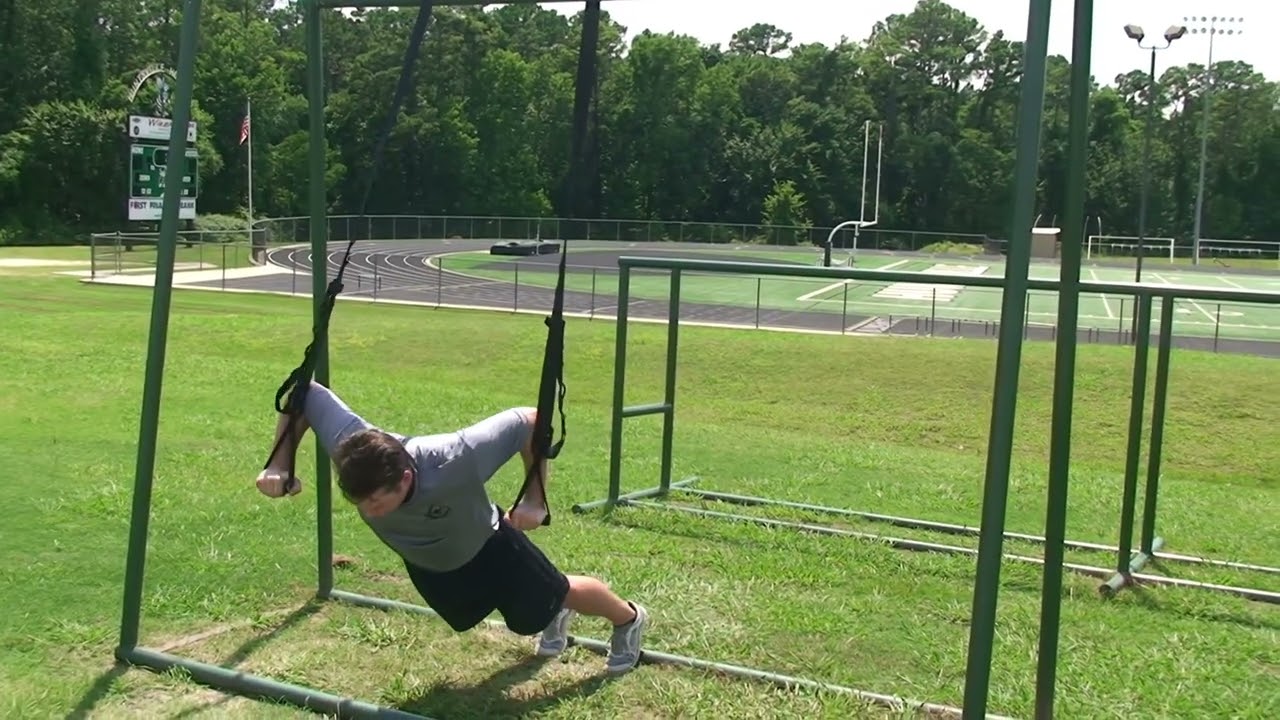
Chapter Guide — 16 Timestamps
| Title & Introduction — Introduction to the TAP Suspension Trainer by Oates Specialties LLC. | |
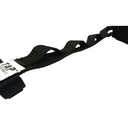
| Key Hardware Features — Overview of the dual high-tensile straps, multiple attachment loops, and aluminum hardware. | |
| Ergonomics & Universal Sizing — Handle/stirrup comfort and using the athlete's body as the reference point for universal height adjustments. | |
| Webbing Retainers — Demonstrating the retainer clips to manage excess strap slack during workouts. | |
| Upper Body & Core Exercises (Using Handles) | |
| Suspension Inverted Rows — Upper back and pulling strength demonstration. | |
| Suspended Push-Ups / Chest Press — Chest and shoulder pressing mechanics. | |
| Standing Abdominal Rollouts — Anti-extension core strengthening. | |
| Suspension Chest Flyes — Advanced horizontal pressing/pec engagement. | |
| Reverse Flyes / Rear Delt Rows — Upper posterior-chain activation. | |
| Configuration & Lower Body / Floor Work (Using Stirrups) | |
| Converting Handles to Foot Stirrups — Step-by-step walkthrough for unhooking handles, releasing webbing, and locking stirrups into position. | |
| Plank Knee Tucks / Mountain Climbers — Prone dynamic core and hip-flexor conditioning. | |
| Suspended Plank Jacks — Core stability and hip abduction in a plank posture. | |
| Supine Hamstring Curls — Posterior-chain bridging, alternating unilateral and bilateral curls. | |
| Supine Leg Scissors / Abductions — Glute, adductor, and lower abdominal conditioning. | |
| Single-Leg Suspended Squats (Bulgarian Split Squats) — Unilateral lower-body strength and stability. | |
| Outro — Oates Specialties LLC contact and website details. | |
How It Works
Three mechanisms behind buckle-free suspension training
Body-Angle Loading
Stepping toward the anchor puts more bodyweight on the straps; stepping away puts less. The load changes in a single step — no plates to add, no pins to move, no buckles to slide — so intensity matches the athlete in seconds.
Instability Demands Trunk Work
The straps swing and the body must hold position, which raises trunk-muscle activation compared with the same pattern done stable. EMG studies show the effect acutely (Aguilera-Castells et al. 2020) — activation during a set is not, by itself, proof of lasting strength gain.
Fixed Straps, Fast Transitions
With no buckles or slides, there is nothing to readjust between exercises — change the angle and start the next pattern. That keeps density high in short sessions and removes a common failure point in strap hardware.
Backed by Research
Research Context: What Suspension Training Evidence Actually Shows
No peer-reviewed study has tested the TAP® Suspension Trainer itself. At the category level, the support is real but bounded: suspension exercises produce higher trunk-muscle activation than stable counterparts in acute EMG studies (Aguilera-Castells et al. 2020), and a 12-week program improved strength comparably to traditional resistance training in older adults (Soligon et al. 2020). This description does not claim that the product prevents injury, rehabilitates injury, guarantees strength gains, or transfers to sport-specific performance.
What the research does not show: no randomized trial has measured actual injury incidence from suspension training, no study has tested suspension training in pitchers, and acute muscle activation is not proof of long-term or sport-specific gain. Treat the trainer as a strength and balance tool: it supplies the instability, the program supplies the development.
Higher
Trunk activation vs stable counterparts in acute EMG studies (Aguilera-Castells et al. 2020)
12 Weeks
Program length matching traditional resistance training on strength in older adults (Soligon et al. 2020)
Better
Balance outcomes vs traditional resistance training in older adults (Çakar & Şahin 2025)
Product Details
How to Use It
Anchor first: Attach the straps to a door or sturdy overhead point that can hold full bodyweight. Test the anchor with partial load before every session — never train on an anchor you have not checked.
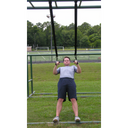
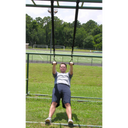
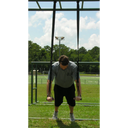
Strength work: Use rows, push-ups, squats, hamstring curls, and planks inside a planned strength block. Set intensity with body angle: closer to the anchor loads more, farther loads less.
Lower-intensity work: Longer angles, comfortable ranges, and short sets on lighter days. Suspension work does not make a session restorative by itself and should not be used to work around pain.
Coaching cues: Keep a neutral spine; if the low back arches or the shoulders shrug toward the ears, reduce the angle. Control the return — do not let the straps snap the body back. Treat athlete-reported fatigue as a meaningful signal (Olsen et al. 2006): stop before fatigue changes mechanics.
Who This Is For
- Commonly used for adults building general strength with portable, bodyweight-based equipment.
- Commonly used for athletes adding trunk-demanding strength and balance work alongside a primary training program.
- Commonly used for coaches programming strength and trunk work in tight spaces or on the road.
- Commonly used for teams and facilities that need one kit to cover pushing, pulling, squatting, and trunk patterns.
Technical Specs
| SKU | TST |
|---|---|
| UPC | 608938930026 |
| Design | Fixed-length straps — no buckles or sliding adjusters |
| Attachments | Handles and foot stirrups, attached directly to the straps |
| Intensity | Adjusted by body angle relative to the anchor |
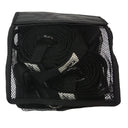
| Portability | Packs down for gym, home, or travel use |
| Instructions | Not included |
Safety, Compliance, and Youth Guardrails
Designed for supervised training. Youth athletes should train under qualified adult or coach supervision, with exercises, angles, and volume matched to current size, strength, and training history. Evidence for suspension training in youth athletes is thin — keep loading conservative.
- Not a toy: Use only as a supervised training implement.
- Anchor every session: Confirm the anchor holds full bodyweight before loading. Keep the floor clear and dry.
- Not for impact or misuse: Do not swing on the straps, and do not use them outside intended exercise patterns.
- Not a rehabilitation device: Do not use as a substitute for medical evaluation, physical therapy, or a return-to-activity plan.
- Inspect before every session: Check straps, handles, stirrups, and anchor points for wear, fraying, or loose parts. Retire damaged equipment.
- Stop for symptoms: Stop immediately for sharp, pinching, or unusual discomfort and seek professional guidance.
We are not coaches. We do not provide coaching.
Frequently Asked Questions
How do I make an exercise harder or easier?
Change your body angle to the anchor: step closer to load more bodyweight, step farther to load less. There is no hardware to adjust.
Will it build strength like lifting weights?
In older adults, 12-week suspension programs improved strength comparably to traditional resistance training (Soligon et al. 2020). No randomized trial shows it matches heavy barbell training in trained adults. Treat it as a complement or a portable option, not a replacement for a barbell program.
Does it work the core more than regular exercises?
Acute EMG studies show higher trunk-muscle activation for suspension exercises than for their stable counterparts (Aguilera-Castells et al. 2020). That is activation during the set — not proof of lasting core strength or of transfer to sport.
Will it prevent injuries?
No such result is established. No randomized trial of suspension training has measured actual injury incidence, and this product is not a rehabilitation device.
What do I anchor it to?
A door or sturdy overhead point that can hold your full bodyweight. Test the anchor with partial load before every session, and keep the floor clear and dry.
Questions before you buy? Call or Text Our Team at (936) 295-4459
Customer Reviews
What Customers Are Saying
Loading reviews…
No reviews yet for this product.
Be the first to review