

The Pitching Pad®
$129.95
Ships from Huntsville, TX
In Stock
Ordering for a team or facility?
Get volume pricing and help choosing the right tools for your players.
Ask me anything about this product
Sizing · use cases · technique · shipping — instant answers
Ask about The Pitching Pad® — how to use it, what athletes it fits, sizing, or how it compares to other tools we make. Answers are focused on this product.
Innovating since 2003
Family-owned, Huntsville TX
Talk to the team
Real specialists, not a call center
Made for daily program use
Designed for continuous reps, every day, every season
100+ implements, organized by goal
Arm care, velocity, strength, and recovery
About This Product
Every throw lands somewhere specific — now you can see exactly where, and call the next one with purpose.
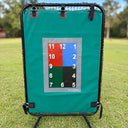
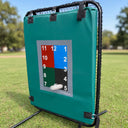
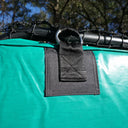
The Pitching Pad® is a patented, padded baseball and softball pitching target that gives athletes a defined strike zone when a catcher is unavailable. Its four-color quadrants, crosshair-style dividing lines, and clock-position numbers turn every throw into a specific location task instead of a vague result somewhere in a net. Mount it to a stable safety screen, fence, or supported cage net with the integrated straps — a catcher, a pitchback, and a radar gun are all separate tools with separate jobs.
- Four-Color Strike-Zone Quadrants — Coaches call a color zone to replace “throw a strike” with a specific, trackable assignment every rep.
- Crosshair Lines and Clock-Position Numbers — Advanced pitchers work edges, corners, and sequences without needing a second, smaller target.
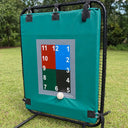
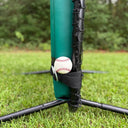
- Padded Impact Surface — Dense foam cushions each throw so the ball drops near the pad rather than rebounding toward the pitcher — not a pitchback.
- Visible Outcome on Every Throw — The marked face shows contact location so coaches track called-location hits, misses, and patterns honestly.
- One Target, Four Levels of Drill Difficulty — Broad color zones for beginners; numbered edges and changing sequences for advanced pitchers — no second pad needed.
What Is It?
The Pitching Pad® is a large, vinyl-covered foam target with a printed strike-zone face and integrated mounting straps. The approximately 43″-wide by 63″-high face is about 4″ thick and includes contrasting quadrants, crosshair-style dividing lines, and numbers arranged around the zone like a clock face. It is not a portable mound, radar device, rebounder, catcher’s substitute for every bullpen purpose, or complete throwing program — it is a defined catcherless command station that makes location results visible and discussable.
A plain net catches almost every ball but gives limited location detail. The Pitching Pad® adds a consistent visual map so coaches can call, see, and record where each throw finished. Compared with a small single-point target, it supports both broad zones for early development and narrower numbered references for advanced sequences on the same surface.
How It Works
Three mechanisms behind location-based pitching development
External Focus and Gaze Anchoring
Directing attention to a specific zone on the marked face — rather than internal body mechanics — is associated with more automatic and efficient movement execution. A broad meta-analysis supports an external-focus advantage; baseball-specific evidence is more restrained, so the practical claim stays narrow: the pad supplies the location, not the accuracy.
Immediate Knowledge of Results
The marked face shows where the ball contacted the target on every throw. That visible outcome gives athletes and coaches a specific result to evaluate rather than a vague “somewhere in the net” answer. Let the athlete feel and assess the throw before coaching; feedback research favors athlete self-evaluation over correction after every rep.
Purposeful Location Variation
Calling a different color, number, or edge from pitch to pitch creates purposeful location problems the pitcher must solve. Use varied sequences because they build specific decision-making and location awareness — not because random practice is universally superior.
Backed by Research
What the Evidence Actually Shows
No peer-reviewed controlled trial has tested The Pitching Pad® as a stand-alone product. Its role is supported at the design and category level by published research on external focus, target fixation, feedback, and varied practice — not by proof that the pad guarantees better command. The pad supplies the location; focused practice, sound coaching, and sensible workload management do the development work.
4 Zones
Color-coded quadrants let coaches replace “throw a strike” with a specific, trackable location call every rep
4 Levels
Broad zones → numbered locations → changing sequences → game constraints — one pad scales the drill difficulty
Patented
Purpose-built padded strike-zone target — not a net, pitchback, or radar substitute
Product Details
How to Use It
Setup — before every session: Inspect cover, foam, straps, and stitching. Secure all straps to a stable screen, fence, or supported cage net — never to a weak or free-moving structure. Position the zone at game-like height and clear the area before anyone throws.
Warm-up: A few low-intensity throws to broad color quadrants to establish rhythm and release intent — not a command test. Reduce intensity or end the block if movement quality changes.
Main training work — four-level drill progression:
- Level 1 — Broad zone: Call one of the four color quadrants — a clear assignment the coach can track.
- Level 2 — Smaller location: Call a clock-position number or crosshair intersection. Every miss has a specific, discussable location.
- Level 3 — Changing sequence: Change the target pitch or build count-based sequences — no smaller pad needed.
- Level 4 — Game constraint: Record balls, strikes, or executions against a defined standard. Add difficulty only after rhythm and intent hold.
Light-day use: Only when a throwing plan already includes a low-intensity command segment. Do not add throws on a true recovery day simply because the target is available.
Variant Selection Guide
| Option | SKU | Included | Best For |
|---|---|---|---|
| Pitching Pad® | TPP-2 | Pad with mounting straps; screen not included | Programs that already own a stable screen, fence, or supported cage net |
| Pitching Pad® Cover Only | PPCover | Replacement cover only | Existing Pitching Pad® owners replacing a compatible cover — confirm fit before ordering |
| Pitching Pad® + 6′×4′ Screen Combo | TPP64 | Pad and 6′×4′ safety screen | Buyers who need both the target and a compatible support screen |
For programs with an existing screen or fence, TPP-2 is the practical starting point.
Who This Is For
- Commonly used for baseball pitchers who need a stationary, catcherless target for strike-zone and called-location work at any level.
- Commonly used for softball pitchers and throwers when the dimensions, mounting height, and drill design fit the program’s task.
- Commonly used for high-school, college, professional, private-facility, and home-gym environments with a stable mounting structure.
- Commonly used for athletes age 13 and older under qualified adult supervision, with volume and intensity matched to current readiness.
What This Implement Does NOT Do
- It does not replace a catcher for pitch reception, pitch calling, blocking work, game communication, or every bullpen purpose.
- It does not return the ball — the foam face cushions the throw so the ball drops near the pad; it is not a rebounder or pitchback.
- It does not measure velocity, spin, movement, or any release characteristic.
- It does not fix mechanics, guarantee command, increase velocity, or prevent injury; those outcomes depend on coaching, practice design, workload, and the full program.
- It does not replace a complete throwing plan, strength work, or recovery practices, and is not a medical or rehabilitation device.
Safety and Care
- Not a toy: Athletic training target for supervised practice only.
- Mount securely: Attach every strap to a stable, undamaged support. Never use a weak or free-moving frame.
- Clear the lane: No person should stand in front of, immediately behind, or beside the target while pitches are being thrown.
- Inspect before use: Do not use if cover, straps, stitching, foam, or net shows damage affecting secure operation.
- Use only as intended: Throw baseballs or softballs at the marked face. Do not climb, sit, hang, swing, or pull on the pad or its straps.
- Not a rehabilitation device: Not a substitute for medical evaluation, treatment, or return-to-throw guidance.
- Youth supervision: A qualified adult must control setup, distance, drill choice, intensity, and total throwing volume.
Wipe with a damp cloth and mild soap. Avoid abrasive cleaners. Store dry and covered.
Frequently Asked Questions
How is it different from throwing into a standard net?
A standard net catches the ball but may not show a precise finish point. The Pitching Pad® adds color zones and numbered locations so the pitcher has a defined assignment and the coach can record whether the called location was hit.
Does it return the ball?
No. The foam-backed face is designed to cushion the throw so the ball drops near the pad. It is not a rebounder, pitchback, or ball-routing system.
Can it replace a catcher?
It removes the need for a catcher during location work, but does not replace catcher-pitcher communication, receiving, blocking, pitch calling, or game preparation.
How should coaches progress the drills?
Begin with broad colored quadrants. Move to numbered locations or changing sequences only when the pitcher maintains normal rhythm and control — one variable at a time.
Where does it fit in a throwing session?
After the general and throwing warm-up, during a focused command block. Keep throws inside the existing workload plan — not as a reason to add volume.
Can athletes use it alone?
The target supports catcherless practice, but athletes under 18 should train under qualified adult supervision with the mounting structure checked before every session.
How do I clean and store it?
Wipe with a damp cloth and mild soap. Avoid abrasive cleaners. Dry before storage, keep covered when not in use, and inspect cover, straps, stitching, and foam regularly.
Which option should I buy?
TPP-2 if you have a stable screen or fence. TPP64 if you also need a compatible 6′×4′ screen. PPCover for replacement only — confirm compatibility before ordering.
Questions before you buy? Call or Text Our Team at (936) 295-4459
Customer Reviews
What Customers Are Saying
Loading reviews…
No reviews yet for this product.
Be the first to review