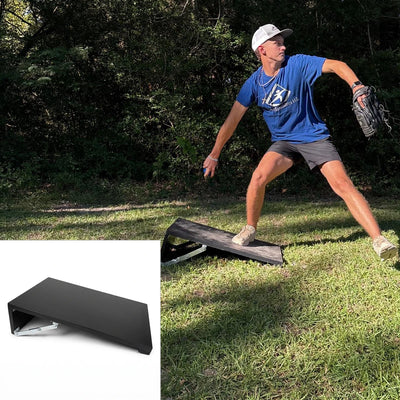
Seven Pitchers. One Mound.
Meet the TAP® Incline Board.
An inclined throwing option for purposeful practice—when flat ground is not the setup you want.
You have seven pitchers and one mound. The mound is occupied, the next pitcher is waiting, and you still need a plan for the rest of the group.
Flat-ground throwing has its place. But sometimes you want an inclined throwing activity—not another flat-ground drill and not another explanation of what the pitcher should feel.
The new TAP® Incline Board gives coaches another option: an inclined support surface for selected downhill throwing activities. Use it to change the practice condition, observe the pitcher’s response, and compare that response on the mound.
Incorporate it into a planned station. Select it for an individual pitcher when the activity serves a purpose. Keep what proves useful.
Throw on an incline. Test it on the mound.
What Is the TAP® Incline Board?
The TAP® Incline Board is a foldable pitching-training tool made from solid-core marine plywood, with a sloped surface covered in a bonded rubber sheet. It measures 30 inches long by 20 inches wide, with the raised end 10 inches above the ground. Weighing 30 pounds, the board folds for convenient storage and transportation. Dimensions and weight are approximate.
It gives coaches an inclined throwing option when flat ground is not the practice condition they want. Incorporate it into a planned station, use it to explore a pitcher’s response to the changed surface, and compare that response on the mound. Coaching questions may focus on drive-leg action, movement into landing, or delivery timing—not an assumption that every pitcher needs the same change.
The board changes part of the throwing setup; it does not create one continuous downhill surface throughout the entire stride and delivery. It is a specialized training tool, not a regulation pitching mound or a replacement for mound work.
Product at a Glance
| Attribute | Description |
|---|---|
| Length | 30 inches |
| Width | 20 inches |
| High-end height | 10 inches above the ground |
| Weight | 30 pounds |
| Construction | Solid-core marine plywood |
| Sloped surface | Covered with a bonded rubber sheet |
| Folding design | Foldable for storage and transportation |
Dimensions and weight are approximate.
What Does the Incline Board Add to Practice?
Instead of asking a pitcher to respond only to another verbal cue, a coach can present a different physical task. The athlete experiences the setup, the coach observes the response, and both have something concrete to discuss.
- Another inclined throwing option when mound access is limited.
- An opportunity to explore drive-leg action and the forward move.
- A different condition for observing landing and lead-leg response.
- A way to investigate rhythm and timing without assuming one universal solution.
- A defined activity that can be revisited and compared across sessions.
The value is not simply that the athlete looks different on the board. It is whether the selected activity contributes something useful to the pitching task.
Why the Throwing Surface Matters
The surface is part of the task. Research comparing mound and flat-ground pitching shows that athletes can organize their lower-body movement differently when that condition changes.
In a laboratory study of 15 adolescent pitchers, researchers found differences in lower-body mechanics between mound and flat-ground pitching. Lead-knee flexion at foot contact averaged 40 degrees on the mound and 47 degrees on flat ground. Ankle position and trailing-knee action also differed, while ball velocity did not differ significantly.¹
The practical lesson is not that one surface is always better. It is that changing the surface can change the response. That supports exploring an inclined throwing activity, but it does not establish that this board reproduces mound mechanics or automatically improves them.
Four Situations Where a Coach Might Select the Board
1. The Mound Is Occupied, but the Work Still Needs a Purpose
With several pitchers sharing one mound, the question is what each athlete should do when it is not their turn. The board provides an inclined activity to consider within that rotation, followed by a mound comparison when access permits.
The purpose is to organize planned work—not automatically add throws. The station still requires suitable space, supervision, and equipment placement. An additional station is an option, not permission for unsupervised simultaneous throwing lanes.
2. Another Cue Is Not Giving the Pitcher a Useful Action
“Use your legs” may mean something to the coach without giving the athlete a clear action. An inclined activity offers another way to present the task rather than repeating the same instruction.
Does the pitcher find a more purposeful forward move? Does the athlete report a useful feel? Does that response appear on the mound? Those questions give the activity a job without requiring every pitcher to find the same solution.
3. The Coach Wants to Explore the Move Into Landing
The delivery includes more than moving off the back leg. The pitcher must arrive at lead-foot contact and continue the throwing action.
Because mound and flat-ground pitching can produce different knee and ankle positions, landing is a reasonable observation point when comparing conditions.¹ A coach can watch how the athlete approaches contact, manages the landing, and continues the delivery.
The purpose is not a harder landing or a forcibly locked knee. It is a useful response within the complete pitching action, followed by a comparison on the mound.
4. The Coach Wants to Investigate Delivery Timing
Changing the starting condition gives the coach another way to investigate rhythm and coordination. A different position on the incline changes the starting elevation and may change how the athlete approaches lead-foot contact.
The response is individual. Do not assume that moving higher gives the arm more time or that moving lower speeds up contact. Define the question, observe the same movement events, and compare the response.
Timing also depends on how it is measured. In the adolescent mound study, some events differed when expressed as a percentage of the analyzed pitching cycle, while the absolute time intervals reported in its timing table were not statistically different.¹ “When does contact occur relative to the rest of the delivery?” is more useful than assuming a particular correction.
Science-Informed Thinking and Practitioner Experience
The use of slopes in throwing practice also has a practitioner context. Texas Baseball Ranch has publicly discussed slope-based training and blending throwing activities back into mound work.² These examples illustrate coaching interest in changing practice conditions; they are not controlled evidence of a particular result.
For this tool, the useful principle is straightforward: present a purposeful task, observe the athlete, and check the response in the intended pitching environment.
The scientific rationale, practitioner experience, and product-specific outcomes should remain distinct. Together they can explain why an application is worth considering without promising what every pitcher will gain.
A Simple Way to Introduce the Board
Establish the Starting Point
Start with one pitcher and one coaching question. Observe the usual mound delivery and identify what you want to compare: the forward move, landing response, timing, or a throwing outcome.
Introduce the Inclined Activity
Select a configuration appropriate to the athlete. Explain the activity clearly and include it within the existing throwing plan.
Listen and Observe
Ask what the athlete notices and compare that feedback with what you see. A new sensation is information, not automatic evidence of improvement.
Return to the Mound
Look for the response in the task the pitcher needs to perform. Consider the throwing result as well as the delivery. A different appearance alone does not establish value.
Keep, Adjust, or Choose Another Task
Keep the application when it serves the purpose. Adjust it when an appropriate change may improve the fit. Select another task when it does not contribute. Revisit a promising response before describing it as lasting learning.
Practical Boundaries Before Use
The TAP® Incline Board is a specialized training surface, not a guarantee of greater velocity, improved command, corrected mechanics, or reduced injury risk.
A surface change should not be assumed to reduce throwing stress. The adolescent study found modestly higher shoulder and elbow moments on the mound than on flat ground; those findings do not establish the loading produced by this board.¹
Select an activity appropriate to the athlete. Follow the equipment instructions for setup and use, and confirm suitable footwear and supporting surfaces. Stop for pain, slipping, equipment movement, or visible damage.
Reversed or uphill landing applications are not included in this introduction.
Does It Have a Job in Your Program?
You do not need another tool simply to have another tool.
You may want this one if you recognize a specific need: an inclined throwing option while your mound is occupied, a different physical task for a pitcher who is not responding to another cue, or a repeatable activity for observing movement and comparing it with mound work.
The purchase question is not, “Will every pitcher need this?” It is, “Do I have pitchers—and practice situations—where this gives me a useful option I do not currently have?”
The TAP® Incline Board can earn its place through that practical fit.
Explore the TAP® Incline Board
The product page provides complete specifications, availability, and purchasing information.
Additional Resources
A practical coaching paper and companion technical white paper are available for readers who want more detail on applications, research findings, and evidence limitations.
Research and Practitioner Sources
- A Biomechanical Comparison of Pitching From a Mound Versus Flat Ground in Adolescent Baseball Pitchers. Sports Health. 2013;5(6):530–536. doi:10.1177/1941738113502918. https://pmc.ncbi.nlm.nih.gov/articles/PMC3806183/
- Texas Baseball Ranch public practitioner posts: “The utilization of slopes to feel a natural glute dominant load…” (October 14, 2026), and “Here are three main ways we can blend when doing our throwing…” (August 20, 2026). These are practitioner communications, not product-specific research.
Related documents
The TAP® Incline Board: A Practical Position Paper for Coaches and Instructors
TAP® Incline Board Training Guide: Developing the Push, the Drop, and the Brace
The TAP® Incline Board Technical White Paper: Rationale and Evidence
© 2026, Oates Specialties LLC