


TAP® Incline Board
$179.95
$199.95
Ships from Huntsville, TX
In Stock
60-day limited warranty
Questions? 936-295-4459
Ordering for a team or facility?
Get volume pricing and help choosing the right tools for your players.
Ask me anything about this product
Sizing · use cases · technique · shipping — instant answers
Ask about TAP® Incline Board — how to use it, what athletes it fits, sizing, or how it compares to other tools we make. Answers are focused on this product.
Innovating since 2003
Family-owned, Huntsville TX
Talk to the team
Real specialists, not a call center
Made for daily program use
Designed for continuous reps, every day, every season
100+ implements, organized by goal
Arm care, velocity, strength, and recovery
About This Product
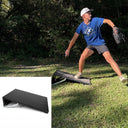
A folding incline board that puts a raised, sloped surface under the drive foot, so pitchers can practice the push, the drop, and the landing on flat ground.
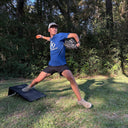
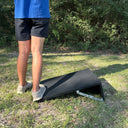
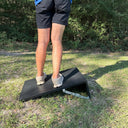
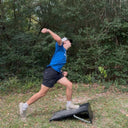
The TAP® Incline Board is a folding, rubber-covered platform for pitching practice. Set it on flat ground and the pitcher throws off the raised surface: the drive foot pushes from the board, and the stride foot lands on the flat ground in front of it. Where the drive foot stands on the surface — higher or lower — sets how much drop the throw has. Pitchers mix a few board throws with regular mound throws, so the push, the drop, and the landing are easier to feel — and the mound throws show whether it helped.
- A drop on flat ground — The drive foot starts raised on the board and the stride foot lands on flat ground, so a throwing session without a mound still has a drop to work with.
- A push you can feel — Pushing off the raised surface makes the back leg’s work easy to feel — holding the back hip loaded at the set and leg lift, then driving.
- A flat landing — The stride foot lands on level ground instead of a downslope, so the front leg’s braking work is easy to see.
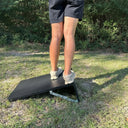
- Higher or lower — Where the drive foot stands on the surface sets the drop: higher on the surface for more, lower down for less.
- Judged on the mound — One board throw mixed with two to four mound throws. The mound — not the board — decides whether anything changed.
What Is It?
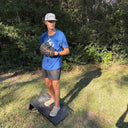
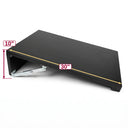
The TAP® Incline Board is a folding ramp — 10 inches at its highest point, with a sloped surface 30 inches long and about 20 inches wide, covered in a bonded rubber sheet, set at a slope of approximately 15.7 degrees. It weighs about 30 pounds, folds flat, and sets up on level turf in seconds. The pitcher stands sideways on the board, drives off the back foot, and lands on the flat ground in front of it.
The Incline Board changes the surface under the drive foot on purpose — and every board throw is checked against the mound throws that follow it. The board changes the surface, not the delivery: the pitcher keeps the ball, the target, and their full throwing motion, and the raised surface is what asks for the adjustment.
How It Works
The drop, the push, and the landing.
The Drop
Flat ground has no drop at all. The board raises the drive foot above the landing, and where the foot stands on the surface — higher or lower — sets how much drop the pitcher feels on the throw. The surface climbs about an inch for every 3¾ inches along it.
The Push
The drive foot pushes off the raised surface instead of level ground. That push is easy to feel, so the back leg’s work — loading and driving — stands out on every throw.
The Landing
A mound lands the stride foot on a downslope. The board lands it on flat, level ground, so the front leg has to stop the body — the brace — on firm ground, in plain view of the coach.
Related Research
The Science of Modified-Surface Pitching
Programs use the board to give flat-ground throwing a raised surface and a drop. The reasoning is geometric: a regulation mound falls about an inch per foot starting 6 inches in front of the rubber, so the landing spot sits lower the longer the stride — and the board’s marks give that same height change, matched to stride length here:
| Stride length | Drop at landing on a mound | Drive foot from the front edge | Height off the ground |
|---|---|---|---|
| ~4 ft | ~3.5″ | 6.75″ | 3.5″ |
| ~5 ft | ~4.5″ | 10.5″ | 4.5″ |
| ~6 ft | ~5.5″ | 14.25″ | 5.5″ |
| ~7 ft | ~6.5″ | 18″ | 6.5″ |
The push off the tilted surface and the flat landing stay different from a mound on purpose. Studies of pitching show that mound and flat-ground throwing differ most at front-foot landing, and in one published single-case study, an 11-year-old pitcher who practiced on an inclined platform under the drive leg showed a more closed pelvis at landing and a stronger drive-leg push on test throws afterward. In that study the platform practice came after verbal coaching, so the platform’s effect cannot be separated from the coaching and the extra practice. No study has tested this specific product, and we state that plainly. The paired mound throws in every block are how a coach checks whether the work carries over for their pitcher.
10″
Height at the highest point
30″
Surface length
20″
Surface width
15.7°
Slope of the surface
Related documents: Position Paper · Education Hub Intro · Training Guide · Technical White Paper
Product Details
How to use it
Warm up and watch the mound first. After warm-up, throw a few mound pitches — film them from a fixed side spot if you can. Pick one thing to work on: the push, the drop, or the landing.
Set the board and the foot position. Set the board on level turf with the slope falling toward the target, the pitcher standing sideways on it. Put the drive foot on the surface where the work needs it: higher on the surface for the most drop, around the middle for less, on the lower part for the least. Measured along the surface from the front edge, the drive foot stands 3.5 inches off the ground at 6.75 inches, 4.5 inches at 10.5 inches, 5.5 inches at 14.25 inches, and 6.5 inches at 18 inches — moving the foot up or down the board changes the drop, not the slope under the foot. Keep the whole foot on the rubber, and set the drive foot the way the athlete sets it on the mound.
Other setups, from the field. The standard setup is the downhill one above. Texas Baseball Ranch coaches also turn the board around or sideways for specific problems: uphill, with the stride foot pushing into the slope — practitioners use uphill throws for sequencing and for feeling the hips get included in the throw; sideways with the slope falling toward the toes, so a pitcher who drifts forward has to resist it; and sideways toward the heels, to feel the hips sit back and hold posture. Those are field variations — this page covers the standard setup.
Mix the throws. One board throw, then two to four mound throws, for three to four rounds — fastballs at controlled effort, same delivery and pitch type on both. As the change shows up on the mound, shift toward more mound throws.
Judge it on the mound. If the named problem is not changing on the mound throws, adjust the setup or choose a different tool. Pain, a slip, or a new problem showing up on the mound ends the block. Count every board throw in the day’s total; skip board work the day before or after a start.
Who this is for
Pitchers 13 and older with an established delivery — not for building one from scratch — throwing without pain. It is for pitchers working on a named problem: drive timing and back-hip loading, holding the hips closed, stride timing, posture against forward drift, or landing control. Programs with limited mound access use it to add a drop to flat-ground practice, or run it as a station while other pitchers throw on the mound, rotating each pitcher onto the mound for the check throws.
Technical specs
| Product | TAP® Incline Board |
|---|---|
| SKU | INB |
| UPC | 608938928900 |
| Highest point | 10 inches |
| Surface length | 30 inches |
| Slope | Approximately 15.7 degrees |
| Drive-foot height by position | Measured along the surface from the front edge: 6.75 inches — 3.5 inches off the ground; 10.5 inches — 4.5 inches; 14.25 inches — 5.5 inches; 18 inches — 6.5 inches |
| Width | About 20 inches |
| Surface | Bonded rubber sheet |
| Weight | Approximately 30 pounds |
| Construction | Folding; hinged joint, locking supports; level, firm turf |
What this implement does not do
- It does not replace a mound, a throwing program, or coaching.
- We make no claim that it adds velocity.
- We make no claim that it reduces injury risk or protects the arm or any joint.
- It does not diagnose a delivery problem or clear a pitcher to throw; the readiness and footing checks are observations, not medical clearance.
- It is not a medical, therapeutic, or rehabilitation device.
Safety and youth guardrails
Oates Specialties training tools are designed for athletes 13 and older, under qualified adult or coach supervision, with load and volume matched to the athlete’s size, strength, and movement quality. Stop immediately if sharp or unusual discomfort occurs.
- Not a toy: a training implement for supervised use by athletes and coaches, not a play item.
- Not for impact use: not designed for impact against another person or object; use only on level, firm turf with clear landing space.
- Not a rehabilitation device: not a substitute for medical treatment or physical therapy.
Before each session: an adult engages every locking support — push the high end; it should not flex, rock, or slide — and inspects the rubber, hinge, and supports. Clean turf shoes with good tread only; no metal spikes. Readiness check: the pitcher holds the set position at their mark for 10 seconds and 10 seconds on the stride leg on flat ground, and sticks three step-downs off the board’s side — unsteady footing or pain means no board throws that day. One half-speed push at the mark before the first throw; any slide stops board work. One athlete at a time; fingers clear of the hinge. Replace worn, torn, or lifting rubber. An adult handles folding and carrying; never fold, move, or adjust the board while anyone is on it. Store the board folded, dry, and out of the weather and direct sun. Any ankle roll, a fall with symptoms, swelling, or pain that persists ends the athlete’s participation until a qualified healthcare professional clears them to return.
Frequently Asked Questions
We don’t have a mound. Does this board replace one?
No. The board gives flat ground a raised surface and a drop to throw off, but the push and the landing are different from a mound on purpose, and only a mound gives the game surface.
How do I set the drop for my pitcher?
By foot position, measured along the surface from the front edge: the drive foot stands 3.5 inches off the ground at 6.75 inches, 4.5 inches at 10.5 inches, 5.5 inches at 14.25 inches, and 6.5 inches at 18 inches. That range covers the drop a regulation mound gives for most strides. Keep the whole foot on the rubber, and judge the change on the mound throws that follow.
Why is this for ages 13 and older?
Thirteen is a conservative program policy. The board asks a pitcher to hold and push from a raised, sloped surface, so it is kept for athletes with an established delivery and secure footing on it.
Where does a board block fit in the session?
Early in practice, after warm-up: three to four rounds of one board throw mixed with two to four mound throws, fastballs at controlled effort. Count board throws in the day’s total.
Does Oates provide coaching on how to use this?
No. We are not coaches. We do not provide coaching. We explain the tool and the reasoning behind it; drill choice, progression, and whether to keep using the board belong to your qualified coach.
Questions before you buy? Call or Text Our Team at (936) 295-4459
Customer Reviews
What Customers Are Saying
Loading reviews…
No reviews yet for this product.
Be the first to review