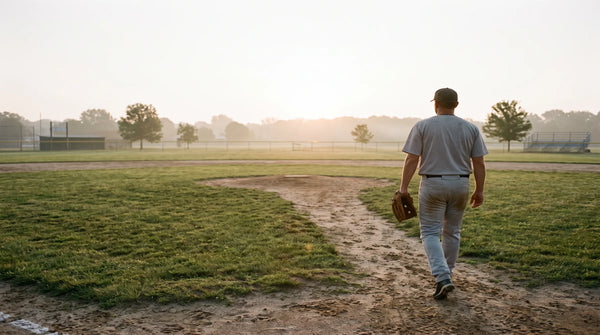
How Long Does It Take to Build Arm Strength?
From Fall to Opening Day — Coach's Preparation Guide
Part of: How to Build a Fall Pitching Program · October 1, 2026
Executive Summary
Coaches, trainers, and researchers use "arm strength" to mean different things. For this guide, we're narrowing it to three measurable qualities — how far a pitcher can throw, how hard he throws, and how strong his rotator cuff and shoulder are (Section 1 explains why).
Quick Answer
Most pitchers can see measurable changes in shoulder endurance or throwing velocity within 4 to 8 weeks. But no study establishes a number of weeks that makes a pitcher's "arm strong" or season-ready. Muscles and coordination adapt in weeks; throwing skill and workload tolerance need progressive throwing; connective tissue adapts over months.
- 4 weeks: the habit forms; measurable endurance change in one supervised adolescent program
- 6 weeks: first small average velocity gains in some controlled training studies
- 8 weeks: selected shoulder-region measures can shift
- 12+ weeks: the realistic window for a full progressive build — strength work, throwing volume, regulation-ball integration, reassessment
No timeline guarantees velocity, health, or readiness. Section 2 breaks this timeline down week by week; Section 7 sets the research aside to look at how two experienced coaches apply it in the field.
Bottom line for coaches: match the plan to the runway you actually have, progress throwing on the tendon's clock, pair every strength or weighted-ball block with regulation-ball throwing, and never mistake a radar-gun gain for a season of health.
Find Your Answer
Answer the question closest to what you need right now, and jump straight there.
- “I just want the bottom line — what's a realistic timeline?” → Jump to: The Short Answer: A Realistic Timeline
- “Does weighted-ball training actually build velocity, and is it safe?” → Jump to: Weighted-Ball Training
- “I only have a few weeks before the season starts — what should I prioritize?” → Jump to: Putting It Together: Matching the Plan to the Runway
- “What actually lowers a pitcher's injury risk?” → Jump to: Rotator-Cuff Strength and Injury Risk
- “How do experienced coaches apply this outside the research?” → Jump to: Practitioners in the Field
Oates Specialties sells baseball-training equipment. This guide explains preparation decisions and research boundaries. It does not claim that a product establishes adaptation speed, throwing readiness, injury prevention, or a guaranteed performance outcome.
🎧 Prefer to listen? Audio version of this article:
1. What "Arm Strength" Means for This Article
Ask five coaches what "arm strength" means and you'll likely get five different answers — grip strength, an isolated shoulder test, pure throwing velocity, or an arm that simply doesn't break down. All are legitimate uses of the term, and none is wrong.
For the purposes of this article, we're using a narrower, three-part working definition — not because it's the only correct one, but because these are three of the most applicable definitions specific to pitching:
How far he can throw. Distance on a line is the most visible expression of throwing capacity — though mechanics, intent, and skill shape it too, not just physical capacity.
How hard he can throw. Velocity, the radar-gun number. Distance and velocity are related but not identical: one rewards carry, the other ball speed at release.
How strong his rotator cuff and shoulder are. Not a vague sense of toughness, but a specific, trainable, measurable quality — and the one most directly tied to injury risk in the pitcher-specific research. A 2014 prospective study of high school pitchers found that preseason weakness in the supraspinatus, one of the four rotator cuff muscles, was linked to more than four times the risk of a major injury over the following season (Section 5d has the full finding).
In this guide, a study counts as building "arm strength" only if it moved one of those three needles — throwing distance, velocity, or rotator-cuff and shoulder strength. General strength work may or may not move them; the scoreboard here is what happens when the pitcher throws.
2. The Short Answer: A Realistic Timeline
Here is what the research, taken together, supports:
| Window | What the Research Shows |
|---|---|
| Weeks 1–4 | Shoulder endurance and familiarity improve fast — measurable endurance gains in a supervised program. |
| Weeks 4–8 | Resistance programs add roughly 1–4% velocity in high schoolers; a 6-week weighted-ball program adds a similar gain; selected shoulder-region measures can shift over 8 weeks. |
| Weeks 8–15 | Longer weighted-ball programs add more — several mph in youth and adolescent pitchers. |
| Months | Tendon stiffness changes take 2–3 months to appear and reverse within a month of detraining; the average training study (~13 weeks) may be too short to capture slower structural change consistently. |
The honest limitations, up front: these are time anchors, not deadlines — group averages from specific populations, not prescriptions for your pitcher. Nearly every study measured velocity or a strength test; almost none measured whether the arm held up over a season. Tendons and ligaments run on a months clock while muscles run on a weeks clock — so plan on the slower clock.
3. What Changes in Weeks
The fastest adaptations are neural and coordinative — the nervous system gets better at recruiting and sequencing muscle before the muscle itself changes much. But "weeks" isn't just a coordination window: real muscular adaptation, from early strength gains to measurable lean-mass change, also falls on a weeks-scale timeline, not a months-scale one. The distinction that matters for a pitcher isn't muscle versus coordination — both move fast. It's muscle versus connective tissue: tendons and ligaments, covered in Section 4, are the tissue that genuinely lags behind.
The clearest baseball example of that weeks-scale window comes from a group of adolescent players, mean age 16, in a supervised 20-week preseason shoulder program, three sessions a week. On a posterior-shoulder endurance test, the group went from roughly 30 repetitions at baseline to 66 after four weeks and 88 after 20 weeks — real, large, fast, though with no control group, some of the early jump is likely test familiarity and maturation rather than pure training effect. The study measured no velocity, workload tolerance, or injury outcomes: a time anchor for one shoulder-endurance measure, not a timetable for building a pitching arm.
The muscle side of that same window shows up in a separate eight-week trial in Division I collegiate pitchers: low-intensity rotator-cuff training, twice weekly on the throwing arm, produced measurable gains in shoulder-region lean mass, isometric internal-rotation strength at 90 degrees, and achievable workload, with blood-flow restriction adding a modest edge. Narrow but useful — actual muscle tissue, not just coordination, can change in eight weeks, though the study measured no pitching performance.
The weeks-scale message: the first couple of months build real capacity, not just a habit. Shoulder endurance improves. Muscle strength and lean mass improve. Coordination and familiarity improve. All of that is useful and all of it is fast — and none of it is the same as the months-scale tendon adaptation in Section 4, or a guarantee about how the shoulder holds up across a season, which Section 5d covers on its own terms.
4. What Takes Months
Muscle adapts faster than tendon. This is one of the most replicated findings in exercise physiology, and the most important timeline fact in this guide.
The clearest available time-course comes from tendon research outside baseball: young men went through three months of lower-leg isometric training, then three months of detraining, with the Achilles tendon tracked throughout. Stiffness didn't change until about two months in; a roughly 50% increase reached significance at three months, and one month of detraining brought it back to baseline. Three months to build, one month to lose. (Achilles research in young men, not a pitching study — included as the clearest tendon time-course available.)
A broader review across the tendon-adaptation literature found the same pattern study after study: tendon adapts more slowly than muscle, and the typical intervention — around 13 weeks — was often too short to detect structural change at all. Muscle adapts "quite dramatically" to training, tendon physiologists note, while the connective-tissue response is "more moderate": tendon reacts to overload within days but adapts structurally over months, which is why a pitcher can feel strong while his connective tissue is still catching up.
The weight room works on a weeks clock; tendons and ligaments work on a months clock. Any plan that builds muscle force faster than connective-tissue capacity is building a gap. The runway matters more than the routine.
5. What the Research Shows Builds Arm Strength
Only methods with peer-reviewed evidence appear here, organized by how directly they move the three-part definition above. Every claim traces to a study in the bibliography; thin or mixed evidence is labeled as such.
5a. Resistance and Band Work
The most coach-usable finding is also the least dramatic: a structured, baseball-specific resistance program, done consistently for six weeks, adds a small but real amount of velocity.
One randomized trial split high school players, ages 14 to 17, into a band-and-tubing shoulder program, a pneumatic-resistance program, a medicine-ball plyometric program, or a non-training control — three days a week for six weeks. Velocity rose across all three training groups, in a tight range of roughly one to two percent (1.7%, 1.2%, and 2.0%); the control group didn't change. No program beat the others. The honest reading: the tool mattered less than the consistency. Roughly 1–1.5 mph for a high school pitcher — modest, real, and about what a fall of steady work buys.
A systematic review spanning 17 studies of band- and forearm-loading work found the same pattern at a larger scale: velocity increases were commonly reported, but only about half of those studies beat a control group significantly, and no single best method emerged. The signal is real but noisy. There is no magic exercise.
5b. Weighted-Ball Training
Weighted-ball work produces the largest velocity effects in the literature — and it's the category coaches ask the most questions about.
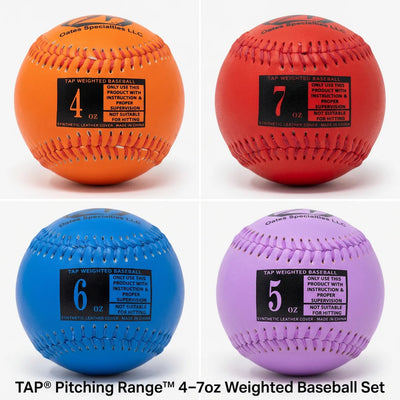
Ball weight matters as much as any other variable here, and most of the supporting research clusters in a narrow band: roughly 4 to 6 ounces, close to a regulation ball's 5. A biomechanics study extended that window to 7 ounces, having experienced throwers work from the mound and flat-ground crow-hop across the full 4-to-7-ounce range, plus flat-ground hold exercises with 14- and 32-ounce balls. Kinematics weren't meaningfully different anywhere in the 4-to-7-ounce throwing range; as ball mass rose, arm velocities and most joint torques generally decreased — the exception was elbow flexion torque, which was significantly greater for the heavy holds. In one acute study of experienced throwers, then: 4-to-7-ounce throwing didn't show a uniform rise in measured arm stress as ball weight increased, but the heaviest holds were a different story. That's a biomechanics snapshot, not a safety finding — it says nothing about how any of this plays out across a training block, for beginners, or for every drill.
An older trial randomized high school varsity pitchers into overweighted, underweighted, or control groups for ten weeks; both implement groups beat the control on velocity. A later review of the same literature reached the same conclusion: over- and underweighted throwing can increase regulation-ball velocity.
The trial that tested the widest implement range — 2 to 32 ounces, well beyond the band above — was a randomized controlled trial in pitchers ages 13 to 18, comparing six weeks of weighted-ball throwing against regulation-ball throwing only, with identical strength training in both groups. Velocity rose 3.3 percent in the weighted-ball group, alongside a 4.3-degree increase in shoulder external rotation, which the authors discussed as a possible contributor to the gain. Four pitchers in the weighted-ball group suffered elbow injuries — two during the program, two the following season — while none in the control group were injured. That deserves attention, and it deserves context: it's a single trial of 38 adolescent pitchers using implements up to 32 ounces. Read it as a reason to be thoughtful about aggressive implement progressions, not as an established injury rate for weighted-ball work.
A separate trial ran pitchers ages 10 to 17 through fifteen weeks using lighter balls only. Mean velocity rose 4.8 miles per hour, with no shoulder or elbow injuries during the program. It was a single-site, uncontrolled program evaluation rather than a randomized comparison, so it can't isolate the lighter balls' effect from coaching, mechanics work, maturation, or the rest of the 15-week program — but it points toward the lighter end of the spectrum deserving more attention.
The coaching summary: weighted balls work, and the research is clearest inside 4 to 7 ounces — not the only range that works, just the most studied one. Plenty of coaches program successfully with heavier implements in supervised systems (Section 7), and the controlled research on those heavier weights simply hasn't caught up to that field experience. Nothing here shows weighted balls build rotator-cuff strength either way — the evidence is about velocity. Pair any of it with regulation-ball throwing (Section 6b) and stay supervised.
5c. Long Toss
Long toss is the most argued-about method in baseball — and the controlled research behind it is thinner than the debate. It's in this guide because practitioners are such strong proponents of it that leaving it out would be dishonest: the coaches in Section 7 treat long toss and distance throwing as central to arm development, and too many programs are built around it to ignore. What follows is what the research actually establishes, which is less than either side of the argument usually claims.
Biomechanically, a motion-analysis study of college pitchers found hard, on-a-line throws from moderate distances looked like mound pitching — reasonable exercises for pitchers, in the researchers' own words — while maximum-distance throws produced the highest shoulder rotation, elbow torque, and joint loads of any throw type, something to use with caution. A separate sensor-based study confirmed it: submaximal long toss produced elbow torque and arm speeds approaching or exceeding pitching. Long toss is not easy throwing.
But does long toss build velocity? No controlled trial has isolated it as the cause of mound-velocity gains — the velocity trials here used weighted balls, resistance programs, or lighter balls. One youth program that included long toss as part of a combined design did show improved velocity, but long toss can't take solo credit there.
The evidence supports long toss as a conditioning and workload tool: it accumulates high-quality throwing volume and loads the arm at near-pitching levels. "Throw far to throw hard" is a slogan; the research version is "throw far, on a line, to build volume — and treat max distance like the high-stress work it is." Section 7 covers the practitioner read, which runs more favorable.
5d. Rotator-Cuff Strength and Injury Risk
This is the one section where the research speaks directly to injury, not just performance. A prospective study followed 101 high school pitchers across four seasons — 166 pitcher-seasons in all, from freshman through varsity — measuring shoulder strength before each season and tracking what happened after. Pitchers who started the season with a weak supraspinatus, one of the four rotator-cuff muscles, were more than four times as likely to suffer a major injury (one costing more than three missed games) over that season. That is a real, measured, injury-linked finding — not a training-outcome proxy standing in for one. It is also a single study in a single population, and it should be read that way: one significant result among several strength and motion measures tested, not a settled law of the shoulder.
The training side of the picture comes from the two programs covered in Section 3. The 20-week adolescent program showed posterior-shoulder endurance improving at both the 4-week and 20-week marks — the decelerator muscles that brake every throw. The eight-week collegiate cuff trial showed measurable gains in lean mass, isometric strength, and workload in the same region the injury study flagged. Neither trial tracked injury outcomes, so neither one proves that the strength gain lowers injury risk — only that the quality the injury study cares about is trainable, and reasonably quickly.
A separate fall-season shoulder program in Division I players supplies the caution: range of motion improved, but external-rotation strength decreased in both arms. The athletes started without meaningful deficits, which likely limited what could change — a shoulder program does not make every number go up. Baseline status and the specific measure determine what changes; "more shoulder work equals lower injury risk" is a reasonable hypothesis, backed by one pointed finding, not a proven chain.
6. The Honest Limitations
6a. The Tissue-Clock Gap
Muscle responds in weeks; tendon and ligament tissue responds in months, as Section 4 lays out, and ligaments are believed slower still. The practical gap: for weeks after a strength program starts working, muscles can produce forces the connective tissue hasn't adapted to handle yet — and detraining erases tendon gains just as fast, as little as a month off. Progress throwing load on the tendon's clock even when the weight room moves faster, and treat uninterrupted consistency as more valuable than any single intense block.
6b. New Capacity Must Transfer to the Regulation Ball
Change the implement and the pattern changes: research on youth pitchers throwing lighter versus standard-weight balls found different kinematics and kinetics. The implication: strength or implement gains don't automatically transfer — new capacity must be rehearsed with the regulation baseball, at intent, in the pitching motion, or it doesn't count as arm strength here.
On proprioception: this guide found no direct pitcher-specific evidence that properly programmed strength training reduces a pitcher's "feel" — the literature runs the other way, with proprioceptive training improving motor control generally. The narrower, evidence-backed point: when the implement or strength changes, the pattern changes with it, and the athlete needs throwing reps to recalibrate.
6c. Velocity Gains Are Not the Same as Health
Nearly every training study measured velocity; only one measured health in a way that ties back to the third leg of the definition. The weighted-ball trial above found a velocity gain and elbow injuries in the same program — but that finding stands mostly alone in a literature that otherwise didn't look for injury at all. A harder thrower is not automatically a stronger or lower-risk thrower. Build the rotator-cuff leg deliberately — shoulder endurance work, gradual throwing volume, honest workload tracking — instead of assuming it follows a radar-gun gain.
7. Practitioners in the Field: How Coaches Apply This
Everything above this section is peer-reviewed research, and it leaves real gaps — on long toss as a velocity builder, on heavier weighted-ball implements, and on what a realistic timeline looks like week to week outside a controlled trial. This section sets that research aside and looks at how two experienced throwing coaches, Ron Wolforth of Texas Baseball Ranch and Randy Sullivan of Florida Baseball ARMory, fill those gaps from field experience. Both are practitioner sources, not peer-reviewed proof, and both operate commercial training businesses with disclosed, long-standing Oates Specialties relationships. Read what follows as informed coaching opinion, not evidence with the same standing as Sections 3 through 6.
7a. Long Toss: The Field Perspective
Practitioners tend to be more bullish on long toss than the biomechanics data alone would suggest. Wolforth is an outspoken advocate, arguing from what he calls the Bernstein Principle — the body organizes itself around the goal of an activity, so throwing for maximum distance recruits and sequences the body more powerfully than mechanics-focused throwing. That's a coaching interpretation of motor-learning ideas, not a tested mechanism. He acknowledges the added stress but argues the developmental payoff outweighs it. Sullivan frames its value differently: not the distance itself, but the variability every long-toss throw demands — different arm slots, intensities, and release points — which he argues trains coordination and force-sharing, and in his view builds the shoulder's work capacity as well as velocity. Both views treat long toss as a tool with a wider range of legitimate use than "use with caution" alone implies.
7b. Timelines from the Field
Both coaches describe timelines from field experience worth setting next to the tissue-adaptation research in Sections 3 and 4. Wolforth lists rushing the offseason-to-competition transition in under 12 weeks as one of the most common reasons he sees pitchers plateau on velocity — a field observation that lines up closely with the months-not-weeks tendon clock in Section 4. Sullivan describes a pattern he reports seeing in aggressive velocity programs: gains climb for the first several weeks, then plateau or reverse around week six or seven, which he attributes to the nervous system "throttling back" to protect tissue that hasn't caught up — a window that sits right at the edge of the six-week controlled trial in Section 5b. His explanation is a coaching hypothesis, not a mechanism established by controlled research. Neither observation is controlled data; they're included because they point in the same direction as the research above, from coaches who report seeing these patterns across hundreds of athletes.
7c. A Shared Philosophy
Both coaches also argue for velocity work as one part of a deliberate, sequenced process rather than an isolated block, and for case-by-case offseason throwing decisions with gradual loading over abrupt shutdowns — consistent with the runway-based planning in Section 9.
8. Oates Specialties Products: What They Are For
Products map to the training tasks the research supports. A product creates a task; the task, done consistently, is what the studies measured. No product below is claimed to increase velocity, build rotator-cuff strength, or prevent injury.
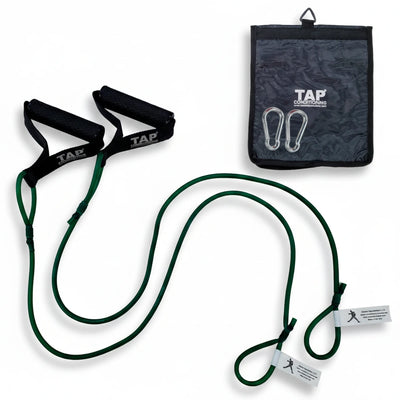
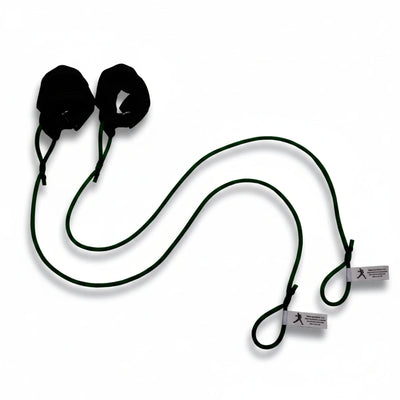
Oates Specialties Tubing. The band-and-tubing program discussed in Section 5a is tubing-based. Tubing creates that task category — controllable, repeatable, low-load shoulder work — though the research behind it tested a program, not a specific product.
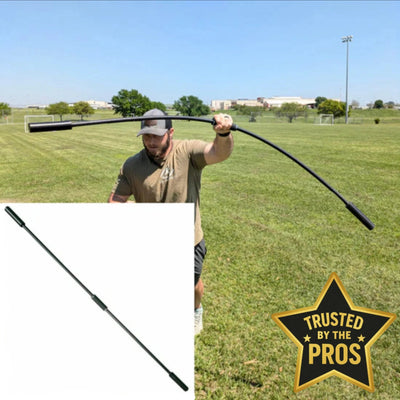
TAP® Shoulder Tube. Repeat-effort shoulder-endurance work of the kind discussed in Section 3 — controlled repetitions for the posterior shoulder and cuff, improving over 4 to 20 weeks in the cited research — is the task category. The tube is one way to perform it.
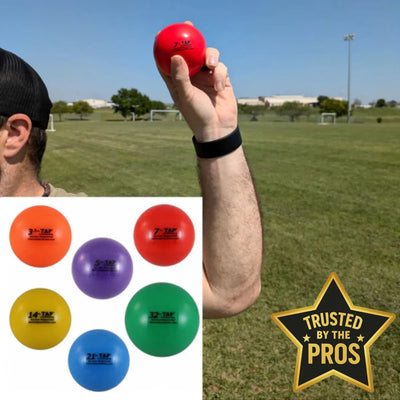
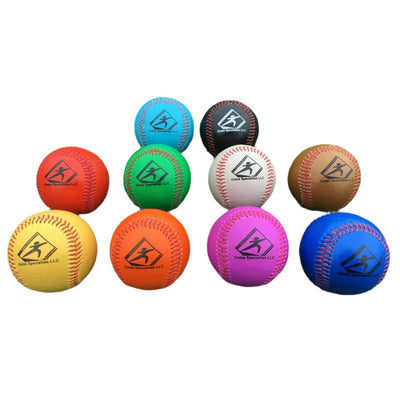
Weighted balls. The one category with direct evidence — and the one where the research is clearest inside 4 to 7 ounces, which is the range Oates Specialties builds this product line around: a deliberate choice to stay inside the most-studied range, not a claim that heavier implements are unsafe (Section 7 covers how practitioners use them). Pair it with regulation-ball throwing (Section 6b), stay supervised, and read the underlying research in full before going heavier.
The rule: choose the capacity first, the task second, the product last. The product never sets the timeline — the tissue clocks in Sections 3 and 4 do.
9. Putting It Together: Matching the Plan to the Runway
The table translates the evidence into planning emphasis by runway. It is coaching guidance, not a research finding — no study tested these windows.
Two rules govern every row: the slow tissue sets the pace, and every block ends with the regulation ball — new capacity integrated through pitching-pattern throwing, or it doesn't count.
| Available Runway | Primary Planning Emphasis | What the Window Cannot Establish |
|---|---|---|
| Less than 4 weeks | Organize existing throwing; clarify the starting point; use familiar tasks. Begin a band/tubing routine for the habit, not a transformation. | It cannot build meaningful new tissue capacity, add velocity, or build rotator-cuff strength. |
| 4–8 weeks | Consistent resistance work three times a week; build shoulder endurance (measurable change by week four in the cited research); gradually organize throwing volume. Light implements only with an established base. | It cannot complete tendon adaptation or prove the arm will hold up. |
| 8–12 weeks | Continue resistance work; add progressive long toss on a line; integrate strength gains with regulation-ball throwing (Section 6b). | It cannot establish that a velocity gain transfers to games or that connective tissue has fully adapted. |
| 12+ weeks | Full progression: resistance, throwing volume, careful implement work, reassessment. The only window reaching the tendon clock described in Section 4. | It cannot guarantee any outcome. More time means more chances to build, observe, and adjust — not certainty. |
10. Safety and Scope
This is preparation guidance, not medical diagnosis, rehabilitation, injury prevention, or return-to-play clearance. It does not diagnose shoulder or elbow problems, prescribe rehabilitation, determine medical readiness, or guarantee an outcome.
Persistent, sharp, unusual, worsening, or function-limiting pain belongs with a qualified professional. Existing restrictions, return-to-throw instructions, or qualified-professional guidance should lead the plan when they apply.
Studies on What Changes and How Fast
Moore, Uhl, and Kibler, 2013 — Moore SD, Uhl TL, Kibler WB. Improvements in Shoulder Endurance Following a Baseball-Specific Strengthening Program in High School Baseball Players. Sports Health. 2013;5(3):233–238. doi:10.1177/1941738113477604.
Why it matters here: Direct adolescent baseball evidence that posterior-shoulder endurance improved at 4 weeks (30 → 66 reps) and 20 weeks (→ 88 reps) of a supervised preseason program. This is the "clearest baseball example" and "20-week adolescent shoulder program" referenced in Sections 3, 5d, 8, and 9.
Use with care: No control group (test familiarity and maturation possible); only 14 of 30 enrolled players met the attendance standard; measured no velocity, workload tolerance, or injury outcomes.
Lambert et al., 2023 — Lambert BS, Hedt C, Ankersen JP, et al. Rotator Cuff Training With Upper Extremity Blood Flow Restriction Produces Favorable Adaptations in Division IA Collegiate Pitchers: A Randomized Trial. Journal of Shoulder and Elbow Surgery. 2023;32(6):e279–e292. doi:10.1016/j.jse.2023.02.116.
Why it matters here: Eight-week randomized trial in collegiate pitchers: the blood-flow-restriction group showed greater gains in shoulder-region lean mass, isometric internal-rotation strength at 90 degrees, and achievable scaption workload than low-load training alone. This is the "eight-week collegiate cuff-training trial" referenced in Sections 2, 3, and 5d.
Use with care: Does not show blood-flow restriction is required, that all pitchers respond similarly, or that the measured changes transfer to pitching performance.
Kubo et al., 2012 — Kubo K, Ikebukuro T, Maki A, Yata H, Tsunoda N. Time Course of Changes in the Human Achilles Tendon Properties and Metabolism During Training and Detraining in Vivo. European Journal of Applied Physiology. 2012;112(7):2679–2691. doi:10.1007/s00421-011-2248-x.
Why it matters here: The clearest available time-course of tendon adaptation: stiffness +~50% over 3 months of loading, back to baseline after 1 month of detraining. This is the "Achilles tendon research" referenced in Sections 2, 4, and 6a.
Use with care: Achilles-tendon research in young adult men — not shoulder, elbow, or baseball-specific evidence.
Bohm S, Mersmann F, Arampatzis A. — Human Tendon Adaptation in Response to Mechanical Loading: A Systematic Review and Meta-Analysis of Exercise Intervention Studies on Healthy Adults. Sports Medicine – Open. 2015;1:7.
Why it matters here: Across many studies, tendon adapts more slowly than muscle; average intervention lasted ~13 weeks — barely long enough to detect structural tendon change. This is the "broader tendon-adaptation literature" referenced in Sections 2, 4, and 6a. Use with care: General exercise review, not baseball-specific; covers healthy adults broadly.
Use with care: General exercise review, not baseball-specific; covers healthy adults broadly.
Cook and Purdam, 2009 — Cook JL, Purdam CR. Is Tendon Pathology a Continuum? A Pathology Model to Explain the Clinical Presentation of Load-Induced Tendinopathy. British Journal of Sports Medicine. 2009;43(6):409–416.
Why it matters here: Tendon reacts to overload quickly (minutes to days) but adapts structurally slowly — the distinction behind "feels fine" versus "is adapted." This is the "model of tendon pathology" referenced in Section 4.
Use with care: A pathology model, not a training study; describes injury processes, not a safe-loading recipe.
Kjaer (Aspetar review) — Kjaer M. Throw Away the Anti-Inflammatories, Start Loading Your Damaged Tendons: Evidence Into Practice. Aspetar Sports Medicine Journal.
Why it matters here: Muscle adapts "quite dramatically" to training while the tendon response is "more moderate"; collagen synthesis rises with loading but structural change is slow. This is the source of the "quite dramatically" / "more moderate" language in Section 4.
Use with care: Narrative review, not a controlled trial; general tendon physiology, not throwing-specific.
Studies on What Builds Velocity and Arm Strength
Escamilla et al., 2012 — Escamilla R, Ionno M, DeMahy MS, et al. Comparison of Three Baseball-Specific 6-Week Training Programs on Throwing Velocity in High School Baseball Players. Journal of Strength and Conditioning Research. 2012;26(7):1767–1781. doi:10.1519/JSC.0b013e3182578301.
Why it matters here: 68 HS players; Throwers Ten (band/tubing, +1.7%), Keiser pneumatic resistance (+1.2%), and medicine-ball plyometrics (+2.0%) all beat the control over 6 weeks; no program superior — consistency mattered more than the tool. This is the "randomized trial" referenced in Sections 2, 5a, and 8.
Use with care: Small velocity gains (~1–1.5 mph); measured no injury outcomes.
Fredriksen and van den Tillaar, 2024 — Fredriksen AB, van den Tillaar R. The Effect of Specific Strength Training on Throwing Velocity in Overarm Throwing: A Systematic Review. Sports Medicine – Open. 2024;10:122. doi:10.1186/s40798-024-00785-7.
Why it matters here: Across 17 studies, band and forearm-loading work increased velocity, but only half beat controls and no best method emerged. This is the "systematic review spanning 17 studies" referenced in Section 5a.
Use with care: Heterogeneous sports, ages, and methods — not a pitcher-specific prescription.
DeRenne, Ho, and Blitzblau, 1990 — DeRenne C, Ho K, Blitzblau A. Effects of Weighted Implement Training on Throwing Velocity. Journal of Strength and Conditioning Research. 1990;4(1):16–19.
Why it matters here: 30 HS varsity pitchers; 10 weeks of overweighted (5–6 oz) or underweighted (4–5 oz) throwing both beat the control group on regulation-ball velocity. This is the "older trial" referenced in Sections 2, 5b, and 9 for the 10–15 week gains.
Use with care: Older study, small sample; did not track injuries.
DeRenne and Szymanski, 2009 — DeRenne C, Szymanski DJ. Effects of Baseball Weighted Implement Training: A Brief Review. Strength and Conditioning Journal. 2009;31(2):30–37. doi:10.1519/SSC.0b013e31819d3396.
Why it matters here: Review summarizing the weighted-implement literature: over/underweighted throwing can increase regulation-ball velocity. This is the "later narrative review" referenced in Section 5b.
Use with care: Narrative review; predates the Reinold 2018 findings below.
Fleisig, Diffendaffer, Aune, Ivey, and Laughlin, 2017 — Fleisig GS, Diffendaffer AZ, Aune KT, Ivey B, Laughlin WA. Biomechanical Analysis of Weighted-Ball Exercises for Baseball Pitchers. Sports Health. 2017;9(3):210–215. doi:10.1177/1941738116679816.
Why it matters here: 25 high school and collegiate pitchers with weighted-ball throwing experience performed mound and flat-ground crow-hop throws with 4-to-7-ounce balls, plus flat-ground hold exercises with 14- and 32-ounce balls. Kinematics were not meaningfully different across the 4-to-7-ounce throwing range; as ball mass rose, arm velocities and most joint torques generally decreased — the exception was elbow flexion torque, which was significantly greater for the heavy holds. This is the basis for the 4-to-7-ounce framing running through Sections 5b and 8.
Use with care: Small sample of experienced weighted-ball throwers, not beginners or first-time users; an acute biomechanics snapshot, not a training-outcome study; does not measure velocity gains or injury over time.
Reinold, Macrina, Fleisig, Aune, and Andrews, 2018 — Reinold MM, Macrina LC, Fleisig GS, Aune K, Andrews JR. Effect of a 6-Week Weighted Baseball Throwing Program on Pitch Velocity, Pitching Arm Biomechanics, Passive Range of Motion, and Injury Rates. Sports Health. 2018;10(4):327–333. doi:10.1177/1941738118779909.
Why it matters here: Level 1 RCT, 38 pitchers ages 13–18: a 6-week weighted-ball program (not 10, as is sometimes assumed) using implements from 2 to 32 ounces produced +3.3% velocity and +4.3° shoulder external rotation — alongside 4 elbow injuries in the experimental group (2 during the program, 2 the following season) versus zero in the control group. This is the trial testing the widest implement range, referenced in Sections 2, 5b, 7b, and 8.
Use with care: The velocity gain and the injuries came from the same 6-week program; the authors discussed increased external rotation as a possible contributor to the velocity change. Small adolescent sample; the 2-to-32-ounce range extends well beyond the 4-to-7-ounce band tested in the biomechanics research above. One trial, not a replicated finding — read as an awareness flag for aggressive implement progressions, not an established injury rate.
Melugin et al., 2021 — Melugin HP, Leafblad ND, Camp CL, Conte S. Weighted Ball Velocity Throwing Programs Are Effective. Are the Benefits Worth the Risk? Clinical Journal of Sport Medicine. 2022;32(1). doi:10.1097/JSM.0000000000000822.
Why it matters here: Review of the weighted-ball literature confirming velocity gains are consistent across studies, but noting injury-rate reporting "has been variable" and that "most studies did not comment on injury risk" at all — the context behind this guide's reading of the Reinold 2018 finding as a one-trial awareness flag rather than an established rate.
Use with care: A narrative review, not new data; synthesizes other studies' reporting gaps rather than resolving them.
Erickson et al., 2020 — Erickson BJ, Atlee TR, Chalmers PN, et al. Training With Lighter Baseballs Increases Velocity Without Increasing the Injury Risk. Orthopaedic Journal of Sports Medicine. 2020;8(3):1–11. doi:10.1177/2325967120910503.
Why it matters here: 44 pitchers ages 10–17; 15 weeks with 3/4/5-oz balls only (no heavy balls): +4.8 mph mean, 98% improved, no shoulder or elbow injuries during the program. This is the "separate trial" with lighter balls referenced in Sections 5b and 9.
Use with care: Single-site, uncontrolled program evaluation (case series, level 4 evidence) — cannot isolate the lighter balls' effect from coaching, mechanics work, maturation, or the rest of the 15-week program; longer program with volunteer youth athletes, not directly comparable to a 6-week HS offseason.
Fleisig et al., 2011 — Fleisig GS, Bolt B, Fortenbaugh D, Wilk KE, Andrews JR. Biomechanical Comparison of Baseball Pitching and Long-Toss: Implications for Training and Rehabilitation. Journal of Orthopaedic & Sports Physical Therapy. 2011;41(5):296–303. doi:10.2519/jospt.2011.3568.
Why it matters here: 17 college pitchers: hard, on-a-line throws at ~120 ft and ~180 ft matched mound-pitching biomechanics; maximum-distance throws produced the highest torques of any throw type. This is the "motion-analysis study" referenced in Sections 5c and 9.
Use with care: Acute biomechanics study, not a training trial; does not show long toss builds velocity.
Wight, Dowling, and O'Loughlin, 2019 — Wight JT, Dowling B, O'Loughlin J. Assessment of Throwing Arm Biomechanics with a motusBASEBALL™ Pitching Sleeve During Long-Toss Throws and Pitching in College Baseball Pitchers. International Journal of Physical Education, Fitness and Sports. 2019:36–44.
Why it matters here: 19 college pitchers: submaximal long toss (27–55 m) produced elbow/shoulder loads approaching or exceeding mound pitching. This is the "separate sensor-based study" referenced in Section 5c.
Use with care: Sensor-sleeve measurement, small sample; acute data, not a training outcome.
Escamilla et al., 2010 — Escamilla RF, et al. Effects of a 4-Week Youth Baseball Conditioning Program on Throwing Velocity. Journal of Strength and Conditioning Research. 2010;24:3247. doi:10.1519/JSC.0b013e3181db9f59.
Why it matters here: A youth conditioning program that included distance-based long toss improved throwing velocity — the closest available trial linking a long-toss-inclusive program to a velocity gain. This is the "youth conditioning program" referenced in Section 5c.
Use with care: Combined program — the long toss cannot be isolated as the cause; youth sample.
Fleisig et al. (youth lightweight balls) — Fleisig GS, et al. Kinematics and Kinetics of Youth Baseball Pitching With Standard and Lightweight Balls. Sports Engineering. 2006;9:155. doi:10.1007/BF02844117.
Why it matters here: Acute proof that changing the implement changes the pattern: lighter versus standard-weight balls produced higher ball/arm velocities with lower joint torques in youth pitchers. This is the "research comparing youth pitchers" referenced in Section 6b.
Use with care: Acute biomechanics, not a training study; supports the "pattern changes with the tool" principle, not a program recommendation.
Supporting Sources
Tyler, Mullaney, Mirabella, Nicholas, and McHugh, 2014 — Tyler TF, Mullaney MJ, Mirabella MR, Nicholas SJ, McHugh MP. Risk Factors for Shoulder and Elbow Injuries in High School Baseball Pitchers: The Role of Preseason Strength and Range of Motion. American Journal of Sports Medicine. 2014;42(8):1993–1999. doi:10.1177/0363546514535070.
Why it matters here: Prospective case-control study, 101 high school pitchers across four high schools and four seasons (166 pitcher-seasons). Preseason weakness in the supraspinatus, one of the four rotator-cuff muscles, was associated with more than four times the risk of a major injury (one costing more than three missed games) over the following season — relative risk 4.58 (95% CI 1.40–15.01, P=.02). This is the central source for the third leg of the definition in Sections 1, 5d, and the Executive Summary.
Use with care: One study, one population; the supraspinatus-strength finding was the clearest of several strength and range-of-motion measures tested, not a uniform result — external-rotation strength, posterior shoulder range of motion, and scapular retraction were not significantly related to injury in this cohort, and an internal-rotation finding ran counterintuitive (pitchers with no loss of internal rotation showed higher risk than those with a meaningful loss). This guide reports the supraspinatus-strength finding because it is the clearest and most directly actionable result, not because every measure in the study agreed.
Plummer et al., 2022 — Plummer HA, Plosser SM, Diaz PR, Lobb NJ, Michener LA. Effectiveness of a Shoulder Exercise Program in Division I Collegiate Baseball Players During the Fall Season. International Journal of Sports Physical Therapy. 2022;17(2):247–258. doi:10.26603/001c.31638.
Why it matters here: A fall shoulder program improved ROM but decreased external-rotation strength — proof that shoulder programs don't make every number go up. This is the "fall-season shoulder program" referenced in Section 5d.
Use with care: Athletes started without ROM deficits, limiting what could change; no performance or injury outcomes.
Proprioceptive training systematic review, 2024 — Effects of Proprioceptive Training on Sports Performance: A Systematic Review. BMC Sports Science, Medicine and Rehabilitation. 2024. doi:10.1186/s13102-024-00936-z.
Why it matters here: Proprioceptive training improves athletes' motor skills, coordination, and movement control — proprioception is trainable, not fixed. This supports the proprioception point in Section 6b.
Use with care: General athletic populations; no throwing-specific or baseball studies in the scope used here; does not show strength training harms proprioception.
Practitioner Sources (Section 7)
Wolforth, R. Chasing the Wrong Rabbit. Texas Baseball Ranch.
Why it matters here: Practitioner source: velocity is one part of a complete development plan; a resilient arm comes from a deliberate process, not a single rule. Referenced in Section 7c.
Use with care: Practitioner interpretation, not peer-reviewed proof; commercial training business with an Oates relationship.
Wolforth, R. Wolforth Throwing Mentorship: Article 13 (on long toss). Perfect Game.
Why it matters here: Practitioner source: Wolforth's case for long toss, built on what he calls the Bernstein Principle — that the body organizes itself around the goal of an activity, so a maximum-distance goal recruits and sequences the body differently than mechanics-focused throwing. Referenced in Section 7a.
Use with care: Practitioner interpretation of motor-learning ideas, not a tested mechanism; acknowledges added stress but argues the developmental payoff outweighs it, without controlled data to weigh that tradeoff; commercial training business with an Oates relationship.
Wolforth, R. Wolforth Throwing Mentorship: Article 30 — "10 Reasons Why You Are Stuck on Your Velocity." Perfect Game.
Why it matters here: Practitioner source: lists rushing the offseason-to-competition transition in under 12 weeks as one of the most common reasons he observes pitchers plateau on velocity. Referenced in Section 7b as a field observation consistent with the months-not-weeks tendon clock in Section 4.
Use with care: Practitioner interpretation from field experience, not controlled data; commercial training business with an Oates relationship.
Sullivan, R. Shut It Down or Keep Throwing? Maybe There's an Alternative. Florida Baseball ARMory.
Why it matters here: Practitioner source: case-by-case offseason throwing decisions; tissue responds to applied stress, supporting gradual loading over abrupt shutdowns. Referenced in Section 7c.
Use with care: Practitioner interpretation, not independent scientific validation; commercial training business with an Oates relationship.
Sullivan, R. Embracing Variability In Pitcher Training: The Key To Performance And Injury Prevention. Florida Baseball ARMory.
Why it matters here: Practitioner source: frames long toss's value as the variability it forces into each throw — different arm slots, intensities, and release points — training coordination and force-sharing rather than raw output alone. Referenced in Section 7a.
Use with care: Practitioner interpretation built on case examples, not controlled data; commercial training business with an Oates relationship.
Sullivan, R. All Effort, No Efficiency: Why Your Velocity Gains Don't Stick. Florida Baseball ARMory.
Why it matters here: Practitioner source: describes a pattern he reports seeing in aggressive velocity programs — gains climbing for the first several weeks, then plateauing or reversing around week six or seven as the nervous system protects under-adapted tissue. Referenced in Section 7b alongside the six-week controlled trial in Section 5b.
Use with care: A coaching hypothesis from field observation, not a mechanism established by controlled research; commercial training business with an Oates relationship.
About This Analysis
Created by the Oates Specialties team led by Robert Oates, M.Ed., Founder
Editorial oversight by Gunnar Thompson, BS, CSCS, General Manager
Certified Strength & Conditioning Specialist | Biomechanics Specialist
October 2026
Complete Credentials
ROBERT OATES, M.Ed., Founder: Founded Oates Specialties in 2003. Master of Education degree. Provides strategic direction for educational content and athlete development philosophy.
GUNNAR THOMPSON, General Manager: BS Kinesiology (Clinical Exercise Science). CSCS (NSCA), PES (NASM), CPPS certifications. Technical authority on biomechanics and performance science. Conducts review of all educational content for scientific accuracy.
Questions or corrections: gunnart@oatesspecialties.com
© 2026, Oates Specialties LLC