Why Hitters Get Fooled, and What Physical Training Can Actually Fix
Executive Summary
Most coaches understand that pitch variety gives hitters trouble. Fewer have a clear picture of why — at a physical level — and almost none have considered whether the right kind of off-field training could build a body that handles timing disruption better than one built entirely on cage repetition. This article explains the physical cascade that happens when a hitter gets fooled, shows how that cascade applies across every timing-disruptor pitch in a pitcher’s arsenal, and makes the case — grounded in peer-reviewed research — that a specific kind of off-field training addresses the root cause rather than the symptoms. It also names three tools that create the right kind of training demand. And it tells you plainly what those tools cannot do, which matters as much as what they can.
🎧 Prefer to listen? Audio version of this article:
Why Hitters Get Fooled
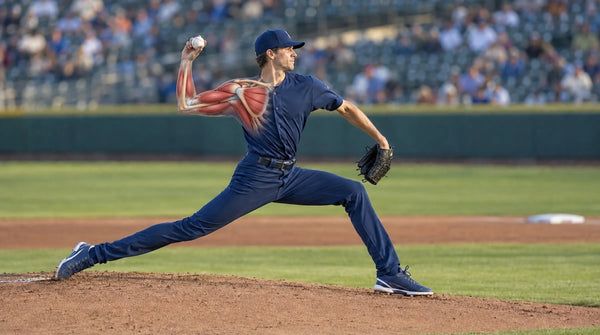
A swing is a sequenced movement organized around timing that has to be produced in advance. The hitter reads the pitch, commits weight forward, starts the trunk turn — and contact happens 150 to 175 milliseconds later. Most of that swing is built on a prediction made before full information arrived. When the pitch behaves as predicted, the swing produces its intended output. When it does not, the body has a fraction of a second to reorganize.
The problem most hitters have is not force output and not raw swing speed. It is that they cannot adjust once the swing starts. Without that adjustment capacity, they are forced out of sequence — and out-of-sequence swings leak force through the wrong segments. The trunk collapses, the front side gives, the hands cast to compensate, and the outputs coaches care about (bat speed, exit velocity, contact quality) drop. Injury risk climbs at the same time, because segments that were supposed to transfer force end up absorbing it.
The same three-part cascade — trunk failing, front side giving, arm-to-body connection breaking — shows up on every pitch designed to disrupt timing. The changeup fools the body into committing before the ball actually arrives. The sinker sets the front side to brace against a pitch that then moves late. The tunneled breaking ball forces the trunk to decelerate and re-fire in a different direction after the swing started. The fastball after three off-speed pitches arrives while the body is being organized late. One physical problem across all four: the body encountered a timing demand it could not reorganize around quickly enough.
Adjustment capacity is the training target. A hitter with more of it has more ways to get his best swing off on any given pitch — more compensations available, more sequences that still hold together, more contact quality preserved when conditions do not cooperate. A hitter with less of it has one plan per pitch and no fallback.
In this article, chaos training refers to training that deliberately introduces unpredictability — either through load instability (an implement whose resistance shifts direction) or through task variability (practice structured so no two reps present the same timing problem). Both address adaptability. Neither replaces the other.
The Bosch Framework — What Should Stay Stable and What Should Adapt
Frans Bosch’s work on athletic movement offers a useful framework for what chaos training should and should not do to a swing. He describes stable, self-organizing parts of a skilled movement as attractors — the components that stay consistent because the skill has to transfer across every situation. Adaptable parts are fluctuations — the components that adjust to changing demands. The reason a swing needs both is a control problem: the body has too many possible joint configurations to organize consciously in the 150 milliseconds a hitter has before contact. Attractors reduce the coordination problem to something the motor system can actually solve. Fluctuations do the moment-to-moment adjusting.
In a baseball swing, Bosch’s own example, the arm path from load through the contact zone is the attractor. It has to stay consistent regardless of pitch type. The trunk rotations — the lateral tilt, the pelvic timing, the front knee flex — are the fluctuations. They adjust from pitch to pitch, fastball to changeup, inside to outside, high to low. Developing good fluctuations does not make the arm path sloppy. It makes the arm path more survivable when conditions change.
Water-inertia implements train the fluctuation system. They put unpredictable demands on the trunk without changing what the arm path is doing. That is what makes them an honest complement to hitting skill work — a training quality batting practice does not address on its own.
Two Kinds of Instability — Not the Same Thing
Instability training is a broad label that covers approaches with very different mechanisms and very different outcomes.
Surface instability places the athlete on an unstable base — wobble board, balance disc, foam pad, BOSU. Training on an unstable surface reduces the force an athlete can produce by roughly 29 percent compared to stable ground. Meta-analytic and applied trials — including one in elite golfers, the closest rotational-sport analog to hitting — show limited or no benefit to strength, power, or rotational-speed outputs. For athletes developing maximal power, this is the wrong tradeoff.
Load instability is a different mechanism entirely. When a water-filled implement shifts inside its shell as the athlete moves it, the ground stays stable and the force he produces is undiminished. What changes is the load direction — the water keeps moving toward wherever the implement is going, arrives late, and pushes from the wrong direction when the athlete tries to stop. A 2026 head-to-head study of unstable load, unstable surface, and stable conditions found unstable load produced the greatest core activation of the three. Surface instability reduces force output. Load instability changes what the body must do with the force it is already producing.
What Skilled Hitters Actually Do Under Timing Pressure
Two independent research threads describe what separates hitters who survive timing stress from those who collapse under it.
The coordination work comes from Dr. Hiroki Katsumata, who used force plates under each foot of college-level batters. He found a near-perfect coupling — correlations around −0.97 — between the timing of the weight shift and the interval remaining before contact. When the weight shift started late, the interval between weight shift and swing compressed automatically so the barrel still arrived on time. The hitter was not making that adjustment consciously. His motor system was making it continuously as the swing unfolded. Skilled batters trusted this coordination; unskilled batters started the swing earlier and relied on raw swing speed to manage timing.
The practice-structure work comes from Dr. Rob Gray, who has spent more than two decades studying how batters learn. His work compared four training approaches, and the group that outperformed every other approach used what is called a constraints-led approach. In a constraints-led session, the coach changes something about the physical task — the pitch type, the timing window, the target zone, the count — so the hitter cannot repeat the same swing solution and has to find a new one. The point is not to hand the hitter a mechanical cue. It is to arrange conditions where the hitter’s own motor system has to organize a solution that works. A follow-up analysis found these hitters developed significantly more good variability (swing-to-swing changes that keep the barrel arriving on time across different pitches) and less bad variability (changes that cause the barrel to arrive early or late). Gray also found that hitters with higher bat speed got more out of variability training — physical capacity gives the coordination system more room to work with.
A hitter who trains under variable, timing-stressing conditions develops the self-organizing coordination Katsumata observed in skilled batters. A hitter who trains under repetitive, predictable conditions may groove a swing that looks good in the cage and collapses on the first changeup.
What Water-Inertia Load Does to the Muscles That Matter
The research above is about practice variability. The research below is about what load-instability training does to the muscles involved in the swing — a separate research thread.
Before getting to what the research shows, it is worth naming why the external obliques matter for hitters specifically. In a swing, force is produced by the ground and lower body, routed through the trunk, and delivered to the barrel. The external obliques are the anatomical bridge between hip rotation and shoulder rotation — the segment that either transmits force from the lower body to the arms or leaks it. When they fire inconsistently under load, the trunk collapse from earlier in this article is what shows up on video. A hitter who cannot activate his obliques reliably under an unpredictable load is a hitter whose swing breaks down first at the trunk when a pitch arrives differently than expected.
The external obliques — the diagonal muscles running from the lower ribs to the pelvis that drive rotation from the hips to the shoulders — respond differently to a shifting load than to a stable one. Water-filled implements produce dramatically higher external oblique activation than solid weights of equal mass, with the largest published effects in a 2026 controlled trial. The mechanism is straightforward: a static weight resists in one direction; a water-filled implement resists in multiple directions because the water keeps moving. The trunk musculature has to fire earlier, hold longer, and adjust continuously. The finding replicates in athletes using water-filled tubes versus barbells, with the somatosensory system — the body’s internal sense of joint position and load direction — identified as the mechanism. A separate two-week study had one group train with a water-filled tube and another with a stable tube of the same weight. The water-tube group produced measurably more consistent muscle firing from rep to rep by the end of two weeks; the stable-tube group did not change. The trunk had learned to activate more reliably under load.
None of these studies measured hitters, and none measured bat speed or contact quality. Connecting trunk-stabilizer findings to what a hitter needs when timing is disrupted is mechanistic inference — the trunk stabilizers are the segments that must hold when the swing has to reorganize. The inference is well-supported. It is not a direct hitting study. Full sample sizes are in the bibliography.
Three Coaching Problems and the Tools That Address Them
The three-part cascade points toward three distinct training demands. Each is addressed by an implement that creates the right kind of unpredictable load for that part of the chain. What follows is not a product showcase — it is three coaching problems and the mechanism that addresses each one.
Training the trunk to hold when the load shifts unexpectedly.
The trunk fails first in every timing-disruption scenario because the pitch arrived differently than the body organized for. Standard rotational training — medicine ball throws, cable rows, barbell rotations — loads the trunk against predictable resistance and does not teach it to manage a load that shifts direction at the end of the turn.
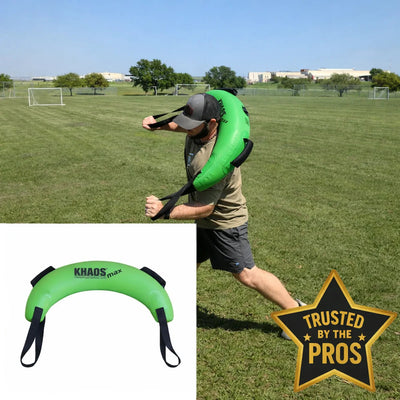
The KHAOS® Bulgarian Water Bag addresses this. Its crescent shape routes water through a curved internal path so the surge arrives at the front of the bag near the end of each rotation — not at the beginning or the middle. The athlete begins the turn with a manageable load; the challenge arrives when the turn is nearly complete and the body is in its most extended, most vulnerable position. That is precisely the moment in a swing where timing disruption causes the trunk to give way. Training the trunk to absorb an unexpected load surge at that exact moment is the mechanism the Bulgarian Water Bag was built around.
Training the front side to brace against something that will not hold still.
The front side fails second. When a pitch arrives at an unexpected location — a sinker dropping under the barrel, a two-seamer running to the hands — the front foot has to plant and brace against a rotational force the body did not fully anticipate. When the front side gives, force leaks out through the front half rather than transferring into the barrel. Coaches see this as a hitter who rolls over the pitch or looks like he is swinging with just his arms. Standard training does not replicate the demand well: a dumbbell lunge or barbell split squat provides stable load and the front side adapts to the weight, not to shifting demand.

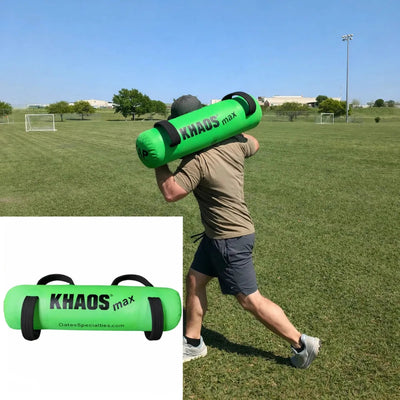
The KHAOS® Waterboy creates directional fluid instability: as the athlete moves through lunge, single-leg hold, or step-up patterns, water shifts toward the lowest point of the tube and rebounds. Any early opening of the front hip or collapse of the front knee causes the water to rush toward the low end and amplify the tipping force. The body receives an honest signal every rep: the front side either held or it did not.
Training the connection between body rotation and arm path.
The third failure — hands casting away from the body — is where coaches spend most of their verbal coaching energy. But casting is rarely the origin. It is the body’s emergency response to the two failures that preceded it: when the trunk gave and the front side opened, the arms tried to get the barrel to the ball by themselves. Train the trunk to hold and the front side to brace, and most hitters’ arm-path problems become substantially less frequent without a single hand-path drill.
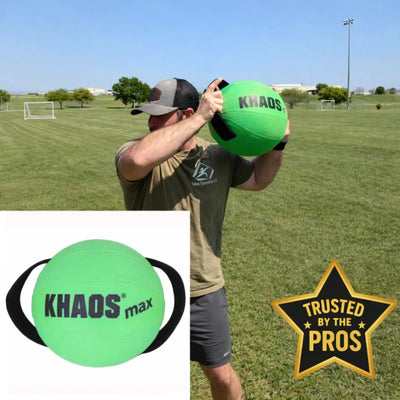
There is still a genuine training demand in the connection between trunk rotation and arm path — the two segments have to work as a linked system, not independent parts. The KHAOS® Water Ball, held at the chest in rotational drive drills, makes it impossible to use the hands to compensate for trunk failure. The water shifts through three dimensions in response to wherever the ball is going. If the arms separate from the trunk — if the athlete tries to push or pull the ball with his hands rather than rotating the trunk through — the water’s response changes, and the athlete feels the difference immediately. The implement does not tell the hitter to stay connected. It makes disconnection feel different from connection without a coach saying a word.
All exercises and training applications described in this article are general educational examples. They are not prescriptive training programs. Oates Specialties does not provide individual training instruction.
Age and Progression
Load-instability training places its heaviest demand at the most extended, most vulnerable joint position — end range of a rotation, deepest point of a lunge, farthest reach of a carry. This is also the position where younger athletes have the least established rotational strength. Start at one-quarter to one-third of maximum fill, and progress fill volume only after several sessions of clean, controlled patterns with good next-day response. Build the pattern before building the load.
Where This Fits and Where It Does Not
Load-instability training has a specific job: developing the trunk-stabilizer and somatosensory-feedback capacity that supports adjustment under unpredictable load. It does not build maximal force output. A hitter who replaces his strength training with water-implement work will develop better trunk coordination and worse maximal force output — a bad trade. The correct application is as a complement: barbells, dumbbells, and medicine balls for force production; load-instability tools for the coordination and stability demand stable training does not provide.
Practice variability is the primary driver of adjustment capacity, and it requires no specialized equipment — only a coach willing to make practice deliberately unpredictable. A hitter who trains with a water bag three times per week but faces the same fastball to the same location every day in BP is missing the point. Load-instability tools are a complement to variable practice, not a substitute. Nothing in this article supports surface instability — wobble boards, balance discs, unstable-surface work — for hitters.
The Evidence in Summary
Adjustment capacity is a physical quality, and the swing depends on it as much as it depends on force output. Training that capacity gives a hitter more ways to get his best swing off on any pitch. Skilled hitters use a self-organizing coordination pattern that responds to how a hitter is trained. Practice variability — particularly a constraints-led approach — is the primary driver of that capacity. Load-instability training is a research-supported complement that increases trunk-stabilizer activation and improves force steadiness. Surface instability is a separate approach with different evidence and is not supported here. No study has directly tested water-inertia implements on bat speed in hitters. The mechanistic case is strong. The direct hitting evidence has not yet been produced.
Where to Go Next
This article is the sixth layer in the bat speed development series. Measurement, strength, mobility, rotational power, overload and underload, and instability and chaos training together build the physical foundation a hitter uses to survive timing disruption. What remains is applying those layers over time. The next article — Applying the System Across the Season — lays out how these training qualities are sequenced across a competitive year: what gets built in the offseason, what gets maintained in-season, and what gets peaked before the games that matter most. From there, the series turns to the younger hitter, covering how to introduce these training qualities safely and progressively before an athlete has the strength base to train them the way older athletes can. How to Increase Bat Speed: A Strength-First System for Power and Transfer maps the full development chain.
Frequently Asked Questions
Because this is usually an adjustment problem, not a mechanics problem. A mechanically sound swing can still break down when the body cannot reorganize fast enough in response to a pitch that arrived differently than expected. The fix is not a new swing cue — it is building the body’s capacity to reorganize under timing pressure.
The research supports water-inertia load training for trunk stabilizer activation and for force-steadiness improvements — qualities mechanistically connected to what hitters need to survive timing-disruption pitches. The research does not yet include a direct study of water-inertia training on bat speed, exit velocity, or contact quality in hitters. The case is extrapolated from adjacent research and is sound. It is not a direct finding.
Different mechanism, different evidence. Surface instability reduces force output roughly 29 percent on average and does not produce the trunk-organization demands described here. Load instability keeps the ground stable and shifts the load itself.
No. Medicine balls build rotational force production. Water implements train the body to organize and direct force when the load is unpredictable. Both qualities matter, and neither replaces the other.
Technical Appendix
This section provides additional detail on the concepts referenced in the article. It is optional reading for coaches who want the underlying mechanisms or need to respond to technical questions.
The Coordinative Structure
Katsumata’s five-phase force-plate analysis identified a coupling correlation near −0.97 between the timing of the weight shift and the interval remaining before the start of the swing. When the weight shift starts late, the following interval compresses automatically so the barrel arrives on time. This is not a conscious adjustment — it is a self-organizing system property. Training that develops adjustment capacity should preserve this coordinative structure rather than replace it with a fixed motor program.
Attractor and Fluctuator (Bosch Framework)
Frans Bosch’s coordination framework distinguishes stable components of a skilled movement (attractors) from adaptable components (fluctuators). In a baseball swing, the arm path from load through contact is the attractor — it has to stay consistent for the skill to work. The trunk tilt, pelvic timing, and front knee flex are fluctuators — they adjust from pitch to pitch. Load-instability training targets the fluctuator system. Developing better fluctuators does not make the arm path sloppy. It makes the arm path more survivable when conditions change.
Load Instability vs. Surface Instability
Load instability: the implement itself creates an unpredictable load — water inside a bag, ball, or tube that shifts direction with movement. The ground is stable and the athlete’s force output is not compromised. Surface instability: the ground is unstable — wobble boards, foam pads, balance discs — and force output drops roughly 29 percent on average. The two approaches produce opposite effects on the qualities hitting depends on.
The Somatosensory System
The body’s internal sense of joint position, load direction, and movement feedback — separate from vision and hearing. Water-inertia loads engage this system continuously because the load direction keeps changing, preventing the body from switching off its active position monitoring once a movement pattern is memorized. Ditroilo et al. (2018) identified this as the mechanism behind the increased external oblique and multifidus activation observed with water-filled tubes.
Good and Bad Variability
Terms from Gray (2020). Good variability is swing-to-swing variation that keeps the barrel arriving on time despite different pitches and locations — a sign of adaptability. Bad variability is swing-to-swing variation that causes the barrel to arrive early or late — the source of most timing errors. Variable practice increases good variability and decreases bad variability. Repetitive practice may do the opposite.
Annotated Bibliography
Katsumata H. (2007). A functional modulation for timing a movement: A coordinative structure in baseball hitting. Human Movement Science, 26, 27–47.
https://pubmed.ncbi.nlm.nih.gov/17204344/
Force-plate analysis of five swing phases in college-level batters. Coupling correlations near −0.97 between weight-shift timing and the interval remaining before the swing. Foundational reference for the self-adjusting coordination structure and the argument that adjustment capacity is a physical quality of the skilled swing.
Gray R. (2020). Comparing the constraints led approach, differential learning and prescriptive instruction for training opposite-field hitting in baseball. Psychology of Sport and Exercise, 51, 101797.
https://doi.org/10.1016/j.psychsport.2020.101797
Forty male baseball players randomized to four conditions across six weeks. The constraints-led approach produced significantly greater improvement in both swing coordination and pitch selection than the other three approaches. Primary reference for the practice-variability half of the adaptability argument.
Gray R. (2020). Changes in movement coordination associated with skill acquisition in baseball batting: Freezing/freeing degrees of freedom and functional variability. Frontiers in Psychology, 11, 1295.
https://www.frontiersin.org/journals/psychology/articles/10.3389/fpsyg.2020.01295
Follow-up ground-reaction-force analysis of Gray’s cohort. Documents good vs. bad variability, functional coupling between swing phases, and the finding that higher bat speed predicts greater benefit from variability training. Basis for the “build capacity, then build the coordination to use it” framing.
Cho D., Kidwell J.A., Yamamoto T., Taylor S., Thomas J., Truneh N., Bright J.J., Hoang J., Shatagopam V., Goldman P., Neufeld E.V., & Dolezal B.A. (2026). External oblique activation is augmented with a water-filled resistance training implement compared to a static load. Scientific Journal of Sport and Performance, 5(3), 542–551.
https://doi.org/10.55860/CEMI8585
Randomized crossover study, twelve college-aged males. Rotational exercise with a water-filled device versus static control of the same mass. External oblique mean activation increased 85 percent (p = .002, d = 0.95); peak activation increased 77 percent (d = 1.59). Primary evidence for the load-instability activation claim in this article.
Ditroilo M., O’Sullivan R., Harnan B., Crossey A., Gillmor B., & Dardis W. (2018). Water-filled training tubes increase core muscle activation and somatosensory control of balance during squat. Journal of Sports Sciences, 36(17), 2002–2008.
https://doi.org/10.1080/02640414.2018.1431868
Eighteen elite Gaelic footballers, water-filled tube versus barbell isometric squat. External oblique and multifidus activation significantly increased with the water-filled condition (p < 0.01). Identified the somatosensory system as the mechanism behind the increased activation.
Glass S.C., & Wisneski K.A. (2023). Effect of instability training on compensatory muscle activation during perturbation challenge in young adults. Journal of Functional Morphology and Kinesiology, 8(3), 136.
https://www.mdpi.com/2411-5142/8/3/136
Two-week training intervention with thirty participants. Water-filled tube training produced significant reduction in EMG activation variability across all measured muscles. Stable-tube training group of the same weight showed no change. Basis for the force-steadiness claim in this article.
Moon S., Seo G., Lee J., Li W., Yu I., & Kim T. (2026). Effects of unstable loads and surfaces on core and lower limb muscle activation during Bulgarian squats. Journal of Back and Musculoskeletal Rehabilitation.
https://doi.org/10.1177/10538127251406954
Direct comparison of unstable load, unstable surface, and stable conditions in a lower-body compound exercise. Unstable load produced the greatest core activation of all three conditions. Key evidence distinguishing load instability from surface instability, and the basis for the distinction maintained throughout this article.
Behm D.G., & Colado J.C. (2012). The effectiveness of resistance training using unstable surfaces and devices for rehabilitation. International Journal of Sports Physical Therapy, 7(2), 226–241.
https://pmc.ncbi.nlm.nih.gov/articles/PMC3325639/
Systematic review of unstable-surface training. Mean force deficit approximately 29 percent under unstable-surface conditions. Foundational reference for the caution against surface instability in power training.
Behm D.G., Muehlbauer T., Kibele A., & Granacher U. (2015). Effects of strength training using unstable surfaces on strength, power and balance performance across the lifespan. Sports Medicine, 45(12), 1645–1669.
https://link.springer.com/article/10.1007/s40279-015-0384-x
Meta-analysis of unstable-surface training. Limited additional effects on strength and power in healthy young adults. Independent confirmation of the surface-instability caution.
Cressey E.M., West C.A., Tiberio D.P., Kraemer W.J., & Maresh C.M. (2007). The effects of ten weeks of lower-body unstable surface training on markers of athletic performance. Journal of Strength and Conditioning Research, 21(2), 561–567.
https://pubmed.ncbi.nlm.nih.gov/17530966/
Nineteen NCAA Division I soccer players. Unstable-surface group showed attenuated sprint and jump gains compared to a stable-surface group. Applied evidence for the force-cost of unstable-surface training in athletic populations.
García Sillero M., Peruzzi C., Chulvi-Medrano I., Peña J., Vargas Molina S., & de Diego M. (2022). Effects of 8-weeks of stable vs unstable surface destabilizing training on shot outcome in elite golfers. Retos, 44, 756–762.
https://doi.org/10.47197/RETOS.V44I0.91771
Twenty-five elite golfers, eight-week trial. No significant changes in club-head speed or carry distance in either group. Closest rotational-sport analog to baseball hitting — independent evidence that surface-destabilizing training does not produce the outputs a rotational-sport athlete cares about.
Bosch F. (2015). Strength training and coordination: An integrative approach. 2010 Uitgevers/Routledge.
Foundational reference for the attractor and fluctuator framework used in this article. Bosch’s work argues that skilled sport movement is best understood as a coordination architecture where some components (attractors) stay consistent and others (fluctuators) adapt to conditions. Applied here to the swing as arm-path attractor + trunk-rotation fluctuators, and to what load-instability training should and should not do to that architecture.
KHAOS® Bulgarian Water Bag. oatesspecialties.com.
https://oatesspecialties.com/products/bulgarian-water-bag
Crescent-shaped water-filled bag routing water through a curved internal path. Referenced in this article as the load-instability tool for rotational trunk organization work.
KHAOS® Waterboy. oatesspecialties.com.
https://oatesspecialties.com/products/waterboy
Cylindrical water-filled tube for lunge, single-leg hold, and carry patterns. Referenced in this article as the load-instability tool for front-side bracing and single-leg stability work.
KHAOS® Water Ball. oatesspecialties.com.
https://oatesspecialties.com/products/water-ball
Sphere-shaped water-filled implement for chest-held rotational drive drills. Referenced in this article as the load-instability tool for trunk-to-arm connection work.
Oates Specialties. How to Increase Bat Speed: A Strength-First System for Power and Transfer. oatesspecialties.com.
https://oatesspecialties.com/blogs/education-hub/how-to-increase-bat-speed
Maps the full development chain this article operates within — measurement, strength, mobility, rotational power, overload and underload training, and instability and chaos training. Adjustment capacity covered here is the sixth layer in that sequence.
About This Analysis
Created by the Oates Specialties team led by Robert Oates, M.Ed., Founder
Editorial oversight by Gunnar Thompson, BS, CSCS, General Manager
Certified Strength & Conditioning Specialist | Biomechanics Specialist
July 2026
Complete Credentials
ROBERT OATES, M.Ed., Founder: Founded Oates Specialties in 2003. Master of Education degree. Provides strategic direction for educational content and athlete development philosophy.
GUNNAR THOMPSON, General Manager: BS Kinesiology (Clinical Exercise Science). CSCS (NSCA), PES (NASM), CPPS certifications. Technical authority on biomechanics and performance science. Conducts review of all educational content for scientific accuracy.
Questions or corrections: gunnart@oatesspecialties.com
© 2026, Oates Specialties LLC