Road Less Traveled: Michael King
At 21 he threw 88 to 90 with no real off-speed pitch, so he learned to study hitters, sequence pitches and win with command. Ten years later, the harder lesson was knowing when to put the scouting report down.
November 2026
Road Less Traveled is not only about athletes with unusual paths. It is about what athletes do when the path that carried them forward stops working.
🎧 Prefer to listen? Audio version of this article:
“My greatest strength as a pitcher was knowing the hitter’s weakness.”
Michael King, on the Dirt From the Dugout podcast
Game Mode: Drafted During the 2016 Coral Gables Super Regional
Coral Gables, Florida. June 11, 2016.
Boston College had never played in an NCAA Super Regional until that weekend. It lost the first game to Miami, 12–7. One more loss and the season was over.
The pitcher Boston College handed the ball to was a junior from Warwick, Rhode Island, named Mike King. He was 6-foot-3 and threw a sinking fastball in the upper 80s. Baseball America’s draft report that spring was polite and blunt at the same time. King “doesn’t have overwhelming stuff,” it said, “but he commands an upper 80s fastball with sink, touching 92 mph.” It also called him “a plus competitor.”
The Major League draft was going on that same day. After the first inning, the news came: the Miami Marlins had taken him in the 12th round, 353rd overall. “My teammates come over and congratulated me,” he said after the game. MLB.com later reported that his mother, in tears, ran down from the stands to the Boston College dugout to tell him.
So here was the situation. A college pitcher had just been drafted by Miami’s big-league team while he was in the middle of pitching against Miami’s college team. He kept pitching. “I struck out only three in a row after I found out,” he told The Heights, the Boston College student paper, “but hey, who’s counting?”
Then came the fourth inning. Miami’s Zack Collins hit a home run. Two singles and a bloop over second base later, Miami led 2–0 and had the bases loaded with one out. Pitching coach Jim Foster walked to the mound. King struck out Edgar Michelangeli and got Carl Chester to fly out.
He finished six innings on 99 pitches. He gave up nine hits and three runs and walked four, a career high. It was not a clean line. Boston College won anyway, 5–3, and forced a deciding game.
Head coach Mike Gambino described the Collins home run the way a coach talks about a pitcher he trusts. “He made a mistake with Zack Collins, and he does what he does with mistakes: he put it off the garage.”
After the game, King explained how he had done it. It wasn’t about overpowering anyone. “Against good hitters you can’t fall behind,” he said, “because they’re going to hit every ball that I have to leave over the plate.” His plan was “getting ahead of hitters and then kind of just nibbling at the corners.” As for the draft, he said he hadn’t even processed it yet. “I still was in game mode the entire time.”
Miami won the next day, 9–4, and went on to the College World Series. Boston College’s season was over. But the 21-year-old in that postgame video had already described the pitcher he would spend the next ten years becoming: a pitcher without overpowering stuff who won by staying ahead, knowing the hitter and not letting the moment pull him off his plan.
This story is about how that pitcher was built. It is also about the two times that same approach needed adjusting. Once was when his body was telling him something he didn’t want to hear. The other was when all that preparation started to weigh more than it helped.
I Wasn’t Throwing That Hard: Warwick, Rhode Island and Bishop Hendricken
King was born in Rochester, New York, and grew up in Warwick, Rhode Island. His father, Jim, was a television news anchor who worked at stations across the Northeast before taking a job in Providence when Michael was about 4. When the Providence contract ended, another move was an option. His mother, Michele, didn’t want to. “We can’t just be moving them every couple of years,” Michael remembers her saying. So Jim started an ice cream company. He called it Gaga’s, after his grandmother, whose sherbet recipe the family had loved for years, and he kept doing news work on and off.
The change gave Michael something specific. As an anchor, his father had worked evenings. “I was asleep by the time he came home, so he wasn’t able to see me play baseball,” King told MLB.com. As an ice cream salesman who set his own hours, Jim could be there. Michael put stickers on the pint lids. “He probably put us through some child labor laws,” he joked.
He wasn’t a baseball-only kid. At Bishop Hendricken High School he was a 6-foot-3 basketball center who, by his own account, was sure he was going to go pro in basketball. Baseball took the spring and summer. Basketball took the fall and early winter. When basketball ended, he had January, February and March to get ready: “a throwing program, a little bit of a lifting thing,” time in the batting cage, and “throwing long toss into a net even, whatever I could do just to get ready for that season.” The seasonal break gave him a change of focus before baseball resumed each spring.
He won. In May 2013, as a senior, he struck out 11 in a complete game against Johnston, the defending Division II champion, and finished it with a strikeout with runners on second and third. Hendricken won state championships in 2012 and 2013. As a senior captain he went 11–0 with a 0.30 ERA, according to Boston College’s records, and was named Rhode Island’s Gatorade Player of the Year.
Matt Blake, later the Yankees’ pitching coach, first crossed paths with him at a high school charity game. “He was one of those guys who had a lot of poise on the mound, had a really good understanding of himself and could execute a game plan,” Blake told MLB.com in 2020. “The ingredients of the person and the poise were all there from the high school level.”
What wasn’t there yet was the arm. “I don’t think I was that good in high school,” King said in a 2026 interview. “I wasn’t throwing that hard. I didn’t get drafted out of high school.” He knew he wasn’t ready for professional baseball, and he committed to Boston College.
88 to 90: Learning to Pitch at Boston College
College is where the obstacle got specific. “I was 88 to 90 in college,” King said on the Dirt From the Dugout podcast. “I didn’t have an off-speed pitch. I had to learn how to pitch. I had to learn how to sequence. I had to learn how to read swings, because I didn’t have this electric stuff.”
Even the breaking ball that worked in high school stopped working. “The curveball that I threw when I got to college was really, really bad,” he said years later. “It played in high school, didn’t play in college, so I had to figure something else out.”
He credits Jim Foster, Boston College’s pitching coach, with the reading part. “He was able to teach us how to read swings, read hitters, and that’s the kind of stuff that I took with me into pro ball,” King said in 2018. He also remembers how Foster reacted when King came back from a sophomore-year visit with pitching instructor Tom House carrying a pile of new ideas. Foster wasn’t offended. As King tells it, Foster believed a coach who stops trying to learn has become a bad coach. “I took that to heart,” King said, “and I said the same thing as a player.”
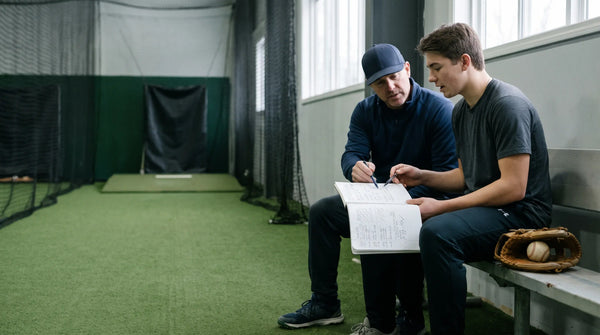
Then he did something with it. He started writing everything down. MLB.com’s Gary Phillips, reporting on King’s notebooks and binders in 2020, wrote that the notes “exceed any reasonable expectation of the word detailed.” King kept a section for every team he had ever faced. Each section listed every hitter on that team in alphabetical order, with the result of every at-bat, the sequence of every at-bat, and notes on why he had pitched each one the way he did.
His roommates were part of it. King, pitcher Justin Dunn and catcher Nick Sciortino spent nights watching college baseball on ESPN3. King built scouting reports for himself and for Dunn, based on how similar pitchers had done against upcoming opponents. Gambino even let them call some of their own games, something that rarely happens in college baseball.
King explained the point with something every student understands, echoing what Gambino used to preach. “You go into a test in school, and you studied your rear off for it, you know everything like the back of your hand,” he said. “You get that test, you’re not nervous at all.” If you go in unprepared, he said, you’re nervous about whatever questions might come. “And I never wanted to feel that while I was on the mound.”
The same attention to detail surfaced in real time. In the 2016 regional round, King noticed early that Utah’s coaches had picked up on his changeup and were tipping off their hitters. He worked his way out of the third inning anyway, then had words with Utah’s third-base coach on his way back to the dugout. Boston College rallied to win, 4–3.
That moment shows the other side of him. Away from the field, people who knew him described King as “easygoing, shy, polite.” On the mound, MLB.com reported, “King’s fire and intensity have scared coaches from pulling him and teammates from approaching him.” Dunn said it more simply: “He hates losing. When he plays, he blacks out and turns into a monster.”
Even his walkout song carried that edge. His sister, Olivia, a recording artist, wrote and recorded “Messin’ With the King” and surprised him with the music video on Christmas Eve during his junior year of college. When Dunn’s father first heard it, Dunn remembered, he said, “Whoa, if he’s gonna walk out to that, he’s gotta be a bad dude.”
Gambino didn’t see any contradiction between the polite kid and the monster on the mound. “People think toughness has to translate to kind of being a jerk,” he said. King, in his view, proved it didn’t. King calls Gambino “one of the most influential guys in my life, just based on the character side of it.”
Gambino gave him one more piece of advice that spring, and King still repeats it. With the draft coming, it was easy to treat every start like an audition. “If you think about raising your Draft stock every time you pitch, it’s going to add way too much pressure on yourself,” King remembers Gambino telling him. “Just focus on winning, and your numbers are going to show up.” Years later, that is the advice he connects to the calm he showed on draft day, when he said, “I still was in game mode the entire time.”
King has said he didn’t really find himself as a pitcher until his sophomore year, and that he has “no idea” whether he would have found it as a 19-year-old in a rookie league. By the time he left, he had a 3.14 career ERA, second-best in school history. He sums up what he built there in one sentence: “My greatest strength as a pitcher was knowing the hitter’s weakness.”
Traded to New York: The 2017 Deal and the 2018 Breakout
In November 2017, the Marlins traded him to the Yankees, along with international bonus money, for Garrett Cooper and Caleb Smith. He got the call while he was working out in Lincoln, Rhode Island, and had to cancel a lesson he was supposed to give a high school student that day.
What came next surprised people. In 2018, across three minor league levels, King went 11–5 with a 1.79 ERA in 161⅓ innings. He struck out 152 and walked only 29. Hadi Raad, the Yankees’ director of minor league operations, watched him pitch several times. “He paints corners with his fastball,” Raad said. “He’s fearless. He throws a ton of strikes.”
Brian Cashman gave the Marlins credit. “In fairness to the Marlins, what he has become is not what was traded,” he told Joel Sherman of the New York Post that August. In Cashman’s words, King had “jumped a category or two.”
That September, a Yankees video caught King walking through his routine. “I watch the last 25 at-bats of a hitter against a right-handed pitcher, and then I look at their spray charts and their heat zones,” he said. “I’ll do my own scouting report, and then I refer to those spray charts and heat maps to make sure that I’m right.” He was 23. The college notebooks had become a professional habit.
The scouts still saw the same limit. Baseball America’s 2019 report said it plainly: “While none of King’s pitches is truly a knockout, his plus command amplifies his entire arsenal.” It projected his most likely future as a back-of-the-rotation starter. The same report called his two-seamer his “money pitch,” one he could start at a left-handed hitter’s hip and bring back over the inside corner.
A stress reaction in his elbow cost him the first half of 2019. He returned in July and made his major league debut at the end of September.
When One Pitch Wasn’t Enough: Meeting Major League Hitters
Then came the problem command couldn’t solve. When he reached the majors, King said, “I basically only had a sinker. … So I felt like I got exposed once I got to the big leagues.”
In the minors, commanding one good pitch could carry him through a lineup. Major league hitters could look for that pitch and wait for it. The skills he had built in college still mattered. By his own account, they just weren’t enough by themselves anymore.
That is the real obstacle in this story. It isn’t that he was overlooked. He was drafted, traded for and promoted. It’s that the strength he built before his velocity and pitch mix caught up had a ceiling, and he had reached it.
A Borrowed Breaking Ball: The 2021 Slider Grip From Corey Kluber
The next piece came from a bullpen session in May 2021. King tells it this way: the day before Corey Kluber’s no-hitter, Kluber, then his Yankees teammate, watched King throw what King called “one of the worst sliders known to man.” “He gave me like a little bit of a grip change and a cue, and I threw the first one, and on TrackMan it actually had the movement that I wanted,” King said on Kluber’s podcast years later.
Kluber no-hit the Texas Rangers on May 19. It took King “a couple more bullpens” before he tried the new pitch in a low-pressure spot in a game. “I think the first one I threw was a swing-and-miss.”
The point isn’t that Kluber fixed him. King has said only that the grip and the cue “just made sense.” The point is that a pitcher who had spent years learning how hitters react knew right away what a new pitch was for.
About two weeks later, on June 4, 2021, he struck out Boston’s Hunter Renfroe, Marwin Gonzalez and Christian Vázquez on nine pitches. It was only the seventh immaculate inning in Yankees history.
The Yankees used him mostly in relief over the next two seasons. He kept preparing as if he would start anyway. “I’m still training this offseason to be a starter,” he said in early 2022. His reasoning was practical. A starter can always be moved to the bullpen, but a pitcher built up only as a reliever can’t get ready to start quickly if the team suddenly needs one.
The 2022 Elbow Fracture: What King Later Acknowledged
By the middle of 2022 he was one of the best relievers in baseball. When he got hurt, he ranked second among major league relievers in both strikeouts and innings. On July 22 at Baltimore, he retired the first three batters he faced and then left the game with a fractured right elbow. His season was over.
The next spring, he said something few athletes say in public. “It got to the point where it didn’t really feel good at any day, but I would not tell trainers that, and this is what happens,” King told reporters in March 2023.
It’s worth reading that carefully, and not reading more into it than he did. He didn’t say that speaking up would have prevented the fracture, and this story won’t either. What he described was a gap between what he felt and what he told the training staff. King had previously been described as an intensely competitive pitcher. His later admission about the elbow revealed something different: he had not told the training staff how often it felt wrong. He did not explain why, and the available reporting cannot establish it. He didn’t explain why he stayed quiet.
His teammates didn’t forget him while he was out. That fall he traveled with the team alongside other injured relievers. When the Yankees clinched the division, the bullpen brought him into the celebration by video call. “You’re still a huge part of this team,” rookie reliever Ron Marinaccio told The New York Times.
Why Not Start? The 2023 Move From the Bullpen to the Rotation
When he came back in 2023, the Yankees’ rotation was thin from injuries, and King was working as a long reliever who still pitched in high-pressure spots. He made his case to manager Aaron Boone directly. “You trust me in high leverage to go multiple times through the order,” he remembers telling Boone. “Why wouldn’t you let me just do it to start the game and use me for 100 pitches instead of the 45 that I’m doing?” There was some pushback. Boone eventually said yes.
The bridge from one job to the other came from a coach who understood how King already thought. “Harkey told me, ‘Treat it like it’s seven one-inning bullpen outings,’” King said, referring to Yankees bullpen coach Mike Harkey. “That’s actually been a good transition piece for me.” On September 20, he struck out a career-high 13 Toronto Blue Jays over seven innings. “I know I had opportunities in 2020 and 2021,” he said, “but I felt like I didn’t capitalize on them.”
Wedding Week: The December 2023 Trade to San Diego
That December, King and his fiancée, Sheila, had tickets to the Rockettes. Trade rumors were everywhere. “You know, this could happen while you’re at the Rockettes,” his agent told him. King said his phone sat on his knee the whole show. Brian Cashman’s call came after they got home. King was headed to San Diego in the trade that sent Juan Soto to New York. “That Wednesday night,” King said, “neither of us really slept.”
They were married at the Pierre Hotel in Manhattan ten days after the trade became official. “It was like our going away party,” he said. Even that week, he made time for long phone calls with Padres manager Mike Shildt, pitching coach Ruben Niebla and veteran pitcher Joe Musgrove. Getting to know the people he would be working with was part of the preparation too.
Learning to Give Up a Run: Becoming a Starter in San Diego (2024–2025)
Starting every fifth day meant unlearning part of what the bullpen had taught him. A reliever’s job, he said, is learning “how to put up a zero.” A starter can give up a run or two in the first five or six innings and still do his job. King kept trying to strike everybody out. “I’m just going to strike out the world,” he remembers thinking. “And now all of a sudden my pitch count goes through the roof, and I only go five innings when I should be cruising.”
Niebla kept pulling him back. “Get that out of your head,” King recalls Niebla telling him, “because it’s okay if we’re up 5 to nothing and you have bases loaded, you can minimize and stay efficient.”
The next spring, King described the same problem from a different angle. “In April and May, I was doing scouting, trying to get as much swing-and-miss as I possibly can,” he told MLB.com’s Mark Feinsand. “I would go four innings with 90 pitches. Is that actually valuable to the team?” Even his preparation had to change. Scouting for strikeouts wasn’t the same thing as scouting to pitch deep into games.
His pitch mix changed, too. MLB.com’s player notes show the changeup became a much bigger part of his plan in his first season in San Diego.
It came together. In 2024 he went 13–9 with a 2.95 ERA and 201 strikeouts in 173⅔ innings and finished seventh in the National League Cy Young voting. In his first postseason start, Game 1 of the Wild Card Series against Atlanta, he threw seven scoreless innings with 12 strikeouts and no walks.
A pinched nerve in his right shoulder interrupted his 2025 season.
Mentally Exhausted: The 2026 Lesson About the Scouting Report
In early May 2026, King had a 2.95 ERA through seven starts. By most measures he was pitching well. Asked whether he had actually been good, he answered, “Not at all.”
Then he explained what was bothering him, and it wasn’t his stuff.
“I’m mentally exhausted after these games. Because I need to go straight to the scouting report. I do my scouting to get through a tough inning or situation. But then it should come back to my strengths: I have the sinker command, I just attack guys.”
Michael King, to MLB.com, May 2026
This is the lesson of King’s career, and it took him ten years to say it that clearly. The habit that built him, studying hitters until he knew their weaknesses, was meant to be a tool for tough spots. Somewhere along the way it had become something he carried onto every pitch. Talking about his college coaches, he had already named the risk. Some players, he said, “take on almost too much information and don’t know how to filter out what is actually beneficial.”
It didn’t fix itself right away. By late June he had a 6.41 ERA over his previous five starts. Then, on Monday, June 22, he threw seven scoreless innings in a 1–0 win over the Braves. Afterward he described a different version of the same trap. “I was tired of getting beaten up out there,” he said. “Got a little bit away from the mechanical feel and was just competing out there. And I know the mechanics will get there, but I always felt like one of my strengths was being able to figure it out on the fly and working with what I got, and I got away from that the last four or five starts.”
In May it was too much scouting. In June it was too much thinking about mechanics. Both times, his answer was the same: go back to competing with what he had.
In late September, before the Padres’ Wild Card Series against the Cubs, he explained what had come together in the second half. “Mechanically, I got pretty consistent, especially with the fastball delivery,” he said. “I think the main key was getting fastball command.” He believed it also helped his velocity “tick up a little bit.” That is how he explains it.
He finished 2026 at 12–10 with a 3.21 ERA in 32 starts and a career-high 185 innings. The numbers alone can’t show whether the May reset produced them. What is on the record is this: in 2016 he described his plan as “getting ahead of hitters and then kind of just nibbling at the corners.” In 2026 he described it as “I have the sinker command, I just attack guys.” Ten years apart, it was the same foundation.
Why It Matters: What King’s Path Shows Young Pitchers
Many high school pitchers are still developing velocity, command and a reliable secondary pitch. King’s story is useful to them not because it promises the same ending, but because it shows what can be built in the meantime.
King describes his own order of events. First came the knowledge: sequencing, reading swings, knowing the hitter. Then, he said, “I got bigger, stronger, learned how different pitch grips … made my secondary pitches better, started throwing harder.” Once both were in place, “I now could combine some nasty movement with some great sequences and the knowledge of reading swings.” In his view, “the development piece” should come after “the knowing how to win piece.” That is one pitcher’s account of his own path, not a formula. But it reverses the way many young pitchers think about it. The command and the homework aren’t a substitute for stuff that you drop once your velocity arrives. In King’s case, they were what the better stuff got built on.
His story also shows that a strength can turn into a weakness when it never gets turned off. The two harder lessons in his story are not the same lesson. The elbow was about noticing a physical problem and telling someone who could help. The scouting was about noticing that a process that used to help had stopped helping, even though he was getting results. One is speaking up about the body. The other is questioning the routine. Neither means he should have cared less or prepared less. Both mean the pitcher has to keep checking whether a habit is still serving him.
No. 14: Bishop Hendricken Retires King’s Number
On January 12, 2026, King went back to Bishop Hendricken, where the school retired his No. 14. Athletics director Jamal Gomes said what he hoped the students would take from the visit: “The level of preparation, how he studies hitters.”
King talked about something else.
“What Hendricken gave me was a strong foundation. How to compete with class, how to respond when things don’t go your way, and how to stay grounded.”
Michael King, January 12, 2026
How to respond when things don’t go your way: that line connects the 21-year-old in Coral Gables to the 30-year-old who called himself mentally exhausted with a 2.95 ERA. Each time the path that had carried him stopped working, he adjusted without throwing away what had gotten him there. It happened with the ordinary fastball, the one-pitch arsenal, the 2022 elbow fracture and the scouting that wouldn’t switch off.
He is still the pitcher from that postgame video. He gets ahead, he knows the hitter and he tries to stay in game mode. He has just learned when to put the notebook down.
Road Less Traveled Takeaway
If you remember one thing from Michael King’s story, let it be this: the skills you build when your stuff is ordinary are not something you outgrow. They are the foundation. King built command and preparation first, then added to them. His harder lessons came later: speaking up about what his body was telling him, and recognizing when preparation had become a weight instead of a tool.
What a Young Pitcher Can Borrow: Six Habits From King’s Career
These are habits King has described in his own career. They are not a plan to copy. Players who want to try one can talk it over with their coach, who knows their age, workload and goals.
- A notebook. King kept notes on every hitter he faced: what he threw, what happened and why he chose each pitch. A young pitcher can keep a simple version of this with a pencil.
- Getting ahead. At 21, his plan was to get ahead and then work the edges of the plate. He showed that owning the first pitch of an at-bat doesn’t require a big fastball.
- Knowing when the scouting report helps. King studied hitters before games, then learned to notice when the report was helping and when it was getting in the way of his strengths. That is the lesson he put into words in 2026.
- Saying when something doesn’t feel right. King’s own words explain why this is on the list: “I would not tell trainers that, and this is what happens.” Coaches, athletic trainers and parents can only help with problems they know about.
- Not treating every outing as an audition. Gambino’s advice to King, as King remembers it, was to focus on winning and let the numbers show up.
- Recognizing when a strength has reached its limit. Command and preparation took King a long way, but they weren’t enough by themselves. He added to that foundation instead of replacing it.
Coaching Boundary
This feature is educational. Michael King’s professional routines, workloads and decisions are described as his own experience, not as a plan for amateur athletes. Nothing here is medical advice. If an athlete has pain, or symptoms that are getting worse, keep coming back or limit how he throws, follow team or school policy and seek evaluation from a qualified professional.
Editorial Disclosure and Methodology
Public-record reporting. This feature was written from published reporting, official records, press-conference transcripts, podcasts and video interviews. No interviews were conducted with Michael King, his family, his coaches or his teammates. Quotations are attributed in the text to the reporting, interview, transcript or recording through which they were verified. Where an original source is identifiable, it is included in the bibliography. Scenes are reconstructed only from what those sources describe.
Video and audio quotations. Quotes from video and podcasts were checked against auto-generated captions or published transcripts. Filler words such as “uh” and repeated words were removed without changing the meaning. Timestamps appear in Appendix A. Caption timestamps can shift slightly between versions of a video. Automatically generated captions and transcripts can contain errors.
Conflicts between sources and how they were handled.
- Where King learned he had been drafted. The June 11 postgame video places the news in the dugout after the first inning. The Heights quotes King saying he found out in the clubhouse. MLB.com separately reports that his mother ran from the stands to the Boston College dugout to tell him. These accounts differ on where King personally received the news; the story attributes the mother’s action to MLB.com and does not resolve the discrepancy.
- Miami’s ranking. The Heights lists Miami as No. 3 and Boston College Athletics lists it as No. 2, most likely from different polls. The story leaves the ranking out.
- Senior-season record. Boston College’s official bio lists 11–0 with a 0.30 ERA. At least one secondary source lists 7–0. The story uses Boston College’s figure and credits it.
- His first Yankees game as a fan. MLB.com places it at Game 5 of the 2003 ALCS. A Cranston Herald reporter’s narration says 2004, though King’s own quote there gives no year. The episode isn’t used.
Left out on purpose. King’s October 2026 relief appearance. Contract terms and free-agency coverage. Family details beyond his parents, his sister and his wife’s first name in the wedding scene. Pitch-usage data and velocity readings, which belong in the Education Hub companion (Appendix B).
Contributors. Coaches and teammates appear in King’s own words or in the reporting that quoted them. The story does not credit any one coach, cue or drill with causing his improvement.
Editorial independence. Oates Specialties is a current vendor of training products to organizations throughout professional baseball. It has sold products to the New York Yankees, San Diego Padres, Atlanta Braves and Miami Marlins in the past and remains available to each as a vendor on an at-will, as-needed basis. No sales involved Michael King or Matt Blake. Oates Specialties did not seek any organization’s permission, input or review, and neither Major League Baseball nor any of those organizations knew of, reviewed or approved it, in concept or in draft. Oates Specialties has no other affiliation with Michael King, Major League Baseball or any outlet cited here. Names are used only to identify public events and sources. Nothing in this feature suggests endorsement, and no products are mentioned or linked. The Dirt From the Dugout podcast is co-hosted by Karl Ravech, whom MLB.com describes as one of Jim King’s connections from his news career. That relationship is disclosed here for transparency.
Annotated Bibliography: Verified Sources by Topic
One deduplicated list, grouped by topic. All 47 URLs were opened and confirmed active between November 13 and November 15, 2026. A few publishers, including Baseball America, the Providence Journal and the Cranston Herald, block automated access or meter articles, so those links may require a normal browser or a subscription.
The 2016 Super Regional
Boston College Athletics (video) — Postgame press conference, Game 2 of the 2016 Coral Gables Super Regional, June 11, 2016. Source for “nibbling at the corners,” “my teammates come over and congratulated me,” the draft news coming after the first inning, and “I still was in game mode the entire time.” Timestamps in Appendix A. https://www.youtube.com/watch?v=i3dqGpBIJYA
The Heights (Boston College student newspaper) — Game 2 story on King and the Super Regional, June 2016. Source for the fourth-inning sequence (Collins home run, bases loaded, Foster’s visit, the Michelangeli strikeout and Chester flyout), the six-inning, 99-pitch line, Gambino’s “off the garage” quote, and King’s “who’s counting?” remark. https://bcheights.com/118607/top-story/boston-college-baseball-miami-super-regional-mike-king/
Boston College Athletics — “Historic 2016 Season Comes to End in Miami,” June 12, 2016. Source for the 9–4 Game 3 result and Boston College’s first Super Regional appearance. https://bceagles.com/news/2016/6/12/baseball-historic-2016-season-comes-to-end-in-miami
Baseball-Reference, BR Bullpen — 2016 College World Series Super Regionals. Corroborates the Coral Gables series results, including the 12–7 and 5–3 scores, and Miami’s advance to Omaha. https://www.baseball-reference.com/bullpen/2016_CWS_Super_Regionals
Baseball America — Michael King player page and scouting reports. Source for the 2016 draft report (“doesn’t have overwhelming stuff,” upper-80s sinker touching 92, “plus competitor”), the 12th-round, 353rd-overall selection, and the 2019 report (“none of King’s pitches is truly a knockout,” back-of-the-rotation projection, pitch descriptions in Appendix B). https://www.baseballamerica.com/players/4135-michael-king/
Family, high school and Rhode Island
AJ Cassavell, MLB.com — Father’s Day story on Jim King and Gaga’s, June 18, 2026. Source for the anchor career, the Providence move, Michele King’s “We can’t just be moving them” line, the Gaga’s name and pints, “I was asleep by the time he came home,” “child labor laws,” and Jim King’s connection to Karl Ravech. https://www.mlb.com/padres/news/michael-king-padres-thankful-on-father-s-day
GoLocalProv — “King Strikes Out 11 to Keep Hendricken Baseball Undefeated,” May 2013. Source for the complete game against defending Division II champion Johnston and coach Ed Holloway’s account of the final strikeout with runners on second and third. https://www.golocalprov.com/sports/king-strikes-out-11-to-keep-hendricken-baseball-undefeated
Bishop Hendricken High School — “Bishop Hendricken Welcomes Home MLB Pitcher Michael King ’13.” Source for the 2012 and 2013 state championships, the 2013 Gatorade honor and the number-retirement ceremony. https://hendricken.com/news/michaelking/
Providence Journal — Story on King’s number retirement at Hendricken, January 13, 2026. Source for the January 12 ceremony and King’s “strong foundation” remarks. https://www.providencejournal.com/story/sports/mlb/2026/01/13/san-diego-padres-pitcher-michael-king-has-number-retired-at-hendricken/88150459007/
Ocean State Media — “From Drake Maye to Michael King, Rhode Island fans suddenly have everything to watch,” January 16, 2026. Source for athletics director Jamal Gomes’s “level of preparation” quote. https://www.oceanstatemedia.org/sports/2026-01-16/from-drake-maye-to-michael-king-rhode-island-fans-suddenly-have-everything-to-watch
Cranston Herald — “That call, it was the NY Yankees.” Rhode Island coverage of the 2017 trade. Source for the workout in Lincoln and the canceled lesson. https://cranstononline.com/stories/that-call-it-was-the-ny-yankees,132716
HollywoodLife — Interview with Olivia King, April 29, 2021. Corroborates the origin of “Messin’ With the King” as a gift to her brother. https://hollywoodlife.com/2021/04/29/olivia-king-brother-yankees-pitcher-music-interview/
Boston College and the minor leagues
Boston College Athletics — Mike King roster biography. Source for the 11–0, 0.30 ERA senior season, the Gatorade honor and the 3.14 career ERA ranking second in school history. https://bceagles.com/sports/baseball/roster/mike-king/7087
Gary Phillips, MLB.com — “Michael King a fierce competitor for Yankees,” February 17, 2020. Source for the notebook description, the ESPN3 nights and scouting reports for Dunn, the test analogy, the Utah changeup game, “easygoing, shy, polite,” “scared coaches from pulling him,” Dunn’s “monster” and walkout-song quotes, Gambino’s “jerk” remark, King on Gambino’s influence, his mother’s run to the dugout and Matt Blake’s quotes. https://www.mlb.com/news/yankees-michael-king-fierce-competitor
Boston College Athletics — “King Carries Birdball Mentality to Pro Ball,” October 12, 2018. Source for King’s credit to Jim Foster for teaching him to read swings and hitters. https://bceagles.com/news/2018/10/12/baseball-king-carries-birdball-mentality-to-pro-ball
New York Yankees — Press release on acquiring King from Miami, November 2017. Source for the trade terms (Garrett Cooper and Caleb Smith, plus international bonus money). https://www.mlb.com/press-release/yankees-acquire-minor-league-pitcher-michael-king-from-miami-262243698
MiLB.com — “Michael King reigns among next wave of New York Yankees prospects,” 2018. Source for the 2018 minor league line (11–5, 1.79 ERA, 161⅓ innings) and Hadi Raad’s “paints corners … fearless” quote. https://www.milb.com/news/michael-king-reigns-among-next-wave-of-new-york-yankees-prospects-301086680
New York Yankees (video) — King on his scouting routine, September 2018. Source for “the last 25 at-bats … spray charts and heat zones.” https://www.youtube.com/watch?v=pNSLIMRGM18
Joel Sherman, New York Post — “A trade throw-in has become rising Yankees starter prospect,” August 20, 2018 (print edition August 21, 2018, as “Prospect King a surprising diamond in the rough”). Primary source for Brian Cashman’s “In fairness to the Marlins, what he has become is not what was traded” and “jumped a category or two.” https://nypost.com/2018/08/20/a-trade-throw-in-has-become-rising-yankees-starter-prospect/
Barry Jackson, Miami Herald — Marlins player-development column, August 28, 2018. Confirms the full Cashman passage and its attribution to Joel Sherman of the New York Post. https://www.miamiherald.com/sports/spt-columns-blogs/barry-jackson/article217476760.html
Sam Dykstra, MiLB.com (Toolshed) — Story on King’s 2019 season and debut. Source for the elbow stress reaction, the July return and the late-September debut. https://www.milb.com/news/toolshed-new-york-yankees-michael-king-recalls-major-leagues-last-debut
Yankees years, 2020–2023
MLB.com — List of no-hitters. Confirms Corey Kluber’s no-hitter against Texas on May 19, 2021. https://www.mlb.com/news/no-hitter-c265779246
WFAN / Audacy — Report on King’s immaculate inning, June 4, 2021. Source for the nine-pitch inning against Renfroe, Gonzalez and Vázquez and its place as the seventh in Yankees history. https://www.audacy.com/wfan/sports/yankees/michael-king-throws-immaculate-inning-vs-red-sox
Bryan Hoch, MLB.com — “Yankees’ Michael King suffers serious elbow injury,” July 23, 2022. Contemporaneous injury report on King’s July 22, 2022 appearance at Baltimore, his departure with a right elbow injury, the initial X-ray reading of a fracture, and his 66 strikeouts in 51 innings, which trailed only Edwin Díaz among major league relievers. https://www.mlb.com/news/yankees-michael-king-suffers-serious-elbow-injury
MLB.com — Michael King player page. Source for the 2022 reliever rankings and elbow fracture, the 2024 changeup note and 2026 season totals. https://www.mlb.com/player/michael-king-650633
Greg Joyce, New York Post — “Yankees’ Michael King on track for opener after broken elbow,” March 7, 2023. Original source for King’s “I would not tell trainers that” remark to reporters in March 2023. https://nypost.com/2023/03/07/yankees-michael-king-on-track-for-opener-after-broken-elbow/
R.J. Anderson, CBS Sports — Story on King’s move to the rotation, September 20, 2023. Secondary report of the “I would not tell trainers that” remark; links to the New York Post original. https://www.cbssports.com/mlb/news/yankees-michael-king-may-be-rotation-help-they-desperately-need-after-being-converted-from-reliever/
The New York Times — Story on King during the 2022 postseason, October 21, 2022. Source for his travel with the injured relievers, the clinch video call and Ron Marinaccio’s quote. https://www.nytimes.com/2022/10/21/sports/baseball/michael-king-yankees.html
MLB.com — “Michael King strikes out career-high 13 batters,” September 2023. Source for the 13-strikeout game on Wednesday, September 20, 2023, Mike Harkey’s “seven one-inning bullpen outings” advice and “I didn’t capitalize.” https://www.mlb.com/yankees/news/michael-king-strikes-out-career-high-13-batters
FanGraphs — “Michael King Has Assumed His Right Place as a Starting Pitcher.” Source for starter and reliever sinker usage in 2023 (Appendix B). https://blogs.fangraphs.com/michael-king-has-assumed-his-right-place-as-a-starting-pitcher/
Padres years, 2024–2026
MLB.com — Story on the wedding and the Soto trade. Source for the Rockettes scene, the agent’s warning, Cashman’s call, “neither of us really slept,” the Pierre wedding, “our going away party,” and the calls with Shildt, Niebla and Musgrove. https://www.mlb.com/news/michael-king-wedding-trade-to-padres
Thomas Harrigan, MLB.com — “Michael King’s potential in first year as starter,” March 9, 2024. Source for King’s comment that Kluber’s grip and cue “just made sense” and for 2023 pitch-mix data (Appendix B). https://www.mlb.com/news/michael-king-potential-in-first-year-as-starter
Mark Feinsand, MLB.com — “Michael King seeks 200-inning season,” March 2, 2025. Source for “In April and May, I was doing scouting … Is that actually valuable to the team?” and for King’s account of Gambino’s draft-stock advice (“If you think about raising your Draft stock every time you pitch …”). https://www.mlb.com/padres/news/michael-king-seeks-200-inning-season
AJ Cassavell, MLB.com — “With King (12 K’s, 0 runs), Padres had an ace up their sleeve,” October 2, 2024. Recaps King’s October 1 postseason debut: seven scoreless innings, 12 strikeouts and no walks against Atlanta. https://www.mlb.com/news/michael-king-first-postseason-start-unparalleled
MLB.com — “Here are the Cy Young Award vote totals,” November 21, 2024. Official Baseball Writers’ Association of America results; source for King’s seventh-place finish, with 14 points, in 2024 National League voting. https://www.mlb.com/news/2024-mlb-cy-young-award-voting-results
MLB.com — “Michael King diagnosed with pinched nerve in shoulder,” 2025. Source for the 2025 injury. https://www.mlb.com/padres/news/michael-king-diagnosed-with-pinched-nerve-in-shoulder
MLB.com — “Michael King talks getting back on track for Padres,” May 2026. Original source for “Not at all,” the 2.95 ERA through seven starts and the full “mentally exhausted” quote. https://www.mlb.com/padres/news/michael-king-talks-getting-back-on-track-for-padres
Sports Illustrated (On SI) — “Padres’ Michael King gives blunt assessment of 2026 season,” May 9, 2026. Secondary coverage of the same comments; its ERA figure differs from MLB.com’s, so the story uses MLB.com’s. https://www.si.com/mlb/padres/onsi/padres-michael-king-blunt-assessment-2026-season
Cole Bradley, MLB.com — “Michael King throws 7 scoreless innings in Padres win,” June 23, 2026. Source for the 6.41 ERA over five starts, the 1–0 win over Atlanta and the “tired of getting beaten up” quote. https://www.mlb.com/news/michael-king-throws-7-scoreless-innings-in-padres-win
ASAP Sports — King press conference transcript, September 28, 2026. Source for the second-half fastball delivery and command remarks and his view of the velocity change. The only source for “tick up a little bit.” https://www.asapsports.com/show_interview.php?id=222264
Noah Camras, SI.com, via Yahoo Sports — “Padres Starting Lineup for Wild-Card Game 1 vs Cubs Revealed,” September 29, 2026. Syndicated republication of SI’s report on the same press conference, not an independent second account. Includes King’s “Mechanically, I got pretty consistent … command both fastballs” remarks; a backup if the transcript is unavailable. Does not include the velocity line. https://sports.yahoo.com/articles/padres-starting-lineup-wild-card-214627328.html
Baseball-Reference — Michael King statistics. Corroborates the 2024 and 2026 major league lines and the debut date. https://www.baseball-reference.com/players/k/kingmi01.shtml
Podcasts and video interviews
Dirt From the Dugout, Part 1 (YouTube) — Karl Ravech and Justin Musil with King, 2026. Source for the basketball background and winter throwing build. See the disclosure on Ravech’s connection to Jim King. https://www.youtube.com/watch?v=UpAbEFboHDA
Dirt From the Dugout, Part 2 (iHeart, with transcript) — 2026. Source for “88 to 90,” Foster and Tom House, “knowing the hitter’s weakness,” “too much information,” “got bigger, stronger” and the “knowing how to win piece.” https://www.iheart.com/podcast/1119-dirt-from-the-dugout-331705121/episode/part-2-michael-king-shares-which-pitches-to-master-as-an-mlb-starter-343564835/
Annie Heilbrunn interview (YouTube) — 2026. Source for “I wasn’t throwing that hard,” “no idea,” the conversation with Boone, “how to put up a zero,” “strike out the world” and Niebla’s advice. https://www.youtube.com/watch?v=LwHiDrhMN5g
Casa De Klub, Episode 24 (YouTube) — Corey Kluber’s podcast with King. Source for the Kluber bullpen story, the college curveball remark and the “aim at the finish” demonstration noted in Appendix B. https://www.youtube.com/watch?v=Y65IzzLC_XE
The Short Porch (YouTube) — Interview with King, early 2022. Source for “I’m still training this offseason to be a starter” and his reasoning. https://www.youtube.com/watch?v=UEs08G7QtcI
About This Analysis
Created by the Oates Specialties team led by Robert Oates, M.Ed., Founder
Editorial oversight by Gunnar Thompson, BS, CSCS, General Manager
Certified Strength & Conditioning Specialist | Biomechanics Specialist
November 2026
Complete Credentials
ROBERT OATES, M.Ed., Founder: Founded Oates Specialties in 2003. Master of Education degree. Provides strategic direction for educational content and athlete development philosophy.
GUNNAR THOMPSON, General Manager: BS Kinesiology (Clinical Exercise Science). CSCS (NSCA), PES (NASM), CPPS certifications. Technical authority on biomechanics and performance science. Conducts review of all educational content for scientific accuracy.
Questions or corrections: gunnart@oatesspecialties.com
Educational content only. If an athlete has concerning, worsening, recurrent, or function-limiting symptoms, follow organization policy and seek qualified evaluation.
© 2026, Oates Specialties LLC