The Audit: What Pitcher Is Actually in Front of Me?
Preseason pitching assessment: what to learn before building a fall plan, what to actually test, and why one screen is never the whole answer.
From Fall to Opening Day · Coach’s Preparation Guide · OatesSpecialties.com
Part of: How to Build a Fall Pitching Program
Executive Summary: What Coaches Need to Know
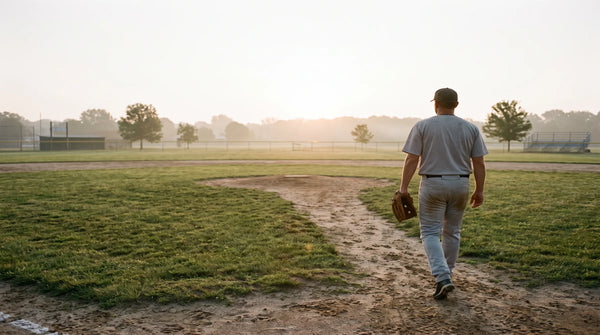
Do not start with the program. Start with the pitcher.
Two pitchers can report on the same day, be the same age, and still need different first weeks. One may have thrown twice a week through the break. The other may not have picked up a ball in three weeks. A preseason audit replaces assumptions with a clearer starting point.
Research supports using history, athlete self-report, and repeatable baseline testing as parts of a broader picture. It does not support treating one shoulder measurement, one movement screen, or one questionnaire as a pass/fail test for a season. A screen is information. It is not a verdict.
The purpose of the audit is not to diagnose the athlete, predict injury, or clear anyone to throw. It is to help a coach choose a better first demand — and to identify which physical quality is the lowest-hanging fruit worth building first.
Find Your Coaching Answer
Answer the question closest to what you need right now, and jump straight there.
- “I don’t know what this pitcher can actually do right now.” → Section 3, The Performance Battery
- “I have test results and need to know what to prioritize first.” → Section 4, From Testing to One Priority
- “I need to know what to ask about his history, role, and calendar.” → Section 7, The Fall Pitching Audit
- “I want to see how experienced coaches organize this process.” → Section 5, Practitioner Perspective
- “I need to know when this becomes more than a coaching question.” → Section 9, Equipment, Safety, and What Tools Cannot Claim
🎧 Prefer to listen? Audio version of this article:
1. The Coaching Situation: Why One Calendar Does Not Fit Every Arm
Fall practice begins with a throwing schedule, dates, distances, and a plan to build toward the season. That is useful, but it is not enough by itself.
Two pitchers can open the same calendar on the same day and arrive from completely different places — one may have kept a regular throwing routine through the break, another may not have faced a hitter since spring. The calendar tells you when the season begins. It does not tell you where each pitcher should begin. A preseason audit helps a coach answer that question before the workload rises.
Our coaching framework: A preseason audit is a practical planning conversation, record, and short battery of measured tests. It is not a research-derived formula, medical examination, injury forecast, or clearance test. Its job is to replace assumptions with a clearer starting point.
Previous articles introduced Floor, Ceiling, and Time as a planning framework. The audit turns those ideas into a first decision: what the pitcher can repeat now is his floor, what his role will eventually require is his ceiling, and the weeks available to build the bridge are the runway.
2. The Four Audit Questions
| Audit Question | What the Coach Learns | What It Changes |
|---|---|---|
| What has he done? | Recent throwing, outside work, training, role, and break history | Starting exposure |
| What can he repeat now? | Current floor and present capacity | First demand |
| What will he need later? | Ceiling, future role demand, and season requirement | Preparation target |
| How much time do we have? | Available runway before competition | Progression rate |
A roster may list two pitchers as the same age and position. An audit does not. Their first demands should not be identical.
Role demand is not the same for every pitcher. A starter needs to build outing length and repeatability across innings — the ability to hold velocity, command, and mechanics deep into a game. A reliever needs availability and quick readiness — the ability to be effective on short notice, sometimes on back-to-back days, without a long warm-up runway. A swingman may need parts of both, which usually means a broader base rather than a deeper one in either direction. Knowing which role a pitcher is building toward changes what “ready” actually means for him.
Not ready is not one thing. A pitcher may not be ready for the same reason another pitcher is not ready — this is a coaching-planning distinction, not a medical classification.
| Situation | What the Coach Actually Knows | What It Changes |
|---|---|---|
| Not recently exposed | The athlete has not thrown enough recently to justify a higher-intent or more specific first session | Build the throwing exposure gradually |
| Not yet role-prepared | The athlete may have maintained throwing but has not built toward the eventual starter, reliever, or multi-role demand | Build the role-specific requirement over time |
| Not enough runway | The gap between current floor and future demand is large relative to the calendar | Lower the early competitive expectation, simplify the plan, or both |
| Not an ordinary training question | Symptoms, restrictions, or a meaningful change from normal need qualified attention | Do not use a group program as a substitute for evaluation |
3. The Performance Battery: What to Actually Test
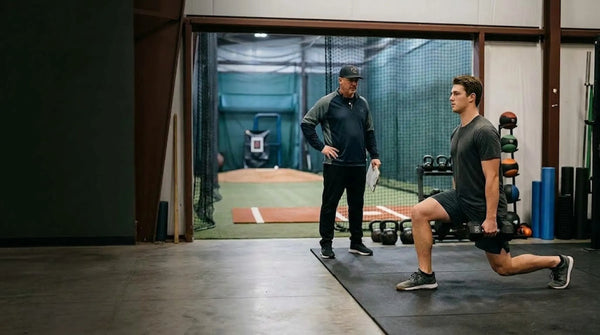
A conversation gives a coach context. A short battery of measured tests gives a coach a number to compare against later — for this athlete, not against a teammate or a published norm. Five tests cover most of what “current floor” actually means for a pitcher: strength, mobility, power, mound performance, and recovery.
Every result below answers the same underlying question: is this quality already close to where the athlete’s role will eventually need it — his ceiling — or is it the gap that will take the most runway to close?
Run the full battery once at the start of the fall and again at the mid-window checkpoint. The change between the two matters more than either number alone.
Strength: Plank Hold and Pull-Ups
Trunk and hip endurance has research support specific to overhead throwers — one study of cricket fast bowlers found trunk endurance measures significantly associated with ball release velocity, and a study of professional pitchers linked lumbopelvic control to days missed because of injury. A standard prone plank held to failure is a practical, no-equipment field version of that same quality. Pair it with max pull-up reps as a simple, repeatable upper-body strength marker. Neither test diagnoses anything. Both give a baseline worth repeating.
A single result means more in context than in isolation. The primary comparison is the athlete against himself over time — this test, repeated at the checkpoint. But a result that stands out sharply from the rest of the roster is also worth noting in the meantime. If most of the staff’s pitchers hold a plank for two minutes and one taps out at thirty seconds, that gap is real information before you ever have a second data point to compare it against. The same logic applies to pull-ups: a wide gap from what the rest of the group can do is itself a signal worth acting on, not just a number to file away.
Mobility: Squat, In-Line Lunge, and Push-Up
These three map onto three of the seven tests in the Functional Movement Screen, a battery with real baseball-pitcher-specific research behind it. A 2025 prospective study used the FMS specifically as a screening tool in high-school pitchers. Score each movement for quality rather than pass or fail.
What to watch for without a formal scoring system: on the squat, whether the heels stay down, whether the knees track over the toes or collapse inward, and whether the lower back stays neutral rather than rounding or overarching. On the in-line lunge, watch for a loss of balance, a noticeable side-to-side difference in how far the athlete can comfortably reach, or excessive forward lean through the trunk. On the push-up, watch whether the hips, trunk, and shoulders move together as one unit, or whether the low back sags or the hips rise first. A pitcher who cannot repeat these positions cleanly on both sides is showing you something worth addressing before adding load or velocity.
One honest limit worth stating plainly: a randomized trial that trained high-school players on these exact movements for twelve weeks improved their scores on all three — and pitching velocity and pitch control both went down by the end of the program. Better movement-screen scores did not translate to better mound performance in that study. Use these tests to flag an obvious limitation worth addressing, not as a training target in themselves.
Power: One Upper-Body Test, One Lower-Body Test
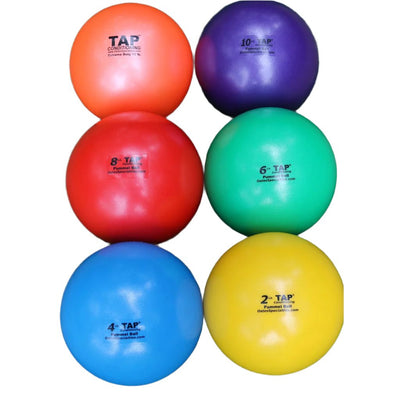
For the upper body and trunk, a rotational medicine-ball throw or scoop toss for distance or velocity is the more consistently supported field test — one study found it the strongest single predictor of throwing velocity among several power tests measured. A weighted, minimal-bounce ball such as the TAP® Pummel Ball is one practical option for this test, since its shape and lack of rebound make it easier to throw safely and repeatably in a confined space. For the lower body, a standing broad jump is the most practical option a coach can run without equipment, though the research here is mixed: some studies find a real association with throwing velocity, others find none, and more traditional tests like the vertical jump and 60-yard dash have shown weak or no correlation in several studies. Broad jump is worth testing. It is not a guaranteed predictor.
As with strength testing, the most useful comparison is often within the roster rather than against a published number. A distance or velocity well short of what most of the team produces on either power test is usually the more obvious signal — worth addressing first, even before a second testing comparing the athlete to themselves.
Mound Performance: Velocity, Command, and Endurance
Track three things across a short mound session.
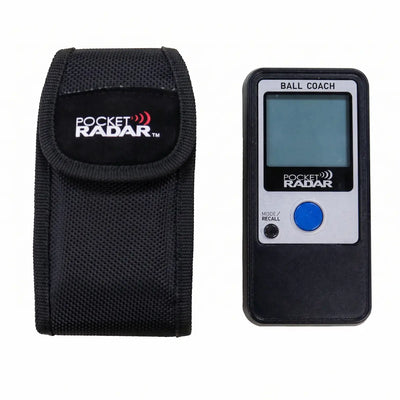
Velocity — radar gun on a set number of pitches, recording peak and average. A handheld unit such as the Pocket Radar is a practical way to track this consistently from the mound or a bullpen.
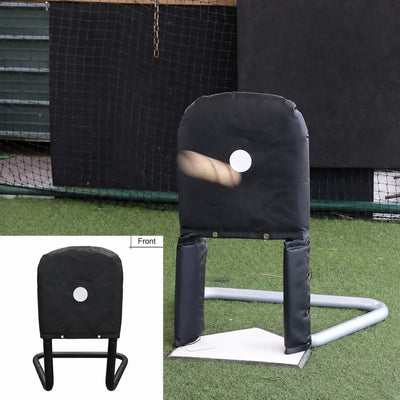
Command — throws at a defined target, recorded as hits against total throws. A target system such as the Advanced Command Trainer makes this easy to run consistently.
Endurance — a simulated inning (roughly 15–20 pitches with radar and command tracked), a rest interval, then a second simulated inning, rest, and repeat. Watch both numbers for decline. Multiple studies, including one in pitchers aged 13 to 16, have found velocity declining across simulated innings under fatigue. One recent study adds an important caveat: in some pitchers, ball speed stayed essentially flat across seven simulated innings even as objective fatigue markers rose sharply — meaning velocity alone can miss real fatigue that a second or third simulated inning, tracked alongside command, is more likely to catch.
Recovery: A Forced-Choice Wellness Check
Subjective self-report has real research behind it as a monitoring tool — a systematic review of 56 studies found subjective wellness measures more sensitive to training load than objective measures in athletes generally. The specific format below is an Oates Specialties suggestion, not a cited research protocol, and we label it as such.
Ask the athlete to rate how his arm feels on a 1–5 scale the morning after a demanding session, with no option to pick 3 — forcing him to indicate a direction rather than default to neutral. Ask once before any activity, then ask again after a few minutes of light, easy throwing. If the number improves meaningfully after light throwing, some of what he reported was normal morning stiffness that warms out. If the number does not move, or gets worse, treat that as more meaningful information.
All tests described here are general coaching tools. They are not medical assessments, and no combination of results clears an athlete to throw or diagnoses a problem.
4. From Testing to One First Priority
Five tests will rarely all look equal. One will usually stand out as the clearest gap between the athlete’s current floor and where his role will eventually need him to be — weak trunk endurance next to strong mound velocity, or a mobility limitation showing up as an obvious compensation, or command falling apart in the second simulated inning while velocity holds.
That gap is the lowest-hanging fruit — the shortest distance between floor and ceiling that the available runway can realistically close first. It is the one thing worth prioritizing, rather than trying to build all five qualities at once. Combine the battery results with what you learn in the audit conversation below to sort where things stand.
| What the Audit Shows | What It Means | First Coaching Response |
|---|---|---|
| Known and appropriate for coaching | The athlete’s recent history, current floor, role demand, and calendar are reasonably clear | Choose a first demand that matches the available evidence |
| Known, but needs attention | The athlete has a large floor-to-ceiling gap, limited runway, substantial outside work, or a meaningful change from normal | Simplify the first demand, collect more context, and monitor more closely |
| Unknown or outside coaching scope | The history is incomplete, the athlete reports concerning symptoms, or existing restrictions apply | Do not fill the gap with assumptions; clarify the information or follow qualified-professional guidance |
An audit is complete not when you have five numbers, but when you can name the one that matters most for this pitcher’s first weeks.
5. Practitioner Perspective: From Information to Action
Ron Wolforth and Randy Sullivan both work with individualized throwing-development models. Their public work is useful because it illustrates how experienced practitioners move from information to action — it does not validate this specific battery or establish a universal protocol.
Wolforth describes an assessment-to-action sequence: Assess, Categorize, Customize, and Prioritize. The transferable idea is not that every program needs a private-facility workup. It is that information should change the plan — sort what you learn, decide what most constrains the athlete now, and choose the first priority accordingly.
Sullivan’s public work emphasizes starting with the athlete’s actual history and present context rather than a template. For a coach, the principle is simple: collect what happened before your program began, identify what has changed, and let that shape the first demand.
Neither framework proves that a specific screen diagnoses a problem or predicts injury. Their value is organizational.
6. Research Findings and Limits
A one-time preseason shoulder screen did not predict which of 832 high-school players would sustain a throwing-related injury during the season — supporting the point that a single screen should not become a pass/fail test. A Division I study found some subjective measures associated with missed time while several objective measures did not predict injury in that cohort — supporting the value of asking the athlete directly. Game pitch counts capture only part of total throwing exposure; catch play, lessons, and showcases can add substantially more.
Research does not yet give coaches one score that predicts a season, one screen that clears or disqualifies a player, or one universal battery for every age and level. A screen is information. It is not a verdict. The coaching response is practical: collect the history, measure the current floor, define the ceiling, use the available time honestly, and choose the first priority accordingly.
7. The Fall Pitching Audit: History, Role, and Calendar
Alongside the performance battery, a short conversation fills in what testing cannot show.
Total throwing volume deserves more than a line item. Ask specifically about the last two to six weeks: games, bullpens, catch play, lessons, private instruction, showcases, and any throwing outside the program. Programs consistently undercount this — a pitcher who looks fresh on paper may have thrown more in the last month than his own coach realizes. A companion guide, How Much Should a Pitcher Actually Throw?, covers why pitch counts alone miss most of an athlete’s real exposure. For this audit, the goal is simpler: get an honest total before assuming anyone is starting from zero.
| Category | What the Coach Records | Why It Matters |
|---|---|---|
| Recent throwing | Frequency, type, approximate intent, last hard day | Establishes starting exposure |
| Outside work | Lessons, showcases, travel ball, private work | Captures what the program may not see |
| Current response | What feels normal, unusual, improving, or different | Helps choose the first demand |
| Role and calendar | Expected role, first competitive date, scheduling constraints | Defines ceiling and runway |
| Training history | Lifting, conditioning, new exercises, new implements | Identifies current capacity and new-stimulus context |
| Maturity and athletic history | Recent growth or coordination changes, prior sports and positions | Adds developmental and exposure context without diagnosis |
| Prior guidance | Existing restrictions or qualified-professional recommendations | Keeps coaching inside appropriate boundaries |
At the end, a coach should be able to name three things: what is known, what is still unknown, and what has changed from the athlete’s usual pattern.
8. Coach’s Takeaway
- Start with the pitcher’s recent history and measured current floor, not a generic calendar
- Run the five-domain battery once at the start of fall and again at the checkpoint
- Identify the one clearest gap and make it the first priority
- Ask about all throwing, including outside work
- Treat every screen and test as context, not a verdict
- Recheck the picture as the first weeks reveal more
9. Equipment, Safety, and What Tools Cannot Claim
A target, radar gun, or command-tracking system may make the performance battery easier to run consistently and observe. The tool belongs after the testing objective is clear, not before it. A radar number, target score, or movement screen cannot tell a coach that an athlete is ready, diagnose a problem, or replace qualified evaluation. Assessment tools add information. The coach still interprets that information alongside history, role, and available time.
This is preparation guidance, not medical diagnosis or injury clearance. Persistent, sharp, unusual, worsening, or function-limiting pain is outside a training article’s scope and belongs with a qualified professional. Existing restrictions or qualified-professional guidance should lead the plan when they apply.
For athletes: Be honest about all throwing, and tell the coach when something feels meaningfully different from normal. A test result is not a verdict about your arm.
For parents: Share information about outside lessons, showcases, and any existing guidance from qualified professionals. The best audit sees the athlete’s whole week.
10. What We Have Already Said, and the Next Question
How to Build a Fall Pitching Program explains the larger preparation framework this audit operates inside. What Actually Happens After You Pitch? explains why a throwing outing is a whole-body demand. Why Can’t My Pitcher Stay Healthy? develops the full injury-history and recurring-problem conversation only briefly touched on here.
The audit chooses the starting point and the first priority. It does not tell a coach how quickly each quality can change. That is the next question: How Long Does It Take to Build Arm Strength? — which develops the different runways of strength, endurance, movement control, and throwing tolerance once you know where a pitcher is starting from.
The coaching guide ends above. The notes below are for readers who want the research detail.
Key Terms
Floor: What the athlete can reasonably handle and repeat now, measured directly rather than assumed. Ceiling: What the athlete’s eventual role will require. Runway: The available time to build from floor toward ceiling. FMS: Functional Movement Screen, a seven-task battery scoring movement quality on a 0–3 scale per task.
Annotated Bibliography
Oyama S, et al. “Preseason Shoulder Range of Motion Screening Does Not Predict Injury in High School Baseball Players.” J Shoulder Elbow Surg. 2017;26(7):1182-1189.
Why it matters here: 832 high-school players; preseason shoulder measures did not identify which players would sustain a throwing-related injury. Supports treating any single screen as information, not a verdict.
Shitara H, et al. “The Preseason Functional Movement Screen as a Predictive Tool for Shoulder and Elbow Injuries in High School Baseball Pitchers: A Prospective Cohort Study.” 2025. DOI: 10.1177/23259671241305607
Why it matters here: Direct high-school-pitcher population using the same FMS tasks referenced in the mobility section of this guide.
Suzuki K, Mizoguchi Y, Kimura F, Sawada Y, Akasaka K. “Effects of Functional Movement Screen Training in High School Baseball Players: A Randomized Controlled Trial.” 2021; secondary outcomes in Healthcare (Basel) 2022;10(12):2409.
2021 trial · 2022 secondary outcomes
Why it matters here: 71 players, intervention vs. control. FMS scores improved with training, while pitching velocity and pitch control both decreased by the end of the 12-week program. Basis for this guide’s caution that improved movement-screen scores did not translate to improved mound performance in this trial.
Anand PC, Khanna GL, Chorsiya V, Geomon TP. “Relationship of core stability with bowling speed in male cricket medium and medium fast bowlers.” Al Ameen Journal of Medical Sciences. 2017;10(3):225–228. Al Ameen Journal of Medical Sciences
Why it matters here: Core stability measures, including trunk endurance, were significantly associated with ball release velocity in overhead bowlers — the cross-sport basis for the plank test in the strength section.
Lumbopelvic control and days missed due to injury in professional baseball pitchers. PMC4216605.
Why it matters here: Links lumbopelvic/core control measures to missed playing time in professional pitchers, supporting trunk endurance as a relevant baseline measure.
Taniyama D, et al. “Rotational Medicine Ball Throw Velocity Relates to NCAA Division III College Baseball Player Bat Swing, Batted Baseball, and Pitching Velocity.” J Strength Cond Res. 2021;35(12):3414-3419.
Why it matters here: Direct support for the rotational medicine-ball throw as the upper-body power test referenced in this guide.
Correlation of Power to Fastball Velocity of Collegiate Baseball Pitchers; Correlation of Throwing Velocity to the Results of Lower-Body Field Tests in Male College Baseball Players.
Szymanski poster · Lehman study
Why it matters here: Mixed evidence base for lower-body field tests. Medicine ball scoop toss showed the strongest single correlation with throwing velocity in one model; broad jump and lateral-to-medial jump showed some association in others; vertical jump and sprint tests showed weak or no correlation in several studies. Basis for this guide’s honest framing of the broad jump as practical but not a guaranteed predictor.
Escamilla RF, et al. “Pitching Biomechanics as a Pitcher Approaches Muscular Fatigue During a Simulated Baseball Game.” Am J Sports Med. 2007;35(1):23-33.
Why it matters here: Collegiate pitchers, 7–9 simulated innings; ball velocity decreased significantly as pitchers approached fatigue. Supports the endurance-testing protocol in this guide.
Okoroha KR, et al. “Effect of Fatigue on Medial Elbow Torque in Baseball Pitchers: A Simulated Game Analysis.” Am J Sports Med. 2018;46(9):2105-2110.
Why it matters here: 90-pitch simulated game; velocity declined and perceived fatigue rose each inning, with elbow torque increasing after inning 3. Direct support for tracking both velocity and command across a two-inning simulated protocol.
The Impact of Fatigue on Baseball Pitching Mechanics in Adolescent Male Pitchers.
Why it matters here: Pitchers aged 13–16; velocity and accuracy both measured across a simulated game, with fatigue and pain increasing as pitch count rose. Adolescent-population support for the mound-performance endurance protocol.
The impact of accumulated pitching counts on performance and lower body neuromuscular fatigue in baseball players: a simulated game analysis. Sports Biomech. 2025.
Why it matters here: Ball speed remained statistically stable across seven simulated innings even as lower-body neuromuscular fatigue markers rose sharply — the basis for this guide’s caution that velocity alone can miss real fatigue that a second tracked inning is more likely to catch.
Saw AE, Main LC, Gastin PB. “Monitoring the Athlete Training Response: Subjective Self-Reported Measures Trump Commonly Used Objective Measures: A Systematic Review.” Br J Sports Med. 2016;50(5):281-291.
Why it matters here: Systematic review of 56 studies; subjective wellness self-report showed superior sensitivity to training load compared with objective measures. General support for the recovery check in this guide. The specific forced-choice 1–5 scale format is an Oates Specialties coaching convention, not a cited protocol from this or any other study.
Pocket Radar. oatesspecialties.com.
Why it matters here: Handheld radar device referenced as a practical way to run the velocity portion of the mound-performance battery consistently across sessions.
TAP® Pummel Ball. oatesspecialties.com.
Why it matters here: Weighted, no-bounce ball referenced as one practical option for the rotational medicine-ball throw or scoop toss described in the power-testing section.
Wolforth, Ron. Public coaching materials on individualized training organization.
Why it matters here: Illustrates a practitioner sequence of assessment, categorization, customization, and prioritization. Practitioner interpretation, not peer-reviewed proof of a universal method.
Sullivan, Randy. Public offseason and assessment materials on recent exposure and athlete-specific starting context.
Why it matters here: Illustrates the practitioner principle that recent history should influence the starting demand. Practitioner interpretation, not peer-reviewed proof of a universal method.
About This Analysis
Created by the Oates Specialties team led by Robert Oates, M.Ed., Founder
Editorial oversight by Gunnar Thompson, BS, CSCS, General Manager
Certified Strength & Conditioning Specialist | Biomechanics Specialist
September 2026
Complete Credentials
ROBERT OATES, M.Ed., Founder: Founded Oates Specialties in 2003. Master of Education degree. Provides strategic direction for educational content and athlete development philosophy.
GUNNAR THOMPSON, General Manager: BS Kinesiology (Clinical Exercise Science). CSCS (NSCA), PES (NASM), CPPS certifications. Technical authority on biomechanics and performance science. Conducts review of all educational content for scientific accuracy.
Questions or corrections: gunnart@oatesspecialties.com
© 2026, Oates Specialties LLC