The TAP® Hitting Target System
Executive Summary
Every hitter who swings into undifferentiated cage netting faces the same problem. The rep happened. The work was done. But nothing came back with a useful answer.
A physical target changes that. It gives every swing a specific place to aim before it begins, and a readable result when it ends. That is a practice design principle, not a product promise.
The TAP® Hitting Target System addresses two different hitting problems. One is directional intent: does the hitter drive the ball where the swing was meant to send it? The other is contact quality: where on the nine-zone result grid did the ball land, and what does that suggest about the vertical outcome and swing path? These are different problems, solved by different tools. The Batting Target™ and the Hitting Target™ are complementary, not competing.
The Problems Hitting Coaches Actually Have
Most coaches do not begin with a research term. They begin with a practical problem. Here are the most common ones this system addresses.
- The ball dies in the cage net and the hitter loses the picture of where it went.
- Cage swings become volume without directional intent. The athlete is working but not practicing.
- Tee work produces contact, but not a readable picture of where the contact went.
- One cage serves the whole program. Every useful hitting station competes for the same lane.
- The hitter can make contact anywhere in the zone. The hitter cannot consistently drive the ball where the swing was intended to send it.
Why Targets Work — The Three Principles
The full science behind target-based training sits in the companion research page, Why Targets Work. What follows here is the plain-language version, applied specifically to hitting.
Principle 1: Give the Rep a Goal
When a hitter directs attention toward an intended outcome in space — a gap, a zone — rather than toward the body producing the movement, performance and learning tend to be better. That finding has been replicated across 143 studies covering more than 3,000 participants. A target makes this happen automatically. The hitter drives toward a panel. Attention goes outward before she thinks to direct it. No cue required.
Principle 2: Give the Rep a Result
After each swing, an athlete needs to know whether the outcome matched the goal. A blank cage net fails this test. A target restores that information. Did the swing drive the ball to the intended area? That verdict is available on every rep, whether anyone is watching or not.
Principle 3: Build It Into the Environment
A verbal cue arrives when someone delivers it. A physical target is present on every rep. No coach needs to speak. The practice environment does the coaching work on its own, rep after rep, session after session.
One baseball-specific nuance worth stating here: skilled hitters benefit more from outcome-focused conditions, while less-skilled hitters may do better with mechanics-focused work first (Castaneda and Gray, 2007). A target makes the most sense once a swing foundation exists.
Hitting Session Map
Two tools, two jobs. Both can share the same cage netting when only one surface is available. Both can run on separate net surfaces when more than one is available.
| Session Type | Primary Tool | What It Does | Best Fit |
|---|---|---|---|
| Directional focus / intent work | TAP® Batting Target™ | Mounts to batted-ball confinement netting. Gives every cage swing a visible directional destination: opposite field, gap, pull side. Makes intent visible before the swing begins. | All levels; opposite-field work, plate-coverage work, gap-to-gap intent training. |
| Contact quality / launch-window awareness | TAP® Hitting Target™ | Nine-zone panel mounted to any qualifying net surface. Gives tee and soft-toss sessions a visible contact-quality result. Can run as a standalone station on a net wall or safety screen when the main cage is busy. | All levels; contact-quality training, launch-window awareness, parallel station work in one-cage programs. |
Why the Two Hitting Tools Are Different
The distinction matters and should stay sharp in every conversation about these tools.
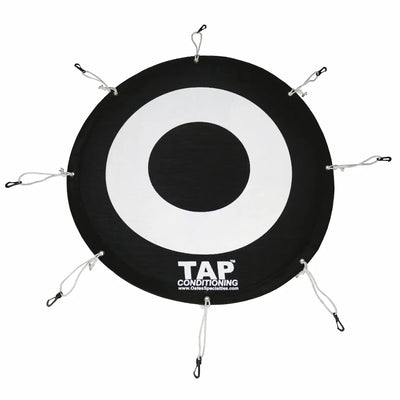
The Batting Target™ mounts to batted-ball confinement netting. It answers one question: did the ball go where the hitter intended to send it? It does not claim to measure exit velocity, launch angle, or contact quality. It gives the swing a direction.
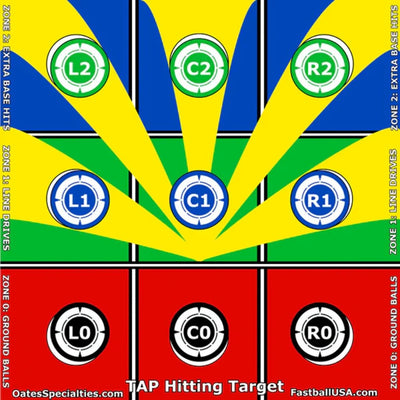
The Hitting Target™ mounts to any qualifying net surface — cage netting, a net wall, or a freestanding safety screen — and runs as its own station. It answers a broader question: where did the ball land on a nine-zone result grid, and what does that suggest about contact quality and vertical outcome? It can run simultaneously with a primary cage session, creating a second hitting station without a second cage.
These tools can share the same cage netting if that is what the program has. They can run on separate surfaces when more space is available. What they should not do is be treated as interchangeable. One measures direction. The other measures contact quality. Both matter. Neither replaces the other.
Each Hitting Tool — Job, Use, Best Fit
TAP® Batting Target™
The directional-focus tool. It mounts to batted-ball confinement netting and gives every cage swing a visible destination: opposite field, gap work, pull-side intent, plate-coverage zones. The hitter knows before the swing where the ball should go. The panel shows after the swing whether it got there.
Its value is intentionally narrow. It does not measure exit velocity, launch angle, or contact quality. It makes the directional intent of every swing visible and accountable. That is the job.
Best for: all levels; opposite-field and gap-to-gap intent training, plate-coverage work, any program where hitters are taking cage swings without a specific directional goal.
TAP® Hitting Target™
The contact-quality and parallel-station tool. Its nine-zone panel creates a visible result for tee work, front-toss sessions, and any other isolated rep work. Because it mounts to any net surface suitable to contain batted ball impact, it can run on a net wall or freestanding safety screen as its own station, independent of the main cage.
This solves two problems at once. It makes contact quality more visible in isolated rep work. And it creates a second meaningful hitting station without requiring a second full cage setup. For programs with one cage and multiple hitters waiting for turns, this is a significant operational advantage.
The Hitting Target™ supports launch-window and contact-quality awareness. It is not a complete launch-angle optimizer and is not a substitute for full ball-flight tracking technology. What it does, it does well.
Best for: all levels; tee and front-toss contact-quality work, one-cage programs needing a parallel station, coaches who want a visible contact result without expensive tracking equipment.
The Honest Limits of This Page
No controlled intervention study has tested any specific Oates product as a training tool. That is stated plainly here and everywhere else in this system.
What This Page Claims
- Every hitter who swings into undifferentiated cage netting faces a practice design problem: no specific goal, no readable result.
- A physical target gives every swing a goal before it begins and a readable result when it ends.
- This principle is supported by peer-reviewed motor learning research going back thirty years.
- The Batting Target™ and Hitting Target™ each serve a distinct training job and are designed around that job.
- The session map above helps coaches match the right tool to the right problem.
What This Page Does Not Claim
- Any specific Oates product has been tested in a controlled study. None has.
- One tool is best for every hitter or every program.
- The Hitting Target™ is a complete launch-angle optimizer or a substitute for full ball-flight tracking technology.
- Targets develop good mechanics. They provide the structure for a hitter to express mechanics she has already developed.
For the full peer-reviewed research foundation behind these principles — attentional focus, knowledge of results, the constraints-led approach, and the honest counter-evidence — see Why Targets Work.
Frequently Asked Questions
The cage net confirms contact happened. It does not clearly preserve or communicate directional intent or contact-quality outcome. A swing that produces a screaming liner to the opposite-field corner and a swing that produces a weak pull-side grounder both hit the same net. A target distinguishes them.
It is better described as a launch-window and contact-quality awareness tool. It makes vertical and directional results more visible in isolated practice. It does not replace full ball-flight tracking or prescribe one ideal swing for every hitter.
Not always. Use the Batting Target™ when the main issue is directional intent on confinement netting. Use the Hitting Target™ when the main issue is contact quality, tee work feedback, or running a parallel station on a net wall or target backstop. Use both when the program wants to address both jobs without forcing them into the same device.
The core motor learning principles — goal-directed attention, knowledge of results, environmental design — apply equally to both. The baseball-specific hitting research (Castaneda and Gray, 2007) adds an important nuance: skilled hitters benefit more from outcome-focused conditions than less-skilled hitters, who may do better with mechanics-focused work first.
© 2026, Oates Specialties LLC