

Khaos® Bungee Suspension Trainer – Elastic Bodyweight System for Core Stability & Reactive Control
Couldn't load pickup availability
Replace rigid suspension straps with elastic bungee cords — and every rep becomes a continuous co-contraction challenge the body cannot groove into.
The Khaos® Bungee Suspension Trainer modifies traditional suspension training by replacing rigid, inelastic webbing with heavy-duty, safety-sleeved bungee cords that stretch and rebound with every repetition. Instead of simply holding body weight against fixed straps, athletes must manage continuously shifting tension and small elastic surges, which forces deep core and shoulder-support muscles to stay organized through each push, row, and lower-body pattern.
- Elastic Bungee Core Instead of Static Straps — A high-grade, safety-sleeved bungee core stretches and recoils during movement, creating continuous micro-oscillations the athlete must organize against — something a rigid strap never demands.
- Perturbations That Force Co-Contraction — Unpredictable perturbations (small bumps and pulls that disturb balance) force muscular co-contraction (muscles on both sides of a joint tightening together to stabilize it rather than move it) around the spine and joints on every rep.
- Decouples Joint Stress from Neuromuscular Demand — Body weight plus elastic stretch keeps joint compression modest while muscular demand stays high — a strong fit for in-season work, movement prep, and lower-impact training sessions.
- Versatile Component System — Anchor straps, multi-point carabiners, safety-sleeved bungees, comfort-grip handles, and padded limb cuffs let coaches shift from upper-body presses to single-leg running drills without changing tools.
- Anti-Rotation & Lateral Core Organization — Single-arm, single-leg, and off-axis positions try to twist or pull the body sideways as the cords rebound, forcing the obliques and deep trunk muscles to brace against rotation and lateral tilt.
- Portable, Field-Ready Setup — Anchors to fences, pull-up bars, or beams; packs compactly at ~6 lb; deploys indoors or outdoors in minutes without a rack or machine.
What Is It?
The Khaos® Bungee Suspension Trainer is an elastic suspension system that uses heavy-duty bungee cords, adjustable anchor straps, handles, and limb cuffs to turn standard bodyweight exercises into instability-rich movement challenges. Athletes use their own body weight as the base load while the elastic stretch and rebound create small, unpredictable changes that demand constant alignment and postural organization.
Compared with a traditional strap-based suspension trainer, where the straps stay mostly still and predictable, the Khaos system introduces rhythmic elastic movement that prevents the body from settling into a fixed groove. Compared with heavy external weights, it emphasizes neuromuscular organization, joint-friendly tension, and multi-directional coordination rather than maximal loading.
How It Works
Three mechanisms behind elastic suspension training
Managing Elastic Tension Changes
Any small deviation in form causes the bungees to stretch unevenly, changing leverage and pulling the athlete out of alignment. The body responds by firing deep core and shoulder-support muscles reflexively to re-center the spine — a demand that repeats with every oscillation of the cord.
Shoulder-Blade Organization Under Motion
Because the cords never fully settle, the shoulder blades cannot lock into a fixed position. The serratus anterior (the muscle that helps the shoulder blade slide and stay flush on the ribcage), mid/lower trapezius, and rotator cuff must coordinate continuously to keep the shoulder centered during every push and pull.
Sharp Proprioceptive Demand
The unpredictable elastic movement continuously challenges proprioception — the body’s ability to sense joint and limb position and adjust automatically — with a stream of changing feedback, while keeping joint compression lower than comparable heavy loading.
Backed by Research
The Science of Elastic Perturbation Training
The Khaos® Bungee Suspension Trainer has not been studied as a stand-alone device in peer-reviewed trials. Its role is supported by broader work on instability training and perturbation-based balance work, where unexpected changes in force can improve postural responses and reactive coordination when training is applied appropriately.
Video Library
See It In Action
Click the thumbnail to play from the start — click any timestamp to jump to that moment.
2023
Khaos® Bungee Suspension Trainer — Comprehensive Setup & Movement Guide
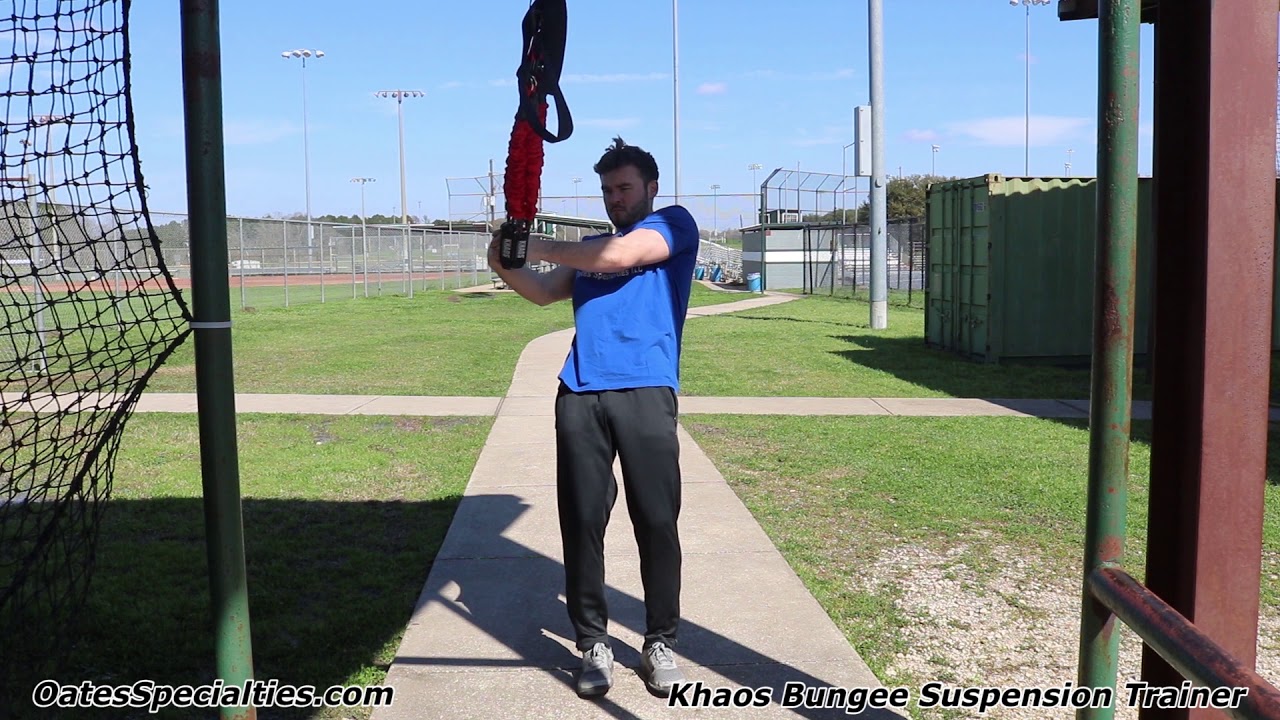
| System overview — heavy-duty safety-sleeved elastic cords, comfort-grip handles, and independent anchor straps. | |
| Setting up the main anchor — securing the extension strap to field fences, pull-up bars, or structural beams. | |
| Adjusting resistance parameters — how body angle and distance from the anchor change elastic tension and instability. | |
| Bungee Push-Up — elastic cords challenge horizontal stability, forcing shoulder-blade muscles to keep the chest steady. | |
| Inverted Row — elastic rebound forces the upper back and rear shoulder muscles to coordinate smoothly through each pull. | |
| Lower-Body Limb-Cuff Setup — swapping handles for padded ankle cuffs for running and lunging drills. | |
| Multi-Directional Hip & Core Work — single-leg stability drills training the lower body to handle sudden balance shifts. | |
| In-season and recovery guidelines — smooth tempos to wake up the nervous system without fatiguing the muscles. |
Product Details
How to Use It
Upper-body pressing and rowing: Bungee push-ups, chest-supported presses, and inverted rows challenge shoulder-blade organization and trunk alignment. Keep ribs stacked over the pelvis. Watch for the most common errors: hips sagging, low back arching too hard, or the head jutting forward as the bungees pull.
Unilateral and single-leg movement: Limb cuffs on the ankles for single-leg running, split squats, and lateral lunges. Emphasize quiet hips, level pelvis, and centered foot pressure to manage shifting tension without collapsing at the spine or knee.
Anti-rotation and lateral core: Single-arm rows or off-axis holds where the elastic wants to rotate the torso. Resist that twist by bracing through the trunk and maintaining a neutral spine while breathing and moving.
In-season activation and recovery: Lower-intensity circuits with smooth tempos to wake up stabilizers before games or high-intensity work. Keep volumes modest to prime the nervous system without excessive soreness.
How to Progress Difficulty
| Level | Adjustment |
|---|---|
| Easier | More upright body angle, closer to anchor, bilateral patterns — less tension and instability |
| Intermediate | Step farther from the anchor or lower the body angle to increase elastic tension and balance demand |
| Advanced | Unilateral and single-leg variations — maximum anti-rotation challenge across the full movement range |
Start with stable bilateral positions at controlled tempos. Progress only after athletes show consistent posture, clean movement, and good next-day response.
Who This Is For
- Commonly used for athletes who have already mastered basic suspension-trainer progressions and are ready for a more demanding instability challenge.
- Commonly used for field and court athletes who need multi-directional coordination, deceleration strength, and balance under unpredictable forces.
- Commonly used for strength and conditioning staffs who want a portable station for trunk organization, shoulder-girdle support, and closed-chain upper- and lower-body work.
- Commonly used for in-season and return-to-play phases where joint-friendly loading and movement quality are priorities.
We are not coaches.
What This Implement Does NOT Do
- It does not replace foundational strength training with barbells, dumbbells, or machines; it adds an instability and movement-quality layer on top of a strength base.
- It does not serve as a primary maximal power tool; elastic instability is better suited for organization and neuromuscular demand than for peak force work.
- It does not automatically correct movement patterns; athletes still need clear coaching on body position, range of motion, and exercise selection.
- Not designed for recreational swinging or unsupervised play — must be properly anchored and used as instructed.
Technical Specs
| Product Name | Khaos® Bungee Suspension Trainer |
|---|---|
| SKU | BST |
| UPC | 608938929723 |
| Also Known As | Suspension System, Core Instability Trainer, Red Bungee Trainer |
| System Contents | Anchor strap, 4 safety-sleeved bungee segments, 2 wide rubber-grip handles, 2 large padded limb straps, multi-point carabiners |
| System Weight | ~6 lb |
| Anchor Options | Stable fences, pull-up bars, beams, and other secure overhead or mid-height attachment points |
| Anchor Safety | Use only on stable structures rated for dynamic bodyweight loading; avoid weak fixtures, loose hardware, or non-load-rated points |
| Training Focus | Core and shoulder organization, anti-rotation bracing, multi-planar coordination, joint-friendly strength |
| Environment | Indoor or outdoor — any stable anchor point with clear space for body-angle changes and unilateral movement |
Safety and Youth Guardrails
Intended for athletes with basic bodyweight strength and movement control, training under coach or qualified adult supervision — especially for unstable single-leg or single-arm variations. Regularly check straps, bungees, and carabiners for wear before sessions. Stop immediately on sharp pain, dizziness, or loss of position.
Youth and less experienced athletes: Use more upright positions, bilateral patterns, and slower tempos before progressing toward steeper angles and unilateral work.
- Not a toy: Not intended for swinging or recreational play.
- Anchor safety: Never attach to unstable structures, weak fixtures, or non-load-rated points.
- Rehabilitation use only under supervision: In rehab settings, exercise selection and intensity should be guided by a medical or rehab professional.
Frequently Asked Questions
How is this different from a regular suspension trainer?
Traditional suspension trainers use rigid straps — the primary challenge is managing body weight against a stable line. The Khaos® Bungee Trainer uses elastic bungees that stretch and rebound, creating continuous instability and reactive demands that a rigid strap never produces.
Is this appropriate for beginners?
It is recommended for athletes who already move well in basic bodyweight and suspension-trainer patterns. Beginners are better served starting with less unstable options — such as the TAP® Suspension Trainer — before progressing to the Khaos system.
Can I use this in-season?
Yes. Because the system separates high neuromuscular demand from heavy joint loading, it works well for in-season activation, maintenance, and movement-quality sessions at appropriate volumes and intensities.
What is the best way to progress difficulty?
The primary levers are body angle and distance from the anchor — farther out or lower increases tension and instability; more upright reduces demand. Unilateral and single-leg variations add the greatest anti-rotation challenge once bilateral control is clean.
Does it require special instructions?
The product ships as a hardware kit. Coaches and athletes should lean on existing suspension-training knowledge, the Oates video guide, or qualified instruction to select appropriate drills and progressions.
Questions before you buy? Call or Text Our Team at (936) 295-4459
Featured Products