

TAP® Folding Balance Beam – Balance Beam Training for Stride Alignment and Lower‑Body Stability
Couldn't load pickup availability
A single-line foam beam that instantly exposes every lateral leak in stride, posture, and lower-half direction.
The TAP® Folding Balance Beam shifts lower-body training from wide, comfortable stances to a single, in-line base that quickly reveals any wobble, drift, or loss of posture. Built from firm yet compressible closed-cell foam — a foam that does not readily absorb water and resists collapsing under repeated use — with a durable, non-slip working surface, the beam folds flat for transport and extends into a long, straight path that forces the feet, ankles, knees, and hips to organize along one track instead of spilling side to side.
- Confined Base of Support — Restricts foot placement to a slim corridor, so any sideways lean or drift shows up immediately and forces the body toward centered, efficient posture.
- Firm, Compressible Foam Core — Dense foam yields slightly under pressure, creating moderate instability and clear positional feedback without the hard impact of wood or metal beams.
- Folding Multi-Segment Design — Collapses flat for travel, extends into a straight training line, and can be used folded for a shorter, more unstable advanced challenge.
- Kinetic-Linkage Force Transfer — Guides feet along a single line so ground-up force travels efficiently to the torso instead of leaking sideways during throwing and hitting motions.
- Front-Side Bracing & Stride Control — Teaches pitchers a clean, inline lead-foot landing and trains hitters to make a tight, directed stride while reserving live swings for stable ground.
What Is It?
The TAP® Folding Balance Beam is a portable foam balance beam that creates a long, slim, slightly unstable surface for walking, lunging, and dry-land mechanics, requiring the lower body to stabilize along a straight line. When an athlete moves along the beam, the compressible foam and tight footprint remove the extra room that flat floors provide, so small leaks in balance and stride path show up immediately.
Compared with a flat gym floor — where wide bases and small missteps often go unnoticed — the beam acts like a physical boundary demanding precise foot placement and stacked joints along a single track. Compared with hard, elevated gymnastics beams, it delivers similar alignment and balance challenges with more forgiving impact and a lower risk of falls, making it more appropriate for team-sport training and rehab environments.
How It Works
Three mechanisms behind every step on the beam
Confined Footpath Activation
Restricting foot placement to a slim track removes the extra width athletes normally use to recover from a drift or lean, forcing intrinsic foot muscles and the peroneals — the ankle tendons that prevent rolling — to fire continuously to maintain balance.
Upward Kinetic Stabilization
The balance challenge at the foot travels directly up the leg. The vastus medialis obliquus (VMO), which guides the kneecap, and the gluteus medius, which levels the pelvis, must contract strongly to prevent the knee from caving inward along the beam.
Proprioceptive Sharpening
Compressible foam and a constrained path continuously stimulate mechanoreceptors in the sole and ankle joint, feeding position and pressure data back to the central nervous system and training fast, automatic micro-adjustments with low impact on bones.
Backed by Research
The Science of Narrow-Base Stability Training
The TAP® Folding Balance Beam has not been studied as an isolated device in controlled trials; its role is supported by broader research on balance-beam and foam-beam training showing that reducing the base of support and adding slight instability can improve balance, ankle stability, and proprioception (position sense) when applied in structured progressions. That same feedback loop — constrained path, compressible surface, continuous sensory demand — is what the beam delivers on every drill.
Video Library
See It In Action
Click a thumbnail to play from the start — click any timestamp to jump to that moment.
Movement Mechanics & Setup Guide
TAP® Folding Balance Beam — Stride Alignment, Lunges & Warm-Up Programming
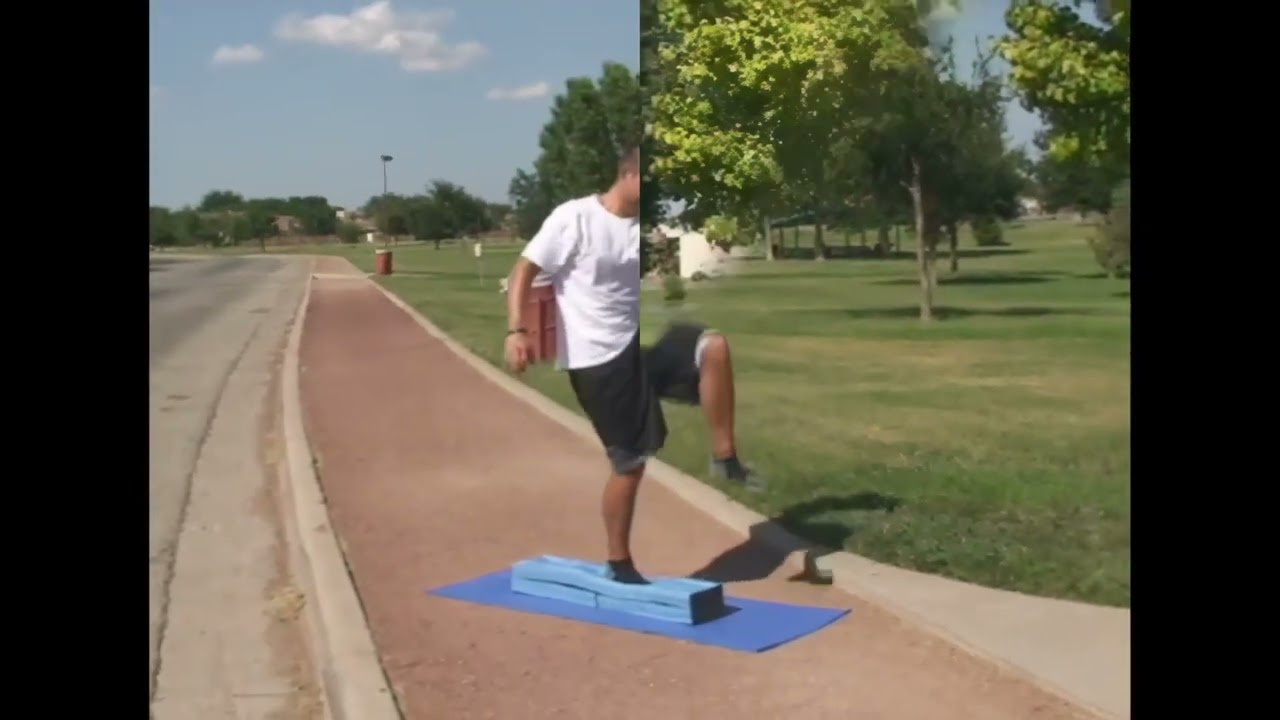
| Product design introduction — segmented folding foam construction and non-slip textured working surface. | |
| Linear Inline Walking — heel-to-toe walking drills that trigger continuous stabilizing adjustments in the foot and ankle. | |
| Dynamic Pitching Stride Alignment — beam placed along the stride line so the lead foot lands perfectly on track without veering offline. | |
| Rotational Hitting Stride Drill — beam under the stride path trains a compact, directed move that keeps the front hip from flying open early. | |
| Multi-Planar Lunges & Split Squats — integrating the beam into standard strength movements to challenge knee and hip stabilizers on a single-track surface. | |
| Programming and safety guidelines — slow, deliberate movements for nervous-system warm-up and controlled return-to-play progressions. |
Product Details
How to Use It
Inline walking and basic balance: Set the beam on a flat, non-slippery surface and begin with slow heel-to-toe walking, using arms for balance and focusing on quiet, centered steps. Progress to short single-leg holds — end sets before fatigue leads to repeated stumbles.
Pitching stride-line and front-side brace work: Place the beam along a pitcher’s stride line and rehearse dry-land strides and plants, landing the lead foot on the beam and holding a balanced finish. Goal is a clean, inline landing without the foot crossing over, spinning off, or drifting across the body.
Hitting stride drills (no live swing on beam): Position the beam under the stride path and use controlled stride-and-hold drills — with or without a bat — to train a compact, directed move. Emphasize the front foot and knee stacked over the beam; reserve full-speed swings for stable ground.
Multi-planar lunges and split squats: Use the beam as the front or back foot surface for forward, lateral, and diagonal lunges. For advanced athletes, place the working foot on a folded section to increase instability. Keep reps slow and controlled; prioritize alignment over depth.
Warm-up and return-to-play: Add 1–2 short passes of heel-to-toe walking or light lunge series to wake up foot, ankle, knee, and hip stabilizers before higher-speed work. In return-to-play settings, follow medically cleared progressions with lower-intensity, shorter sets.
Variant Selection Guide
| Variant | SKU | Included | Best For |
|---|---|---|---|
| TAP® Folding Balance Beam | BBF | One folding foam beam, non-slip surface, multi-segment hinges | Individual or small-group stride and balance training |
Coaches running group lanes often purchase multiple beams so athletes rotate through walking, stride, and lunge stations in small pods.
Who This Is For
- Commonly used for baseball and softball players who need better stride-line organization, front-side bracing, and lower-half direction in pitching and hitting mechanics.
- Commonly used for athletes in cutting, jumping, and running sports who want improved single-leg stability and better management of direction changes and deceleration.
- Commonly used by strength and conditioning staffs who want a portable, single-track platform for balance work, movement prep, and stability circuits in weight rooms, cages, and bullpens.
- Commonly used in rehab and return-to-play settings to rebuild joint confidence and coordination along a forgiving, ground-level beam once medical clearance has been given.
We are not coaches. We do not provide coaching.
Technical Specs
| Product Family | TAP® Folding Balance Beam |
|---|---|
| Product Aliases | Balance Beam, Stability Beam, Foot and Ankle Pad, Folding Balance Pad |
| SKU | BBF |
| UPC | 608938927057 |
| Construction | Firm, compressible closed-cell foam core with textured, non-slip upper surface |
| Nominal Length | Approximately 74.8 inches when fully extended |
| Approximate Weight | 4 lb |
| Folding Segments | Multi-segment hinged design for compact folding, transport, and optional folded-segment use |
| Surface Use | Flat, dry indoor surfaces; barefoot or clean training shoes that will not damage the surface |
Safety and Youth Guardrails
Not a toy: The TAP® Folding Balance Beam is a training implement and is not designed for unsupervised play, games, or roughhousing.
Not for impact use: Not intended for high-impact jumps from height, flips, or advanced acrobatic skills; use only for controlled balance, stride, and lunge drills on level ground.
Not a rehabilitation device: It can support balance and stability work in rehab or return-to-play plans, but exercise selection and intensity must be guided by a licensed medical or rehab professional.
Younger athletes and those returning from injury should work under supervision, starting with simple stance and walking drills before advancing to more challenging patterns. Stop immediately if the athlete feels pain, dizziness, or repeated loss of balance.
Frequently Asked Questions
How is the TAP® Folding Balance Beam different from a typical gymnastics or foam beam?
The TAP® Folding Balance Beam is a low, foam-based tool built for joint stability, stride alignment, and movement prep in rotational and field sports — not for elevated tumbling or acrobatics found on traditional gymnastics beams.
Can the TAP® Folding Balance Beam help with ankle stability?
It can help improve balance, ankle stability, and position sense — important elements of lower-body resilience — but it does not replace medical care, taping, bracing, or comprehensive strength and conditioning programs.
Is the TAP® Folding Balance Beam only for baseball and softball players?
No. While many examples focus on pitching and hitting mechanics, the same linear-base stability challenge applies to any athlete who cuts, jumps, lands, or decelerates on one leg.
How long should a typical session on the TAP® Folding Balance Beam last?
Most athletes do well with short blocks — 1–3 passes of heel-to-toe walks and 6–10 controlled reps per leg for lunges or split squats — rather than long, fatiguing sessions that lead to repeated missteps and poor positions.
Can athletes stand on folded sections of the TAP® Folding Balance Beam?
Yes — more experienced athletes can stand or lunge on folded segments for a shorter but more unstable platform, provided movements stay controlled and the beam is on a flat, non-slippery floor.
Is the TAP® Folding Balance Beam appropriate for youth athletes?
Yes, when used with age-appropriate drills, conservative volumes, and close supervision. Younger athletes should start with simple walking and stance drills before progressing to more advanced movements.
Questions before you buy? Call or Text Our Team at (936) 295-4459
Featured Products