How Should Lifting and Throwing Fit Together?
How to use the fall weight room to build what a pitcher's role will demand without letting training fatigue compete with the throwing he also has to do
A Coach's Preparation Guide from Oates Specialties
Part of: From Fall to Opening Day
This guide is updated as relevant research becomes available.
Executive Summary
The fall weight room should build the capacity the season will spend — not become a separate project that leaves a pitcher too fatigued to complete the throwing his role requires.
The practical question isn't "What should pitchers lift?" It's: What does this pitcher need to build, how much work can he absorb right now, and is the lifting helping his throwing or competing with it?
This guide organizes that decision through four steps: Demand (what will the role require, and how often?), Gap (what's most limiting him now, and can the weight room address it?), Dose (what's the smallest useful amount of new work?), and Response (can he repeat lifting and throwing with the quality and recovery the plan assumed?).
Studies in college pitchers show selected shoulder-region strength, hip strength, and hip-motion measures can decline over a competitive season, and other studies show selected physical qualities can improve during organized training. Those findings support deliberate preparation, but don't supply one universal lift program, schedule, readiness score, or injury-prevention guarantee — the athlete's starting point, role, calendar, throwing history, supervision, and response still decide the plan.
This guide does not start from zero. The Audit already named the pitcher's role demand, runway, current floor, and one priority gap — the lowest-hanging fruit, the shortest distance between floor and ceiling the available runway can close first. Earlier guides covered throwing in depth (Why Can't My Pitcher Stay Healthy?, How Long Does It Take to Build Arm Strength?, What Actually Happens After You Pitch?, How to Build a Fall Pitching Program). This guide only re-highlights throwing; its job is narrower — build the audit's priority gap in the weight room, and schedule that work so it helps throwing instead of competing with it.
Find Your Answer
Answer the question closest to what you need right now, and jump straight there.
- “I want to plan this week’s lifting and throwing without overhauling everything.” → Jump to: Start Here: Plan Tuesday’s Session
- “How do I schedule lifting so it doesn’t get in the way of his throwing?” → Jump to: 3A. Scheduling Lifting So It Does Not Hinder Throwing
- “How do I decide whether an exercise is worth the fatigue it costs?” → Jump to: 3B. Risk Versus Reward
- “I know my pitcher’s main issue. What should the weight room and the throwing emphasize?” → Jump to: 4. Decision Matrix and Example
- “What does the research actually say about lifting and pitchers?” → Jump to: 5. What Research Can and Cannot Tell a Coach
🎧 Prefer to listen? Audio version of this article:
Start Here: Plan Tuesday's Session
Do not overhaul lifting and throwing in the same week. Record each pitcher's recent throwing, outside work, likely role, and next meaningful baseball demand; keep throwing at a level he's recently handled, and add one new training emphasis at a time — not a new lower-body block, a new shoulder circuit, and a weekend showcase together, since the staff loses the ability to tell what helped from what just added fatigue. Watch whether he can repeat both lifting and throwing with the response the plan expected; if the response is unclear, hold rather than add more.
| Step | What to do | What to record |
|---|---|---|
| 1. Identify demand | What role is he likely to fill, and how often? | Expected role, frequency, weeks until first serious demand |
| 2. Identify the gap | What limitation is most likely to interfere with that role now? | Recent throwing, lifting history, recovery, outside work, one priority gap |
| 3. Choose the dose | Smallest new demand that addresses the gap; keep the rest familiar | The new work, why, what stays unchanged |
| 4. Watch response | Compare the actual week with the week the plan assumed | Throwing/lifting completed, recovery, fatigue report, next decision |
1. The Fall Question
It's October. Your pitchers lift three days a week and throw on the others. Someone asks the question that decides the whole fall: "Are we lifting the right way for pitchers?" Underneath it: Does this athlete need more general strength, more throwing exposure, more repeatability, or something else? How much work can he handle before lifting starts costing him on the mound? What is the weight room supposed to build for his likely role?
A lot of fall lifting is inherited — a college program, a summer facility, a football template, a video. It may be good work aimed at a problem this pitcher doesn't have. The fall weight room has one job: build the capacity the season is going to spend.
2. Why Fall Usually Offers More Room to Build
A competitive season crowds out the preparation problem — throwing, games, travel, school, recovery, and role uncertainty all compete for time. Fall usually offers more room to organize work, observe response, and progress selected qualities deliberately, rather than hoping the competitive calendar builds capacity on its own. Small studies in college pitchers have documented declines across a season in selected shoulder-region strength, hip-abduction strength, and hip-motion measures (figures in the bibliography). They don't identify a cause or prove any fall plan prevents those declines — their value is narrower: a reminder to build or maintain what the season will spend before the calendar gets crowded.
3. The Four-Step Coaching Model
Demand. Start with what the athlete will actually be asked to do. A starter needs to hold up across innings and repeat that every few days; a reliever needs to be available often, sometimes on short notice; a position player who pitches occasionally already works his arm on non-pitching days; a developmental pitcher usually needs a base before a specialized plan. Without a demand, a coach builds toward an average that describes nobody. Coach's question: what will this athlete most likely be asked to do when games start, and how often?
Gap. Identify what's actually limiting him — recent throwing, training history, recovery, outside work. It's often one of a few things: little strength history; strong in the gym but under-thrown for spring demands; can produce force but can't repeat it late in a session; or a short runway against a large gap, which is a scheduling problem more than a training one. Name the gap in one sentence, then filter it: can the weight room address it, can the athlete repeat it this week, will it still matter when the role demand arrives? A throwing-exposure gap needs throwing, a recovery gap needs a schedule change, a symptom gap needs referral — don't force a lift onto any of those. Coach's question: what's the one thing most limiting this athlete, and can the weight room address it?
Dose. How much work the athlete is asked to absorb in a week. Research gives broad direction here, not a pitcher-specific prescription — build progressively, add one new emphasis at a time, keep appropriate throwing present, choose the smallest new demand that addresses the gap. Coach's question: what's the least new work that addresses the gap while leaving him able to complete his throwing?
Response. The schedule isn't the intervention — the athlete's response to it is the information. Watch a pattern across two or three weeks, not one hard day: Is lifting completed with control? Is throwing holding at the level the plan assumed? Is recovery on schedule? Then hold, reduce, progress one part, coordinate, or refer. Athlete-reported arm fatigue deserves particular weight — he may be the only one who notices in real time — so reduce or end that day's throwing rather than requiring the scheduled volume, and coordinate or refer when symptoms are persistent, worsening, unusual, or function-limiting. Coach's question: what did this week tell us to do next?
3A. Scheduling Lifting So It Does Not Hinder Throwing
Oates Specialties’ suggested applications, not research-derived rules — no validated schedule fits every pitcher, so use the athlete's response to test the one in front of you.
Pair high-intent throwing with the heavier lift on the same day, then keep the next day genuinely low — stacking hard days back-to-back spreads fatigue across the whole week instead of containing it. Avoid heavy pressing, forearm work to fatigue, and hard lower-body work the day before a key bullpen. Place new exercises on the lowest-stakes day first, introduce one at a time, and watch throwing quality and fatigue for two weeks before progressing. Count any throwing in the weight room — finisher throws, plyo work, weighted-ball holds — on the same calendar as bullpens and catch play.
A simple weekly shape: a high day (high-intent throwing, then the main lift), a low day (mobility, bodyweight work, easy catch — no new stressor), and a build day (moderate throwing and the second lift, targeting the audit priority). If throwing quality drops after a schedule change, hold or reduce the lift first — never cut the throwing the role requires to protect a gym number.
3B. Risk Versus Reward: Choose the Cheaper Way to Buy the Adaptation
Every exercise buys an adaptation and charges fatigue, joint stress, soreness, and time. Before adding one, ask: What adaptation do we need? What does this charge the athlete? Is there a cheaper task with similar reward? What would tell us the price was too high?
The examples below are Oates Specialties’ judgments, not research findings. Overhead pressing illustrates the trade — it builds pressing strength but loads an overhead athlete's shoulder in a position he already stresses. An incline or suspension push-up is a reasonable substitute: it trains pushing and trunk control at a load that is easy to scale, without taking the arm overhead. Heavy grip work to failure builds forearm size and strength but can blunt the next throwing day; submaximal, controlled forearm work buys most of the reward for less recovery cost. Risk versus reward is individual — a mature college pitcher may tolerate what a growing fourteen-year-old shouldn't. When in doubt, choose the cheaper task.
4. Decision Matrix and Example
| If the athlete's main issue is... | Weight-room emphasis | Throwing emphasis | What would make you hold or reduce? |
|---|---|---|---|
| Little lifting history, stable recent throwing | Build a familiar general-strength base, supervised and repeatable | Preserve current throwing exposure | Excessive soreness, poor movement control, or a change in normal throwing |
| Strong in the gym, underexposed to throwing | Maintain lifting without adding major fatigue | Gradually rebuild repeatable throwing exposure | Inability to repeat throwing tasks, or recovery exceeding the plan |
| Adequate strength, poor repeatability late in sessions | Controlled repeat-effort work, not a test every session | Keep throwing quality visible and comparable | A persistent drop in quality across sessions |
| Short runway before role demand | Avoid solving every gap at once | Prioritize the limitation closest to game demand | Multiple new demands competing for the same recovery |
| Frequent reliever role | Low-disruption, familiar lifting | Maintain availability for unpredictable use | Throwing or recovery less repeatable after lifting changes |
Example — reliever, regular throwing, inconsistent lifting. Demand: pitches often, sometimes on short notice. Gap: no consistent lifting base. Dose: keep the throwing rhythm visible, add two supervised full-body sessions rather than a high-volume program. Response: if throwing gets less repeatable after the change, hold or reduce the new dose before adding anything else.
5. What Research Can and Cannot Tell a Coach
Seasonal changes are worth planning around. Studies of college pitchers have found periscapular strength, hip-abduction strength, and selected hip-motion measures declining across a season; in the shoulder study, scaption was the only measure to reach statistical significance (specific figures and limits in the bibliography). That doesn't mean every pitcher needs the same shoulder or hip program; it means the season places demands on selected qualities, and fall is a reasonable time to organize training before they accumulate.
Selected physical qualities can change. A 20-week preseason program in adolescent players, with no control group, improved a posterior-shoulder endurance test from about 30 reps at baseline to 88 at 20 weeks; an eight-week randomized study in college pitchers found selected shoulder-related changes when blood-flow restriction was added to low-intensity rotator-cuff training. Both support the modest conclusion that selected tasks can change selected physical measures — a test-score change is not automatically a change in mound readiness or injury risk.
Why "shielding" is the wrong promise. Pitching places substantial valgus stress on the inside of the elbow. Flexor-pronator strength can contribute dynamic resistance to that load, but doesn't make the elbow injury-proof. One lab study found that the forearm muscles' contribution to elbow stability dropped after a single 100-pitch session, and another found forearm girth and grip strength improving over eight weeks without a significant change in static elbow gapping. Use forearm work as one controllable task, not a claim that it shields the elbow.
What "enough" means. No validated standard tells a coach when a pitcher is "strong enough" — practitioner benchmarks are reference points, not readiness gates. Enough is the capacity that lets the athlete repeat the work his role requires while completing his throwing and recovering as the plan expects. A lifting number shows what he did once; repeating the task, throwing, and recovering on schedule shows whether that capacity is useful.
6. Practitioner Lens
Applied interpretation, not peer-reviewed proof — experienced coaches help organize decisions research hasn't settled, but their frameworks are applied reasoning, not universal validation.
Ron Wolforth holds that the offseason is the time to build capability, since competition makes work and recovery harder to organize; in season he favors maintaining what was built over chasing records or volume, and argues weight-room work can over-focus on size and mass at the expense of coordination and mobility. His in-season priorities — core strength, shoulder-blade stability, single-leg stability, forearm-flexor work — are facility priorities, not validated requirements.
Randy Sullivan, a physical therapist and CSCS whose programming integrates strength with mobility, mechanics, arm care, and recovery, hasn't published a specific in-season lifting prescription, but his work supports a useful principle: strength development and throwing exposure should stay connected, since building capacity while removing the skill can create a coordination problem rather than solve one.
Neither treats the weight room as the primary answer or the enemy, and neither framework has been tested against an alternative in a trial. Commercial transparency: Wolforth, and Sullivan operate commercial training businesses; Wolforth and Sullivan use Oates Specialties’ products and have commercial relationships with Oates. Their frameworks appear here as applied reasoning, not independent validation that a method or product prevents injury or improves performance.
7. Equipment Creates Tasks, Not Outcomes
Oates Specialties designs and sells baseball training equipment, including resistance, shoulder, rotational, and grip-training products. This guide does not claim any Oates Specialties’ product builds capacity faster, protects a joint, prevents injury, corrects mechanics, or guarantees mound performance. A coach doesn't need a product to run a fall program — bodyweight work, equipment already on hand, supervision, a throwing plan, and enough time can be sufficient. Equipment is useful when it makes a task more repeatable, controllable, visible, or scalable.
| Coaching need | Task to create | What the equipment cannot establish |
|---|---|---|
| General strength base | A controlled resistance task | A fixed timeline, velocity gain, or joint protection |
| Shoulder endurance and control | Repeatable low-load shoulder work | Readiness, injury prevention, or guaranteed recovery |
| Forearm, wrist, grip capacity | Controlled hand and forearm work | A change in elbow behavior during pitching |
| Single-leg and lateral work | Controlled side-to-side movement | Mechanics correction or a fix for every lower-body limitation |
| Workload visibility | A record of sessions and outside work | Tissue status, injury prediction, or medical readiness |
Choose the capacity first. Choose the task second. Choose a product last. Research supporting a training objective does not validate a particular product or brand, including ours.
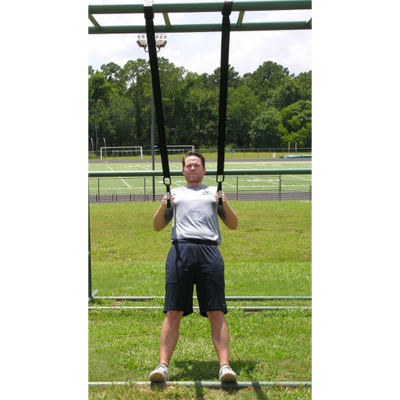
General strength base: TAP® Suspension Trainer. Start here when the audit priority is a general base. The TAP® Suspension Trainer uses body weight and angle to scale resistance — steeper angles lower the load, shallower raise it. Rows, incline push-ups, split squats, and trunk tasks adjust without adding plates, so one session can cover pushing, pulling, single-leg, and trunk work, or fill one gap without overworking another area. Use the incline push-up as an example for pressing: it trains pushing strength through a controlled range while avoiding heavy overhead pressing for athletes who already live overhead. Boundary: still resistance training — it creates soreness and fatigue like any other, and does not prevent injury, correct mechanics, or guarantee throwing performance.
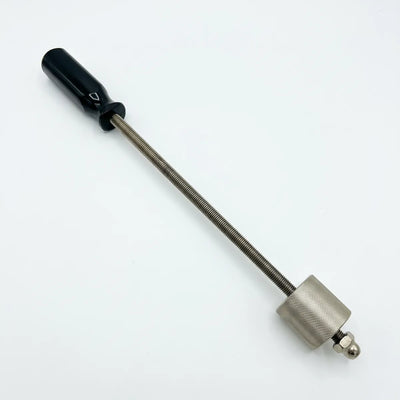
Forearm and wrist development: Supi-Pro™. Use forearm work when the audit shows that gap. The Supi-Pro™ trains supination, pronation, radial and ulnar deviation through a cantilever design with adjustable, trackable resistance. Dose it by need, not habit — some pitchers need more grip and forearm work, others very little beyond throwing itself; start submaximal, stay well short of failure, and watch the next throwing day before progressing. Boundary: one controllable task, not an elbow shield. In the study reviewed above, an eight-week forearm-strengthening program using dumbbells and sledgehammers for these same movements did not change static medial elbow gapping; the Supi-Pro™ itself has not been studied. Do not present it as joint protection.
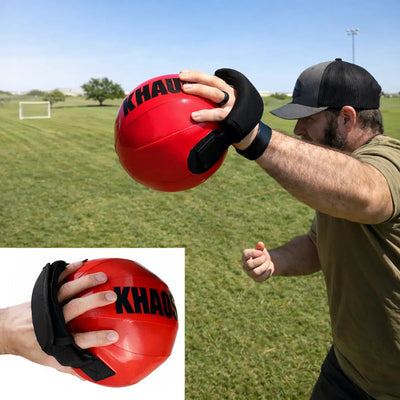
Shoulder-specific strength and endurance: KHAOS® Shoulder Shaker. Use unstable water resistance when the priority is shoulder control. Water shifts inside the compact, water-filled ball as the athlete moves, so he has to keep adjusting to control it — a reactive task aimed at the rotator cuff and shoulder-blade muscles, suited to short, controlled circuits, warm-ups, or a build day, not chasing fatigue before throwing. Boundary: a training task, not shown to prevent injury or guarantee recovery. Progress fill and volume only when next-day response stays normal.
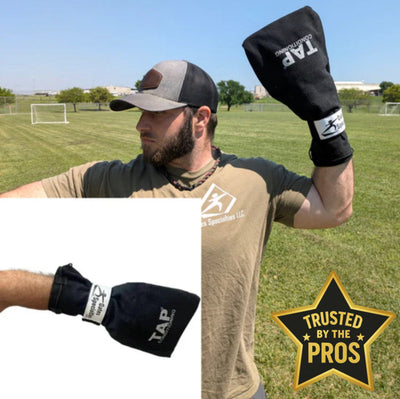
Decelerator strength inside the lift: TAP® Baseball Training Sock. Use the Sock as part of the strength program to train the muscles that slow the arm. Finish selected lifts with 10 to 15 low-to-moderate-intent throws, so the posterior shoulder has to slow the arm through a full throwing motion with release. That is our coaching rationale; research has not compared it with band or machine eccentric work.
What the research backs: Deceleration is one of the highest-demand phases of the throw. Laboratory work in 26 skilled pitchers measured roughly 1,090 N of compressive and 400 N of posterior force at the shoulder just after release, and a review of throwing research reports peak rotator-cuff activity of about 37–84% of maximal voluntary contraction during deceleration in baseball pitching, as the cuff helps resist distractive forces of roughly 80–120% of body weight during arm cocking and deceleration. Because these muscles are slowing a moving arm, we reason that eccentric strength is a sensible quality to train — that link is our inference, not a finding of these studies. Eccentric strength in this region does respond to training: collegiate pitchers who added Theraband work in a throw-like diagonal pattern gained about 20% in eccentric posterior-cuff force over six weeks at the slower 60°/s test speed, against a small decline in controls; and a randomized trial in junior handball players found about a 15% gain in eccentric external-rotator strength at a slow 30°/s test, against about 1% in controls. Together these support training the posterior shoulder eccentrically; they do not show that doing so with throws, or inside a lift, works better than other methods.
Where the support stops: No study has tested the Sock itself, so this is evidence for the task, not the product. These studies measured strength, not injury or mound performance. Both training studies used slow test speeds, neither used throws, and the Theraband group showed no advantage at the faster 180°/s test. In practice, coaches at high schools, colleges, and training facilities tell us they already finish weight-room sessions with it and are happy with the results — practitioner experience, not research, but it is how the task is being used today.
Guardrails: use it only on a day that already includes throwing; keep intent low-to-moderate and volume at 10–15 throws, stopping for fatigue, pain, or mechanical change; use a familiar, regulation-weight ball or slightly heavier without progressing weight and intent the same week; record every throw on the throwing calendar; and skip it after a lift that already fatigued the shoulder or forearm. Used that way, it is one eccentric task inside the strength program — not a recovery treatment or a substitute for the throwing progression.
8. Athlete and Family Action
Athletes: Getting stronger doesn't by itself show your arm is ready for spring. Tell the staff everything you throw and lift outside the program. Speak up when your arm feels unusually tired — you may be the only one who notices in real time. Don't chase a personal record in the weight room at the cost of your throwing, and report sharp, unusual, or worsening pain instead of training through it.
Families: Make the whole week visible — lessons, showcases, travel teams, outside lifting, school, and informal throwing all change what a plan can accomplish. Support clear communication about outside work and fatigue, and be cautious about promises: research hasn't produced a universal strength standard or one training plan proven to prevent injury.
Ask your athlete: "Do you believe you can report unusual arm fatigue or pain without being punished, dismissed, or automatically losing your place?" If the answer is no, the communication system needs attention before workload rises.
9. Safety and Scope
This guide helps coaches organize training. It does not diagnose a shoulder, elbow, hip, or back problem; prescribe rehabilitation; or determine medical readiness. Refer when pain is persistent, sharp, unusual, worsening, or function-limiting, or when there is numbness, tingling, weakness, catching, or locking. Existing restrictions and qualified-professional guidance lead the plan when they apply.
Introduce unfamiliar movements and loads under appropriate supervision, beginning below an assumed maximum and progressing only as the athlete's response supports it. The coach's role is to ask, record, notice, monitor, adjust, coordinate, and refer; qualified professionals evaluate, diagnose, and clear.
10. Where This Guide Fits in the Series
This guide owns one decision: what the fall weight room should build for this pitcher, and whether lifting and throwing are working together. The Audit establishes the starting point, role demand, and runway; How Long Does It Take to Build Arm Strength? covers how fast qualities change; Why Can't My Pitcher Stay Healthy? and What Actually Happens After You Pitch? cover recurring problems and tissue response; How to Build a Fall Pitching Program sets the whole window.
11. The Next Coaching Question
Knowing what to build in the weight room doesn't tell a coach whether stronger legs will reach the mound. If a pitcher gets stronger through his hips and legs, will he throw harder? Does Lower-Body Strength Increase Pitch Velocity? takes up that question next.
Technical Appendix
Appendix A: How to Read Training Research
A practical hierarchy: randomized trials test defined interventions; longitudinal observational studies show what changed, not why; single-group pre/post programs show change occurred during a program, not that the program caused it; practitioner frameworks organize decisions but don't validate outcomes.
A result applies most directly to the athletes studied — college pitchers may not transfer to a 15-year-old. An association is not a cause. A physical-test change is not automatically a throwing outcome. A study without a control group can't separate training from growth and test familiarity. Non-inferiority is not superiority. Most evidence here comes from adolescent and college male baseball players, which may not apply to younger athletes, professionals, female athletes, or softball players. No published study has followed a defined fall lifting-and-throwing plan through a full season to determine whether it preserves capacity or reduces injury — the guidance here is organized from shorter, narrower studies, not validated end to end. The bibliography carries each study's sample size, design, and limits.
Terms worth knowing: Flexor-pronator mass — the inner-elbow forearm muscles that help resist the force that opens the inside of the elbow during throwing. Hazard ratio — how quickly an outcome occurs in one group versus another; below 1.0 favors the first, but interpretation depends on the confidence interval. Medial elbow gapping — how far the inside of the elbow opens under a sideways load. Non-inferiority study — shows one approach isn't worse than another, not that it's better. Valgus stability — the elbow's resistance to being forced open on the inside.
Appendix B: Fall Lifting and Throwing Worksheet
A planning record, not a medical assessment or readiness score.
Athlete: ____________________ Date: ____________________ Coach: ____________________
| Step | Prompt |
|---|---|
| Demand | What role is he likely to fill, and how often? |
| Runway | How many weeks until the first serious demand? |
| Gap | What most limits him right now? |
| Can the weight room address it? | Yes, partly, or no |
| Current throwing | What has he thrown in the last 14 days? |
| Outside work | Lessons, showcases, teams, other lifting |
| This week's new work | What is being added, and why? |
| Next decision | Hold, reduce, progress, coordinate, or refer |
Stop and refer under the same conditions Section 9 sets out — this worksheet is a planning record, not a substitute for that judgment.
Annotated Bibliography
Core peer-reviewed research
Moore SD, Uhl TL, Kibler WB. Improvements in Shoulder Endurance Following a Baseball-Specific Strengthening Program in High School Baseball Players. Sports Health. 2013;5(3):233–238. doi:10.1177/1941738113477604. https://pmc.ncbi.nlm.nih.gov/articles/PMC3658410/
Why it matters here: The clearest evidence that a preseason program can improve a selected shoulder-endurance task over time — 14 adolescent players, 30 reps at baseline to 66 at four weeks and 88 at 20 weeks on a prone posterior-shoulder endurance test.
Use with care: Small adolescent sample with no control group, and pitchers and position players were analyzed together — both limitations the authors state. No velocity, workload, or injury outcome; early gains may reflect learning the test and maturation as much as training.
Plummer HA, Plosser SM, Diaz PR, Lobb NJ, Michener LA. Effectiveness of a Shoulder Exercise Program in Division I Collegiate Baseball Players During the Fall Season. International Journal of Sports Physical Therapy. 2022;17(2):247–258. doi:10.26603/001c.31638. https://ijspt.scholasticahq.com/article/31638-effectiveness-of-a-shoulder-exercise-program-in-division-i-collegiate-baseball-players-during-the-fall-season
Why it matters here: Shows that a fall program can move some measures while others decline. On the throwing arm, horizontal adduction was the only range-of-motion measure that improved, while external-rotation strength decreased in both arms — proof a shoulder program doesn't make every number go up.
Use with care: Single team with no control group, as the authors state, so the changes cannot be credited to the program. Athletes began without meaningful deficits, which may have limited change; no performance or injury outcome measured.
Shitara H, Tajika T, Kuboi T, Ichinose T, Sasaki T, Hamano N, Kamiyama M, Yamamoto A, Kobayashi T, Takagishi K, Chikuda H. Shoulder stretching versus shoulder muscle strength training for the prevention of baseball-related arm injuries: a randomized, active-controlled, open-label, non-inferiority study. Scientific Reports. 2022;12:22118. doi:10.1038/s41598-022-26682-1. https://www.nature.com/articles/s41598-022-26682-1
Why it matters here: A randomized comparison of strength training against stretching in high-school pitchers aged 15–17 (51 vs. 62 athletes, 150 days): injury rates were 9.8% versus 22.6% (hazard ratio 0.489).
Use with care: Non-inferiority design. In the time-to-event (Cox regression) analysis, the hazard-ratio confidence interval (0.174–1.375) crosses 1.0, the between-group difference was not significant (P = .175), and that analysis had a power of 0.731, below the conventional 0.80. The simple comparison of injury rates was also not significant (P = .082), power for the non-inferiority test itself was only about 0.50, and the authors state that superiority was not demonstrated. Do not describe this study as showing strength training is better — only that it wasn't shown to be worse.
Lambert BS, Hedt C, Ankersen JP, Goble H, Taft C, Daum J, Karasch R, Moreno MR, McCulloch PC. Rotator Cuff Training With Upper Extremity Blood Flow Restriction Produces Favorable Adaptations in Division IA Collegiate Pitchers: A Randomized Trial. Journal of Shoulder and Elbow Surgery. 2023;32(6):e279–e292. doi:10.1016/j.jse.2023.02.116. https://pubmed.ncbi.nlm.nih.gov/36933646/
Why it matters here: An eight-week randomized trial in 28 pitchers. Both groups did low-load rotator-cuff training alongside offseason training; one group added blood-flow restriction. That group showed greater gains in shoulder-region lean mass, scaption workload, and internal-rotation strength at 90°, while the group without it lost shoulder-flexion and internal-rotation strength at 0°. The authors describe rotator-cuff strength as maintained. Measurable shoulder-related changes appeared within eight weeks.
Use with care: Specialized method requiring supervision and equipment. The between-group differences belong to the blood-flow-restriction method, not to low-load cuff work by itself. No injury outcome.
Lopez RD, Perez AR, Mehta N, et al. The effect of a forearm-strengthening program on medial elbow gapping in collegiate baseball pitchers. JSES Reviews, Reports, and Techniques. 2025;5(4):751–759. doi:10.1016/j.xrrt.2025.08.010. https://pubmed.ncbi.nlm.nih.gov/41179464/
Why it matters here: Building forearm size and grip strength over eight weeks in 14 Division I pitchers did not change medial elbow gapping under a static valgus load.
Use with care: Fourteen athletes in a single group with no control. Static rather than dynamic loading.
Nara M, Samukawa M, Oba K, Ishida T, Takahashi Y, Kasahara S, Tohyama H. Repetitive pitching decreases the elbow valgus stability provided by the flexor-pronator mass: the effects of repetitive pitching on elbow valgus stability. Journal of Shoulder and Elbow Surgery. 2023;32(9):1819–1824. doi:10.1016/j.jse.2023.03.026. https://pubmed.ncbi.nlm.nih.gov/37172887/
Why it matters here: In 15 college players, medial elbow joint space under a valgus load with the forearm muscles contracted increased significantly after a session of 100 pitches. The authors attribute the loss of valgus stability to decreased flexor-pronator contractile function.
Use with care: A single laboratory session, not a dose-response across pitch counts. Measures joint behavior, not injury, and does not test whether forearm training changes this response.
Zeppieri G Jr, Lentz TA, Moser MW, Farmer KW. Changes in Hip Range of Motion and Strength in Collegiate Baseball Pitchers Over the Course of a Competitive Season: A Pilot Study. International Journal of Sports Physical Therapy. 2015;10(4):505–513. https://pmc.ncbi.nlm.nih.gov/articles/PMC4527197/
Why it matters here: In 14 collegiate pitchers, lead and trail hip external-rotation motion, total hip rotation motion, and hip-abduction strength all declined from preseason to postseason. None of these changes was significantly associated with pitching workload.
Use with care: Pilot study of 14 pitchers; the lack of association with workload may reflect limited statistical power rather than the absence of a relationship.
Pabian PS, Roach V, Howard R, Johnston L, McGuire R. Periscapular Strength Profile Changes in Collegiate Baseball Pitchers Over the Course of a Season. International Journal of Sports Physical Therapy. 2024;19(6):724–734. doi:10.26603/001c.117398. https://pubmed.ncbi.nlm.nih.gov/38835988/
Why it matters here: In 18 Division I pitchers tested preseason, midseason, and postseason, all measured strength values decreased across the season (about 3%–14%); scaption strength (about 8.3%) was the only change reaching statistical significance.
Use with care: Small retrospective sample from one university. The authors note their data did not include the specifics of the team's strength-training program, and throwing volume was not recorded, so the study cannot identify why the decline occurred.
Klein B, Cobian D, Simmons G, Reinold M. Offseason Workout Recommendations for Baseball Players. Current Reviews in Musculoskeletal Medicine. 2021;14(2):174–184. doi:10.1007/s12178-021-09700-z. https://pmc.ncbi.nlm.nih.gov/articles/PMC7990992/
Why it matters here: A peer-reviewed narrative review describing a five-phase offseason structure, with a sample program, supporting progressive preparation.
Use with care: A review with a sample program, not a dose-comparison trial. It illustrates an approach rather than validating one schedule.
Olsen SJ II, Fleisig GS, Dun S, Loftice J, Andrews JR. Risk Factors for Shoulder and Elbow Injuries in Adolescent Baseball Pitchers. American Journal of Sports Medicine. 2006;34(6):905–912. doi:10.1177/0363546505284188. https://pubmed.ncbi.nlm.nih.gov/16452269/
Why it matters here: Supports treating athlete-reported arm fatigue as a meaningful workload and injury-risk signal: comparing 95 adolescent pitchers who had shoulder or elbow surgery with 45 who had not, the authors found overuse and fatigue were the factors most strongly associated with injury.
Use with care: Observational case-control evidence based on surveys; it shows association, not cause, and does not diagnose an individual athlete.
Salamh P, Jones E, Bashore M, Liu X, Hegedus EJ. Injuries and associated risk factors of the shoulder and elbow among adolescent baseball pitchers: A systematic review and meta-analysis. Physical Therapy in Sport. 2020;43:108–119. doi:10.1016/j.ptsp.2020.02.013. https://pubmed.ncbi.nlm.nih.gov/32143085/
Why it matters here: A meta-analysis of five studies found pitching with arm fatigue was a significant risk factor for shoulder and elbow injury (pooled odds ratio 13.32). Long competitive seasons, pitching for more than one team, and catching as a secondary position were not significant in the pooled analysis.
Use with care: The pooled studies were observational and varied in design. The review does not create an individual readiness or injury-prediction rule.
Page PA, Lamberth J, Abadie B, Boling R, Collins R, Linton R. Posterior rotator cuff strengthening using Theraband in a functional diagonal pattern in collegiate baseball pitchers. Journal of Athletic Training. 1993;28(4):346–354. PMID: 16558251. https://pubmed.ncbi.nlm.nih.gov/16558251/
Why it matters here: Twelve collegiate pitchers; six added Theraband work in a diagonal pattern emphasizing eccentric posterior-cuff contraction. Eccentric force rose 19.8% at 60°/s versus a 1.6% drop in controls.
Use with care: Six per group, strength outcome only. No significant difference at 180°/s, where both groups declined, and no pitching or injury outcome.
Fleisig GS, Andrews JR, Dillman CJ, Escamilla RF. Kinetics of baseball pitching with implications about injury mechanisms. American Journal of Sports Medicine. 1995;23(2):233–239. doi:10.1177/036354659502300218. https://pubmed.ncbi.nlm.nih.gov/7778711/
Why it matters here: In 26 skilled adult pitchers, about 1,090 N of shoulder compressive force and 400 N of posterior force were produced shortly after ball release — part of the load the shoulder must control as the arm slows.
Use with care: Laboratory kinetics. It describes demand; the paper does not frame these loads in terms of eccentric muscle action, and it does not test whether training changes injury risk.
Escamilla RF, Andrews JR. Shoulder muscle recruitment patterns and related biomechanics during upper extremity sports. Sports Medicine. 2009;39(7):569–590. doi:10.2165/00007256-200939070-00004. https://pubmed.ncbi.nlm.nih.gov/19530752/
Why it matters here: Review reporting peak rotator-cuff activity of 37–84% of maximal voluntary contraction during the deceleration phase of baseball pitching, as the cuff helps resist distractive forces of roughly 80–120% of body weight during arm cocking and deceleration.
Use with care: Cuff values are reported together, not by individual posterior muscle. EMG describes activity, not strength needs or injury.
Vetter S, Witt M, Hepp P, Schleichardt A, Schleifenbaum S, Roth C, Denecke T, Henkelmann J, Köhler HP. A 6-week randomized-controlled field study: effect of isokinetic eccentric resistance training on strength, flexibility and muscle structure of the shoulder external rotators in male junior handball players. Frontiers in Physiology. 2024;15:1368033. doi:10.3389/fphys.2024.1368033. https://pmc.ncbi.nlm.nih.gov/articles/PMC10955123/
Why it matters here: Randomized trial in 29 junior handball players: eccentric external-rotator peak torque rose about 15% at the slow 30°/s test versus about 1% in controls — the one strength measure with a significant between-group difference — along with longer supraspinatus and infraspinatus fascicles. Range of motion did not change.
Use with care: Handball players, not pitchers; small analyzed sample. The overall strength interaction was not significant (p = .132), the groups did not differ at 60°/s, and training was done supine on a laboratory dynamometer at slow speed.
Practitioner sources
Wolforth R. Wolforth Throwing Mentorship, Article 28: The 7 Steps to Adding Velocity During the Season. Perfect Game. https://www.perfectgame.org/articles/view.aspx?article=21786
Why it matters here: His direct statement on maintaining offseason gains and choosing lower-recovery-cost work, and the source for his in-season priorities, including single-leg stability and forearm-flexor work.
Classification: Practitioner interpretation, not peer-reviewed evidence.
Wolforth R. Wolforth Throwing Mentorship, Article 50: Making Adjustments During the Season. Perfect Game. https://www.perfectgame.org/articles/View.aspx?article=23575
Why it matters here: The support-based rather than stress-based formulation and instruction to stop chasing numbers in season.
Classification: Practitioner interpretation.
Wolforth R. Wolforth Throwing Mentorship, Article 46: The Growing Threat to Youth Baseball. Perfect Game. https://www.perfectgame.org/articles/View.aspx?article=23336
Why it matters here: His position that weight-room focus on size and mass can come at the expense of coordination and mobility.
Classification: Practitioner interpretation.
Sullivan R. Shut It Down or Keep Throwing? Maybe There's an Alternative. Florida Baseball ARMory. https://floridabaseballarmory.com/shut-it-down-or-keep-throwing-maybe-theres-an-alternative/
Why it matters here: Supports the point that adding physical capacity while removing throwing can create a coordination problem.
Classification: Practitioner interpretation. Developed in an offseason decision context.
About This Analysis
Created by the Oates Specialties team led by Robert Oates, M.Ed., Founder
Editorial oversight by Gunnar Thompson, BS, CSCS, General Manager
Certified Strength & Conditioning Specialist | Biomechanics Specialist
October 2026
Complete Credentials
ROBERT OATES, M.Ed., Founder: Founded Oates Specialties in 2003. Master of Education degree. Provides strategic direction for educational content and athlete development philosophy.
GUNNAR THOMPSON, General Manager: BS Kinesiology (Clinical Exercise Science). CSCS (NSCA), PES (NASM), CPPS certifications. Technical authority on biomechanics and performance science. Conducts review of all educational content for scientific accuracy.
Questions or corrections: gunnart@oatesspecialties.com
© 2026, Oates Specialties LLC