What a Mobility Screen Actually Tells You
What a mobility screen measures, whether a restriction shows up on the mound, and what a coach can do with the answer.
From Fall to Opening Day · Coach’s Preparation Guide · OatesSpecialties.com
Part of: How to Build a Fall Pitching Program
Executive Summary: What Coaches Need to Know
A mobility screen measures the range a pitcher has on the day you measure it. Whether that range reaches the mound is a different question. This guide answers it and then turns the answer into a fall plan.
A restriction does travel into the delivery. In 57 college-age pitchers, those with less than 160 degrees of total shoulder rotation reached about 10 degrees less external rotation while pitching and threw slower: 82.4 miles per hour against 85.0.
What it does to the arm is unsettled. That study found no difference in elbow or shoulder load. A 2026 study of 43 adolescents found a smaller arc predicted higher elbow valgus torque. Two studies, two answers.
Coaches can measure pass or fail, but not degrees. Assistant coaches scored a defined three-part screen about as consistently as a physical therapist. The smallest change distinguishable from error, even for a skilled clinician, was 1.7 to 2.8 degrees. The possibility of error could be even higher for a coach in a gym, so a 3-degree change may not be a real change.
So the plan is simple. Build range where an athlete lacks it. Build control of the range he owns. Keep throwing present. Judge the work by a comparable mound task over weeks, not by the table.
Find Your Answer
Answer the question closest to what you need right now, and jump straight there.
- “What is a mobility screen actually measuring, and what is it not?” → Jump to: 2. What a Mobility Screen Measures
- “If a pitcher is restricted on the table, does it show up when he throws?” → Jump to: 3. Does a Restriction Reach the Mound?
- “Does a restriction mean he is more likely to get hurt?” → Jump to: 4. What the Research Does Not Settle
- “Can I measure this myself, and how far can I trust the numbers?” → Jump to: 5. Can a Coach Measure This Himself?
- “When should a screen result actually change the fall plan?” → Jump to: 8. What a Fall Plan Should Build
🎧 Prefer to listen? Audio version of this article:
1. The Coaching Situation: The Screen That Answered the Wrong Question
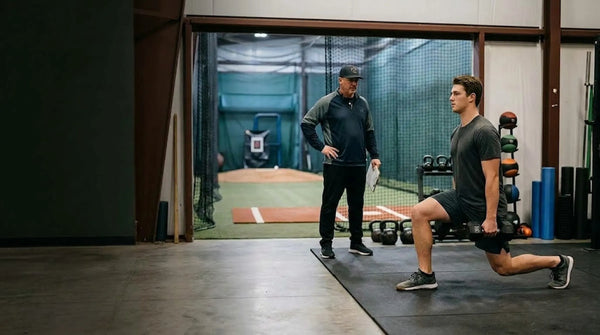
A coach measures his pitchers in the first week of fall. One comes up short on internal rotation. The coach adds a stretch, and three weeks later the number is 4 degrees better.
Nobody knows whether anything happened. Those 4 degrees may be real. They may also be measurement error, a different arm position, or a warmer athlete. And even if real, the mound was never measured.
That is not an argument against screening. It is an argument for knowing what a screen is for:
Does this athlete lack a position he needs, can I tell that reliably, and does anything change in his throwing when I address it?
The fall is the right time to ask. There is room to build and time to find out.
2. What a Mobility Screen Measures
A screen describes the range an athlete produced during a defined task on a defined day. Used well, it flags a position worth working on, sets a reference point, and helps a coach pick a simpler first training task. It does not identify tissue, predict a season, establish readiness, choose the right exercise, or replace evaluation when something hurts.
Three ideas get blended together. Reliability asks whether the same answer comes back twice. Validity asks whether the task measures what it claims. Usefulness asks whether the result changes a decision. A screen can clear the first two and still fail the third. Ask what you would do differently if the number were 8 degrees better.
Range is not access. A pitcher may own a position on a table and never reach it in a delivery lasting about a second and a half.
3. Does a Restriction Reach the Mound?
A limited range of motion showed up in the delivery and on the radar gun. Researchers grouped 57 pitchers aged 18 to 24 by total shoulder rotation. The limited group reached about 10 degrees less external rotation while throwing, opened the shoulder less during the stride, and threw 2.6 miles per hour slower. A restriction measured off the mound was visible on it. This is the strongest evidence in the guide that a limitation deserves attention.
The 160-degree cutoff only sorted groups in one study. It is not a pass-fail line for an individual pitcher.
On arm load, two studies disagree. The limited and normal groups showed no significant difference in elbow valgus torque or shoulder distraction force. A 2026 study of 43 adolescents found a smaller arc was one of two variables predicting higher elbow valgus torque. The same research group produced both, so they are not independent replication. Population and design differences are more likely explanations than a simple conflict. Anyone who says a screen identifies arm risk is ahead of the evidence. So is anyone who says mobility has nothing to do with the arm.
The lower body and the forearm add little. One high-school study linked a passive hip measurement with a trunk position, but it explained only a small share of delivery variation. A small thesis on forearm range in 22 Division I pitchers found strength related to spin efficiency while range related to nothing. The hip and trunk question belongs to What Do the Hips Have to Do With the Elbow?
4. What the Research Does Not Settle
The deciding study has not been run. No trial improved a pitcher’s range, confirmed the improvement, then measured whether his delivery or velocity changed. Mound studies compare groups. Training studies measure ranges. Nothing connects them.
Range does not reliably decline across a season. In 92 Major League pitchers, total range of motion rose about 9 degrees from spring training to season’s end, and no range change tracked pitch count, innings, or velocity. That is professional baseball, not a high-school season. It still undercuts the assumption that screening will catch range disappearing.
A normal value moves. Across 223 players aged 11 to 26, internal rotation and total range of motion differed by level. Side-to-side differences and internal rotation deficit, the two comparisons coaches reach for most, did not separate the groups.
A screen can spot a movement limitation without predicting injury. In 150 players, each part of a three-part screen flagged about 85 to 89 percent of the athletes who had the limitation it was checked against. But the study did not follow anyone for injuries. Spotting a limitation is not the same as predicting who gets hurt.
5. Can a Coach Measure This Himself?
Yes, when the task is defined and the answer is pass or fail. Two assistant coaches and a physical therapist scored 31 high school players on three tasks, then rescored from video a week later. Agreement was strong, and experience made no significant difference. The authors still said validation was needed before wide use.
The three tasks need no equipment beyond a wall:
- Reciprocal shoulder reach. The athlete stands with feet together, reaches one hand over the head and the other up the back, and tries to touch fingertips. Fail: the fingertips do not touch in both reach directions.
- 90/90 total body rotation. Feet stay together and in place, arms at 90 degrees of shoulder and elbow bend. The athlete rotates hips, shoulders, and head as far as possible. Fail: the coach, standing behind, cannot see the athlete’s back shoulder.
- Lower body diagonal reach. Two shoe lengths from a wall, the athlete balances on one leg and reaches the other foot behind and across to touch the wall near the floor, five times without touching down or losing balance. Fail: any miss or loss of balance on either side.
Pain during any task is recorded but is not a score. It is a reason to stop.
No, when the answer is a number of degrees. Under favorable conditions, one skilled clinician with a medical inclinometer could only detect changes of 1.7 to 2.8 degrees. A school gym will do worse. A widely used arm care sensor also agreed poorly with goniometry on range, though its strength measures held up better. A coach can reliably record whether an athlete can get into a defined position. He cannot reliably record how many degrees changed last month.
6. Compare the Athlete With Himself
The useful reference is the athlete’s own pattern, not a chart. That is a harder standard, because it requires knowing what normal looks like for this pitcher.
Consistency comes before meaning. One awkward result may be a poor explanation or a bad morning. Repeat it before acting on it. Timing changes the measurement. Range the morning after a bullpen is not range three days later, so pick a consistent point in the week.
Ask what changed. Growth, time away, a change in throwing, new outside work, or unreported discomfort may explain a result better than the tissue theory a coach reaches for first.
7. Practitioner Lens: Two Routes to the Same Question
Practitioner lens: applied interpretation, not peer-reviewed proof. The frameworks below come from experienced practitioners with published positions. They help organize a decision research has not settled. Neither has been tested against an alternative in a trial.
Commercial transparency. Ron Wolforth and Randy Sullivan operate commercial baseball-training businesses. Wolforth and Sullivan use Oates Specialties’ products in their facilities and have commercial relationships with Oates Specialties. Their frameworks appear as applied reasoning, not independent validation.
Both reject generic charts and one-size-fits-all mechanics. Their routes start in different places.
The Texas Baseball Ranch route: get the question answered. Its published recommendation is a functional-movement assessment from a qualified physical therapist and a strength assessment from a qualified strength-and-conditioning professional. The coach notices a repeated compensation, gathers qualified input, then trains what the assessment makes clear.
Sullivan’s route: train the movement solution while the answer develops. He argues athletes must organize control, timing, and co-contraction around the structure and range they have, and that some constraints, such as retroverted hips, are structural. The coach trains control of the range the athlete already owns.
A fall program can combine them. Refer the athlete whose compensation repeats, and train control in the range he already has. Referral depends on access and follow-through. Training first can leave a responsive limitation unaddressed if nobody revisits it. Neither practitioner has published evidence that this changes injury rates, velocity, or careers.
8. What a Fall Plan Should Build
A screen earns its place when it changes a modest, defensible part of the plan. Four uses qualify.
1. A position the athlete does not have. If the restriction looks like the kind that responds, work it, and keep throwing in the week so he has somewhere to put it.
2. Control of a range he already owns. Reaching a position on a table and holding it under speed are different jobs.
3. A simpler starting task. A pitcher who wobbles through a single-leg reach needs an easier version, done well, until it is his.
4. A reason for a conversation. Discomfort, a pattern different from his own normal, or a restriction he has not mentioned is a reason to ask, and to involve someone qualified.
A result that fits none of those has not yet earned a change to the plan. A failed task should not produce a corrective exercise chosen because it failed. No study connects a failed movement task to the right exercise for that athlete.
9. A Sample Fall Block
This is an example of how one block could run. It is Oates Specialties’ suggestion, not a protocol the research tested, and no study supports specific sets, reps, loads, or timing.
Weeks 1 to 2: observe. Run the three screen tasks at the same point in the week, ideally before throwing. Record pass or fail for each side, anything that looked different from the athlete’s usual pattern, and his outside throwing. Change nothing yet.
Weeks 3 to 6: one change at a time. Pick the one finding that fits a use in Section 8. Choose a slow, loaded task on a range the athlete can already reach, such as a light cuff task for a shoulder-blade control pattern or a light club for controlled arm circles. Keep effort submaximal and judge it by how the athlete feels, not how far someone else can reach. Keep throwing in the week. Do not stack it on the week throwing volume rises or a showcase lands.
Week 7: recheck. Repeat the same tasks at the same point in the week. Ask four things. Can he reach the position? Does it hold when the task gets faster or the session longer? Has his throwing quality, command, or recovery moved unexpectedly? Did outside factors change the picture?
Then decide. Hold, reduce, progress one part, coordinate with others in the athlete’s week, or refer. Range often arrives before the skill of using it, so a gain with no immediate mound change is not proof the work failed.
10. Tools as Examples
Commercial transparency. Oates Specialties designs and sells baseball training equipment, including the products below. This guide does not claim that any Oates Specialties’ product improves mobility faster, identifies a restriction, protects a joint, prevents injury, or raises velocity.
The first tools in a screen are a clear instruction and a simple record. Equipment helps after the coaching question is settled, as a way to give a range a slow, loaded job. The products below are examples of such tasks. None has been tested for changing a pitcher’s range, and none has been shown to change velocity.
Examples of loading a test position. When an athlete repeatedly fails one of the Section 5 tasks, a coach might use a tool to practice that position slowly under load. These are adaptations, not documented uses, and the research does not match any tool to any failed task.
- Reciprocal shoulder reach: light Wrist Weights on the arms during slow reaches, or a light Bell Club or band for controlled arm circles and holds.
- 90/90 total body rotation: a band held in the 90/90 arm position, or a light club held in both hands during a slow rotation.
- Lower body diagonal reach: Wrist Weights worn at the ankles, or a band around the legs.
Loading a test position changes the task. The screen is scored unloaded, so a loaded version is practice, not a retest.
What the research supports. Resisted training changed range of motion about as much as stretching in a review of 11 randomized trials, though the trials were mixed and not baseball-focused. Short-term range gains from stretching appear to reflect tolerance more than tissue length. In one trial of 60 volleyball players, holding the shoulder blade steady during a stretch produced larger immediate gains in internal rotation than stretching alone. Together these point toward control under load as a route to usable range.
What is our reasoning. We read that evidence as consistent with stability unlocking mobility. No study has tested loaded stability work in throwers, shown a lasting gain, or shown that it reaches the mound.
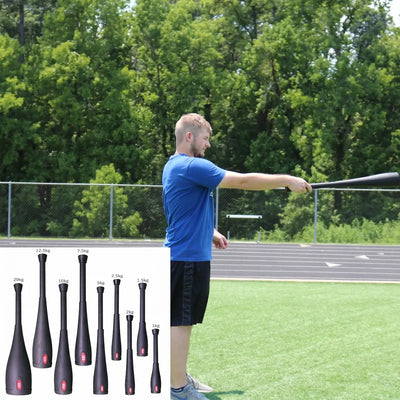
TAP® Bell Club. The weighted head sits on a long shaft, so the load sits away from the hand. Slow halos and casts ask the shoulder and shoulder blade to control position. Choking up shortens the lever. One six-week study of 21 cricket bowlers found club exercises went with gains in rotation range and internal rotation strength. A seven-person pilot found one swinging session changed range not at all. Boundary: a loaded task for range the athlete already owns. Begin with the lightest club.
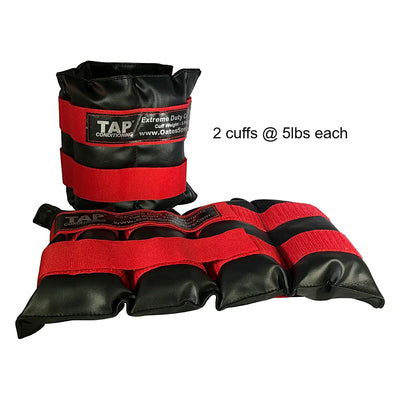
TAP® Wrist Weights. Adjustable weighted cuffs add a small load to slow forearm rotation and shoulder-blade control drills. Boundary: a way to load slow, controlled positions. It does not build range.
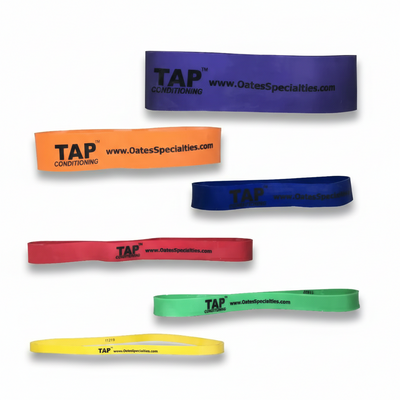
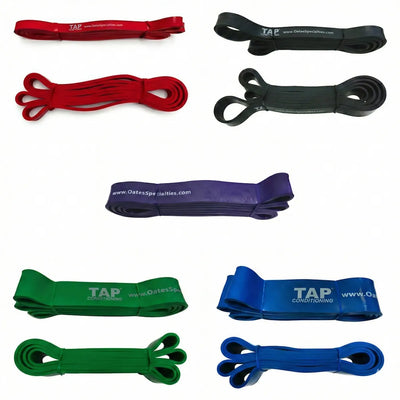
TAP® Exercise Bands/TAP® Giant Flat Bands. Resistance band loops in graded widths scale the load for isometric holds and pull-aparts. Exercise bands used in lateral walks can help load the hips. Research on elastic resistance covers general strength, not pitching, and no study has tested these bands. Boundary: a way to load a position, not a shown range builder.
Choose the objective first, the task second, and a product last. Research supporting an objective does not validate a product, including ours.
11. Athlete Action and Parent Note
Athletes: Report all your throwing, including lessons, showcases, and travel ball. Say when a position or throw feels different. Do not hide a restriction or missed work. A result describes a task on a Tuesday, not your arm or your ceiling.
Parents: No parent should be handed a number and left to worry. The most useful thing a family supplies is context: outside throwing, schedule pressure, time away, growth, and instructions from a qualified professional. A few degrees of change is usually not a finding, and no mobility measurement has been shown to predict injury.
12. Safety Boundary: When Coaching Gives Way to Evaluation
This guide is written for coaches of male baseball pitchers from junior high through college. Some research includes professional pitchers and does not automatically carry across ages. It is preparation guidance, not medical advice, injury prevention, rehabilitation, or clearance to play.
Stop treating the situation as ordinary training when pain is sharp, persistent, worsening, or limiting normal function. The same applies to numbness, tingling, unusual weakness, catching, locking, a complaint that keeps returning, and any existing restriction or return-to-throw instruction. Qualified-professional guidance then leads the plan.
Coaches ask, record, notice, monitor, adjust, coordinate, and refer. Qualified professionals evaluate, diagnose, and determine medical clearance.
13. Where This Guide Fits in the Series
This guide owns one decision: what mobility information tells a coach about the positions a pitcher can reach, and whether working on them reaches the mound. The Audit: What Pitcher Is Actually in Front of Me? owns preseason screening as a starting-point question and the evidence on whether a one-time measurement predicts injury. How Should Lifting and Throwing Fit Together? owns fitting lifting into the throwing week, and Does Lower-Body Strength Increase Pitch Velocity? owns the lower-body question.
14. The Next Coaching Question
A pitcher who can reach a position and control it has solved half a problem. The delivery still has to be stopped. The next guide, Why Does Deceleration Matter?, asks what happens after the ball leaves the hand and what a fall program can build to support it.
Evidence and Sources
The coaching guide ends above. The notes below are for coaches, athletes, parents, staff members, and academics who want the research details.
Verification note. Each source below was reviewed at the level its entry states. Thirteen research sources were reviewed at full text, including methods, results, and stated limitations. The four equipment-task sources added for Section 12 were reviewed at the level their entries state, mostly abstract level. Both practitioner sources and the Education Hub source were read directly. Two studies owned by another guide in this series are cross-referenced rather than restated, and their entries name the guide that carries them.
How to read this evidence
A result applies most directly to the athletes who were studied, and mobility research is unusually sensitive to this, because range varies with age, level, and throwing history.
Reliability and validity are different claims. A measurement can be repeatable and still not describe what a coach cares about.
Measurement error sets a floor under any change. If the smallest detectable change for a measurement is 2 degrees, then a 2 degree change is not a result.
An association does not establish that altering one measure alters the other. Most of the mound evidence below compares groups of pitchers rather than following pitchers through a program.
A practitioner framework can organize a decision without being evidence. Where practitioner material appears in this series, it is labeled as interpretation.
Study-card summary
| Source | Population | What it found | What it does not establish |
|---|---|---|---|
| Ide et al., 2024 (collegiate) | 57 pitchers, ages 18 to 24 | Limited total arc went with less external rotation reached while pitching, less horizontal abduction at stride, and lower velocity. No difference in elbow valgus torque or shoulder distraction force | That improving total arc raises velocity, or that a limited arc is safe for the arm. The authors state the sample lacked power for the kinetic comparisons |
| Ide et al., 2026 (adolescent) | 43 adolescent pitchers, ages 15 to 18 | Reduced total arc and greater internal rotation strength together predicted higher elbow valgus torque, explaining about 26 percent of its variation | That increasing total arc lowers elbow load, or that one measurement predicts injury |
| McGraw et al., 2019 | 92 Major League pitchers | Range of motion did not decline across a season. External rotation, total arc, and horizontal adduction all increased. No workload measure correlated with the change | That a high school season behaves the same way, or that screening is unnecessary |
| Wilcox et al., 2021 | 223 players, ages 11 to 26 | Internal rotation and total arc differed by level. Side-to-side differences did not differ across levels, and internal rotation deficit was no more common in pitchers than position players | A normal value for any individual athlete, or that side-to-side comparison has no use |
| Hanks and Myers, 2023 | 50 healthy adults, one expert tester | Minimal detectable change of 1.7 to 2.8 degrees. The medical inclinometer outperformed the standard goniometer | That a coach in a gym will achieve this error, which is a best case rather than a typical one |
| Matsel et al., 2025 | 51 players, ages 14 to 23 | One arm care sensor’s range of motion output agreed poorly with goniometry, from 0.17 to 0.37. Its strength measures performed better | That all sensors behave this way, or whether the device or the test position caused the disagreement |
| Matsel et al., 2021 | 31 high school players, 3 raters | Coaches scored a defined pass-or-fail screen as consistently as a physical therapist. Rater experience made no significant difference | That the screen is diagnostic, predictive, or prescriptive. The authors called for validation before mainstream use |
| Matsel et al., 2023 | 150 players, youth through college | Each screen component was sensitive to matched impairments: 0.89, 0.86, and 0.85 | Injury prediction. Outcomes were not measured, and a sensitive test flags athletes who are fine |
| Plummer et al., 2021 | 25 high school pitchers | One passive hip measurement related to trunk rotation angle, explaining about 18 percent of its variation | That hip range explains a delivery, or that changing it changes pitching |
| Plummer et al., 2022 | Division I collegiate players | A fall shoulder program moved some measures and not others. Athletes began without meaningful deficits | That the program caused every change, or that findings carry to high school |
| Watson thesis, 2024 | 22 Division I pitchers | Forearm strength measures related to spin efficiency. Forearm range of motion related to nothing in ball flight | Anything conclusive. Graduate research with a small single-team sample and investigator bias |
Annotated bibliography
Primary research
Ide T, Hamer TJ, Rosen AB, Vogel C, Haan D, Knarr BA, Wilkins SJ. Limited Total Arc Glenohumeral Rotation and Shoulder Biomechanics During Baseball Pitching. Journal of Athletic Training. 2024;59(10):997-1003. doi:10.4085/1062-6050-0565.23
https://nata.kglmeridian.com/view/journals/attr/59/10/article-p997.xml
Why it matters here. The central evidence that a shoulder restriction measured off the mound is associated with less rotation reached on it and with lower velocity, while showing no measured difference in arm load. Limited total arc was defined as less than 160 degrees, a threshold drawn from a prior meta-analysis. The limited group’s total arc deficit was 12.4 degrees against 1.5 in the control group.
Use with care. Cross-sectional group comparison, not a training study. The authors report that the sample, with a roughly 1 to 2 group ratio, lacked power to determine kinetic differences, so the absence of load differences is not a settled negative. They also note that the design did not account for seasonal timing, humeral retrotorsion, strength, lower-extremity characteristics, or pitching habits.
Shared authorship. Ide, Rosen, Knarr, and Wilkins are also authors on the 2026 adolescent study below. See the note under that entry.
Verification. Full text reviewed. Author list verified against the Crossref record for the DOI.
Ide T, Thomas SJ, Ogasawara T, Rosen AB, Knarr BA, Akehi K, Wilkins SJ. Shoulder Strength and Total Arc Range of Motion: Associations With Upper-Extremity Joint Kinetics and Ball Velocity in Adolescent Baseball Pitchers. Orthopaedic Journal of Sports Medicine. 2026;14(2). doi:10.1177/23259671251389223
https://journals.sagepub.com/doi/10.1177/23259671251389223
Why it matters here. The counterweight to the study above, in a younger population. Goniometric rotation measures with the athlete supine, isokinetic strength at 60 degrees per second, and 18-camera motion capture. Reduced total arc predicted higher elbow valgus torque, and internal rotation strength was also positively associated with velocity.
Use with care. Cross-sectional and correlational. It does not show that improving total arc reduces elbow load, and the authors state that single-time-point range of motion assessment is not adequate for injury prediction. Pitchers with prior upper-extremity injuries were neither excluded nor separately analyzed, and isokinetic testing may not reflect the extreme positions reached while pitching.
Shared authorship, and why it matters. Tomohiro Ide is first author on both this study and the 2024 collegiate study above, and Rosen, Knarr, and Wilkins appear on both. The two results in Section 3 therefore should not be described as independent replication. They come from one group reporting opposite directions in two different age bands, which makes population, sampling, and study-design differences more plausible explanations than a simple difference between unrelated laboratories. Which of those differences produced the conflicting association is not identifiable from the two papers. The samples appear distinct, with 57 pitchers aged 18 to 24 in the earlier study and 43 aged 15 to 18 here, but participant overlap was not stated in either paper and should be confirmed before publication.
Verification. Full text reviewed. Author list, volume, issue, and article number verified against the Crossref record for the DOI.
McGraw MH, Vrla M, Wang D, Camp CL, Zajac JM, Pearson D, Sinatro AA, Dines JS, Coleman SH. Shoulder and Elbow Range of Motion Can Be Maintained in Major League Baseball Pitchers Over the Course of the Season, Regardless of Pitching Workload. Orthopaedic Journal of Sports Medicine. 2019;7(2):2325967118825066. doi:10.1177/2325967118825066
https://journals.sagepub.com/doi/10.1177/2325967118825066
Why it matters here. Directly contradicts the assumption that a season removes shoulder range and that a screen will catch it going. Measured at spring training and season’s end by two physical therapists across six seasons. External rotation rose from 118.8 to 125.4 degrees and total range from 173.1 to 181.7, both at P < .001.
Use with care. Major League pitchers with professional support are not a high school population. The authors cite possible underpowering, imprecise workload measurement, unmeasured confounders including prior injuries and throwing outside games, and no interrater reliability assessment.
Verification. Full text reviewed.
Wilcox CL, Plummer HA, Ostrander RV III. Comparison of Glenohumeral Range of Motion Deficits in Youth, Collegiate, and Professional Baseball Players. International Journal of Sports Physical Therapy. 2021;16(6):1485-1491. doi:10.26603/001c.29683
Why it matters here. Establishes that normal range differs by level and that the two comparisons coaches use most did not separate these groups. Internal rotation differed at P < .0001, external rotation at P = .038, and total arc at P < .0001, while side-to-side differences were not significant at any level.
Use with care. Cross-sectional at a single point in time. Tanner staging was not performed, so maturity was not assessed. Pitcher subsamples within each level were small, and youth players often play several positions.
Verification. Full text reviewed.
Hanks J, Myers B. Validity, Reliability, and Efficiency of a Standard Goniometer, Medical Inclinometer, and Builder’s Inclinometer. International Journal of Sports Physical Therapy. 2023;18(4):989-996. doi:10.26603/001c.83944
Why it matters here. Supplies the measurement-error floor used throughout this guide. The medical inclinometer averaged an intraclass correlation of 0.933 against 0.822 for the standard goniometer, with minimal detectable change of 1.7 to 2.8 degrees across all devices and motions.
Use with care. Symptom-free adults aged 23 to 58, a single tester with more than 30 years of experience, and shoulder and forearm motions only. The authors note results may not generalize to inexperienced clinicians or to painful conditions. Conditions less favorable than these produce larger error, not smaller.
Verification. Full text reviewed.
Matsel KA, Burns M, Newbold J, Sherwood S, Plisky PJ. The Reliability and Validity of the ArmCare Strength and Range of Motion Sensor and Mobile Application in Baseball Players. International Journal of Sports Physical Therapy. 2025;20(9):1345-1354. doi:10.26603/001c.142905
Why it matters here. The one published comparison of a widely used arm care sensor’s range of motion output against goniometry. Intra-rater reliability for range measures reached 0.65 to 0.67 for internal rotation and fell to 0.19 for dominant-arm shoulder flexion.
Use with care. Testing positions differed between the device, which used half-kneeling, and goniometry, which used supine, and the authors could not determine whether the device or the protocol produced the disagreement. Male baseball players only. This entry describes one device and does not generalize to all sensors.
Verification. Full text reviewed.
Matsel KA, Brown SN, Hoch MC, Butler RJ, Westgate PM, Malone TR, Uhl TL. The Intra- and Inter-rater Reliability of an Arm Care Screening Tool in High School Baseball Coaches. International Journal of Sports Physical Therapy. 2021;16(6):1532-1540. doi:10.26603/001c.29680
Why it matters here. Establishes that trained high school coaches can score a defined pass-or-fail movement screen about as consistently as a physical therapist. Three raters scored 31 players live and again from video seven days later.
Use with care. Reliability is not diagnostic or predictive validity, a point the authors make in calling for validation before mainstream use and for further investigation of discriminant validity. Comparing live observation against single-angle video may have affected external validity, and collegiate and professional players were excluded.
Verification. Full text reviewed.
Matsel KA, Hoch MC, Butler RJ, Westgate PM, Malone TR, Uhl TL. A Field-expedient Arm Care Screening Tool Can Identify Musculoskeletal Risk Factors in Baseball Players. Sports Health. 2023;15(5):736-745. doi:10.1177/19417381221125465
https://journals.sagepub.com/doi/10.1177/19417381221125465
Why it matters here. The validation step the 2021 reliability study called for. Screen components were evaluated from video against predetermined impairment cutoffs, dichotomized as present or absent.
Use with care. Cross-sectional, level 3 evidence, and injury outcomes were not measured. Sensitivity alone does not establish that a flagged athlete is at risk, and the paper does not supply the specificity a coach would need to judge how many flags are false.
Verification. Full text reviewed.
Plummer HA, Bordelon NM, Wasserberger KW, et al. Association Between Passive Hip Range of Motion and Pitching Kinematics in High School Baseball Pitchers. International Journal of Sports Physical Therapy. 2021;16(5):1323-1329. doi:10.26603/001c.27625
Why it matters here. Shows how much of a delivery a passive hip measurement accounts for. Seated measurement by digital inclinometer with intra-rater reliability of 0.92 to 0.95. Drive leg hip internal rotation related to trunk rotation angle at P = 0.036 with an R² of 0.177, and drive leg total motion approached significance at P = 0.053.
Use with care. Small sample from one region of the United States, and a measurement method that differs from prior professional-pitcher studies, which limits comparison. Hip contributions to elbow loading belong to a separate guide in this series.
Verification. Full text reviewed. The publisher listing abbreviates the author list.
Plummer HA, Plosser SM, Diaz PR, Lobb NJ, Michener LA. Effectiveness of a Shoulder Exercise Program in Division I Collegiate Baseball Players During the Fall Season. International Journal of Sports Physical Therapy. 2022;17(2):247-258. doi:10.26603/001c.31638
Why it matters here. A fall program moved some measures and not others, and the athletes began without meaningful range of motion deficits, which limited how much room there was to change. Baseline status shapes what a program can demonstrate.
Use with care. Prospective cohort rather than a randomized trial, with no performance or injury outcome. Developed further in How Should Lifting and Throwing Fit Together?
Verification. Full text reviewed.
Graduate research
Watson CW. Division I Collegiate Baseball Pitching Performance in Relation to Forearm Kinematics and Kinetics. Master of Science thesis, Kinesiology, Louisiana Tech University; August 2024.
https://digitalcommons.latech.edu/context/theses/article/1124/viewcontent/Thesis___Chris_Watson.pdf
Why it matters here. Forearm range of motion showed no significant correlation with any ball flight metric in a study where strength measures did. Twenty-two Division I pitchers, mean age 20.4 years.
Use with care. Graduate research, not peer-reviewed intervention evidence. The author lists a small sample, a single team coached by study personnel, principal investigator bias arising from that coaching role, and an inability to standardize grip and seam orientation.
Verification. Full text reviewed.
Referenced here, developed further elsewhere
Bullock GS, Faherty MS, Ledbetter L, Thigpen CA, Sell TC. Shoulder Range of Motion and Baseball Arm Injuries: A Systematic Review and Meta-Analysis. Journal of Athletic Training. 2018;53(12):1190-1199. doi:10.4085/1062-6050-439-17
https://nata.kglmeridian.com/view/journals/attr/53/12/article-p1190.xml
Why it matters here. The source of the 160 degree total arc threshold. Six studies and 1,056 participants met inclusion criteria, with three pooled in the meta-analysis. Pooled absolute total range of motion was lower in injured athletes by 6.19 degrees (95% CI 10.28 to 2.10 lower, P = .003), absolute internal rotation by 5.93 degrees (95% CI 9.43 to 2.43 lower, P < .001), and absolute horizontal adduction by 8.32 degrees (95% CI 12.08 to 4.56 lower, P < .001). Absolute external rotation was not significant at P = .13. The authors identified absolute internal rotation below 44 degrees and total range below 160 degrees, with side-to-side deficits beyond 5 and 8 degrees, as values that should inform injury-prevention programs.
Use with care. The authors note that only English-language articles were included, that the underlying studies mostly followed athletes for a single season, and that most assessed athletes at only one competition level, so findings may not generalize across ages and levels. Read alongside the level-comparison study above, which found that side-to-side differences did not separate competitive levels, and alongside the 2020 overhead-athlete review below, which found professional-pitcher patterns inconsistent across broader groups. This guide does not adopt the 44-degree or 160-degree values as Oates screening thresholds. The smaller 5-degree and 8-degree side-to-side values are close enough to published measurement-error ranges that they should not be treated as stand-alone coaching findings without standardized positioning, timing, and repeated observation.
Verification. Full text reviewed. The publisher’s own platform returned an access error during earlier review; the article was reached through the National Athletic Trainers’ Association host. Citation verified against an institutional bibliographic record.
Pozzi F, Plummer HA, Shanley E, Thigpen CA, Bauer C, Wilson ML, Michener LA. Preseason shoulder range of motion screening and in-season risk of shoulder and elbow injuries in overhead athletes: systematic review and meta-analysis. British Journal of Sports Medicine. 2020;54(17):1019-1027. doi:10.1136/bjsports-2019-100698. https://bjsm.bmj.com/content/54/17/1019
Why it matters here. This systematic review and meta-analysis included 15 prospective studies and 3,314 overhead athletes, including 2,471 baseball participants. Across overhead sports, preseason shoulder range of motion was not a consistent predictor of later shoulder or elbow injury. The review concluded that screening may help identify at-risk professional baseball pitchers and swimmers, but may not be effective in handball, softball, volleyball, or tennis players. The clearest pooled association came from three professional-baseball-pitcher cohorts: throwing-arm external rotation less than 5 degrees greater than the non-throwing arm was associated with injury, odds ratio 1.90, 95 percent confidence interval 1.24 to 2.92.
Use with care. The pooled result was limited to professional pitchers. Study counts were small, and populations, measurement protocols, injury definitions, and competition levels differed. It does not create a screening cutoff for high-school or adolescent pitchers.
Verification. Full text reviewed.
Author concentration note. Hillary Plummer is an author on this review and on three other sources in this bibliography, and Charles Thigpen appears on this review and on the 2018 meta-analysis above. The shoulder screening literature is produced by a small number of groups, and a reader should not mistake repeated appearances for independent replication.
Oyama S, Hibberd EE, Myers JB. Preseason Screening of Shoulder Range of Motion and Humeral Retrotorsion Does Not Predict Injury in High School Baseball Players. Journal of Shoulder and Elbow Surgery. 2017;26(7):1182-1189. doi:10.1016/j.jse.2017.03.038
Owned by The Audit: What Pitcher Is Actually in Front of Me?, which reports its population, findings, and limits. Cross-referenced here and not restated.
Shitara H, Hamano N, Tajika T, et al. The Preseason Functional Movement Screen as a Predictive Tool for Shoulder and Elbow Injuries in High School Baseball Pitchers: A Prospective Cohort Study. Orthopaedic Journal of Sports Medicine. 2025;13(2):23259671241305607. doi:10.1177/23259671241305607
Owned by The Audit: What Pitcher Is Actually in Front of Me?, which reports its population, findings, and limits. Cross-referenced here and not restated.
Equipment-task research (supports the tasks in Section 10, not the products)
Afonso J, Ramirez-Campillo R, Moscão J, Rocha T, Zacca R, Martins A, Milheiro AA, Ferreira J, Sarmento H, Clemente FM. Strength Training versus Stretching for Improving Range of Motion: A Systematic Review and Meta-Analysis. Healthcare. 2021;9(4):427. doi:10.3390/healthcare9040427
Why it matters here. Across eleven randomized trials (452 participants), supervised strength training and stretching did not differ in their effect on range of motion.
Use with care. Mixed joints, ages, and health status; substantial heterogeneity; several small trials with high risk of bias; few eccentric or lengthened-position protocols. Not a baseball or shoulder-specific review.
Verification. Reviewed in the repository copy of the full text.
Lopes JSS, Machado AF, Micheletti JK, de Almeida AC, Cavina AP, Pastre CM. Effects of training with elastic resistance versus conventional resistance on muscular strength: a systematic review and meta-analysis. SAGE Open Medicine. 2019;7. doi:10.1177/2050312119831116. Corrigendum: SAGE Open Medicine. 2020;8. doi:10.1177/2050312120961220
Why it matters here. Elastic and conventional resistance gave similar strength gains.
Use with care. Eight studies, wide confidence intervals; not baseball. The abstract was corrected by the corrigendum, so confirm any effect size against the corrected version.
Verification. Verified against the abstract and the corrigendum record.
Walter S, Moltchanova E, Petersen C. Effect of Indian clubbell exercises on cricket fast bowlers’ shoulder kinematics. South African Journal of Sports Medicine. 2023;35(1).
Why it matters here. The closest controlled test of club exercises on shoulder rotation range: 21 male fast bowlers, six weeks, clubs plus regular training against regular training alone.
Use with care. Cricket bowlers, small sample, short duration, no velocity outcome. Groups were pair-matched on rotator strength; whether allocation was random was not confirmed.
Verification. Verified against the journal page and abstract; limitations and full text not read.
Phillips S, Rothstein A. Pilot Study Analyzing the Effects of Acute Indian Club Swinging on Strength, Endurance, and Mobility. International Journal of Exercise Science: Conference Proceedings. 2024;15(5).
Why it matters here. One eight-minute swinging session raised strength in one diagonal pattern and did not change goniometric range.
Use with care. Seven participants, a single session, a borderline p value (.05), and a conference abstract rather than a full paper.
Verification. Verified against the abstract.
Reinold MM, Wilk KE, Fleisig GS, et al. Electromyographic analysis of the rotator cuff and deltoid musculature during common shoulder external rotation exercises. Journal of Orthopaedic and Sports Physical Therapy. 2004;34(7):385-394.
Why it matters here. In ten healthy adults, intramuscular recordings showed which external rotation positions loaded the infraspinatus, teres minor, and rear deltoid most: side-lying external rotation, and prone horizontal abduction with full external rotation.
Use with care. Ten healthy subjects, activation only, no training outcome. The record we read did not state the resistance used or list the authors, so confirm the author list before publishing.
Verification. Verified against the abstract record.
Salamh PA, Kolber MJ, Hanney WJ. Effect of scapular stabilization during horizontal adduction stretching on passive internal rotation and posterior shoulder tightness in young women volleyball athletes: a randomized controlled trial. Archives of Physical Medicine and Rehabilitation. 2015;96(2):349-356.
Why it matters here. Sixty athletes with an internal rotation deficit did the same stretch with or without manual scapular stabilization. The stabilized group gained more internal rotation and posterior shoulder range immediately afterward.
Use with care. Women volleyball players, manual stabilization rather than a loaded tool, immediate effect only, PEDro score of 5 of 10. It supports the direction of the idea, not a training effect in throwers.
Verification. Verified against the PEDro record; full text not read.
Weppler CH, Magnusson SP. Increasing muscle extensibility: a matter of increasing length or modifying sensation? Physical Therapy. 2010;90(3):438-449.
Why it matters here. Concluded that short-term stretching gains (single sessions to eight weeks) reflect modified sensation, or tolerance, more than a lasting change in muscle length.
Use with care. A review of stretching, not of resistance or stability work. Longer programs had not been evaluated.
Verification. Verified against the abstract record.
Oates Specialties product pages for TAP® Bell Club, TAP® Wrist Weights, and TAP® Exercise Bands (oatesspecialties.com/products/bell-club, /wrist-weights, /exercise-band).
Why it matters here. Source for the product descriptions, uses, and stated boundaries in Section 10.
Use with care. Commercial material. The Bell Club page carries a “Backed by Research” heading without citations, and the Wrist Weights page makes company-level claims this guide does not repeat. Align the product pages with this guide before linking.
Verification. Pages read directly.
Practitioner sources
Wallace F. Efficient Movements. Texas Baseball Ranch. Published September 22, 2016; updated July 30, 2023.
https://www.texasbaseballranch.com/blog/efficient-movements/
Why it matters here. Carries the Texas Baseball Ranch recommendation that an athlete obtain a functional-movement assessment from a qualified physical therapist and a strength assessment from a qualified strength and conditioning specialist. It frames a mobility constraint as a driver of compensation and pattern deterioration, and it does not address whether a given constraint is structural.
Classification. Practitioner and commercial facility material, not peer-reviewed evidence. Authored by a Texas Baseball Ranch staff member rather than by Ron Wolforth, and presented here as the facility’s published position.
Verification. Read directly.
Sullivan R. Anatomy of Hip-to-Shoulder Separation. Florida Baseball ARMory.
Why it matters here. Supplies the structural half of the practitioner picture. Retroverted hips and limited thoracic rotation are treated as constraints an athlete works around rather than through, and the athlete adopts another movement strategy. Sullivan challenges the assumption that more separation and more range are better.
Classification. Practitioner and commercial facility material, not peer-reviewed evidence. It does not validate the ARMory’s assessment methods, proprietary model, or training claims.
Verification. Read directly.
Sullivan R. The Truth About Hip-to-Shoulder Separation. Florida Baseball ARMory. Published February 12, 2025.
https://floridabaseballarmory.com/the-truth-about-hip-to-shoulder-separation/
Why it matters here. States Sullivan’s argument that more hip-to-shoulder separation is not automatically better, and emphasizes athlete-specific self-organization, slack regulation, timing, and adaptable movement solutions.
Classification. Practitioner and commercial facility material, not peer-reviewed evidence. It does not validate the ARMory’s proprietary training methods or outcome claims.
Verification. Read directly.
Oates Education Hub
Oates B. Stability and Mobility. Oates Specialties Education Hub.
https://oatesspecialties.com/blogs/default-blog/stability-and-mobility
Why it matters here. Owns the joint-by-joint mobility and stability framework applied to pitching. This guide builds on that concept rather than restating it, and addresses what happens when a coach tries to measure it.
Classification. Oates editorial content, not research. The Hub article presents no tests, screens, or peer-reviewed sources.
Appendix A: How to Read Measurement Research
Five ideas separate using a screen well from misusing it.
Reliability asks whether the same answer comes back. It comes in two forms. Inter-rater reliability is whether two people scoring the same athlete agree. Intra-rater reliability is whether one person agrees with himself on a second look.
Validity is always validity for something. A measurement may accurately capture passive rotation on a table and still fail to describe rotation during a delivery. When a study reports validity, ask which claim was tested.
Minimal detectable change is the floor under every comparison. It is the smallest change larger than the error of the measurement itself. Report a change smaller than that and you are reporting noise. For a coach who tracks numbers, this is the most useful idea on the page.
Sensitivity and specificity answer different questions, and studies often report only one. Sensitivity is how well a test catches athletes who have the condition. Specificity is how well it clears athletes who do not. A test with high sensitivity and unknown specificity will flag athletes who are fine, so its failures are questions rather than findings.
Cross-sectional comparison is not an intervention. Most evidence in this guide compared one group of pitchers with another at a single point in time. That can show pitchers with less range move differently. It cannot show that giving a pitcher more range would change how he moves.
Most of this research comes from adolescent, high school, collegiate, and professional male baseball players. It may offer useful context for a high school pitcher. It does not automatically describe younger athletes, female athletes, or softball players.
Appendix B: Where Each Claim Comes From
This table maps the claims in the coaching guide to the studies behind them, so any statement can be checked against its source.
| Claim in the guide | Section | Source |
|---|---|---|
| A restricted total arc went with less external rotation reached while pitching, and lower velocity | 3 | Ide et al., 2024 |
| That restriction showed no difference in measured elbow or shoulder load | 3 | Ide et al., 2024 |
| A smaller total arc predicted higher elbow valgus torque in adolescents | 3 | Ide et al., 2026 |
| A passive hip measurement explained about 18 percent of a trunk position | 3 | Plummer et al., 2021 |
| Forearm range of motion related to nothing in ball flight | 3 | Watson thesis, 2024 |
| Range of motion did not decline across a Major League season, and did not track workload | 4 | McGraw et al., 2019 |
| Normal range differs by level, and side-to-side differences did not separate levels | 1, 4, 6 | Wilcox et al., 2021 |
| Professional patterns are not consistent predictors across overhead athletes | 4 | Pozzi et al., 2020 |
| A screen can be sensitive to impairments without measuring injuries | 4 | Matsel et al., 2023 |
| Coaches scored a defined pass-or-fail screen as consistently as a clinician | 5 | Matsel et al., 2021 |
| Minimal detectable change was 1.7 to 2.8 degrees under favorable conditions | 5, 11 | Hanks and Myers, 2023 |
| One arm care sensor’s range output agreed poorly with goniometry | 5, 10 | Matsel et al., 2025 |
| Baseline status limits how much a fall program can change | 8, 9 | Plummer et al., 2022 |
| The 160 degree total arc threshold | 3 | Bullock et al., 2018, the cutoff Ide et al., 2024 used |
| Strength training and stretching changed range of motion about equally | 10 | Afonso et al., 2021 |
| Club exercises went with more rotation range and internal rotator strength in cricket bowlers | 10 | Walter et al., 2023 |
| One club-swinging session did not change range of motion | 10 | Phillips and Rothstein, 2024 |
| Certain external rotation positions load the rotator cuff and rear deltoid most | 10 | Reinold et al., 2004 |
| Short-term stretching gains reflect tolerance more than tissue length | 10 | Weppler and Magnusson, 2010 |
| Scapular stabilization during a stretch increased immediate internal rotation gains | 10 | Salamh et al., 2015 |
| Preseason shoulder measures and a functional movement screen as injury predictors | 13 | Owned by The Audit |
Appendix C: Terms Used in This Guide
Confidence interval. The range of values a study’s result is consistent with. A wide interval means an imprecise estimate.
Cross-sectional study. A study that measures athletes once and compares them. It can describe differences between groups. It cannot show what would happen if one athlete changed.
External rotation. Turning the upper arm outward at the shoulder. In a pitcher, the position the arm reaches before the ball is delivered.
Glenohumeral. Of the ball-and-socket shoulder joint itself, as distinct from the shoulder blade or the surrounding structures.
Goniometer. The hinged protractor used to measure joint angles. Common, inexpensive, and the least reliable of the three devices compared in this guide.
Horizontal abduction. Moving the arm backward away from the midline with the shoulder out to the side. Part of how the arm gets behind the body in a delivery.
Horizontal adduction. Bringing the arm across the body in front of the chest. A common measure of tightness at the back of the shoulder.
Humeral retrotorsion. A normal twist in the upper-arm bone that varies between people and between arms. It influences rotation measurements without being a soft-tissue restriction, which is one reason two athletes with the same number are not in the same situation.
Inclinometer. A device measuring an angle relative to gravity. The medical version outperformed the goniometer in the reliability comparison in this guide.
Internal rotation. Turning the upper arm inward at the shoulder. The measure most often reported as reduced in throwing arms.
Internal rotation deficit. Less internal rotation on the throwing arm than on the other arm. Widely measured, and in the level-comparison study above it was no more common in pitchers than in position players.
Isokinetic dynamometry. Strength testing on a machine that holds the speed of movement constant.
Kappa. A measure of agreement that accounts for agreement expected by chance. Higher values mean closer agreement, with values above roughly 0.8 generally described as excellent.
Minimal detectable change. The smallest change in a measurement that is larger than the error of the measurement itself.
Mobility. The range a joint or region can move through. Distinct from stability, which is resistance to unwanted movement, and from control, which is managing a range under speed and load.
Passive range of motion. How far a joint moves when someone else moves it. Distinct from active range, which the athlete produces himself, and from what he reaches in a delivery.
Sensitivity. How often a test correctly identifies athletes who have the condition being tested for.
Specificity. How often a test correctly clears athletes who do not have it.
Thoracic rotation. Turning of the mid-back. A common structural contributor to how much separation a pitcher can produce.
Total arc. Internal rotation plus external rotation added together. Often more informative than either number alone, and the measure used to group pitchers in the two studies that disagree in Section 3.
Valgus torque. The turning force at the inside of the elbow during throwing, which the ligament and surrounding muscles resist.
Appendix D: The Mobility Observation Record
Use this to organize what you observed and what you intend to do about it. It is a planning record. It is not a screening protocol, a medical assessment, or a readiness score.
Athlete: ______________________ Date: ______________________
Coach or staff member: ______________________
Point in the week observed, and days since the last hard throwing day: ______________________
| Step | Prompt | Notes |
|---|---|---|
| Position observed | What position or task did you look at, and what were the instructions? | |
| Result | Could he get there, could he not, or was it inconsistent? | |
| Repeated | Did the same result appear on a second look at a comparable point in the week? | |
| Compared with | His own earlier pattern, or something else? | |
| What changed | Growth, time away, throwing change, outside work, discomfort, existing guidance | |
| Likely kind of restriction | Positional and likely to respond, structural and unlikely to, or unclear | |
| What the plan changes | The task, the starting complexity, the observation schedule, or nothing | |
| What would make you hold | The response that would stop you from progressing | |
| Next decision | Hold, reduce, progress, coordinate, or refer |
Stop treating it as a training question when:
Pain is sharp, persistent, worsening, or limiting normal function, or pain occurs during the screen itself
There is numbness, tingling, unusual weakness, catching, or locking
The same complaint returns in the same place
A restriction or qualified-professional instruction applies
Coaches ask, record, notice, monitor, adjust, coordinate, and refer. Qualified professionals evaluate, diagnose, interpret clinical findings, and determine medical clearance.
Educational content only. If an athlete has concerning, worsening, recurrent, or function-limiting symptoms, follow organization policy and seek qualified evaluation.
About This Analysis
Created by the Oates Specialties team led by Robert Oates, M.Ed., Founder
Editorial oversight by Gunnar Thompson, BS, CSCS, General Manager
Certified Strength & Conditioning Specialist | Biomechanics Specialist
October 2026
Complete Credentials
ROBERT OATES, M.Ed., Founder: Founded Oates Specialties in 2003. Master of Education degree. Provides strategic direction for educational content and athlete development philosophy.
GUNNAR THOMPSON, General Manager: BS Kinesiology (Clinical Exercise Science). CSCS (NSCA), PES (NASM), CPPS certifications. Technical authority on biomechanics and performance science. Conducts review of all educational content for scientific accuracy.
Questions or corrections: gunnart@oatesspecialties.com
© 2026, Oates Specialties LLC