How SMR tools — including foam rollers and massage balls — support recovery, range of motion, and movement quality across all three phases of arm care.
EXECUTIVE SUMMARY
This article is written for baseball coaches, pitchers, and parents looking for simple, low-cost tools to support arm care and recovery. It is most relevant to pitchers in-season — high school, travel ball, and college athletes managing regular throwing workloads.
Self-myofascial release — or SMR — refers to techniques where an athlete applies direct pressure to their own soft tissue using a tool and their body weight. Foam rollers and massage balls are the two most common SMR tools in baseball settings. SMR can support movement quality and recovery across all three phases of arm care. The strongest case is in Restore — consistent research supports its use after heavy throwing days for stiffness reduction and soreness management. The case in Prepare is real but individual: some athletes respond well, others do not, and that feedback should drive the decision. During competition, limited research suggests brief SMR during extended breaks may help maintain physical readiness, though it does not sharpen technical execution.
This article is a companion resource to the In-Season Arm Care for Pitchers pillar. Read that article first for the full Prepare–Compete–Restore framework these tools fit inside.
1. Why It Matters
Pitching is built from the ground up. Recovery work should reflect that. When the hips, trunk, and upper back are less stiff, pitchers often move better through the kinetic chain that supports the throw. Starting recovery at the arm and ignoring everything below the shoulder misses most of the picture.

That is why SMR tools show up so often in real-world coaching systems. Both foam rollers and massage balls are low-cost, portable, and easy to fit into a daily routine. Both are most useful as support tools inside a bigger arm care plan — not as standalone fixes.
For high school pitchers, in-season college athletes, and travel ball players managing heavy workloads, that kind of simple daily SMR habit often makes more difference than an elaborate protocol used once a week.
2. What the Research Says
2.1 — Short-Term Range of Motion
The most consistent finding in the SMR literature is an acute improvement in range of motion. Multiple meta-analyses confirm that foam rolling — the most studied SMR tool — produces a small but reliable short-term gain in flexibility. One review confirmed this pattern across 32 studies, finding a large effect size for ROM improvement in every study included in the analysis. Additional systematic reviews found that SMR reduces muscle stiffness and increases ROM when used before a training session.
The key point for coaches: Both the foam roller and a firm massage ball can help athletes enter a drill or throwing session with more usable range of motion. That improved movement access does not require any dramatic tissue change — it can happen in a few minutes.
2.2 — Recovery and Soreness Reduction
Research also supports modest recovery benefits. Multiple reviews have found that SMR helps reduce muscle soreness and attenuates performance declines after intense exercise. When rolling was used after activity, studies found meaningful decreases in perceived soreness. A systematic review focused specifically on athletes found that SMR tools — including foam rollers and massage balls — can improve recovery perception and reduce the effects of delayed-onset muscle soreness.
The key point for coaches: Post-throwing soreness is normal. Using a foam roller or massage ball in the Restore window after an outing is one of the simplest ways to support the recovery process before the next day's work.
2.3 — Performance Impact
The research here is more nuanced. Systematic reviews consistently find no detrimental effect on performance when SMR is used before activity. Most studies found no meaningful gain or loss in sprint speed or strength. The practical takeaway is that SMR before throwing is unlikely to hurt anything, and may help the athlete feel more prepared to move.

The key point for coaches: SMR is not a performance enhancer in the direct sense. It does not replace progressive throwing, strength work, or high-quality sleep. It is best understood as a preparation and maintenance habit — not a training stimulus.
2.4 — Evidence Limits
Most SMR research involves non-baseball populations, lower-body outcomes, and general athletic settings. The data must be translated carefully to pitchers. No study has followed a group of pitchers through an in-season throwing program using it as the primary variable.
The current literature also does not support exaggerated claims. The practice does not outperform every other recovery method. It does not fix pain, eliminate soreness, or rebuild damaged tissue. Coaches who present it as a cure are overstating what the evidence shows.
The honest message is not “SMR is magic.” It is: SMR is one of the easiest habits a pitcher can build to support recovery and movement quality inside a bigger arm care plan — and it tends to show up in the coaching systems of people doing this work at a high level.
3. How SMR Works
SMR likely functions through a mix of sensory, neural, and mechanical effects — not by physically “breaking up” tissue. Current reviews point to improved stretch tolerance, temporary reductions in perceived stiffness, changes in pain sensitivity, and short-term neural responses that help the athlete move more comfortably.
For pitchers, those sensory changes can be more useful than a structural shift. If the lats feel less restricted, the athlete may rotate better. If the glutes feel less guarded, the hips may move more freely through hip-shoulder separation. When the base of the delivery works well, the arm has a better foundation to operate from.
That is the practical value: it can help the pitcher enter the next drill or throwing session feeling more normal. That is often enough to improve movement quality without adding fatigue to the system.
4. Two Tools, Two Jobs
4.1 — The Foam Roller: Broad Coverage
Within the SMR category, foam rollers and massage balls are the two most practical options for baseball players. They achieve the same general outcome — reduced stiffness and better perceived movement quality — but in fundamentally different ways. Knowing the difference helps coaches use both more intentionally.
A foam roller covers large surface areas efficiently. It is well-suited for the quads, hamstrings, glutes, lats, and upper back — the big kinetic-chain contributors to pitching mechanics. Because the pressure is distributed over a longer contact area, a roller is generally more comfortable for beginners and more forgiving of imprecise technique. One pass along the thoracic spine or the quad takes seconds. That efficiency makes it the right starting point for most post-throwing recovery sequences.

The trade-off is that a roller cannot easily reach smaller, denser regions. The pectoralis minor, rear deltoid, and periscapular tissue between the shoulder blade and spine are difficult or impossible to address effectively with a standard roller.
4.2 — The Massage Ball: Targeted Precision
A firm massage ball concentrates force into a much smaller contact area. That concentration is what makes it useful for areas a roller cannot reach. For pitchers, the most relevant targets are the pecs, rear deltoids, periscapular tissue, and the posterior hip complex. Pressing into any of these spots with a lacrosse-ball-sized implement against a wall or the floor creates a level of localized pressure that no roller can replicate.
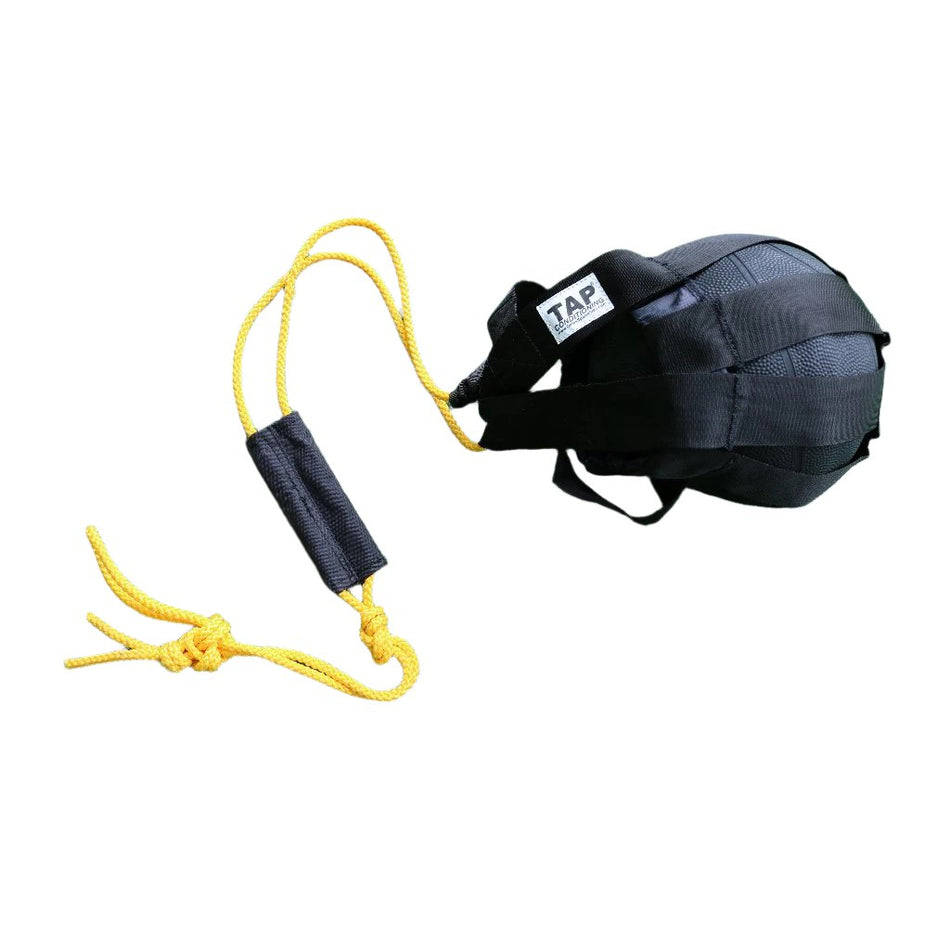
Because the contact area is smaller, the perceived intensity is higher. Athletes who are new to massage ball work should start with less body weight and work up gradually. A firm rubber ball in the lacrosse-ball range — like the TAP® Weighted Massage Ball — is the right density for most of these applications.
4.3 — How They Work Together
The most effective sequencing is foam roller first, massage ball second. The roller addresses broad surface tissue and large muscle groups. The ball targets the specific spots the roller surfaces over. A complete Restore sequence using both tools can run in eight to twelve minutes and cover the full kinetic chain from hips to periscapular tissue.
After both tools, a short shoulder tube sequence addresses the rotator cuff and periscapular tissue through oscillatory loading — a different stimulus that complements compression-based release without replacing it. That three-part sequence (roller → ball → shoulder tube) covers the full kinetic chain in a daily-maintenance window that is portable and easy to repeat.
Think of it as layers: the roller opens the kinetic chain broadly, the massage ball addresses the specific areas the roller misses, and the shoulder tube challenges the shoulder system through controlled oscillation. Each tool earns its place because it does something the others cannot.
5. What Baseball Coaches Use SMR For
In applied baseball settings, SMR work is used on the legs, hips, trunk, lats, upper back, pecs, and rear deltoids — not just the arm. Those regions influence pelvis control, trunk rotation, and the ability to transfer force efficiently through the delivery.
Ron Wolforth’s Texas Baseball Ranch includes SMR sequences in its daily post-throwing routine. Those routines incorporate foam rolling alongside other implements — including the Shoulder Tube — as a daily maintenance habit. The emphasis is on consistency and simplicity, not novelty. Wolforth’s coaching environment treats it as part of a repeatable rhythm, not an occasional intervention.
Randy Sullivan’s coaching philosophy adds another useful layer. Recovery work should be individualized and movement-based. The point is not to follow a rigid protocol — it is to help the athlete move well enough to train and throw again. That framing fits these tools well. They work because athletes actually use them.
6. Safety: Keeping It Productive
6.1 — Age and Training Age
For youth athletes and high school pitchers, SMR tools should be supervised and kept light. Younger athletes have less body mass to modulate pressure, which means they can easily apply too much force without realizing it. Parents and coaches should guide intensity and duration, keeping sessions brief and watching for facial guarding, breath-holding, or reports of significant next-day soreness.
For the massage ball specifically, work with beginners against a wall first. Wall work allows the athlete to control how much body weight contacts the ball, which lowers the risk of overpressure. Floor work and direct body weight loading should be introduced gradually after the athlete is comfortable with wall-based pressure.
6.2 — Stop Signals
SMR should produce a manageable discomfort, not sharp pain. Stop signals that warrant stopping or reducing intensity include:
- Sharp, stabbing, or shooting pain — either during or after the session.
- Pain that increases over consecutive days of use, rather than decreasing.
- Numbness, tingling, or radiating sensation into the arm, hand, or leg.
- Significant bruising or skin irritation in areas of repeated application.
A session that consistently produces these responses is being done too aggressively. Reduce pressure, shorten duration, and reassess. If symptoms persist, a sports medicine professional should evaluate the athlete before continuing.
6.3 — Movement Quality Progression Ladder
Not every athlete needs the same entry point. Use this progression ladder to match the tool to the athlete’s experience and tolerance:
- Roller, standing or sitting, light body weight only. Appropriate for all beginners. Keep sessions under three minutes per region.
- Roller, floor-based, moderate body weight. Progress once the athlete reports manageable discomfort and no next-day increase in soreness.
- Massage ball, wall-based. Begin here when introducing the ball. The wall allows precise pressure control and easy unloading.
- Massage ball, floor-based on soft tissue regions. Appropriate once wall work feels manageable. Avoid bony landmarks at all times.
- Massage ball with active movement. Pressing into a spot and moving the joint through range of motion increases intensity. Reserve for athletes who have worked through the earlier progressions without issue.
6.4 — Basic Setup Notes
Keep these setup principles in mind regardless of tool or progression level:
- Never roll directly on the lower back or the front of the knee.
- Avoid bony prominences — roll on muscle belly, not on bone.
- Pause on tender spots rather than rolling aggressively over them.
- Keep the massage ball away from the neck and nerve-dense areas.
- Sessions should feel like they helped — not like they added stress.
7. Load, Volume, and Timing
7.1 — Duration and Intensity
The research supports short, consistent sessions. Most studies used 60 to 120 seconds per muscle group as the intervention protocol. For pitchers, that translates to roughly two minutes per region — long enough to produce a sensory response, short enough to fit into a daily post-throwing routine without adding fatigue.
Intensity should be calibrated to a 4 to 6 out of 10 on a perceived discomfort scale. Below a 4, the stimulus is unlikely to produce a meaningful response. Above a 6, the athlete may guard against the tool, which defeats the purpose. The goal is a manageable “working discomfort” — not tolerance of pain.
7.2 — Off-Season vs. In-Season
Off-season use can be more exploratory. Athletes have more recovery time between sessions, which means they can experiment with slightly longer sequences, additional body regions, and higher-intensity ball work. The off-season is also the right time to develop the habit pattern — learning which regions respond well and building a sequence the athlete will actually repeat during the season.
In-season use should be simplified and consistent. Reduce the sequence to the three or four regions that matter most for that athlete — typically hips, lats, upper back, and pecs — and keep the total session time under ten minutes. A short sequence done daily is far more valuable than a comprehensive protocol done once a week.
A practical starting progression for in-season pitchers:
- Week 1–2: Roller only. Hips, lats, upper back. Two minutes per region. Post-throwing only.
- Week 3–4: Add massage ball for pecs and rear deltoids. One to two minutes per side.
- Week 5+: Full sequence (roller + ball), six to ten minutes total, daily post-throwing habit.
8. Where They Fit in Prepare–Compete–Restore
Prepare
The research on pre-competition use is real but mixed, and individual response matters more here than in any other phase. That is the honest starting point.
What the evidence does support: a brief rolling session before throwing can produce acute reductions in stiffness and short-term improvements in range of motion. One meta-analysis concluded that the available evidence actually better supports foam rolling as a warm-up tool than as a recovery tool — a finding that often surprises coaches who think of rolling as purely a post-activity intervention. Researchers recommend combining rolling with dynamic stretching before activity, with 90 to 120 seconds per region as the optimal dose for flexibility benefits.
Where the evidence gets complicated: a more recent systematic review found that rolling does not produce superior ROM or stiffness improvements over other warm-up activities. Walking, light cycling, and calisthenics produced comparable outcomes. Rolling is not uniquely necessary before a game — it is one option among several that can prepare the body to move.
What that means in practice is that individual response should drive the decision. Some athletes feel noticeably better and more prepared after a short rolling sequence. Others feel disrupted, over-stimulated, or simply do not respond. A pitcher who has rolled before starts all year and swears by it is using it correctly for him. A pitcher who finds it changes his feel or his mental routine should not force it. Coaches should know which athletes respond positively before making pre-competition rolling a team-wide protocol.
When used in Prepare, keep the session brief and targeted — under five minutes, focused on the regions that feel most restricted that day. Follow it immediately with dynamic movement and progressive throwing. The tools should serve the warm-up, not replace it.
Compete
The research base here is thin, but it is not empty. One study tested foam rolling during a simulated soccer half-time — a ten-minute window with five rolling exercises performed at 45 seconds each. Rolling did not improve technical skill performance, but it did attenuate sprint performance decrements in the second half. The proposed mechanisms were reduced tissue viscoelasticity, improved neuromuscular efficiency, and increased local blood flow.
Baseball does not have a clean ten-minute half-time equivalent, but a pitcher sitting in the dugout through a long inning is an analogous situation. The research suggests brief rolling during an extended break may help maintain physical output — but it does not appear to sharpen technical execution. For a pitcher, that distinction matters. Rolling on the bench between innings is not going to help command or feel. But for an athlete who tends to get tight or stiff during long waits, brief targeted ball work on the hip or upper back during a long dugout stretch may help them stay more physically ready when they return to the mound.
Like the Prepare phase, this is individual. Some athletes are built to roll and reset. Others need stillness and mental focus between innings. Coaches should pay attention to which type they are coaching before introducing any between-inning SMR habit.
Restore: Post-Outing (Immediately After)
This is the highest-value window for SMR. Within thirty to sixty minutes of finishing a start or high-intensity bullpen, a short foam roller and massage ball sequence helps manage initial soreness, supports circulation, and begins restoring movement quality in the tissues that just worked hardest. The sequence does not need to be long. Five to eight minutes covering the glutes, quads, lats, upper back, pecs, and rear deltoids is enough to initiate the recovery response.
Adding a short shoulder tube sequence directly after SMR targets the rotator cuff and periscapular tissue through oscillatory loading. That combination — compression-based release followed by oscillatory challenge — addresses both the kinetic chain foundation and the arm itself in a single post-outing session.
Restore: Recovery Day (The Day After)
On the day after an outing, the goal shifts from acute recovery to restoring movement quality before the next throwing session. Stiffness in the hips and upper back is common. A short rolling and ball sequence before easy catch or mobility work can help the athlete feel more normal and ready to move, without adding stress to the system. Keep intensity lower than the post-outing session and focus on tissues that feel restricted rather than running a full sequence.
This is also the right time to check whether any specific spot has become meaningfully more tender than the day before. If it has, note it and consider reducing throwing intensity that day.
9. Practical Example
A high school pitcher throws six innings on Friday evening. Saturday morning, he wakes up with stiff hips, a tight upper back, and some soreness in the back of his throwing shoulder. Before light catch that afternoon, he spends eight minutes on his routine:
- Two minutes each on the glutes, quads, and lats with the foam roller.
- Ninety seconds on the upper back, pausing on the areas that feel most restricted.
- One minute against the wall with a firm massage ball on the right pec.
- One minute on the right rear deltoid and periscapular region.
He follows with five minutes of easy movement — hip circles, arm swings, band pull-aparts — and then a light catch session starting at thirty feet. That sequence does not “fix” the arm. But it helps the body feel more normal and ready to move. That is the point.
For younger athletes and parents who are new to these tools, a supervised version of this sequence is appropriate. Start with the roller only, keep intensity light, and introduce the massage ball only after the athlete has a few weeks of roller experience. The goal is to support movement quality — not to create additional stress on the day after an outing.
10. Coaching Takeaways
SMR is most valuable when used consistently, simply, and in the right phase of the training plan. The tool matters less than the habit. A five-minute sequence done every day after throwing is worth more than a comprehensive protocol done twice a week.
Use a foam roller for the big kinetic-chain regions — hips, trunk, lats, and upper back. Use a massage ball for the areas the roller cannot reach — pecs, rear deltoids, and periscapular tissue. Follow both with shoulder tube work if the Restore sequence allows time. Judge the result by one standard: does the athlete feel and move better for the next task?
The right message for athletes and parents is not that SMR is magic. The right message is that it is one of the easiest, lowest-cost habits a pitcher can build to support recovery inside a bigger arm care plan — and that is exactly how it appears in the coaching systems of Wolforth and Sullivan.
11. Soft Next Step
If you want to start simply, add three to five minutes of SMR to the end of post-throwing recovery. Start with a foam roller, then add a massage ball once that habit is consistent. Follow both with your existing shoulder tube work.
Judge the results by whether your athletes feel and move better going into the next session. For the full Prepare–Compete–Restore framework and the complete in-season arm care tool sequence, return to the In-Season Arm Care for Pitchers pillar article.
Annotated Bibliography
1. Wiewelhove, T., Döweling, A., Schneider, C., Hottenrott, L., Meyer, T., Kellmann, M., Pfeiffer, M., & Ferrauti, A. (2019). A meta-analysis of the effects of foam rolling on performance and recovery. Frontiers in Physiology, 10, 376. Active URL
Primary evidence source for acute flexibility gains, soreness attenuation, and sprint/strength recovery effects. Used to support the research summary in sections 2.1 and 2.2.
2. Skinner, B., Moss, R., & Hammond, L. (2020). A systematic review and meta-analysis of the effects of foam rolling on range of motion, recovery and markers of athletic performance. Journal of Bodywork and Movement Therapies, 24(3), 105–122.
Confirms consistent ROM improvement across 32 studies with a large effect size. Supports the position that flexibility benefits are the most reliable finding in the foam rolling literature.
3. Cheatham, S. W., Kolber, M. J., Cain, M., & Lee, M. (2015). The effects of self-myofascial release using a foam roll or roller massager on joint range of motion, muscle recovery, and performance: A systematic review. International Journal of Sports Physical Therapy, 10(6), 827–838. Active URL
Useful for positioning foam rolling relative to other common flexibility and recovery methods. Supports performance-neutral framing in section 2.3.
4. Hendricks, S., Hill, H., den Hollander, S., Lombard, W., & Parker, R. (2020). Effects of foam rolling on performance and recovery: A systematic review of the literature to guide practitioners on the use of foam rolling. Journal of Bodywork and Movement Therapies, 24(2), 151–174.
Practitioner-focused review. Supports dosing guidance and caution against overstating foam rolling as superior to all other recovery methods. Used in sections 2.1 and 7.1.
5. Martínez-Aranda, L. M., Molina-Moreno, C., Gómez-Espejo, V., Olmedilla-Zafra, A., & Ortega, E. (2024). Effects of self-myofascial release on athletes' physical performance: A systematic review. Journal of Functional Morphology and Kinesiology, 9(1), 20. Active URL
Athlete-specific SMR review covering foam rollers and massage balls. Confirms recovery perception improvement, DOMS reduction, and ROM gains across 25 studies in athletic populations. Used to support the massage ball framing in sections 2.2 and 4.2.
6. Oates Specialties. (2026). In-season arm care for pitchers: Low-tech tools to stay ready all season. Read article
Pillar article that provides the Prepare–Compete–Restore framework used throughout this article. Serves as the primary ecosystem anchor for all tool placement guidance.
7. Texas Baseball Ranch. (n.d.). 5 simple steps to increase pitching performance during the season. Active URL
Authority source showing recovery routines that include foam rolling and other implements from Ron Wolforth’s system. Supports the coaching application framing in section 5.
8. Texas Baseball Ranch. (2024, August 5). The Shoulder Tube is something we use before or after throwing. Facebook video. Active URL
Wolforth video demonstrating the Shoulder Tube’s role in pre- and post-throwing recovery. Supports the three-tool Restore sequence described in sections 4.3 and 8.
9. Oates Specialties. (n.d.). TAP® Weighted Massage Ball: Deep tissue myofascial release & muscle therapy. Product page
Product page for the weighted massage ball described in section 4.2. Available in 8oz and 16oz. Rubber compound with raised seam for grip and controlled rebound.
10. Kaya, S., Cuğ, M., & Behm, D. G. (2021). Foam rolling during a simulated half-time attenuates subsequent soccer-specific performance decrements. Journal of Bodywork and Movement Therapies, 26, 193–200.
The only study identified that directly tests SMR during a competition break. Found that rolling during a simulated ten-minute half-time maintained sprint performance but did not improve technical skill scores. Proposed mechanisms included tissue viscoelasticity changes, neuromuscular efficiency, and increased vasodilation. Used to support the nuanced Compete-phase guidance in section 8.
11. RPP Baseball. (2022, June 4). Controlling the pelvis and back leg in pitching with Randy Sullivan [Video]. YouTube. Active URL
Useful authority source for individualized pitching development and recovery philosophy. Supports the individualized-approach framing in section 5.
12. Florida Baseball Armory. (2023, November 14). Embracing variability in pitcher training: The key to performance and injury prevention. Active URL
Supports the individualized, non-cookie-cutter approach to recovery tool integration described in section 5.
About This Analysis
Created by the Oates Specialties team led by Robert Oates, M.Ed., Founder
Editorial oversight by Gunnar Thompson, BS, CSCS, General Manager
Certified Strength & Conditioning Specialist | Biomechanics Specialist
April 2026
Complete Credentials
ROBERT OATES, M.Ed., Founder: Founded Oates Specialties in 2003. Master of Education degree. Provides strategic direction for educational content and athlete development philosophy.
GUNNAR THOMPSON, General Manager: BS Kinesiology (Clinical Exercise Science). CSCS (NSCA), PES (NASM), CPPS certifications. Technical authority on biomechanics and performance science. Conducts review of all educational content for scientific accuracy.
Questions or corrections: gunnart@oatesspecialties.com