Long-Loop Bands (41" Giants): Whole-Body Pulling, Mobility, and Stability for Pitchers
Executive Summary
Most arm‑care work lives between the shoulder blades and around the rotator cuff, but pitchers throw with their whole bodies, not just their arms. Long‑loop bands extend elastic work to the hips and trunk so the lower half and mid‑back can share more of the load before, during, and after a long season. Used inside a simple Prepare–Compete–Restore routine, a single long‑loop band gives coaches a field‑ready way to layer in whole‑body pulling, anchored trunk work, and assisted mobility without turning game day into a hidden lift or duplicating what tubing and 9″ loops already do well.
Why Long‑Loop Bands Matter for Pitchers
Pitchers may feel the effects of throwing in their arms, but the forces that reach the shoulder start in the ground, travel through the hips and trunk, and only then arrive at the arm. When the hips are stiff or the trunk can't rotate and brace well, the shoulder often has to work harder just to keep ball speed where it needs to be. Long‑loop bands make it practical to rehearse hip hinge, trunk rotation, and scapular motion together, rather than treating them as separate parts in the weight room and hoping they show up on the mound.
Where tubing and 9″ loops focus mostly on the shoulder girdle and local activation, long‑loop bands bridge the gap between "arm‑path" work and full‑body movement. They connect the hands to the hips and trunk, allow anchored positions that teach the body to share load up the chain, and support low‑load mobility for the shoulders and mid‑back on dense in‑season schedules.
What the Research and Field Experience Suggest
Most published research talks about elastic resistance and loop‑band work in terms of shoulder strength, scapular control, muscle activation, and dynamic warm‑ups for overhead athletes, not brand‑specific "giant flat bands." Across those studies, controlled pulling and rotation under band tension improve strength, scapular control, and key throwing‑related measures when they are dosed sensibly and integrated into a broader program. Kinetic‑chain analyses of pitching consistently show that when the hips and trunk contribute less, relative load on the shoulder and elbow goes up, and when lumbopelvic mechanics are better organized, work is distributed more evenly.

In applied settings, coaches who regularly use whole‑body pulling and anchored mobility patterns with throwers often hear the same early‑outing feedback: the first throws feel "easier," "more connected," or "less stiff through the mid‑back." That matches what you would expect when the hips and thoracic spine are better prepared to share the load and the shoulder is not trying to do someone else's job alone. The practical takeaway is not that long‑loop bands are magical, but that they let you apply well‑understood elastic‑resistance and kinetic‑chain principles to the parts of the body that usually sit outside traditional arm‑care lists.
How Long‑Loop Bands Behave: Roles and Mechanisms
Long‑loop bands are continuous flat loops long enough to span from hands to hips or from an anchor to the pelvis, which opens up patterns that shorter loops and standard tubing can't comfortably reach. For in‑season baseball use, they live mostly in two lanes:
- Whole‑body pulling patterns that connect the hands to the hips and trunk.
- Assisted mobility and stability patterns that organize the shoulders and mid‑back under low load.

Light to moderate bands work best for most pitchers in‑season, because they allow a smooth tempo and relaxed neck and shoulders instead of bracing and muscling against the band. Heavier bands make more sense in off‑season or with older, stronger athletes who need more strength‑endurance or anti‑rotation demand, but they can quickly overpower movement on game weeks and pull you toward fatigue‑chasing instead of readiness.
Whole‑Body Pulling Patterns
These patterns ask the legs, hips, trunk, and shoulders to share work instead of isolating a single joint.
Standing hinge row or standing row with hip hinge
Band anchored around the feet, athlete in a slight hip hinge with chest over toes, pulling elbows back while keeping the trunk tall (neutral spine), ribs stacked over the hips, and the neck quiet. The goal is to feel the hips and trunk support the pull so the lats and rhomboids are better activated and connected to lower half stability.

High‑anchor pulldown
Band anchored overhead, athlete in an athletic stance pulling elbows down and slightly back. The cue is "shoulder blades slide down and in while the ribs stay stacked," not "yank the band as hard as you can."
Rotational pull
Band anchored at roughly chest height to the side, athlete in a split stance performing a controlled pull across the body while the hips and trunk turn together. The emphasis is on smooth rotation and resisting any wild twist or lean so the athlete learns to organize around the mid‑body, not spin out.

Constraint-Based Movement Correction
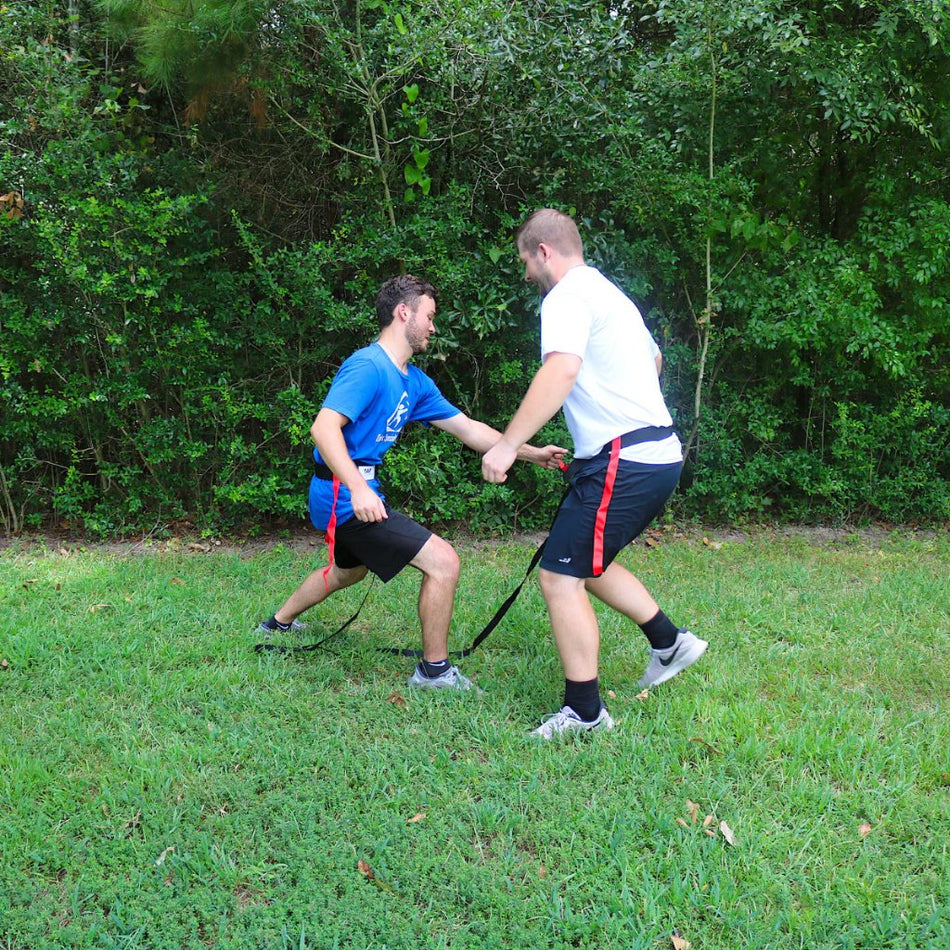
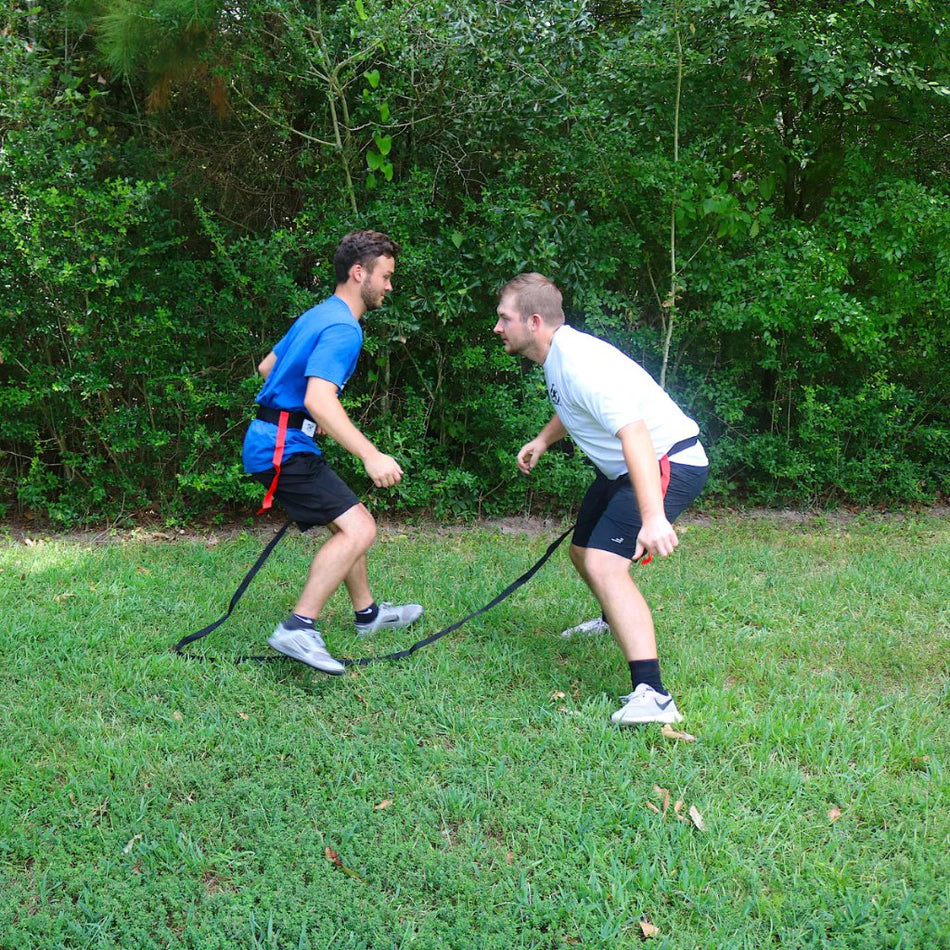
Long-loop bands allow coaches to "feed the mistake," pulling an athlete further into an error to force a subconscious self-correction. By exaggerating a flaw—like pulling a quad-dominant pitcher's hips forward—you trigger an instinctive counter-reaction that engages the correct muscles. It is a highly effective way to rewrite movement patterns without over-cueing.
These patterns target blood flow, mobility, stability, strength endurance, and overall movement quality up the chain.
Assisted Mobility and Stability
Here, the band guides motion or provides just enough pull to challenge posture and breathing without chasing big ranges or fatigue.
-
Band‑guided shoulder and thoracic mobility
The athlete uses the band as an anchor to move the arm and trunk into flexion, abduction, or rotation and then return under control. The band gives a clear direction to move toward and away from, which can smooth out motion without aggressive end‑range forcing. -
Hip‑anchored holds
The band wraps around the pelvis or attaches low and pulls gently while the athlete organizes posture and breathing. The goal is to feel the pelvis, trunk, and ribs stack under a mild elastic challenge that resembles what they need to hold on the mound. -
Low‑amplitude, low‑velocity end‑range holds
On recovery days, short, quiet holds at comfortable end ranges for the shoulders, trunk, and even legs support range of motion and stability without turning into stretching contests.
Taken together, these roles give long‑loop bands a clear job that is different from tubing's arm‑path focus and 9″ loops' compact scapular and ankle activation.
Safety, Setup, and Choosing Load
The same habits that keep tubing safe also apply to long‑loop bands, with a few extra reminders because more of the body is involved.
-
Anchors and surfaces
Attach bands to stable, non‑abrasive structures such as fence posts, sturdy racks, or dedicated anchors. Avoid sharp edges and rough surfaces, and inspect regularly for thinning, cracking, or abrasions, especially where the band contacts the anchor or ground. -
Elongation and resistance
Bands should not be stretched near their limits just to "feel" resistance. If an athlete has to walk too far back or brace hard to get tension, the band is too light for that pattern; move to a slightly heavier band or adjust the setup. Choose resistance that allows smooth, controlled movement with a relaxed neck and stable trunk—if posture breaks, the band is too heavy or the pattern is too complex. -
Fatigue and discomfort
In‑season, these patterns are there to wake up the chain and reclaim motion, not to chase soreness. Stop well before form breakdown or deep fatigue, and treat any sharp, odd, or localized pain—especially around the shoulder, elbow, or spine—as a firm stop sign.
Because long‑loop bands recruit larger segments of the body, it is easy for older or stronger athletes to "beat the band" with brute force from the hips, back, and a lot of times the arms. Coaching cues like "tall trunk," "quiet neck," and "smooth tempo" help keep the emphasis on organization and control rather than maximal pulling, which matches the in‑season priority of maintenance and readiness.
Youth and Developing Athletes
For youth and developing throwers, the target is teaching the hips and trunk to work with the shoulder under low load, not building maximum strength. Lighter bands, bilateral or simpler stances, and smaller ranges are the default, always under close supervision. If a young athlete can't maintain a tall trunk, relaxed neck, and easy breathing throughout a pattern, the coach should scale back resistance, stance, or range until the movement looks smooth and sustainable.
Quick Coaching Checks
Coaches can keep a simple mental checklist during band work:
- Can the athlete breathe normally through the movement?
- Do the hips and trunk initiate the pull, or is the arm dragging the body along?
- Do the shoulders stay away from the ears, or does the neck creep up and look tense?
If any of these checks fail, the adjustment is usually straightforward: lighten the band, shorten the range, or simplify the stance.
Where Long‑Loop Bands Fit in Prepare, Compete, and Restore
Long‑loop bands do not replace tubing or 9″ loops; they sit alongside them in the same framework and extend arm care to the hips and thoracic spine.
Prepare (pre‑throw)
After a general warm‑up and before or alongside tubing, a small block of whole‑body pulling can bring the lower half and trunk into the conversation so the shoulder is not asked to generate force alone.
Example Prepare block (about 5–6 minutes) with a light or moderate long‑loop band:
- Standing hinge row – 2 x 8
- High‑anchor pulldown – 2 x 8
- Light rotational pull – 1 x 6 each side
The emphasis is rhythm and connection, not burn.
Compete (between innings and dense days)
Between innings, long‑loop bands are usually a secondary option; tubing and 9″ loops are faster, more compact, and easier to manage in tight bullpens and dugouts. On practice‑heavy days without high‑intent throwing, though, a short whole‑body pulling block (2–3 minutes with a very light band) can help athletes feel their trunk and hips stay engaged when they are stiff from travel, classroom sitting, or long days on their feet.
In this phase, the priority is very low load and smooth motion so the arm feels "awake" and connected, not fatigued.
Restore (post‑throw and the next day)
Later the same day or the following day, long‑loop bands can support gentle, band‑guided mobility for the shoulders and thoracic spine and low‑load whole‑body pulls that promote circulation and range of motion. Paired with foam rolling and simple mobility work, this gives pitchers a practical way to address the areas that often tighten up after outings—the hips, mid‑back, and shoulder girdle—without leaning on aggressive static stretching.
The message to athletes stays consistent: restore comfortable motion, reinforce that the legs and trunk share deceleration and recovery, and avoid pushing into pain or deep fatigue in this window.
How This Fits Into the Series
Within the elastic‑resistance series, each tool has a defined, non‑overlapping job. The in‑season pillar lays out the overall Prepare–Compete–Restore framework and the core mechanisms—blood flow, mobility, stability, strength endurance, and movement quality—that the whole system serves. The tubing article shows how to use classic fence‑clip tubing for controlled arm paths, reaching and pulling patterns, and role‑specific dosing so pitchers build durability without turning warm‑ups into workouts. The 9″ band cluster shows how compact loops support scapular organization and lower‑half activation around the wrists and ankles, especially before and between innings.
This long‑loop band guide rounds out the elastic‑band chapter by:
- Extending band work to the hips and trunk through whole‑body pulling.
- Adding anchored anti‑rotation and posture work that supports lumbopelvic mechanics.
- Providing assisted mobility options for the shoulders and mid‑back on dense in‑season schedules.
Together, the system looks like this:
- Tubing – primary arm‑path and reaching tool.
- 9″ loops – low‑load organization for the shoulder girdle and lower half, especially in tight spaces.
- Long‑loop bands – whole‑body pulling and assisted mobility that teach the hips, trunk, and shoulder to share the job.
Next Step
If you are adding long‑loop work to your in‑season routine, it often works best to start with one light band and a short Prepare block, then expand from there. Once that block feels smooth and sustainable, you can layer in simple Restore‑day mobility patterns and, for older athletes or off‑season phases, consider a moderate band for slightly more stability and strength‑endurance demand—always inside the same Prepare–Compete–Restore framework and with the same emphasis on smooth motion, shared load, and clear guardrails.
Annotated Bibliography
A. Peer-reviewed and clinical sources
1. Kruchten, M. Effectiveness of Resistance Band Training on Scapular Stability in High School Baseball Players. University of Wisconsin–Eau Claire.
Study comparing traditional strength training alone versus strength training plus resistance bands in high school baseball players; adding bands improved several functional strength measures, supporting band use as part of shoulder and scapular programs for throwers.
URL: https://minds.wisconsin.edu/bitstream/handle/1793/74574/KruchtenSpr15.pdf
2. Seroyer, S. T., et al. The Kinetic Chain in Overhand Pitching: Its Potential Role for Performance Enhancement and Injury Prevention. Sports Health.
Reviews how forces are generated and transferred from the lower body through the trunk to the arm in pitching, highlighting how breakdowns in hip and trunk mechanics increase shoulder demands and supporting the emphasis on hips and thoracic rotation in this article.
PMC full text: https://pmc.ncbi.nlm.nih.gov/articles/PMC3445080/
Abstract: https://journals.sagepub.com/doi/abs/10.1177/1941738110362656
3. Beardsley, C., & Škarabot, J. Effects of Self-Myofascial Release: A Systematic Review. Journal of Bodywork and Movement Therapies.
Summarizes foam-rolling research, reporting improved range of motion and reduced soreness without negative performance effects, supporting the use of recovery-day mobility and soft-tissue work alongside low-load band-guided movement rather than aggressive stretching.
4. Walker, S. M. The Effectiveness of a Surgical Tubing Strengthening Program in the Maintenance of Pitching Velocity and Shoulder Strength in High School Baseball Pitchers. Oregon State University.
Six-week in-season study where a surgical-tubing shoulder program improved pitching velocity and internal/external rotation strength with no time-loss shoulder or elbow injuries, illustrating that modest, well-structured elastic programs can fit inside an in-season schedule.
5. Myers, J. B., et al. On-the-Field Resistance-Tubing Exercises for Throwers. Journal of Athletic Training.
EMG and load-cell analysis of 12 common tubing drills for throwers; identified patterns and anchor heights that most effectively activate key shoulder muscles, supporting the idea that field-based band work can meaningfully target throwing musculature.
6. Wilk, K. E., et al. The Youth Throwers Ten Exercise Program: A Variation of an Exercise Series for Enhanced Dynamic Shoulder Control in the Youth Overhead Throwing Athlete. International Journal of Sports Physical Therapy.
Youth-focused adaptation of the Thrower's Ten using body weight and a single band, associated with lower medial elbow injury incidence and improvements in shoulder and hip rotation and thoracic posture, supporting light, supervised band use in younger athletes.
7. Kinematic Modeling of Pitch Velocity in High School and Professional Baseball Pitchers.
Recent kinematic modeling work identifying trunk flexion and other shared features as predictors of pitch velocity across levels, reinforcing the importance of trunk mechanics in performance and supporting attention to mid-body organization in band work.
B. Internal framework and ecosystem references
8. Oates Specialties. In-Season Arm Care for Pitchers – Low-Tech Tools to Stay Ready All Season. Pillar article.
Establishes the Prepare–Compete–Restore model, defines core mechanisms (blood flow, mobility, stability, strength endurance, movement quality), and introduces long-loop bands as a category for whole-body pulling and assisted mobility within an in-season rhythm.
9. Oates Specialties. Elastic Resistance Tubing for Baseball and Overhead Athletes – A Field-Tested Guide to Smarter Arm Care. Cluster article.
Deep dive on tubing as the primary arm-path tool in the series, including research summaries, tubing construction and safety, and example Prepare/Restore circuits; anchors the idea that long-loop bands extend, rather than replace, existing elastic-resistance work.
10. Oates Specialties. 9" Exercise Bands for Arm Care – Wrist and Ankle Placement for Throwers. Cluster article.
Explains how 9″ loop bands support scapular organization and lower-half activation at low load, especially for between-innings and on-field usage, clarifying the distinct role of compact loops versus long-loop bands.
11. TAP® Giant Flat Bands – Oates Specialties Product Page.
Describes TAP® 41″ Giant Flat Bands, including their continuous-loop design, resistance ranges, and use for strength, stretching, and mobility, supporting neutral claims about form factor, progressive resistance, and suitability for whole-body pulling and band-guided mobility patterns.
12. Oates Specialties. TAP Exercise Bands – Resistance Training for Warmups & Strength.
Product and usage information for 9″ loop exercise bands, illustrating how shorter loops are positioned for wrist and ankle placement and lower-load organization work, which this long-loop cluster is designed to complement rather than duplicate.
URL: https://oatesspecialties.com/products/exercise-band-warmup
13. Oates Specialties. Bands & Tubing Collection.
Overview of Oates' bands and tubing line, including full-body and shoulder-focused options, reinforcing that long-loop bands sit within a broader elastic-resistance ecosystem for athletes.
URL: https://oatesspecialties.com/collections/strength-stability
14. Frontiers for Young Minds. Whole Body Movements to Throw Safer, Better, and Faster!
Educational article explaining the kinetic chain to younger readers and emphasizing how whole-body movement supports safer, more effective throwing, conceptually aligned with using long-loop bands to involve hips and trunk in preparation.
URL: https://kids.frontiersin.org/articles/10.3389/frym.2025.1495404
About This Analysis
Created by the Oates Specialties team led by Robert Oates, M.Ed., Founder
Editorial oversight by Gunnar Thompson, BS, CSCS, General Manager
Certified Strength & Conditioning Specialist | Biomechanics Specialist
February 2026
Complete Credentials
ROBERT OATES, M.Ed., Founder: Founded Oates Specialties in 2003. Master of Education degree. Provides strategic direction for educational content and athlete development philosophy.
GUNNAR THOMPSON, General Manager: BS Kinesiology (Clinical Exercise Science). CSCS (NSCA), PES (NASM), CPPS certifications. Technical authority on biomechanics and performance science. Conducts review of all educational content for scientific accuracy.
Questions or corrections: gunnar@oatesspecialties.com