
Building Strength the Body Can Actually Use
Executive Summary
General preparation is the off-season strength and hypertrophy block where overhead athletes build the physical foundation for the season ahead — and where most athletes leave their biggest performance gains on the table by training strength without training the body how to use it. It is the heaviest, most physically demanding block of the year. Strength, hypertrophy, and force output are the priorities. Athletes get bigger and stronger in this phase — and that can be the problem if nothing else changes. New muscle fibers do not automatically fire at the right moment, in the right sequence, at the right speed. Water-filled implements at higher loads and aggressive movement tempos solve that problem by forcing the nervous system to organize new tissue under conditions it cannot fully predict. This is also the phase where real shoulder strength and shoulder stability are built simultaneously — through loaded, dynamic implement work that demands the rotator cuff and scapular stabilizers produce force and control at the same time. General preparation done correctly does not just create a stronger athlete. It creates a stronger athlete whose body knows how to use what it built.
🎧 Prefer to listen? Audio version of this article:
This Phase Is Different
The Bridge (Active Recovery) Phase had one job: keep the neuromuscular system from going dormant while recovering tissue rebuilt itself. Loads stayed light. Movements stayed slow and deliberate. The entire block was built around what a recently competed, worn-down body could tolerate without adding stress on top of stress.
General preparation removes that ceiling entirely.
This is where athletes get in the weight room and push. Compound lifts. Progressive overload. Volume. Greater stability challenges. The goal is structural — more muscle, more strength, more capacity to produce force.
The implements or variations of the implements change too. What was used to maintain in the previous phase is now used to build. Higher loads. Movements are faster, more aggressive, and performed with maximal intent. The goal is not to feel controlled. The goal is to force the body to produce control under conditions that demand it. That is a fundamentally different goal from the phase that just ended — and it should feel that way.
What the Research Says: Hypertrophy, Neural Drive, and Specificity
Strength training is the foundation of general preparation — and it deserves to be treated that way. Progressive overload through compound movements increases fiber cross-sectional area, adds mass to working tissue, and drives the structural adaptations that raise an athlete's physical ceiling. At the same time, the nervous system becomes more efficient at recruiting and synchronizing motor units — producing more force from the same tissue with every training cycle. Both adaptations are products of hard, consistent strength work.
The question general preparation has to answer is not whether to build strength. It is how to build strength that performs under sport conditions. That is where the SAID principle — Specific Adaptations to Imposed Demands — becomes the practical guide. The body adapts specifically to the demands placed on it. Stable, heavy loading builds a powerful and efficient system for producing force under stable, predictable conditions. Adding unstable loading alongside it extends that adaptation into the unpredictable, reactive conditions sports actually create — without replacing or competing with the strength work that drives the structural foundation.
Research has documented that unstable loading conditions increase activation of stabilizing musculature across the full kinetic chain beyond what matched stable loads produce alone. That is not a reason to avoid stable loading. It is a reason to add unstable loading on top of it. The two training demands are additive. Strength training builds the force potential. Unstable loading trains the nervous system to recruit and coordinate that potential under shifting, unpredictable conditions — the conditions a pitcher, hitter, tennis player, or volleyball athlete faces on every rep of competition.
Hypertrophy raises the ceiling. The combination of strength training and reactive loading determines how close athletes perform to it.
The Failure Mode Nobody Talks About
Most athletes under-load their water implements in general preparation. They carry the conservative fills and slow tempos from active recovery into a block that demands something completely different. It feels responsible. It is a missed opportunity.
Active recovery requires light loads because tissue is recovering. General preparation does not carry that constraint. An athlete who is squatting and deadlifting at high intensity and then moving a lightly filled implement slowly is doing maintenance work inside a building block — and the body will respond accordingly. General preparation is the phase where heavier fills and more aggressive movement become available. That opportunity is worth taking.
The goal is not to maximize fill. It is to challenge the body at a level that demands genuine organization and reaction. More load creates more unpredictability, and more unpredictability is what drives the reactive stability adaptation. When the implement challenges the athlete, the chain has to work. When it does not, it does not.
When the load is right, the body has to work to stay organized. When the movement is right, there is a clear demand for speed and power rather than careful control. That is the difference between bridge phase maintenance and general preparation development — and it should be felt in every session.
Reactive Stability: The Missing Link Between the Weight Room and the Field
Static stability is the ability to hold a position under load. Reactive stability is the ability to reorganize the chain under a load that is actively working against the athlete — in real time, with no preview of what direction the demand is coming from. Sports demand reactive stability. The weight room builds a strong foundation, but ballistic unstable loading is what develops the reactive system on top of it.
Research confirms that unstable loading increases trunk and stabilizer activation significantly above matched stable conditions. Performed with maximal intent and ballistic movement speed, that demand builds reactive stability alongside the strength the weight room produces.
The exercises do not need to be sport-specific to produce this adaptation. General movements — rotational patterns, lateral power drills, multi-plane landing and stabilization work — all train reactive stability through the kinetic chain. The more closely a movement simulates the actual patterns of a specific sport, the more directly that stability transfers. But the general adaptation comes first, and it is valuable regardless of where on that spectrum the exercise falls. Coaches and athletes can progress from broader movement patterns toward sport-adjacent ones as the phase advances and the body demonstrates the control to handle the specificity.
The barbell builds force potential. Aggressive water implement work builds the body's ability to deploy that force reactively — in sequence, under conditions the athlete cannot fully predict. Both are necessary. Neither replaces the other.
Shoulder Strength, Stability, and Asymmetry
In the Bridge Phase, the shoulder needed protection. The KHAOS® Shoulder Shaker was a timing tool — a way to keep the rotator cuff and scapular stabilizers engaged at minimal cost to recovering tissue.
General preparation changes that relationship completely. The shoulder is not recovering. It is training. At 12–24 oz of fill depending on the athlete, the Shoulder Shaker becomes a genuine shoulder strength-and-stability implement — and this phase is also the right time to address what the season left behind in terms of side-to-side asymmetry.
Overhead athletes accumulate asymmetries across a competitive season. Dominant-arm structures grow stronger and often tighter. The non-dominant side contributes less and gets trained less. Research on overhead throwing athletes confirms that external-to-internal rotation strength ratios and overall shoulder balance can shift meaningfully over the course of a season. General preparation — with its lower sport-specific volume and higher structural focus — is the ideal window to close those gaps before the next training cycle begins.
One possible handheld water device application: hold the arm straight out at shoulder height and move the hand in a circle, driving the water into continuous motion, for 15 seconds of all-out effort. The shifting water creates force the shoulder must resist and redirect continuously. A second pattern moves the arm to the front and replicates the overhead sport arc — shoulder driven through the full range while the shifting load challenges the stabilizers throughout. Both arms receive equal training. The non-dominant side gets the same attention as the dominant side. Any meaningful difference in what each side can handle and control in this drill is information worth acting on before the throwing ramp-up begins.
Research has established that scapular control under dynamic conditions is central to efficient force transfer through the shoulder. An athlete who leaves general preparation with a shoulder complex that is not just bigger but dynamically stronger — and more balanced — arrives at specific preparation with a structural advantage no throwing volume alone can build.
Product-Specific Applications
General preparation is the phase where fill weight becomes a real training variable. More water means more unpredictability, and more unpredictability drives the reactive stability and coordination adaptations this phase is built around. One important guideline applies across all implements: keep fill below halfway. Water needs room to shift inside the implement to produce the instability that makes these tools effective. Filling past that point reduces the shifting and reduces the training effect. Rotational implements like the Bulgarian Water Bag should stay well below halfway — speed is the variable there, not load.
All exercises described below are examples of how athletes may apply each implement. They are not prescriptive training programs. Oates Specialties does not provide individual training instruction.
KHAOS® Water Yoke — Strength Movements with Unstable Load
Fill: Below halfway on each ball to maintain water shift.

The KHAOS® Water Yoke is the most direct bridge between the weight room and water implement training in the entire lineup. A bar with two straps, each ending in a water-and-air-filled ball, allows athletes to perform squats, lunges, and other compound lower-body movements with an unstable load that shifts independently on both sides simultaneously. Because it carries two water balls, the Water Yoke supports more total load than other implements in the lineup — making it the natural fit for a phase built around strength and hypertrophy. The body is asked to produce force through the same movement patterns as the barbell while continuously organizing against a load it cannot predict. That combination does not replace heavy strength work. It extends its training effect into the reactive, unpredictable conditions the body will face in competition. Pair it directly after or in place of a squat or lunge variation to maximize the transfer between the strength stimulus and the coordination demand.
KHAOS® Shoulder Shaker — Dynamic Shoulder Strength and Asymmetry Work
Fill: 12–24 oz depending on the athlete. Train both arms equally.
The KHAOS® Shoulder Shaker at meaningful fill and aggressive movement tempo builds simultaneous cuff strength and dynamic stability. Arm extended at shoulder height, full circular motion at all-out effort for 15 seconds. Then arm forward, overhead sport arc, stabilizers working through the full range. Equal attention to both sides. Gaps in strength or control between arms are diagnostic information for the phase ahead.
KHAOS® Water Ball — Lower-Body Power and Multi-Plane Stability
Fill: Increased from active recovery. At or below half fill.
Following a heavy squat or lunge variation, the KHAOS® Water Ball used in dynamic single-leg side jumps with a simultaneous ball touch to the ground trains power on the push-off, controlled deceleration on landing, and multi-plane hip and trunk stability at the same time. The ball's displacement of load away from the core increases the demand at the moment of ground contact. Power and stability are trained in the same rep rather than separately. It also utilizes the fibers you just activated with the heavy squat or lunge variation.
KHAOS® Waterboy — Lateral Power, Speed, and Core Redirection
Fill: Load the bag, staying at or below half fill. Overhead variations lighter.

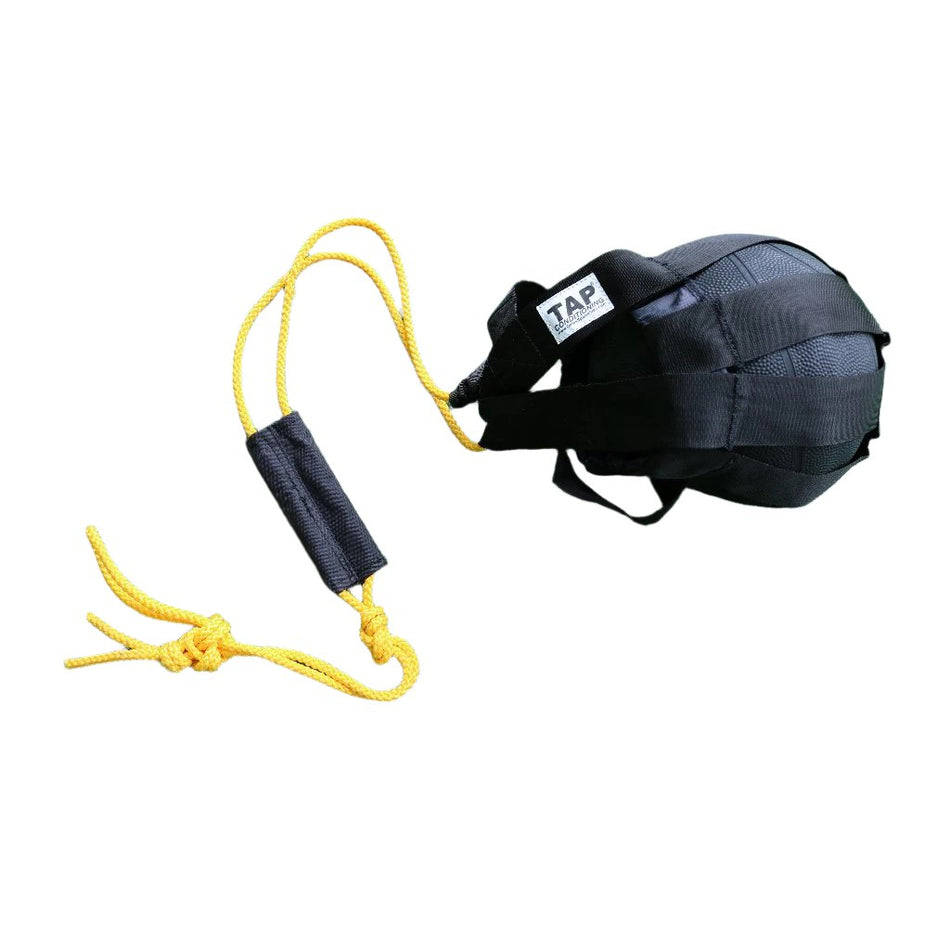
After deadlifts, side lunges, or box squats, the KHAOS® Waterboy held out in front during side shuffles — jab the bag outward and immediately redirect the shuffle — trains lateral force production and the core's ability to absorb and redirect momentum in sequence. Moving the bag overhead during carries or marching patterns increases trunk and shoulder complex demand. These movements are general enough to apply across sports and specific enough to reinforce the lateral and rotational patterns overhead athletes use in competition.
KHAOS® Bulgarian Water Bag — Full-Chain Power and Deceleration
Fill: Well below half fill. Speed is the training variable, not load.
The KHAOS® Bulgarian Water Bag at light fill and maximal movement speed — spinning and rotational variations — trains the hips, core, and shoulders to generate explosive force and immediately absorb the impact of redirection. This is more functional than traditional loaded ab work because it requires the chain to both produce and stop force — the same demand throwing, hitting, and serving place on the body in real time. The lighter fill allows movement speed that heavier fills prevent, and that speed is what drives the adaptation.
KHAOS® Waterbell — Shoulder Complex Stability Under Sustained Load
Fill: Load the implement. A weight plate can be added to increase the challenge further.

The KHAOS® Waterbell used in bottom-up farmer's carries and Turkish get-ups develops shoulder complex stability under sustained, shifting demand. The bottom-up carry forces the shoulder to actively stabilize through every step as the load fights to shift. The Turkish get-up demands stability across the full range of positions from floor to standing. Both are appropriate after upper-body strength work and build the overhead stability that pressing movements alone cannot fully develop.
Scheduling: How the Two Training Signals Coexist
Water implement training does not compete with the strength block. Its demand is neuromuscular. The two signals run in parallel. The practical scheduling answer is straightforward.
Heavy compound work gets priority. On days that include both, the barbell comes first and implement work follows. On dedicated implement days, treat them as power and coordination sessions — short, high-intent, full recovery between sets. Neither session should leave the athlete too depleted to train hard the next day.
These implements are not conditioning tools in this phase. Sets should be powerful and complete. Rest should be full. The goal is quality of effort, not just accumulation of volume.
Where to Go Next
General preparation builds the engine and trains the body to use it. The next article in this series covers specific preparation — the eight-to-twelve week window before competition where that strength and reactive stability gets directed into the exact patterns, speeds, and demands the sport creates. The goal there shifts from building capacity to converting it. The implement applications shift accordingly.
Athletes and coaches who want the full picture of how water-based instability training fits across the entire competitive year can start with the article, The Overhead Athlete's Blind Spot, which maps all five phases and establishes the framework this series builds on.
The Evidence in Summary
Hypertrophy builds the ceiling. The combination of strength training and reactive loading — built through higher-load, ballistic, unpredictable conditions — is what allows new strength to transfer to sport. General preparation done correctly is not a choice between getting bigger and getting more coordinated. It is both, running concurrently, each one making the other more effective at the field level.
Annotated Bibliography
Anderson, K. G., & Behm, D. G. (2005). Trunk muscle activity increases with unstable squat movements. Canadian Journal of Applied Physiology, 30(1), 33–45.
URL: https://pubmed.ncbi.nlm.nih.gov/15855681/
Demonstrated that unstable loading conditions significantly increase core and stabilizer muscle activity compared to matched stable conditions. Supports the ballistic, higher-load water implement prescription in general preparation as a direct mechanism for building reactive stability alongside compound strength training.
Behm, D. G., & Colado, J. C. (2012). The effectiveness of resistance training using unstable surfaces and devices for rehabilitation. International Journal of Sports Physical Therapy, 7(2), 226–241.
URL: https://pmc.ncbi.nlm.nih.gov/articles/PMC3325639/
Distinguished reactive stability from static stability and confirmed that implements displacing load away from the center of mass increase stabilizer demand beyond absolute load alone. Foundational to the Water Ball and Waterboy lateral power prescriptions and to the distinction between bridge phase maintenance and general preparation development.
Escamilla, R. F., & Andrews, J. R. (2009). Shoulder muscle recruitment patterns and related biomechanics during upper extremity sports. Sports Medicine, 39(7), 569–590.
URL: https://pubmed.ncbi.nlm.nih.gov/19530752/
Documented rotator cuff activation demands across all phases of the overhead throwing motion. Established the biomechanical rationale for training the cuff under dynamic, multi-directional loading and supports the loaded Shoulder Shaker prescription for building simultaneous shoulder strength and stability in general preparation.
Kibler, W. B., Sciascia, A., & Wilkes, T. (2012). Scapular dyskinesis and its relation to shoulder injury. Journal of the American Academy of Orthopaedic Surgeons, 20(6), 364–372.
URL: https://pubmed.ncbi.nlm.nih.gov/22661566/
Established scapular control under dynamic conditions as a trainable quality central to kinetic chain force transfer. Supports the Shoulder Shaker and Waterbell prescriptions and the argument that shoulder complex stability built in general preparation is structural preparation for the competition demands ahead.
Kraemer, W. J., & Ratamess, N. A. (2004). Fundamentals of resistance training: Progression and exercise prescription. Medicine & Science in Sports & Exercise, 36(4), 674–688.
URL: https://pubmed.ncbi.nlm.nih.gov/15064596/
Established the SAID principle as the theoretical foundation for concurrent stable and unstable training. Supports the argument that adding unstable loading alongside strength training extends adaptation into the unpredictable conditions sport creates.
Sale, D. G. (1988). Neural adaptation to resistance training. Medicine & Science in Sports & Exercise, 20(5 Suppl), S135–S145.
URL: https://pubmed.ncbi.nlm.nih.gov/3057313/
Established that early strength gains are predominantly neural before significant hypertrophy occurs. Foundational to the argument that new muscle fibers added during the hypertrophy block benefit from concurrent dynamic loading to develop coordinated, sport-specific force expression.
Schoenfeld, B. J. (2010). The mechanisms of muscle hypertrophy and their application to resistance training. Journal of Strength and Conditioning Research, 24(10), 2857–2872.
URL: https://pubmed.ncbi.nlm.nih.gov/20847704/
Comprehensive review of the mechanistic drivers of muscle hypertrophy and their application to resistance training prescription. Supported the structural foundation of the general preparation block and the role of compound posterior chain loading in driving hypertrophic adaptation alongside coordination training.
Wilk, K. E., Macrina, L. C., Fleisig, G. S., Porterfield, R., Simpson, C. D., Harker, P., Paparesta, N., & Andrews, J. R. (2011). Correlation of glenohumeral internal rotation deficit and total rotational motion to shoulder injuries in professional baseball pitchers. American Journal of Sports Medicine, 39(2), 329–335.
URL: https://pubmed.ncbi.nlm.nih.gov/21131681/
Documented measurable shifts in shoulder rotation ratios and range-of-motion asymmetries across competitive seasons in professional pitchers. Provided the sport-specific evidence base for training both arms equally in general preparation and for treating side-to-side differences identified during Shoulder Shaker work as actionable information before the throwing ramp begins.
Oates Specialties. The Overhead Athlete's Blind Spot: A Five-Phase, Year-Round Framework for Overhead Athletes Using Water-Filled Instability. oatesspecialties.com.
URL: https://oatesspecialties.com/blogs/default-blog/the-overhead-athletes-blind-spot
Establishes the five-phase framework this article operates within. Maps the role of water-filled implements across the full competitive year and identifies the kinetic chain emphasis of each implement in the KHAOS® lineup. The general preparation phase covered here is one of five phases addressed in that framework.
About This Analysis
Created by the Oates Specialties team led by Robert Oates, M.Ed., Founder
Editorial oversight by Gunnar Thompson, BS, CSCS, General Manager
Certified Strength & Conditioning Specialist | Biomechanics Specialist
May 2026
Complete Credentials
ROBERT OATES, M.Ed., Founder: Founded Oates Specialties in 2003. Master of Education degree. Provides strategic direction for educational content and athlete development philosophy.
GUNNAR THOMPSON, General Manager: BS Kinesiology (Clinical Exercise Science). CSCS (NSCA), PES (NASM), CPPS certifications. Technical authority on biomechanics and performance science. Conducts review of all educational content for scientific accuracy.
Questions or corrections: gunnart@oatesspecialties.com
© 2026, Oates Specialties LLC