A Five-Phase, Year-Round Framework for Overhead Athletes Using Water-Filled Instability
Traditional training puts overhead athletes on a stop-start schedule. Heavy lifting in the off-season. Skill work before the season. Then little or no structured training once games start. Each time that schedule shifts, something gets left behind. Raw strength carries over from one phase to the next. But the body's ability to stabilize joints, time muscle activation, and coordinate movement from the ground up does not. Whether the season just ended, ended months ago, or has not ended yet, the arm and shoulder are working with whatever survived the last phase change.
Water-filled implements solve this problem through something traditional tools cannot copy: unpredictable loading. When a water-filled implement moves, the water inside shifts. That forces the entire system—feet, hips, trunk, shoulder blade, and shoulder—to organize and react in real time. That training demand is higher than what heavier stable tools produce at the same weight, and it does not compete with the strength, skill, or sport training already in the program. Its role is not fixed. In some phases it plays a major supporting role. In others it works as a short recovery session or a quick primer before practice. What never changes is the problem it solves: the full chain's ongoing need for coordination, timing, and stability.
This article presents a five-phase framework that keeps the full chain tuned from the last game of one season to the first game of the next. The shoulder gets the most attention in overhead athletes because it is where problems show up first. But the legs, hips, trunk, and shoulder blade that power and organize every throw, serve, swing, and spike all benefit just as directly.
🎧 Prefer to listen? Audio version of this article:
The Block-Training Cliff: The Real Overhead Athlete Problem
The off-season strength block ends and the throwing program begins. The throwing program peaks and the season starts. The season ends and everything stops. Most overhead athletes have lived this cycle so many times it feels natural to them, and they assume it is the right way to train. It is not. Each time the program shifts, a gap opens. A gap is a window where the stabilizing patterns, timing, and coordination built in the previous phase get quietly left behind while the new phase takes over. Raw strength carries through those shifts. Coordination and timing do not. For example, a strength block may add muscle to an athlete—but has that new muscle been trained to engage and react the way the sport actually demands? Has the surrounding soft tissue learned how to stabilize the new mass? That is what a gap looks like.

In overhead athletes, that gap lands hardest on the shoulder. The shoulder is the visible failure point of a whole-body problem. The glenohumeral joint—the ball-and-socket joint where the upper arm bone meets the shoulder socket—trades bony stability for a wide range of motion. That trade is useful for performance. Over a career, it can be costly. The rotator cuff—a group of four muscles that surround the shoulder—does not create the force that accelerates the arm. Its job is to hold the ball of the upper arm bone firmly in the socket at exactly the right moment, so that the larger muscles producing force do not drive it into the soft cartilage ring lining the socket. The cuff must then fire again during deceleration to keep that ball seated as the arm is brought violently to a stop. That job cannot be done by the cuff alone. The shoulder sits at the top of the body's kinetic chain—the connected system from feet to fingertips through which force travels. It pays for every breakdown below it. When the hips stop contributing, when trunk control slips, when the shoulder blade loses stability, the shoulder and elbow absorb more than they were designed to handle. Research on overhead throwing confirms that efficient force transfer from the ground up directly determines how much stress reaches the arm. When coordination and timing erode between phases, every link in the chain is affected.
That is the block-training cliff. Each time the program shifts phases, the qualities that protect the shoulder—and the chain that feeds it—take the hit. Tissues adapt to the new training. But neuromuscular control—the nervous system's ability to time and organize muscle activation—can suffer during that adjustment. Water implements address this directly. They train the entire chain as one connected system under unpredictable conditions, at loads the recovering body can handle alongside the barbell, the field/court, and the skill work already in the program. The ankle that absorbs force on landing, the hip that starts the rotation, the trunk that carries it, the shoulder blade that organizes the arm above it—all of them are involved every time an unpredictable load has to be controlled. Protecting the shoulder means training the chain that feeds it, at every phase of the year.
The Low-Load Paradox: Why Load Predictability Beats Load Magnitude
The gap created by block training is not just a strength gap. It is a coordination and timing gap—and that difference matters for how it gets fixed. Traditional resistance tools use predictable loading. The weight behaves the same way on every repetition. That consistency lets the nervous system spread effort efficiently between the muscles doing the main work and the muscles stabilizing the joint. That is useful for building strength. But it is not how the body learns to organize itself under the unpredictable conditions sports actually create. Most training conversations ask the wrong question: how much weight is on the implement? For overhead athletes who are already pushing the shoulder close to its stress limit during competition, the better question is: how predictable is the load?

The nervous system organizes movement differently when the load is unpredictable—even if the total weight is the same. Stable tools allow the main working muscles and the stabilizing muscles to share the work efficiently because the load never changes between reps. When the same weight is carried in a water-filled implement, the water shifts with a short delay and forces the athlete to adjust in real time. Research comparing water-filled implements to standard resistance tools has found higher muscle activation in the side abdominals, lower back muscles, and outer hip muscles during similar exercises. Studies focused on upper-body work with water-filled tubes have found increased demand on shoulder and trunk musculature. Water-filled tube training has also been linked to measurable improvements in how steadily muscles produce force—in as little as two weeks.
Critically, this demand runs through the entire chain at the same time. The feet, ankles, knees, hips, trunk, shoulder blade, and shoulder all have to work together to manage a shifting load. No stable tool creates that kind of full-body demand at the same weight level. Multiple research reviews confirm that unstable training conditions increase muscle activation in both the upper body and the core, even when the weight used is lower than what stable tools would require.
That is the low-load paradox. A lighter, unpredictable implement can create a training demand that heavier stable equipment cannot—not because it weighs more, but because it is less predictable. For overhead athletes whose shoulders are already close to their competitive stress limit, that is the whole point. Water implements are not just lighter weights. They push the entire system toward better coordination, better joint stability, and better body awareness under uncertainty. That is what overhead athletes need more of at every phase of the year.
The Concurrent Training Question
Unpredictable loading fills the coordination and timing gap. The next question that follows naturally—especially for coaches already running a structured program—is whether adding water implement training creates a new problem. If an athlete is in a serious strength block, does adding water work hurt strength gains?
Concurrent training interference is real. But it refers specifically to the conflict that happens when high-volume endurance work and heavy strength training compete for the same resources in the body. At the cellular level, endurance training activates a pathway that tells the body to get more efficient at sustained effort. Heavy strength training activates a different pathway that tells the body to build muscle and get stronger. When both signals are running at high volume, the body has trouble fully committing to either. Strength gains get reduced as a result.
Water implement training does not send an endurance signal. Its main demand is learning to control an unpredictable load—a coordination and stability signal that works alongside strength training rather than against it. That means the interference problem either disappears or becomes easy to manage with a few simple scheduling decisions:
- Heavy barbell or dumbbell work gets priority on days that include both.
- Water work comes later in the session, at lighter loads, with a focus on movement quality.
- Or place water sessions on separate days as shorter coordination and control blocks.
That approach—treating water implements as a complement to strength training rather than a competitor—is what allows them to fit into every phase of the year without asking athletes to choose between getting stronger and staying coordinated and stable.
The Five-Phase Year-Round System
Water implements do not replace other training tools. They fill a specific gap that barbells, skill work, and sport training each leave open: the chain's ongoing need for coordination, timing, and joint stability under unpredictable load. How much water training is needed in any given phase depends entirely on what else the program is doing. In some phases it is a primary complement to the strength block. In others it is a short recovery session or a five-minute activation before skill work. The table below maps how that role changes across the full year.
| Phase | Timing | Water Implement Role | Load / Fill | Movement Approach | Parallel Training |
|---|---|---|---|---|---|
| Active Recovery | Immediately post-season | Neuromuscular bridge; tissue quality; movement pattern development | Minimal | Submaximal; address inefficiencies; full-chain patterns | Tissue recovery, general movement |
| General Preparation | 8–16 weeks pre-competition | Kinetic chain coordination; new tissue integration | Higher fill available | Explosive options; complement strength work | Heavy strength block |
| Specific Preparation | 8–12 weeks pre-competition | Skill primer; stabilizer challenge; slack removal | Lower weight; high intensity | Sport-adjacent patterns; constraint-led | Skill development, throwing ramp |
| Competitive Maintenance | During active competition | Recovery; timing stimulus; stabilizer activation | Minimal — enough to drive a response | Short, targeted; explosive where appropriate | Practice and game volume |
| Taper / Peak | 1–2 weeks pre-major event | Nervous system priming; slack removal | Low fill; deload | Familiar patterns only | Volume reduction |
Active Recovery
The bridge phase starts when the season ends. Rest is necessary. But stopping completely comes with a cost. The ability to time muscle activation and coordinate movement from the ground up is one of the first things to regress when training stops completely. The timing and responsiveness that protected the shoulder under competition speed are exactly what the next season will need first.
But active recovery does more than just preserve what was built. For many overhead athletes, this phase is also a chance to fix movement patterns and movement problems that got ignored during the season. At reduced loads and reduced intensity, an athlete can work on mechanics, hip-shoulder separation, or deceleration control without putting already-worn tissue through the stress of full-effort throwing, serving, or hitting. That matters for every athlete. It matters most for athletes trying to make a roster, earn a scholarship, or close a gap on their peers. Doing nothing is not a development plan. But overstressing the body when it is already spent from a long season is not a solution either. Water implements offer a third option: real movement work at loads the recovering athlete can actually handle.

This phase also builds tissue quality directly. More blood flow brings fresh building material to recovering tissue. The working muscles act as a pump, pushing waste products and dead cells into the lymphatic system—the body's drainage and waste-removal network—for clearance. Even low-intensity mechanical stress signals new cells to line up and layer in the direction of the forces they will eventually need to handle. This is not passive rest. It is active tissue development at a level that respects what the athlete just went through.
Load stays light. Movements stay below maximum effort. Volume stays low. The goal is not to create fatigue, push for progress, or break tissue down. The goal is to keep movement patterns, joint stability timing, and the body's sense of position and coordination alive across the full chain while building the foundation for general preparation.
General Preparation
General preparation is where athletes build raw strength: heavier loading, more resistance, and traditional strength goals. Water implement training does not replace that work. It fills the gap that stable strength training cannot reach.
Heavy lifting builds the engine. But new muscle and tissue created during a strength block needs new coordination. The nervous system does not automatically know how to use tissue that was not there before. If an athlete waits until the strength block is done before working on that coordination, the window for integration closes. What was built in the weight room becomes a limitation rather than an asset when sport demands arrive. Think of it this way: if a pitcher adds strength to their shoulder and back, but that new tissue has never been trained to engage and react at game speed, it does not help them perform. Water implement training in this phase allows coordination and stability to develop alongside strength in real time. New muscle and the ability to actually use it grow together.
Water implements also allow meaningful skill work during this phase without taking away from the weight room. A water implement session sends a different signal to the body than a heavy barbell set. It does not leave the athlete too worn down to train hard the next day. The strength block builds force potential. Water work builds the organized system through which that potential becomes usable performance.
Heavier fills, more explosive movements, and higher training volumes are all appropriate in general preparation. The implement complements the strength block. It does not substitute for it.
Specific Preparation
As the season gets closer, the training goal changes. The athlete no longer just needs more strength. They need to use that strength in the actual patterns, speeds, and situations their sport demands. Strength built in a gym does not automatically transfer to a mound, a service line, or an approach at the plate. The whole chain has to learn how to use it.
This phase runs eight to twelve weeks out from competition. That window exists for a reason. Tissue—muscle, tendon, and connective tissue—needs time to organize and strengthen along the specific lines of force it will actually be asked to handle. Rushing this window produces athletes who are more fit but still not physically prepared for what competition places on their bodies.
Water implements serve two connected purposes here. First, they keep external load low while the stability challenge across the chain stays high. The athlete is ramping up throwing, serving, or hitting volume. Adding more heavy shoulder loading on top of that works against the goal. Second, water implements prime muscles before skill work by removing slack. A muscle with slack in it is slow to respond. A muscle that has been activated against an unpredictable load fires faster, contracts with better timing, and contributes more cleanly to the movement that follows. Using a water implement before a skill session is not just a warm-up. It prepares the system for higher-quality work during the session itself.
The constraint-led environment that water implements create is especially valuable in this phase. A constraint-led approach means the tool or condition naturally pushes the athlete toward better movement without them being told exactly what to do step by step. The athlete does not just repeat a memorized pattern. They have to solve the movement under shifting conditions. That problem-solving builds more adaptable, more efficient mechanics through the hips, trunk, shoulder blade, and shoulder than repetition of a stable pattern alone can produce.
Competitive Maintenance
In season, the shoulder moves at its highest speeds and handles its highest volume of the year. Many athletes respond by dropping all structured training. The thinking makes sense on the surface. The outcome usually does not. When structured maintenance disappears completely, the chain qualities that kept the athlete healthy and performing at the start of the season start to slip backward—even while competition keeps going.
Recovery between outings is the first priority. Water implement training supports that recovery through the same mechanisms that make active recovery effective after the season ends: more blood flow to recovering tissue, removal of waste products through the body's drainage system, and low-level mechanical stress that helps new cells align properly. The whole body—not just the shoulder—is adding up wear across a long season. The legs absorb force on every landing and push-off. The hips and trunk generate and transfer rotational force hundreds of times per week. The shoulder is the most visible point of breakdown, but it is rarely the only one under stress. Short water sessions support tissue quality throughout the entire chain, not just at the shoulder. That is what allows an athlete to move the same way in the final week of the season as they did in the first. This is not the phase for new loading or new training—other parts of the program handle that. Water training here means recovery support and timing maintenance, and it should be scheduled that way.
The second priority is keeping the timing of muscle activation sharp across the full chain. This is what makes competitive maintenance different from every other phase. The shoulder stabilizers do not just need to be strong enough. They need to fire at exactly the right moment. But timing is a whole-body problem before it is a shoulder problem. If the hip stabilizers are slow, the trunk is disorganized, or the shoulder blade has lost its stability, the shoulder arrives late to do its job. At the speeds overhead athletes compete at, the window for the shoulder muscles to seat the arm bone in the socket before forces arrive is measured in milliseconds. Everything below the shoulder either creates more of that window or takes from it. A chaotic, unpredictable training stimulus—exactly what water implements produce—trains that full-chain timing more effectively than any stable resistance tool can. Athletes who keep this kind of training in their in-season routine arrive at each outing with a body that is not just recovered but organized and ready from the ground up.
Load management is critical here. The body adapts to what it has been handling recently. A sudden spike above that level raises injury risk. Practice and competition already fill most of the available training budget. Water implement work in season performs best when it is short, targeted, and scheduled where it helps rather than competes with game demands.
Taper and Peak
In the final one to two weeks before a major competition—or during a brief deload in season when there is an off-week, a bye, or extended time between games—the meaningful training work is already done. The athlete does not need more building. They need to be ready.
Water implement training in the taper phase is a primer and a reminder. The nervous system needs to be reminded how to remove slack from the legs, hips, trunk, and shoulder, how the full chain activates in the right sequence, and how each link protects the one above it under competition speed—without adding any fatigue in the process. Loads are minimal. Movements are familiar. Sessions are short. A session that leaves the athlete wondering if they did enough did its job. A session that leaves them tired did not.
The goal is not new adaptation. The goal is to arrive at competition with a full chain that is organized, responsive, and ready to perform.
Water Implements Across the Kinetic Chain
The five phases establish when and how water implements are used. The kinetic chain explains why different implements are not interchangeable. Each link in the chain—the lower body that generates force, the trunk that carries it, the shoulder blade that organizes the arm, the shoulder that delivers it—responds differently to different tool shapes and movement demands. An implement built for rotational hip-to-shoulder power is not the same tool as one built for shoulder stabilization or for slowing down rotation after force is expressed. The shape of the implement, where it places the load, and what movement it encourages all determine which link in the chain gets the primary training emphasis. Knowing that distinction is what allows a coach or athlete to match the right tool to the right goal at any point in the year—rather than grabbing the same implement no matter what the session is trying to accomplish. The KHAOS® lineup is built around exactly those distinctions.
| Implement | Kinetic Chain Emphasis | Primary Movements & Outcomes |
|---|---|---|
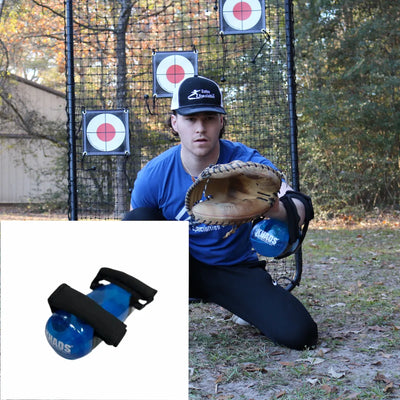
| KHAOS® Shoulder Shaker | Shoulder / scapula | Shoulder stabilization and activation, overhead mobility simulations, rotator cuff timing work, anticipatory stability training. Ideal low-load primer across all phases. |
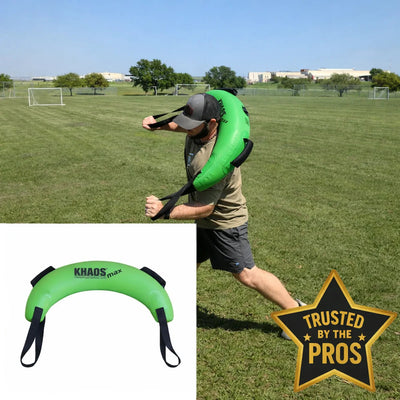
| KHAOS® Water Bulgarian Bag | Hip-to-shoulder transfer | Rotational movements, hip-to-shoulder separation, core control, and energy transfer through the kinetic chain. Natural fit for any throw, swing, or serve pattern. |
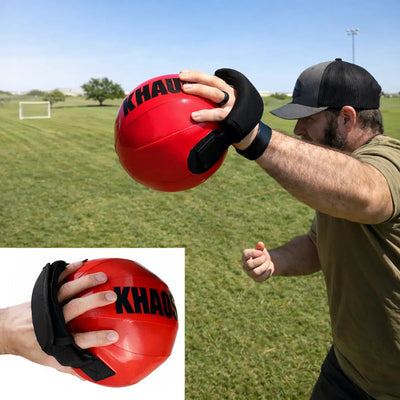
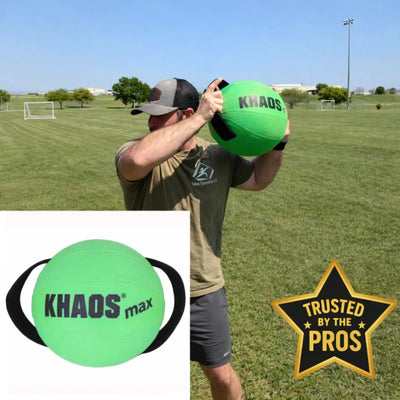
| KHAOS® Water Ball | Posterior chain / core | Sport-specific movement simulation where load is displaced away from the core, demanding greater co-contraction through the entire posterior chain. Baseball pitchers can mirror their delivery to drive rear-leg engagement and core stability through release. |
| KHAOS® Waterboy | Lower body / trunk | Deceleration training, lateral stability, weight-shift patterns (left to right), knee and hip control during planting and rotation. Best for training what happens after force is expressed. |
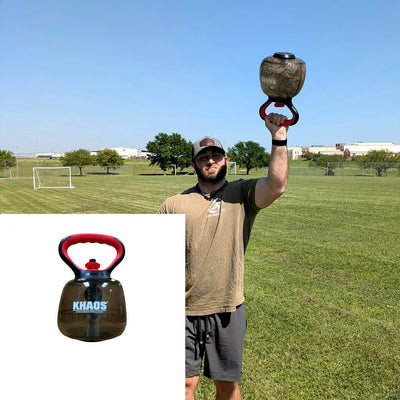
| KHAOS® Waterbell | Shoulder / trunk | Shoulder stability through waiter's carries and loaded holds, enhanced kettlebell movements, scapular control under dynamic load. |
| KHAOS® Waterboy Junior | Distal chain / separation | Forearm and shin loading to strengthen a movement or create a reactive response. A quarterback can load the lead arm to rotate around it more efficiently, improving separation and accuracy through better chain organization. |
Every implement in the lineup has a role in every phase. What changes is the prescription—how much fill, how fast the movement, how much volume—based on where the athlete is in the year. The phase determines how the implement is used. The implement determines which link in the chain is being trained.
The specific exercise prescriptions for each implement, including phase-by-phase progressions and sport-specific applications, follow in the companion articles for each phase. The principle here is simple: pick the implement based on which link in the chain needs the training emphasis. Adjust the fill, speed, and volume based on where the athlete is in the competitive year.
Where to Go Next
This framework is the map. The companion articles that follow deliver the territory. Each one takes a phase or a product into full programming detail: specific exercises, progressions, loading guidelines, and sport-specific applications that this article can only point toward.
The most useful next step depends on where the reader is in the calendar. The athlete who just finished a season starts with the active recovery article. The coach building a winter program goes to the general preparation piece. The athlete eight to twelve weeks from opening day needs the specific preparation article.
The goal is simple. When the season changes, the athlete should not have to guess what their training tools are supposed to be doing. This framework answers that question for the full year. The following companion articles answer it for every phase, every implement, and every sport.
Annotated Bibliography
1. Behm, David G., and Juan C. Colado. "The Effectiveness of Resistance Training Using Unstable Surfaces and Devices for Rehabilitation." International Journal of Sports Physical Therapy, 2012.
URL: https://pmc.ncbi.nlm.nih.gov/articles/PMC4637913/
Use in article: Supports the claim that unstable conditions increase stabilizer demand and muscle activation even at lower external loads. Anchors the low-load paradox logic and the argument that unpredictable loading biases the system toward coordination and co-contraction.
2. Baritello, Omar, et al. "Neuromuscular Shoulder Activity during Exercises with Different Combinations of Stable and Unstable Weight Mass." BMC Sports Science, Medicine and Rehabilitation, 2020. PMC7098120.
URL: https://pmc.ncbi.nlm.nih.gov/articles/PMC7098120/
Use in article: Primary shoulder-specific evidence source. Demonstrates that unstable weight mass raises neuromuscular activity in shoulder stabilizers beyond what stable weight alone produces, increasing the stabilization demand especially during internal and external rotation. Supports the low-load paradox section and the competitive maintenance timing argument.
3. Ditroilo, Massimiliano, et al. "Water-Filled Training Tubes Increase Core Muscle Activation and Somatosensory Control of Balance during Squat." Journal of Sports Sciences, 2018. PMID 29364062.
URL: https://pubmed.ncbi.nlm.nih.gov/29364062/
Use in article: Core mechanistic study supporting the low-load paradox section. Demonstrates higher trunk muscle activation and balance-control demands under water instability compared to stable conditions at equivalent loads. Conducted with elite Gaelic footballers using isometric squat protocols.
4. Farias, Diego A., et al. "Effects of Instability Resistance Training on Muscle Activation: A Systematic Review and Meta-Analysis." PeerJ, 2025.
URL: https://peerj.com/articles/19099/
Use in article: Review-level synthesis confirming that unstable resistance training reliably increases muscle activation across upper-limb and core musculature. Used alongside Behm and Colado to establish the review-level case for the low-load paradox.
5. Fleisig, Glenn S., James R. Andrews, Charles J. Dillman, and Rafael F. Escamilla. "Kinetics of Baseball Pitching with Implications About Injury Mechanisms." American Journal of Sports Medicine, 1995. PMID 7778711.
URL: https://pubmed.ncbi.nlm.nih.gov/7778711/
Use in article: Primary peer-reviewed source for the kinetic chain argument. Quantifies shoulder and elbow kinetics in skilled pitchers and establishes the relationship between lower-body and trunk energy transfer and upper extremity joint load. Supports the block-training cliff framing and the argument that the shoulder pays for breakdowns below it.
6. Fyfe, Jeremy J., David J. Bishop, and Nigel K. Stepto. "Interference between Concurrent Resistance and Endurance Exercise: Molecular Bases and the Role of Individual Training Variables." Sports Medicine, 2014.
URL: https://pubmed.ncbi.nlm.nih.gov/24728927/
Use in article: Provides the molecular and programming basis for the concurrent training section. Establishes the cellular pathway framing and the distinction between endurance-driven interference and neuromuscular complementarity. Supports the argument that water implement training does not trigger classical concurrent training interference.
7. Gabbett, Tim J. "The Training-Injury Prevention Paradox: Should Athletes Be Training Smarter and Harder?" British Journal of Sports Medicine, 2016.
URL: https://bjsm.bmj.com/content/50/5/273
Use in article: Grounds the acute:chronic workload ratio logic in the Competitive Maintenance phase. Supports the argument that in-season training decisions must account for the load already imposed by practice and competition.
8. Hickson, Robert C. "Interference of Strength Development by Simultaneously Training for Strength and Endurance." European Journal of Applied Physiology and Occupational Physiology, 1980.
URL: https://pubmed.ncbi.nlm.nih.gov/7193134/
Use in article: Classical foundational reference for concurrent training interference. Establishes the objection addressed in the concurrent training section and defines the interference phenomenon that water implement training is argued not to replicate.
9. Kibler, W. Ben. "The Role of the Scapula in Athletic Shoulder Function." American Journal of Sports Medicine, 1998. PMID 9548131.
URL: https://pubmed.ncbi.nlm.nih.gov/9548131/
Use in article: Landmark kinetic chain review establishing the scapula's role in overhead shoulder function and the relationship between proximal stability and distal force transfer. Used alongside Fleisig et al. to support the argument that the shoulder is the visible failure point of a kinetic chain problem.
10. Mujika, Iñigo, and Sabino Padilla. "Detraining: Loss of Training-Induced Physiological and Performance Adaptations. Part I: Short-Term Insufficient Training Stimulus." Sports Medicine, 2000. PMID 10966148.
URL: https://pubmed.ncbi.nlm.nih.gov/10966148/
Use in article: Short-term detraining reference used in Active Recovery and Competitive Maintenance. Establishes that neuromuscular timing and coordination qualities begin to regress rapidly when training stimulus is removed, supporting the case against full cessation and for the bridge role of water implements.
11. Mujika, Iñigo, and Sabino Padilla. "Detraining: Loss of Training-Induced Physiological and Performance Adaptations. Part II: Long-Term Insufficient Training Stimulus." Sports Medicine, 2000. PMID 10999420.
URL: https://pubmed.ncbi.nlm.nih.gov/10999420/
Use in article: Companion to Part I. Covers long-term neuromuscular and structural regression beyond four weeks of insufficient stimulus. Used alongside Part I throughout Active Recovery and Competitive Maintenance to support the full detraining argument.
12. Oates Specialties. "How Water Training Prepares Your Body for the Demands of Sport and Life."
URL: https://oatesspecialties.com/blogs/default-blog/water-training-applications-for-overhead-athletes
Use in article: Foundational internal article establishing the overhead-athlete framing, PCR framework alignment, and the practical application bridge between the external research evidence and the five-phase framework presented in this article.
About This Analysis
Created by the Oates Specialties team led by Robert Oates, M.Ed., Founder
Editorial oversight by Gunnar Thompson, BS, CSCS, General Manager
Certified Strength & Conditioning Specialist | Biomechanics Specialist
May 2026
Complete Credentials
ROBERT OATES, M.Ed., Founder: Founded Oates Specialties in 2003. Master of Education degree. Provides strategic direction for educational content and athlete development philosophy.
GUNNAR THOMPSON, General Manager: BS Kinesiology (Clinical Exercise Science). CSCS (NSCA), PES (NASM), CPPS certifications. Technical authority on biomechanics and performance science. Conducts review of all educational content for scientific accuracy.
Questions or corrections: gunnart@oatesspecialties.com