

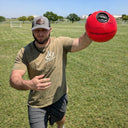
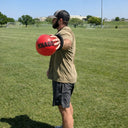
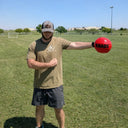

KHAOS® Shoulder Shaker – Compact Water Shoulder Trainer for Stability & Control
$69.95
Ships from Huntsville, TX
In Stock
Ordering for a team or facility?
Get volume pricing and help choosing the right tools for your players.
Ask me anything about this product
Sizing · use cases · technique · shipping — instant answers
Ask about KHAOS® Shoulder Shaker – Compact Water Shoulder Trainer for Stability & Control — how to use it, what athletes it fits, sizing, or how it compares to other tools we make. Answers are focused on this product.
Innovating since 2003
Family-owned, Huntsville TX
Talk to the team
Real specialists, not a call center
Made for daily program use
Designed for continuous reps, every day, every season
100+ implements, organized by goal
Arm care, velocity, strength, and recovery
About This Product
A compact, water-filled shoulder tool that trains the entire shoulder girdle to react to unpredictable, shifting loads — not just predictable, straight-line resistance.
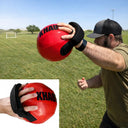
The KHAOS® Shoulder Shaker is a compact, water-and-air-filled shoulder training ball that uses internal fluid movement to create unstable resistance and challenge the entire shoulder girdle. By forcing the arm, shoulder blade, and trunk to react to constantly changing water motion, it gives overhead athletes a practical in-between tool for warm-up, arm-care conditioning, and active recovery.
- Hydrodynamic Water Load — Internal water shifts unpredictably with every movement, forcing continuous real-time adjustments from the shoulder and scapular muscles that fixed-weight tools cannot replicate.
- Tunable Fill Volume — Adjust from 4 oz to 12 oz to move between quick neural warm-ups and more demanding conditioning blocks without changing tools.
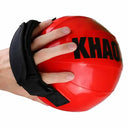
- Hand-Rest Grip with Adjustable Strap — The strap keeps the hand anchored without a constant hard squeeze, so the drill trains shoulder and scapular response rather than grip endurance.
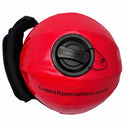
- Portable and Travel-Ready — Deflates flat, packs into any bag, and refills with a standard water bottle at the destination.
- Warm-Up, Conditioning & Recovery — Works at light fills before throwing, heavier fills in arm-care blocks, and low-intensity fills in active recovery circuits.
What Is It?
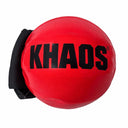
The KHAOS® Shoulder Shaker is a handheld water turbulence ball: a small, flexible sphere filled with both water and air, with an attached adjustable strap that keeps the hand resting on the ball during use. When the athlete moves the ball, the water shifts and impacts the shell, creating unpredictable, multi-directional forces the arm and shoulder must control.
Unlike solid dumbbells or rigid oscillation rods that have a fixed center of mass and predictable rebound path, the Shoulder Shaker’s internal fluid changes position with every subtle variation in speed and direction. Compared to traditional band or tubing work, it offers a more fluid-based, irregular challenge that trains the shoulder to react to sudden changes.
How It Works
Three mechanisms behind the shifting water load
Hydrodynamic Mass Disruption
In standard dumbbell work, the weight’s center of mass stays fixed. Inside the Shoulder Shaker, the water constantly shifts its position, preventing the shoulder from settling into a simple groove and forcing continuous micro-corrections.
Scapulothoracic Integration
Because the internal load is unstable, the forces travel up the arm and recruit the muscles that control the shoulder blade—not just the rotator cuff alone. This trains the arm and scapula to work together as a single unit.
Rapid Joint-Reaction Training
Irregular water motion exposes the joint’s position-and-motion detectors to a stream of unexpected inputs, training fast, automatic responses instead of slow, conscious contractions — preparing the shoulder for sudden forces in real throwing.
Backed by Research
The Science of Hydrodynamic Shoulder Training
There is no single peer-reviewed trial on the KHAOS® Shoulder Shaker itself; support comes from broader work on unstable resistance, perturbation-based training (using small, unpredictable forces to train balance and control), and reflex-based shoulder stabilization, alongside early field use and internal case feedback. Research on upper-body perturbation and unstable-resistance training supports improvements in neuromuscular control and dynamic stability for overhead athletes.
4–12oz
Adjustable water fill range — lighter for warm-up, heavier for conditioning
360°
Multi-directional water shift — no two reps produce the same force pattern
21cm
21 cm diameter — compact enough to fit in a travel bag; no open field or partner required
Video Library
See It In Action
Click the thumbnail to play — click any timestamp to jump to that moment.
2023
KHAOS® Shoulder Shaker | Improve Shoulder Strength and Stability
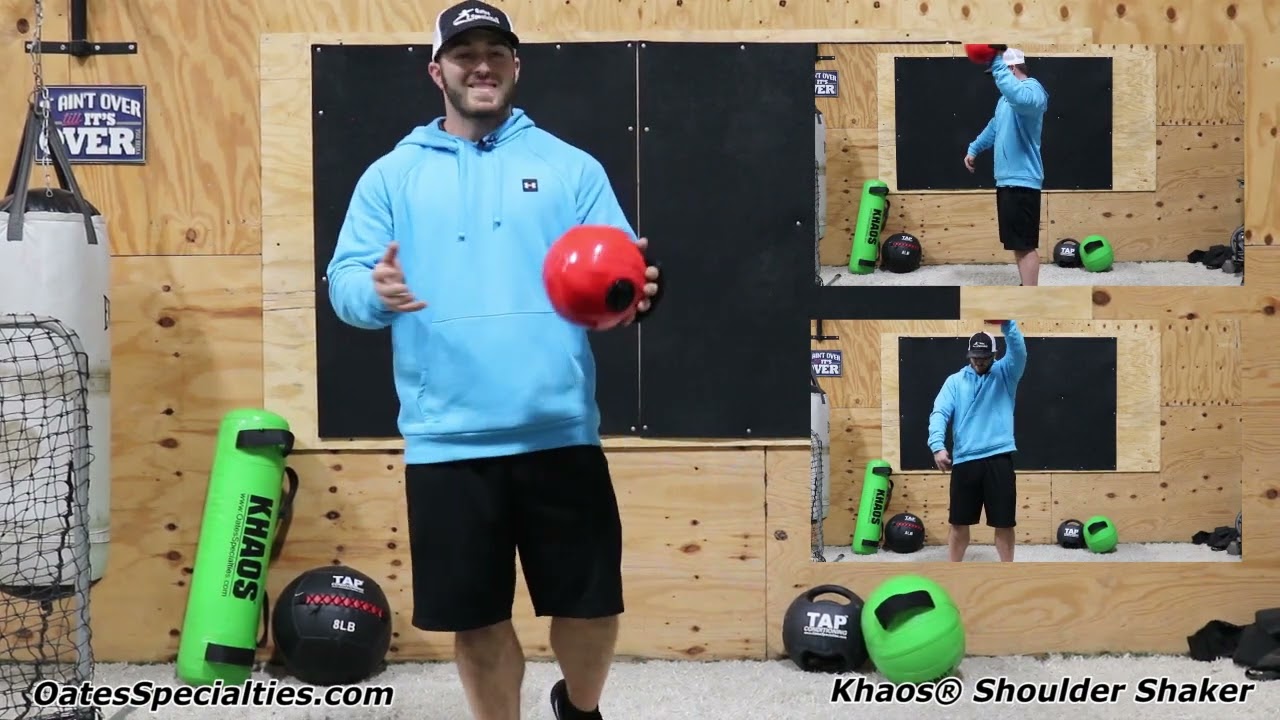
Chapter Guide — 11 Timestamps
| Gunnar Thompson introduces the KHAOS® Shoulder Shaker to the product catalog. | |
| Structural design — single-handle, smaller profile vs. the original larger green water balls. | |
| Adjustable loop assembly and the anti-abrasive hand protection sleeve. | |
| Fluid volume parameters — starting at 4 oz, upper limit at 12 oz. | |
| Modifying internal air pressure — leaving slight give for an active, engaged grip. | |
| Movement demo — transitioning between smooth circular paths and multi-directional jagged movements. | |
| Travel guide — how to fully deflate and collapse the ball to fit in standard luggage. | |
| Programming — 4 oz for pre-throw warm-ups; 12 oz for targeted strengthening. | |
| Comparative analysis — midway between high-speed spinners and long-lever oscillation rods. | |
| Anatomical reach — engages broader structures of the arm and scapula, not just the rotator cuff. | |
| Movement patterns — long rods offer steady rhythm; the water ball requires managing a chaotic, changing load. |
Product Details
How to Use It
Warm-up and pre-throw prep: Start with a light fill (around 4 oz) and use controlled, high-frequency oscillations at shoulder height in front of the body. Progress to overhead, angled, and diagonal patterns that trace the natural acceleration and deceleration arc of a throw while keeping the trunk steady.
Main arm-care / conditioning use: Use moderate to heavier fills (up to 12 oz) for short sets moving between circular paths and sharper, multi-directional shifts. Focus on keeping the shoulder centered and the shoulder blade engaged while the internal water repeatedly tries to pull the arm off line.
Light-day and recovery use: Keep the volume near 4 oz and prioritize smooth, rhythmic movement to promote blood flow and joint lubrication without high stress. Integrate into active recovery blocks as a bridge between complete rest and higher-load work, especially in the day-after-throwing window.
Fill Volume Selection Guide
The KHAOS® Shoulder Shaker is a single model; all customization comes from water volume and how it is used.
| Fill Volume | Best For |
|---|---|
| ~4 oz | Warm-up, active recovery, introductory use, youth athletes |
| 6–8 oz | Regular arm-care work in high-school and college programs |
| 10–12 oz | Targeted conditioning blocks; athletes who tolerate lighter fills well |
For most high-school and college programs, start at 4–6 oz for a few sessions to confirm clean control before progressing to heavier fills.
Who This Is For
- Commonly used for pitchers and position players who want a compact shoulder tool that challenges control without requiring large space or heavy equipment.
- Commonly used for overhead athletes in other sports, such as volleyball and tennis, who need shoulder girdle stability around changing arm paths.
- Commonly used by strength, athletic training, and rehab staffs as a bridge tool in in-between phases — between pure rehab and full-intent training — under professional guidance.
- Commonly used for older youth athletes with lighter fills and short sets under coach or qualified adult supervision.
We are not coaches. We do not provide coaching.
What This Implement Does NOT Do
- It does not replace a complete throwing or strength program; it is one unstable-resistance option inside a broader plan.
- It does not guarantee velocity gains or injury prevention; outcomes depend on total workload, mechanics, and recovery habits.
- It does not train lower-body force production, mound command, or sport-specific decision-making.
- It should not be used as a stand-alone rehabilitation solution without direct oversight from a qualified medical or rehab professional.
Technical Specs
| Product Name | KHAOS® Shoulder Shaker |
|---|---|
| SKU | KSS |
| UPC | 608938931382 |
| Also Known As | Shoulder Shaker, Red Ball, Khaos Ball, Water Turbulence Ball, Shoulder Stabilization Ball |
| Construction | Flexible outer shell; attached adjustable hand strap |
| Dimensions | 21 cm diameter |
| Empty Weight | ~12 oz (without water) |
| Water Capacity | ~4 oz to 12 oz for training use |
| Fill Composition | Water (variable load) + air (firmness and shape) |
| Training Focus | Shoulder control, scapular stability, rapid joint-reaction training, active recovery |
| Environment | Indoor or outdoor — clear space with room to move the ball without contacting walls, ceilings, or nearby athletes |
Safety and Youth Guardrails
Oates Specialties training tools, including the Khaos® Shoulder Shaker, are designed for athletes roughly 13 and older training under coach or qualified adult supervision. For younger or growth-window athletes, most benefits come from better movement quality and timing, not from high-load strength gains. Use in clear spaces. Stop immediately on sharp pain, loss of normal control, or unusual symptoms.
Growth-window guidance: Athletes going through rapid growth should use conservative loading and volume, and be cautious about any soreness at growth plates or tendon attachment sites, as bone adaptation can outpace soft-tissue adaptation during these periods.
- Not a toy: A training implement for supervised athlete and coach use only.
- Rehabilitation use only under supervision: If used in a rehab context, introduce only under the direct advisement of a certified medical professional or rehab coordinator.
Frequently Asked Questions
How much water should I start with?
Most athletes start with about 4 oz of water (plus enough air to keep the ball slightly firm) for warm-up and light arm-care work, then gradually increase toward 8–12 oz only after handling the lighter fills well.
How is this different from a standard dumbbell or tubing exercise?
Dumbbells and tubing provide steady, predictable resistance. The KHAOS® Shoulder Shaker’s internal water keeps the load changing with every movement, which trains rapid joint reactions and whole-shoulder coordination that fixed-weight tools cannot replicate.
How is this different from the TAP® Shoulder Tube®?
The TAP® Shoulder Tube® is a long-lever oscillation tool that challenges shoulder stability through bending waves along a 69-inch rod, while the KHAOS® Shoulder Shaker is a compact water ball that loads the shoulder with a more localized, fluid-based, hand-held stimulus. Both complement an arm-care system; the choice depends on the training goal, available space, and whether the athlete needs oscillation-based or fluid-resistance-based work.
Is this only for baseball players?
No. Any overhead athlete — baseball, softball, volleyball, tennis, and more — can use the Shoulder Shaker as part of a supervised shoulder-control routine.
Where does it fit in a weekly plan?
A practical starting plan is 1–2 sessions per week at 4–6 oz, 2–3 short sets of 15–30 seconds — always within a broader plan. Add heavier fills or more complex patterns only after several sessions of clean control and good next-day response.
Questions before you buy? Call or Text Our Team at (936) 295-4459
Customer Reviews
What Customers Are Saying
Loading reviews…
No reviews yet for this product.
Be the first to review