A Dose-First Guide to Rotational Medicine-Ball Training for Bat Speed
Executive Summary
Rotational power is the layer between the weight room and the swing — the quality that converts force built through strength training into force the bat can actually express at contact speed. Medicine-ball throws are the primary training tool for developing it, and the research is clear on what separates programs that produce results from those that do not: it is a dose question, not a yes-or-no question. Programs that ran six to twelve weeks at full intent with low reps produced measurable gains. Programs that ran too short or at too low an intensity produced nothing. This article covers where rotational power fits in the bat speed development sequence, what medicine ball throws are actually training and what they are not, the dose that separates programs that worked from those that did not, how to match the right ball to the right throw and player, and what the evidence will and will not support.
🎧 Prefer to listen? Audio version of this article:
Rotational Power: The Bridge Between Strength and the Swing
Rotational power is the layer that turns force already built into force that can be expressed in a swing. Strength sets how much force is available. Mobility determines whether the positions exist to use it. Rotational power sits between those two layers and the swing — training the body to fire that force quickly through the trunk and out toward the bat.
A swing builds speed like a chain. The hips start the turn, the trunk passes it along, and the arms and bat finish it. Each link speeds up just after the one before, so the bat is moving fastest of all at contact. How fast that chain moves climbs with competition level. Research comparing hitters across ages and levels has documented the progression in bat speed at contact:
| Level | Bat Speed at Contact | Source |
|---|---|---|
| Skilled youth (~12 years) | ~25 m/s (~56 mph) | Escamilla et al., 2009 |
| Skilled adult | ~30 m/s (~67 mph) | Escamilla et al., 2009 |
| Professional | ~31 m/s (~69 mph) | Welch et al., 1995 |
These figures come from different labs and protocols. Read them as a directional ladder rather than exact thresholds.
What Rotational Training Is Actually For: The Relay, Not the Spin
Here is the finding that should change how coaches approach rotational work. The gap between a young hitter and a professional is not hip speed. It is what happens after the hips.
Research comparing swing kinematics across four competition levels — youth, high school, college, and professional — found that distal velocities, specifically the bat and the back arm extension, rise consistently from youth to professional. Bat linear velocity climbs from roughly 25 m/s in skilled youth to 31 m/s in professionals. The pelvis does not follow the same pattern. Skilled youth rotate the hips as fast as or faster than professionals. What separates levels is not how fast the hips rotate — it is the trunk’s ability to stabilize against that rotation and transfer it up the kinetic chain to the arms and bat.
So rotational throwing is not about spinning the hips harder. It is about training the trunk to receive the hip rotation and express it efficiently into the arms and bat.
Train the relay. That is the job.
Why a Throw, and Not Just More Swings?
It is a fair question. If the goal is a faster swing, why not just swing more? Three reasons medicine ball throws earn their own place in the program — none of which makes them a replacement for swing work.
First, you get to release the load. A bat swing must brake before and through contact to keep the barrel on plane. A thrown ball lets the athlete accelerate all the way through and release, so achievable intent on each rep is higher.
Second, intent shapes the adaptation. Research confirms that gains in how fast force can be produced are greatest when the athlete trains with the intention to move explosively and when the training movement resembles the target movement. A rotational throw supplies both at once: maximal intent and a turn that mirrors the swing without the precision demand of squaring up a live pitch.
Third, medicine ball throws remove the timing tax. Hitting a live pitch adds a perception-and-timing demand that quietly caps how much raw explosive effort an athlete can apply. Medicine ball throws strip that away. Swing work still teaches the swing. Medicine ball throws are where unfiltered rotational intent gets trained.
Does Throwing a Medicine Ball Actually Make Bat Speed Go Up?
In baseball players who already have a strength base, rotational medicine-ball throws can contribute to bat speed — when trained hard enough, long enough, and often enough. Short or low-effort blocks, especially in young athletes, show little or no measurable transfer.
The honest argument in the research is no longer whether rotational throwing matters. It is how much training it takes before it shows up.
The baseball evidence comes first. In NCAA Division III college baseball players, how fast an athlete throws a medicine ball in a rotational pattern tracks how fast he swings the bat — a moderate relationship at approximately r = 0.65, meaning rotational throw velocity accounted for roughly 40 percent of the player-to-player difference in bat swing velocity.
Relationships are not proof that training one moves the other. Look at the training studies. When high-school baseball players added twelve weeks of medicine-ball work on top of identical strength training and daily swings, they gained significantly more torso rotational strength than the group that did everything except the throws. A companion study in high-school baseball tied trained torso rotational strength to angular hip velocity, angular shoulder velocity, and linear bat velocity. A 2023 review of strength and conditioning programs for collegiate baseball lists rotational medicine-ball work among the methods used to raise bat swing velocity. Collegiate softball players who added medicine-ball training posted large effect sizes in batting velocity over a control group — near-sport corroboration pointing the same direction.
How Much, How Hard, How Often: The Dose That Separates the Studies
| Effective Dose (Transfer Seen) | Ineffective Dose (Little or No Transfer) |
|---|---|
| 6–12 weeks | Short block (8 weeks or less at low dose) |
| Several sessions per week | Sparse or inconsistent exposure |
| Maximal intent on every throw | Sub-maximal, casual effort |
| Low reps, full recovery | High-rep, fatigued, conditioning-style |
| Developed athletes (high school and above) | Young, undeveloped athletes |
Three dials explain that gap.
Duration. Give it six to twelve weeks before evaluating it. The baseball gains came from twelve-week programs. A two-week trial tells you almost nothing about rotational power development.
Intent. This is the dial most programs get wrong. The research is direct: the intention to produce force rapidly — not the actual speed of the load — is one of the primary drivers of rate-of-force-development gains. A simple field rule keeps the work in that zone: if throw speed drops noticeably within a set, the set is done or the ball is too heavy. If the athlete is not trying to throw as hard as possible, the training stimulus is not present.
Volume. Keep the reps low and the recovery full. Rotational throwing is a power quality, not conditioning. Short maximal sets with complete rest between them beat long fatiguing rounds every time. Quality of each throw is the target, not accumulation of throws.
For younger or prepubescent athletes, bias the entire prescription toward the gentle end — light loads, lower volume, and clean mechanics over maximal intent. Light, rhythmic throwing at this age is legitimate coordination development. It should not be positioned as a bat-speed intervention on a short timeline.
All exercises and training applications described in this article are general educational examples. They are not prescriptive training programs. Oates Specialties does not provide individual training instruction.
What Kind of Throws, and With What Ball?
Pick the throw for the pattern you want to express. Pick the ball for how you will use it.
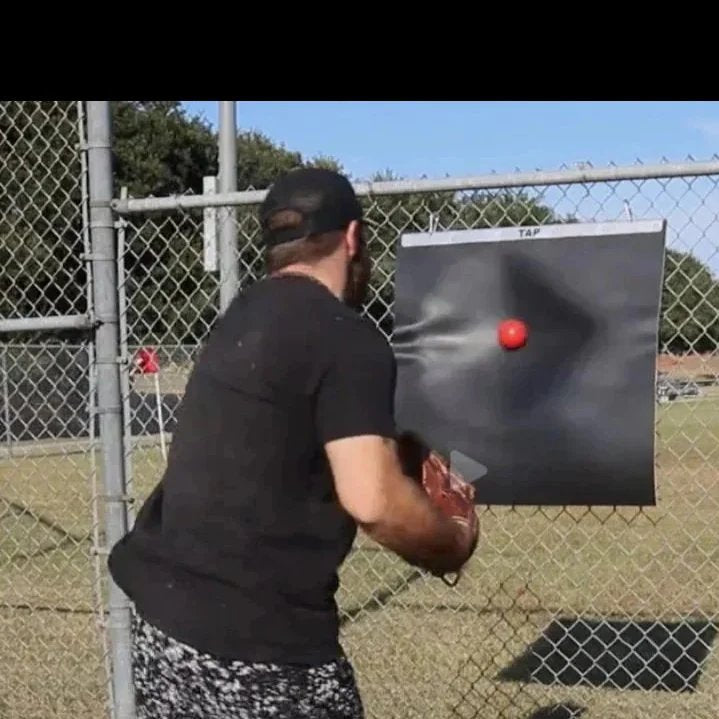
The throw families. Three patterns cover most of what hitters need. The rotational side throw drives a ball sideways off the back hip, rehearsing the coil-and-release of the swing. The overhead slam trains a violent finish and resets effort between rotational sets. The wall series has the athlete drive the ball into a surface in short, maximum-effort sets — the core of “from wall to bat.”
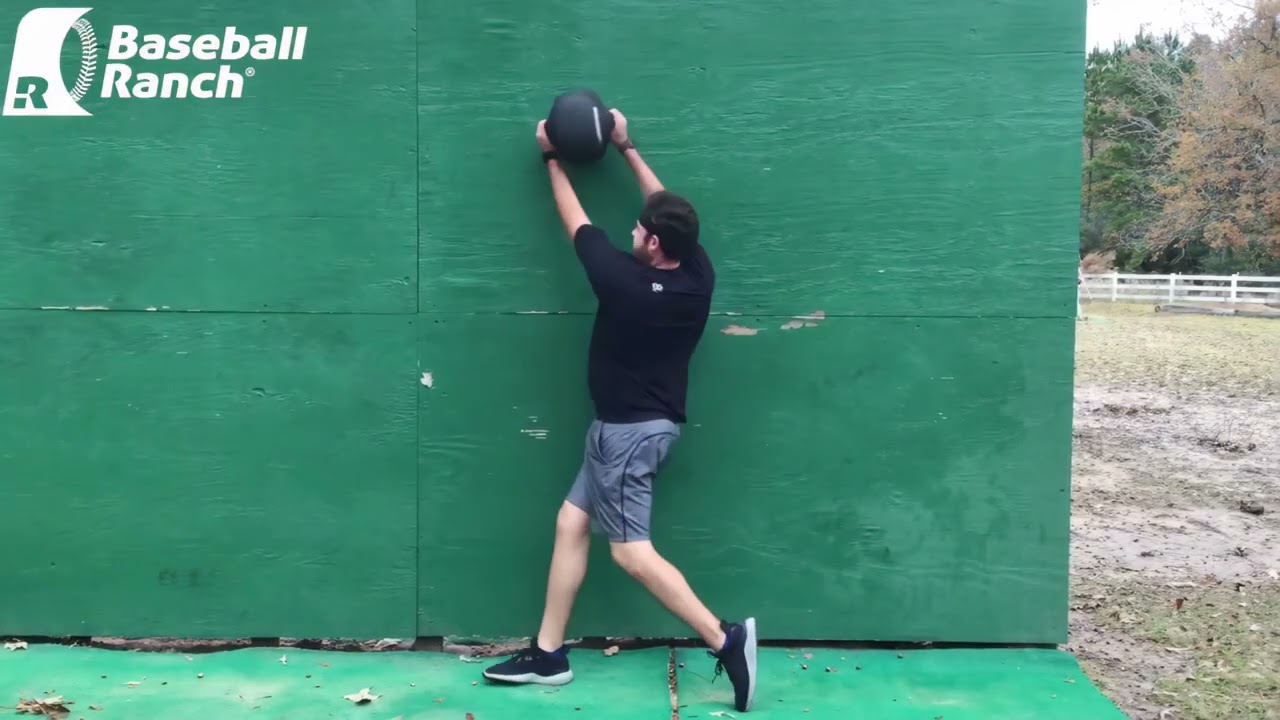
In wall-series work, the surface choice matters. A hard wall returns a reactive rebound, so the muscles must absorb the return and re-drive — a more reactive stimulus that suits in-season maintenance. A soft wall or net absorbs at contact, so the athlete must generate all force from near-dead start on every rep — a higher-demand version that suits off-season force production.
Choosing the ball: criteria first. The job picks the tool.
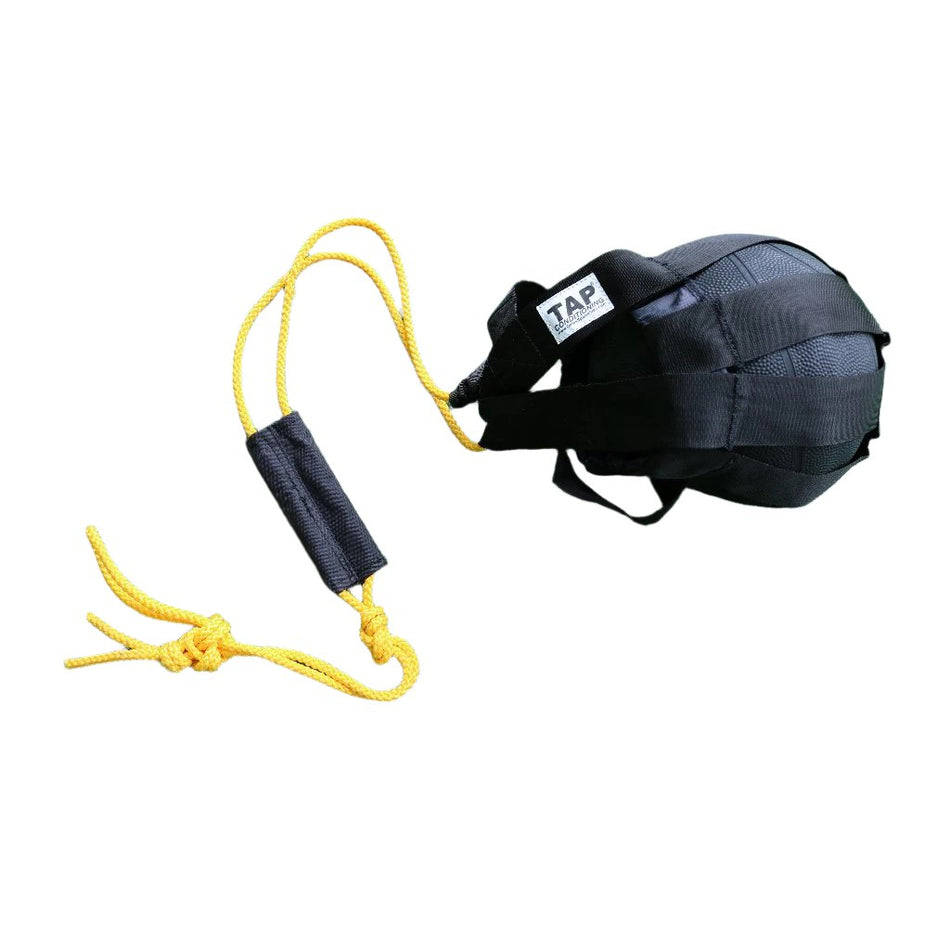
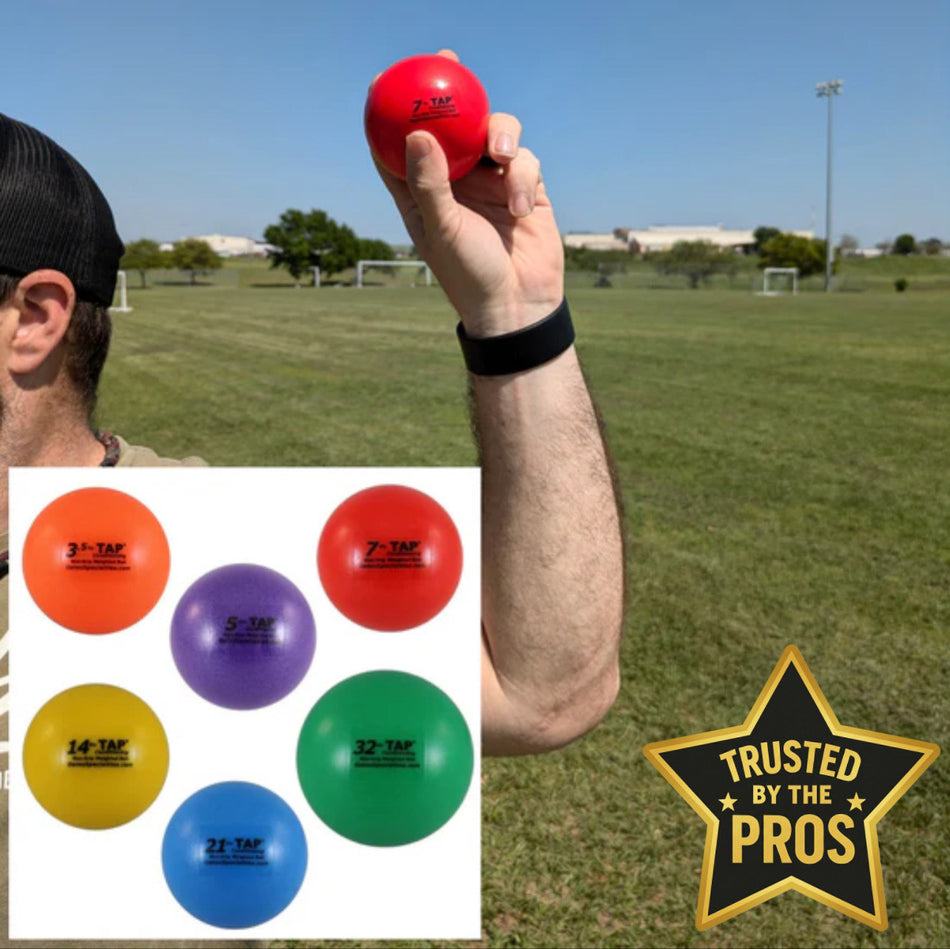
For full-intent solo throws and slams in tight space, the criterion is a no-bounce ball that absorbs at contact instead of rebounding. That allows full-effort throwing in a cage, a garage, or any confined space without chasing a rebound. The TAP® Pummel Ball — sand-filled with a soft shell — is one example built for this. It handles repeated full-intent throws and slams across a training block without changing behavior.
For retained-grip rotational wall patterns, the criterion is a ball with a secure grip throughout the entire turn. The TAP® Double Handle Medicine Ball is one example, with dual handles that keep the grip locked through repeated drive-into-wall sets.

For catchable partner throws, where two athletes throw back and forth and a softer catch is preferable, the criterion is a ball that can be caught safely at full-effort throw velocity. The TAP® Soft Medicine Ball is one example for this use.
What This Looks Like in Practice
This is an illustration, not a prescription. Specific sets, reps, loads, and progressions are the coach’s call for the athlete in front of them.
One throw, done well — the rotational wall throw. Stand side-on to a wall, about a stride away, feet roughly shoulder-width, holding the ball at belly height. Load by turning the hips and trunk back together, away from the wall. Then drive: open the hips toward the wall and let the trunk fire after them, sending the ball into the wall as hard as possible.
The tell that it is right is sound. The ball should crack off the surface, not thud. A good rep feels like the hips lead and the trunk whips through behind them. A leaked rep feels like the whole torso spins as one block, the arms do the throwing, and the sound softens. That difference is the relay distinction made physical.
The shape of a set. A few maximal-effort throws, full rest between them, and stop the set the moment the ball starts hitting softer. That drop means the power quality is fading. The work should feel powerful and unhurried — never like conditioning.
Priming: A Brief Effect, Not a Training Program
A set of medicine ball throws can produce a small short-term bump in bat speed and exit velocity in the minutes that follow — a priming window, not a training effect.
In collegiate baseball players, medicine wall-ball throws produced small short-term gains in bat speed and a moderate short-term gain in exit velocity immediately after. Two caveats keep this in proportion. First, the effect was small for bat speed and short-lived. Second, those throws were performed on a whole-body vibration platform, so the medicine ball throws and the vibration are combined and cannot be separated. Medicine ball throws alone cannot be credited with the entire result.
As a practical move, a few hard throws can sit in the pre-hitting warm-up. The real gains still come from the training block, not the warm-up session. More throws before a game is not better — a tired athlete is not a primed one.
How to Test Rotational Power
The same rotational throw used for training doubles as a reliable field test of the quality being built. A radar-measured rotational medicine-ball throw for velocity has been validated against laboratory three-dimensional motion capture as an accurate, repeatable field assessment. Rotational-power throw protocols have also established strong test-retest reliability.
One important note on the validation study: it was conducted in professional female cricketers. The test itself transfers across rotational athletes, but practitioners should establish their own baseball-specific norms rather than borrowing absolute numbers from another sport.
Mind the boundary. This test measures the input — rotational power — not the swing output it is meant to support. For exit velocity, bat speed, and launch angle, use the measurement framework in the companion article What Gets Measured Gets Better. Pair the medicine ball throw test with the bat speed and exit velocity tests, and the full input-to-output picture closes.
What the Evidence Will Not Support
A medicine ball does not raise bat speed on its own. It expresses and supplements force. The weight room builds the force. Rotational throwing is the bridge between them — not a replacement for either.
A low dose or a short block may show nothing. The prepubescent softball null result documented in the evidence section above is real and honest. Do not promise a result from a two-week or low-effort program.
Medicine ball throws train toward the gap; they do not provably close it on their own. The developmental data shows the gap between youth and professional hitters is trunk-and-bat expression, and medicine ball throws are the right kind of stimulus for that. That is mechanism plus association — a strong direction, not proof of cause.
Cross-sport results support the principle; they do not transfer one-to-one to baseball. Tennis and cricket strengthen the case that rotational power is a general, trainable quality. The direct bat-speed evidence is baseball-led.
The controlled training evidence is concentrated, not vast. The strongest intervention data sits in high-school baseball and collegiate softball, much of it from the same research group. Independent replication is still limited.
The Evidence in Summary
Whether rotational medicine-ball training transfers to bat speed is a dose question. The programs that moved the needle ran long, hard, and with high intent. The one that did not was short, gentle, and in undeveloped athletes. Rotational power is the bridge between the weight room and the swing — it expresses force rather than building it, which means it supplements strength rather than replacing it. Medicine ball throws train the relay between the hips and the bat, the specific quality that separates hitters as they climb levels. Match the ball to the job, keep the intent maximal and the reps low, give it a full training block before evaluating it, and measure the output at the barrel to confirm what carried over.
Where to Go Next
This article is the fourth layer in the bat speed development series. The series begins with measurement — establishing a baseline before training starts and re-measuring after to confirm what carried over. Strength comes next, building the force capacity that everything else expresses. Mobility follows, clearing the access the rotation needs to move cleanly through the chain. Rotational power sits here, converting that force into speed through the trunk.
The next article in the series — Overload, Underload, and Overspeed — covers what the force-velocity curve means for hitters: the distinction between building special strength through resistance and training higher swing velocity through lighter implements, and how both fit into a full development plan. How to Increase Bat Speed: A Strength-First System for Power and Transfer maps the full development chain and where each layer fits within it.
Frequently Asked Questions
In baseball players with a strength base, yes — when trained hard enough, long enough, and often enough. Research in high-school and college baseball shows meaningful rotational strength gains from twelve-week programs combining medicine-ball work with strength training. Short blocks at low intensity, particularly in younger athletes, have shown no measurable transfer. The dose is what determines the outcome.
The baseball programs that produced measurable results ran twelve weeks. The block that produced nothing ran eight weeks at a lower dose in younger athletes. Six to twelve weeks is the range the evidence supports. A two-week or casual trial is not a meaningful test of the method.
It depends on the throw. For full-intent solo throws and slams in confined space, a no-bounce ball that absorbs at contact — like the TAP® Pummel Ball — allows maximum effort without chasing a rebound. For retained-grip rotational wall patterns, a dual-handled ball — like the TAP® Double Handle Medicine Ball — keeps the grip secure through the full arc. For catchable partner throws, a softer ball — like the TAP® Soft Medicine Ball — allows safe catching at throw velocity. Match the ball to the rep type first, then evaluate whether the tool will hold up through repeated full-effort use across the full block.
The TAP® Pummel Ball is sand-filled and absorbs at contact rather than rebounding. That allows full-effort throwing and slamming in a cage, garage, or any tight space without chasing a rebound between reps. A standard rubber medicine ball bounces — which changes the stimulus, limits where the work can happen, and requires the athlete to manage the return between throws. The no-bounce criterion is what earns the Pummel Ball its specific place in this training method, not the brand.
Annotated Bibliography
Taniyama R., et al. (2021). Rotational medicine ball throw velocity relates to NCAA Division III college baseball player bat swing, batted baseball, and pitching velocity. Journal of Strength and Conditioning Research, 35(12), 3414–3419.
https://pubmed.ncbi.nlm.nih.gov/34570055/
Baseball-specific anchor: rotational throw velocity related to bat swing velocity at approximately r = 0.65, accounting for roughly 40 percent of player-to-player variance. Correlational design — verbs stay at “relates to,” not “causes.” Primary reference for the baseball relationship between rotational power and bat speed.
Szymanski D. J., et al. (2007). Effect of twelve weeks of medicine ball training on high school baseball players. Journal of Strength and Conditioning Research, 21(3), 894–901.
https://pubmed.ncbi.nlm.nih.gov/17685676/
Twelve weeks of medicine-ball work added to identical strength training and daily swings produced significantly greater torso rotational strength gains than the same plan without it. The core dose-response anchor for the baseball intervention evidence.
Szymanski D. J., et al. (2007). Effect of torso rotational strength on angular hip, angular shoulder, and linear bat velocities of high school baseball players. Journal of Strength and Conditioning Research, 21(4), 1117–1125.
https://www.semanticscholar.org/paper/EFFECT-OF-TORSO-ROTATIONAL-STRENGTH-ON-ANGULAR-HIP,-Szymanski-McIntyre/10a2bc4fe352a8aa597f05c9bb5b189e499b0869
Trained torso rotational strength related to angular hip velocity, angular shoulder velocity, and linear bat velocity in high-school baseball players — tying the trained rotational quality directly to swing kinematics.
Buso S., Willardson J. M., & Shafer A. (2023). Effects of medicine wall ball throws with whole-body vibration on bat swing performance in collegiate baseball players. Journal of Strength and Conditioning Research.
https://pubmed.ncbi.nlm.nih.gov/37729518/
Acute wall-ball throws produced small-to-moderate short-term gains in bat speed (d ≈ 0.22) and exit velocity (d ≈ 0.48). Performed on a whole-body vibration platform — the throw alone is not isolated. A priming signal, not a training claim.
Szymanski D. J., DeRenne C., & Spaniol F. J. (2009). Contributing factors for increased bat swing velocity. Journal of Strength and Conditioning Research, 23(4), 1338–1352.
https://journals.lww.com/nsca-jscr/fulltext/2009/07000/contributing_factors_for_increased_bat_swing.42.aspx
Foundational review tying strength, power, torso rotation, and lean mass to bat swing velocity. Used for the bridge framing and the strength-then-express logic throughout this article.
Haruna R., Doi T., Habu D., Yasumoto S., & Hongu N. (2023). Strength and conditioning programs to increase bat swing velocity for collegiate baseball players. Sports (Basel), 11(10), 202.
https://www.mdpi.com/2075-4663/11/10/202
Recent collegiate baseball review listing full-body resistance training and rotational medicine-ball exercises among methods used to raise bat swing velocity — independent corroboration of the Szymanski intervention line.
Shari S., et al. (2024). The effects of medicine ball training on batting velocity in female collegiate softball players. Pertanika Journal of Social Sciences and Humanities, 32(3), 875–886.
http://www.pertanika.upm.edu.my/pjssh/browse/regular-issue?article=JSSH-8931-2023
Eight weeks of full-body medicine-ball training produced large effect sizes for batting velocity (d ≈ 1.17) versus control in collegiate softball — near-sport corroboration of the baseball training direction. Published in a social science journal rather than a strength-and-conditioning journal; weight accordingly.
The effects of medicine ball training on bat swing velocity in prepubescent softball players. (2018). International Journal of Exercise Science, 11(4), 75–83.
https://digitalcommons.wku.edu/cgi/viewcontent.cgi?article=2176&context=ijes
Eight weeks of medicine-ball training produced no added bat-speed benefit over a control group in young athletes (~6.4% vs 4.6%, not statistically significant). The dose-and-age floor for the method — not a refutation, but a boundary condition that shows where the minimum requirements are not met.
Hardy L., et al. (2025). Criterion validity and reliability of a new medicine ball rotational power test. Journal of Strength and Conditioning Research, 39(3), e429–e435.
https://journals.lww.com/nsca-jscr/abstract/2025/03000/criterion_validity_and_reliability_of_a_new.17.aspx
Validated a radar-measured rotational medicine-ball throw for velocity against three-dimensional motion capture as an accurate, reliable field test. Sample was professional female cricketers — set baseball-specific norms rather than borrowing absolute values from this population.
Andre M. J., et al. (2012). A reliable method for assessing rotational power. Journal of Strength and Conditioning Research, 26(3), 720–724.
https://www.researchgate.net/publication/221798458_A_Reliable_Method_for_Assessing_Rotational_Power
Established test-retest reliability for a rotational-power throw protocol — the earlier reliability support for using the throw as a repeatable field test across a training block.
Fitness testing in tennis: Influence of anthropometrics, physical performance, and functional tests on serve velocity in professional players. (2021). PLOS ONE.
https://www.ncbi.nlm.nih.gov/pmc/articles/PMC8629317/
A medicine-ball throw was the strongest single predictor of serve velocity in professional tennis players (r² ≈ 0.87). Supporting evidence that rotational ballistic output drives performance across rotational sports beyond baseball.
Loturco I., et al. (2016). Determinants of club head speed in PGA professional golfers. Journal of Strength and Conditioning Research, 30(8), 2266–2270.
https://pubmed.ncbi.nlm.nih.gov/26849785/
Seated medicine-ball throw related to clubhead speed (r ≈ 0.71) while the rotational throw specifically did not reach significance (r ≈ 0.57) in professional golfers. Supportive but not one-to-one for baseball — still evidence that rotational power matters in golf.
Escamilla R. F., Fleisig G. S., DeRenne C., et al. (2009). A comparison of age level on baseball hitting kinematics. Journal of Applied Biomechanics, 25(3), 210–218.
https://pubmed.ncbi.nlm.nih.gov/19827470/
Skilled youth versus skilled adults: adults showed higher upper-torso angular velocity (857 vs 717°/s) and higher bat linear velocity at contact (30 vs 25 m/s). The reference ladder for the developmental gap and the basis for “the gap is distal expression.”
Dowling B. J., & Fleisig G. S. (2016). Kinematic comparison of baseball batting off of a tee among various competition levels. Sports Biomechanics, 15(3), 255–269.
https://www.tandfonline.com/doi/full/10.1080/14763141.2016.1159320
170 batters across youth, high-school, college, and professional. Distal velocities (bat, back-arm extension) rise consistently with level while youth rotate the pelvis as fast as or faster than professionals. The primary evidence for “train the relay, not the spin.”
Welch C. M., Banks S. A., Cook F. F., & Draovitch P. (1995). Hitting a baseball: A biomechanical description. Journal of Orthopaedic & Sports Physical Therapy, 22(5), 193–201.
https://www.jospt.org/doi/10.2519/jospt.1995.22.5.193
Three-dimensional description of the swing in seven professional hitters: hips ~714°/s, shoulders ~937°/s, bat ~31 m/s at contact — the proximal-to-distal sequence the rotational bridge is designed to train. Elite sample; figures represent professional-level benchmarks.
Balsalobre-Fernández C., et al. (2020). Effects of resistance training movement pattern and velocity on isometric muscular rate of force development: A systematic review with meta-analysis and meta-regression. Sports Medicine.
https://link.springer.com/article/10.1007/s40279-019-01239-x
54 studies. Maximum rate of force development is driven by the intention to produce force rapidly — independent of actual load speed — and by similarity between training and target movement patterns. The backbone for “intent is the hidden ingredient” and for why a throw earns its own place in the program.
TAP® Pummel Ball. oatesspecialties.com.
https://oatesspecialties.com/products/taptm-pummel-ball
Sand-filled, no-bounce ball built for full-intent throws and slams in confined space across a training block. Referenced in this article as the worked example for the no-bounce solo-throw criterion.
TAP® Double Handle Medicine Ball. oatesspecialties.com.
https://oatesspecialties.com/products/handle-medicine-ball
Dual-handle ball built for retained-grip rotational wall-series work. Referenced as the worked example for the retained-grip criterion in repeated drive-into-wall sets.
TAP® Soft Medicine Ball. oatesspecialties.com.
https://oatesspecialties.com/products/soft-medicine-ball
Softer, minimal-bounce ball for catchable partner throws. Referenced as the worked example for the gentle-catch criterion where two athletes throw back and forth.
Oates Specialties. How to Increase Bat Speed: A Strength-First System for Power and Transfer. oatesspecialties.com.
https://oatesspecialties.com/blogs/default-blog/how-to-increase-bat-speed
Establishes the full development chain this article operates within — measurement, strength, mobility, rotational power, and loaded swing work. Rotational power covered here is the fourth layer in that sequence.
About This Analysis
Created by the Oates Specialties team led by Robert Oates, M.Ed., Founder
Editorial oversight by Gunnar Thompson, BS, CSCS, General Manager
Certified Strength & Conditioning Specialist | Biomechanics Specialist
July 2026
Complete Credentials
ROBERT OATES, M.Ed., Founder: Founded Oates Specialties in 2003. Master of Education degree. Provides strategic direction for educational content and athlete development philosophy.
GUNNAR THOMPSON, General Manager: BS Kinesiology (Clinical Exercise Science). CSCS (NSCA), PES (NASM), CPPS certifications. Technical authority on biomechanics and performance science. Conducts review of all educational content for scientific accuracy.
Questions or corrections: gunnart@oatesspecialties.com
© 2026, Oates Specialties LLC