The 4-to-7 Ounce Range
Why a narrower weighted-baseball set begins with what the research has actually tested — and where its boundaries remain.
For coaches, athletes, and the families supporting them · With an annotated bibliography
Sixty years of weighted-ball research covers a lot of ground. One narrow slice of it — 4 to 7 ounces thrown from a mound — is the part that has actually been tested against a regulation baseball under controlled conditions. This is why we built our set around that range, and what it does and does not tell you.
This article assumes you have read Sixty Years of Weighted Baseballs, and Nobody Knows Why They Work, our full research review, and The Lag, our article on the gap between coaching practice and biomechanics research. Both inform the reasoning below. This piece narrows in on one specific range and one specific product decision.
🎧 Prefer to listen? Audio version of this article:
Executive Summary
Our research review laid out the whole picture: weighted-ball training has produced velocity gains across six decades of study, nobody has confirmed why, and that gap is the reason careful, individualized use matters more than any blanket promise.
This article is about one specific slice of that picture, the 4-to-7-ounce range, and why we built our set around that weight range.
The available mound biomechanics data most directly support this range. Within 4 to 7 ounces, thrown from a mound, measured arm stress decreases as the ball gets heavier, while body position changes very little.
Our set spans two separate research conventions that overlap: DeRenne’s roughly plus-or-minus-20-percent training band, approximately 4 to 6 ounces, and Fleisig’s 4-to-7-ounce mound-biomechanics range. The 7-ounce ball belongs to the second convention, not the first; we designed the set to cover both.
The one randomized controlled trial in this field found an elbow-injury imbalance using discrete 2, 4, 6, 16, and 32-ounce implements thrown entirely from flat ground using kneeling, rocker, and full-intent running throws. It did not use a mound and did not isolate any single weight. Two weights, 4 and 6 ounces, overlap with our set. That remains a real, unresolved caution rather than evidence this set is exempt from it.
None of this tells you what will happen for a specific athlete. The mechanism behind the velocity effect is still unknown, which means no protocol — including ours — can be presented as a guarantee. The evidence is useful precisely because it lets us state both what is known and what is not.
Why 4 to 7 Ounces, Specifically
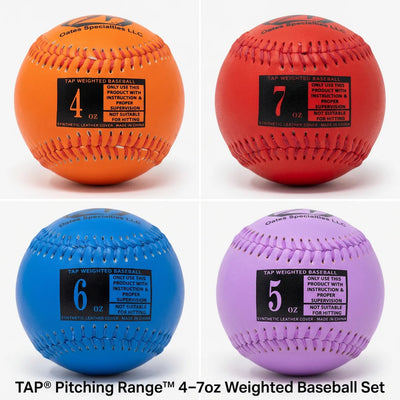
Our set targets four training weights inside the range Fleisig’s mound-biomechanics study examined: 4, 5, 6, and 7 ounces. For historical reference, a regulation baseball itself has a legal weight range rather than one exact number; Official Baseball Rule 3.01 places it at not less than 5 nor more than 5¼ ounces. We include that reference because DeRenne’s original training convention was defined relative to a regulation baseball, not because our 5-ounce training ball is intended to substitute for one.
DeRenne set the roughly ±20 percent convention in his own research. His studies used balls at approximately 20 percent under and over a 5-ounce regulation baseball, a ratio tracing back to weighted-implement methodology and a 2:1 training-frequency convention. His studies, covering roughly 255 pitchers across two ten-week programs, used balls in that band and found velocity gains. That describes the research this range draws on.
The 7-ounce ball extends the set into a second convention: the 4-to-7-ounce range Fleisig’s team tested for acute arm stress and mechanics from a mound. Their data found that measured arm stress decreased as ball weight increased. That range does not follow DeRenne’s ±20 percent logic; a 7-ounce ball is roughly 40 percent above a 5-ounce reference. Our set spans both conventions: four target weights covering DeRenne’s training band and Fleisig’s biomechanical range in one progression.
Why synthetic material, not real leather
Leather can absorb ambient moisture, a documented mechanism that affects baseball mass and aerodynamic properties. For a training implement, the practical concern is consistency. A synthetic ball is intended to avoid weather-, storage-, and use-related weight shifts that can occur with leather, helping the athlete use the same target weight from one session to the next.
What the Research Says About This Specific Range
Our full research review covers the broader six-decade history and the unresolved mechanism question in depth. Here is what is specific to the 4-to-7-ounce zone.
Arm stress decreases as weight increases within this range
A motion-capture study of 25 high school and collegiate pitchers throwing 4, 5, 6, and 7-ounce balls from a mound found no significant increase in elbow or shoulder stress at 4 or 6 ounces relative to a standard ball, and significant decreases in key measured kinetic values at 7 ounces. A later paper by the same research group summarized the trend as steady decreases in arm velocities, trunk velocities, and arm forces as ball weight increased from 5 to 7 ounces.
Mechanics hold together across the same range
Body position changed by roughly one degree across all four weights, small enough that the authors concluded pitchers can throw across this range using their normal delivery. That combination — stress decreasing while mechanics stay intact — is why this is the range the product can point to most directly in the available mound-biomechanics data.
The velocity evidence is strongest from 4 to 6 ounces
For the DeRenne portion of the range, 4 to 6 ounces, the velocity evidence is old and consistent but does not answer every question. DeRenne’s 1990 and 1994 studies, together covering roughly 255 high school and college pitchers, found velocity gains after ten-week training programs using balls in this band. A 2000 synthesis of the 1960-to-1994 literature reached a similar conclusion across eleven training studies. A later review noted that most older training studies it discussed used distances below 60 feet 6 inches, but it explicitly treated DeRenne’s competitive-distance work as an exception.
As explained in Sixty Years of Weighted Baseballs, and Nobody Knows Why They Work, no one has since confirmed why the velocity effect occurs. The leading candidate explanations — faster arm speed from lighter balls and more arm strength from heavier ones — were tested under motion capture in 2017 and were not supported in that experiment. The velocity finding is real; the mechanism remains unsettled.
What this exact set has not been tested for
No single study has tested a multi-week, full-mound training program using the complete 4-to-7-ounce set and measured lasting velocity outcomes. Nor has a study measured post-release deceleration behavior across different ball weights. Those are boundaries of the evidence, not details to skip over.
Where the Evidence Draws a Careful Line
Every comparison in this article starts with a full-intent throw of a regulation-weight baseball as the reference point. The research asks whether changing ball weight changes measured mechanics or arm loading relative to that baseline; it does not compare weighted-ball throwing with rest.
A hard throw with a regulation baseball is already a high-load activity. So when a study reports “no significant increase,” it means no measured increase above that specific pitching baseline — not no load, no fatigue, and no consequence from accumulating throws. Total volume, intent, distance, running approaches, recovery, and the athlete’s individual readiness still govern the decision.
Where the Mound Fits In
A common assumption is that throwing from a mound necessarily adds risk compared with flat ground. The evidence is more specific: distance and a running approach appear to be important variables, rather than the slope alone or flat-ground throwing as one uniform category.
A wearable-sensor study of high school pitchers found no statistically significant difference in elbow torque, arm speed, or shoulder rotation between mound and stationary flat-ground pitching at matched, regulation distance. The study’s stated conclusion was that pitching from the mound did not significantly increase elbow stress compared with flat-ground pitching at regulation distance.
Flat-ground work is not uniform. The 2017 motion-capture study behind the 4-to-7-ounce mound findings also tested a flat-ground crow-hop throw — a running approach into the throw — and found significantly increased elbow varus torque and shoulder internal-rotation velocity relative to mound pitching. Separately, a 2011 study comparing mound pitching with flat-ground throws at 37 m, 55 m, and maximum distance found maximum-distance long toss produced greater elbow and shoulder torques than mound pitching.
The randomized trial that found an injury imbalance fits inside that context: its six-week program used no mound throwing and included kneeling, rocker, and full-intent running positions on flat ground with weights from 2 to 32 ounces. Two weights in that protocol, 4 and 6 ounces, overlap with this set; the study did not identify which implement or drill produced the injuries. The responsible reading is that the trial is a meaningful caution about its entire protocol, not a basis for assigning a single cause to a single weight.
Why Younger Pitchers Are a Separate Conversation
This is the most important limitation carried over from our full research review, and it applies directly to this product.
Every mound-comparison and stress-trend finding above comes from studies of pitchers in their mid-teens through college. The one study that looked specifically at pitchers aged 9 to 14 found the opposite pattern from the older data: measured medial elbow torque increased, rather than decreased, as ball weight increased. That reversal is why this set is designed and marketed for pitchers 13 and older.
That age line deserves an honest caveat. The Reinold trial’s cohort averaged 15.3 years old and ranged from 13 to 18, a span the authors themselves noted covered meaningfully different stages of physical maturity without separating them in the results. The product’s 13-and-up audience therefore overlaps with the one trial that found an injury signal. The appropriate response is close supervision, individual assessment, and conservative progression for younger athletes — not a claim that a birthday alone resolves the concern.
A Track Record That Ran Ahead of the Proof
Our article The Lag traces the gap between what a lineage of pitching coaches, including Ron Wolforth, was teaching in the early 2000s and later biomechanics work examining related movement principles. The 2026 University of Waterloo study discussed there used simulation, not human subjects, and examined a general pattern rather than any specific tool.
One lesson from that story shapes how we use practitioner guidance throughout this article and our full research review: a real, repeatable coaching result can exist before research fully explains it. That does not turn practitioner accounts into peer-reviewed proof. It is why we identify them clearly, disclose relationships, and place them alongside research rather than in place of it.
A Practitioner’s Track Record, Alongside the Research
Ron Wolforth, founder of the Texas Baseball Ranch, has worked with weighted implements since 2002–2003. His public position is not blanket enthusiasm. He has argued against careless, one-size-fits-all weighted-ball programs and emphasizes assessment, ramp-up, athlete readiness, and workload context before altered-ball work is introduced.
His framework considers structural balance, baseline strength, mobility, mechanical efficiency, injury history, and where the athlete sits in the competitive calendar. That is practitioner guidance, not a universal clinical protocol or independent evidence that a particular set will work for a particular athlete.
Disclosure: Wolforth has a long-standing working relationship with Oates Specialties. We quote and link him as a named practitioner with a public record, not as independent confirmation of our product claims.
What This Means for This Set
- Built for pitchers 13 and older with an established, repeatable delivery. The youngest end of that range still calls for close supervision because the one trial with an injury signal drew from the same broad age band.
- Stay within the 4-to-7-ounce range if you want the specific mechanics and acute-stress findings discussed here to apply. Heavier implements are different exercises requiring different justification and supervision.
- Stationary mound and stationary flat-ground pitching at matched regulation distance look comparable in the available data. Running approaches such as crow-hop and maximum-distance flat-ground work are distinct conditions the evidence associates with greater stress.
- Track total throwing volume, including every team and setting. A ball weight is only one component of the athlete’s full throwing exposure.
- The research compares these weights with hard throws using a regulation baseball. It does not show that weighted-ball throwing reduces arm load below the baseline load of hard regulation-ball throwing.
- No program built around this set, or any set, replaces an individual assessment of the athlete in front of you.
From Research to the Ball in Your Hand
Everything above is the evidence behind one design decision: four target weights spanning both the historical 4-to-6-ounce training band and the 4-to-7-ounce mound-biomechanics range. The article’s job is narrower than a promise: to show what the research does and does not say about the range itself, so the product decision that follows is grounded in something you can check.
Explore the TAP® Pitching Range™
See construction details, available weights, and product information for the TAP® Pitching Range™ 4–7 oz Weighted Baseball Set.
View the TAP® Pitching Range™ 4–7 oz Weighted Baseball SetFrequently Asked Questions
That range is where two separate lines of research overlap: DeRenne’s roughly ±20 percent training convention, approximately 4 to 6 ounces, and Fleisig’s 4-to-7-ounce mound-biomechanics testing. Within the latter window, mechanics changed very little across the weights and measured arm kinetic values decreased as the ball got heavier from 5 to 7 ounces.
Not exactly. The 4, 5, and 6-ounce balls sit inside DeRenne’s historic roughly ±20 percent training convention. The 7-ounce ball belongs to a different convention: the upper end of Fleisig’s 4-to-7-ounce mound-biomechanics range. Both are tested territory, but they did not originate from the same research question.
No. That finding is specific to acute, single-throw measurements in the 4-to-7-ounce range from a mound relative to a regulation baseball. It does not establish safety for weights above 7 ounces, every drill context, or an entire training block. Volume, intent, distance, recovery, and athlete readiness still matter.
No. Two of the trial’s weights, 4 and 6 ounces, overlap with this set. What differs is the surrounding protocol: that trial used no mound and included kneeling, rocker, and full-intent running throws with implements ranging from 2 to 32 ounces. The study did not identify which weight or drill was responsible for the injuries. That makes it a real caution, but not a direct verdict on an individual ball or this exact set.
The research does not support that as a blanket statement. At matched regulation distance, a wearable-sensor study of high school pitchers found no significant differences in measured elbow torque, arm speed, or shoulder rotation between mound and stationary flat-ground pitching. The evidence flags certain flat-ground conditions — notably a running crow-hop and maximum-distance long toss — rather than flat ground in general.
Track total throwing volume, honestly counted across games, practices, bullpens, training sessions, and every team an athlete plays for. A single ball weight does not describe the full throwing exposure; overall volume, progression, recovery, and the athlete’s response remain essential context.
This set is designed and marketed for pitchers 13 and older. In the one study of pitchers aged 9 to 14, medial elbow torque increased as ball weight increased — the opposite of the pattern in older-adolescent and collegiate mound data. Younger athletes should be treated as a separate and conservative decision with qualified supervision.
Annotated Bibliography
Verified research and source links for The 4-to-7 Ounce Range
The citations below support the claims in this article. Each entry explains why it matters to the 4-to-7-ounce range and links to a public source. A citation does not turn a study finding into a universal protocol; it identifies the evidence and its boundary.
Core 4-to-7 oz Range Research
[B1] Fleisig GS, Diffendaffer AZ, Aune KT, Ivey B, Laughlin WA. 2017. Biomechanical Analysis of Weighted-Ball Exercises for Baseball Pitchers. Sports Health, 9(3):210–215.
Primary acute mound-biomechanics study for this range. Twenty-five high school and collegiate pitchers threw 4, 5, 6, and 7-ounce balls from a mound. It found small positional differences across the mound conditions and lower measured kinetic values at 7 ounces. It also included crow-hop conditions, but did not test long toss, a longitudinal program, or injury outcomes.
[B2] Reinold MM, Macrina LC, Fleisig GS, Aune K, Andrews JR. 2018. Effect of a 6-Week Weighted Baseball Throwing Program on Pitch Velocity, Pitching Arm Biomechanics, Passive Range of Motion, and Injury Rates. Sports Health, 10(4):327–333.
Randomized trial central to the article’s caution. It used 2, 4, 6, 16, and 32-ounce balls in kneeling, rocker, and run-and-gun flat-ground positions, with no mound throwing. Four elbow injuries occurred in the training arm and none in the control arm; the study did not identify the responsible ball weight or drill.
[B3] DeRenne C, Ho KW, Blitzblau A. 1990; DeRenne C, Buxton BP, Hetzler RK, Ho KW. 1994.
Two ten-week training studies behind the historical 4-to-6-ounce band and the commonly cited combined total of roughly 255 high school and collegiate pitchers. Both reported velocity gains in training groups.
[B4] DeRenne C, Szymanski DJ. 2009. Effects of Baseball Weighted Implement Training: A Brief Review. Strength and Conditioning Journal, 31:30–37.
Historical review source for the roughly ±20 percent convention, the 2:1 altered-to-standard frequency convention, and the distance caveat. It explains that the older studies’ under-60-feet-6-inches limitation did not apply to DeRenne’s competitive-distance work.
[B5] Escamilla RF, Speer KP, Fleisig GS, Barrentine SW, Andrews JR. 2000. Effects of Throwing Overweight and Underweight Baseballs on Throwing Velocity and Accuracy. Sports Medicine, 29(4):259–272.
Systematic synthesis of eleven 1960-to-1994 training studies. It supports the historical statement that altered-weight training had a velocity record before modern biomechanics research.
[B6] Caldwell JE, Alexander FJ, Ahmad CS. 2019. Weighted-Ball Velocity Enhancement Programs for Baseball Pitchers: A Systematic Review. Orthopaedic Journal of Sports Medicine, 7(2):2325967118825469.
Evidence-quality context. The review found that most included programs reported velocity improvements, but rated the overall literature low quality because of small samples, dated methods, and inconsistent programs. It supports the refusal to promise a universal outcome or protocol.
Mound, Distance, and Workload
[B7] Dowling B, McElheny KD, Camp CL, Ling DI, Dines JS. 2020. Effects of Mound Versus Flat-Ground Pitching and Distance on Arm Mechanics and Elbow Torque in High School Pitchers. Orthopaedic Journal of Sports Medicine, 8(12).
Wearable-sensor study of high school pitchers. At matched regulation distance, mound and stationary flat-ground pitching did not differ significantly in measured elbow torque, arm speed, or shoulder rotation outcomes.
[B8] Fleisig GS, Bolt B, Fortenbaugh D, Wilk KE, Andrews JR. 2011. Biomechanical Comparison of Baseball Pitching and Long-Toss: Implications for Training and Rehabilitation. Journal of Orthopaedic & Sports Physical Therapy, 41(5):296–303.
Study of 17 collegiate pitchers comparing mound pitching with flat-ground throws at 37 m, 55 m, and maximum distance. Maximum-distance throws produced the highest elbow and shoulder torques.
[B9] Saito A, Kikuchi T, Shibata K, et al. 2026. Increased Elbow Valgus Torque During Pitching Is Not a Risk Factor for Medial Elbow Injuries in Young Baseball Players. Arthroscopy, 42(2):430–439.
Prospective cohort of young pitchers. Baseline elbow torque was not a significant injury predictor, while higher daily pitch count was associated with medial elbow injury. It supports the article’s narrow emphasis on total daily workload.
Age and Post-Release Limits
[B10] Okoroha KR, Meldau JE, Jildeh TR, Stephens JP, Moutzouros V, Makhni EC. 2019. Impact of Ball Weight on Medial Elbow Torque in Youth Baseball Pitchers. Journal of Shoulder and Elbow Surgery, 28(8):1484–1489.
Nineteen youth pitchers aged 9 to 14 threw 3-to-6-ounce balls from ground level. Measured medial elbow torque increased as ball weight increased — the reverse of the older-adolescent and collegiate mound pattern described in B1.
[B11] Solomito MJ, Garibay EJ, Nissen CW. 2019. Deceleration Phase Elbow Varus Moments: A Potential Injury Mechanism for Collegiate Baseball Pitchers. Sports Biomechanics.
Study of regulation-ball pitching that identified a second elbow-varus loading event after ball release. It supports the article’s statement that deceleration across different ball weights remains unmeasured.
Context and Materials
[B12] Major League Baseball, Official Baseball Rules, Rule 3.01.
States that an official baseball weighs not less than 5 nor more than 5¼ ounces. Cited as historical context for the regulation-baseball reference underlying the altered-weight convention, not as a product specification for the training balls in this set.
[B13] Meyer E, Bohn J. 2007. Influence of a Humidor on the Aerodynamics of Baseballs.
Measured changes in baseball mass and diameter across humidity conditions and modeled related aerodynamic effects. Cited only for the physical principle that moisture exposure can alter a baseball’s mass and properties.
[B14] Wolforth R. Wolforth Throwing Mentorship series, Perfect Game USA; and Give Credit, Texas Baseball Ranch.
Public practitioner sources for Wolforth’s assessment emphasis, his argument against one-size-fits-all weighted-ball programs, and his account of his 2002–2003 weighted-implement timeline. These are practitioner testimony, not peer-reviewed protocol research. Oates Specialties has a long-standing working relationship with Wolforth.
Oates Research Pathway
Sixty Years of Weighted Baseballs, and Nobody Knows Why They Work
Full research article covering the history of altered-weight baseball training, reported velocity findings, studies that did not find benefit, and the unresolved mechanism question.
Context article on the gap between coaching practice and later biomechanics research. The Waterloo simulation discussed there is treated as a model-based examination of a general movement principle, not evidence for a named product.
Disclosure
Ron Wolforth and Randy Sullivan have long-standing working relationships with Oates Specialties and have contributed to Oates product development. Oates products appear in both facilities. Practitioner guidance is identified as practitioner guidance, not peer-reviewed protocol research. Oates products are named where they fit the product decision; functional equivalents from other manufacturers may fit the same criteria. This article is for general educational purposes and does not constitute medical advice. For symptoms, injury, or return-to-throwing decisions, consult a qualified healthcare professional or athletic trainer.
About This Analysis
Created by the Oates Specialties team led by Robert Oates, M.Ed., Founder
Editorial oversight by Gunnar Thompson, BS, CSCS, General Manager
Certified Strength & Conditioning Specialist | Biomechanics Specialist
August 2026
Complete Credentials
ROBERT OATES, M.Ed., Founder: Founded Oates Specialties in 2003. Master of Education degree. Provides strategic direction for educational content and athlete development philosophy.
GUNNAR THOMPSON, General Manager: BS Kinesiology (Clinical Exercise Science). CSCS (NSCA), PES (NASM), CPPS certifications. Technical authority on biomechanics and performance science. Conducts review of educational content for scientific accuracy.
Questions or corrections: gunnart@oatesspecialties.com
OATES SPECIALTIES · Huntsville, Texas · OatesSpecialties.com