





Khaos® Waterbell – Water-Filled Kettlebell Trainer
Couldn't load pickup availability
Khaos® Waterbell – Water-Filled Kettlebell Trainer
The Khaos® Waterbell is a water and air-filled kettlebell trainer designed to make familiar kettlebell patterns—like light swings, waiter’s carries, and bottom-up holds—more demanding for the shoulder and trunk without requiring heavy loads. Instead of a fixed mass, the internal water shifts as the athlete moves, creating small, continuous perturbations that the shoulder, wrist, and core must manage together.
In a Prepare–Compete–Restore framework, it fits well in off-day strength work, shoulder-focused stability blocks, and in-season maintenance sessions where the goal is smooth control and position, not max effort.
Key Features & Benefits
- Water-filled kettlebell design: Internal water and air create a shifting load that makes classic light kettlebell patterns more demanding for stabilizers without having to jump to heavier bells.
- Adjustable volume and load: The Waterbell can be filled from very light up to approximately 10–13 pounds of water, and a small plate weight can be added between the handle and bladder for extra resistance.
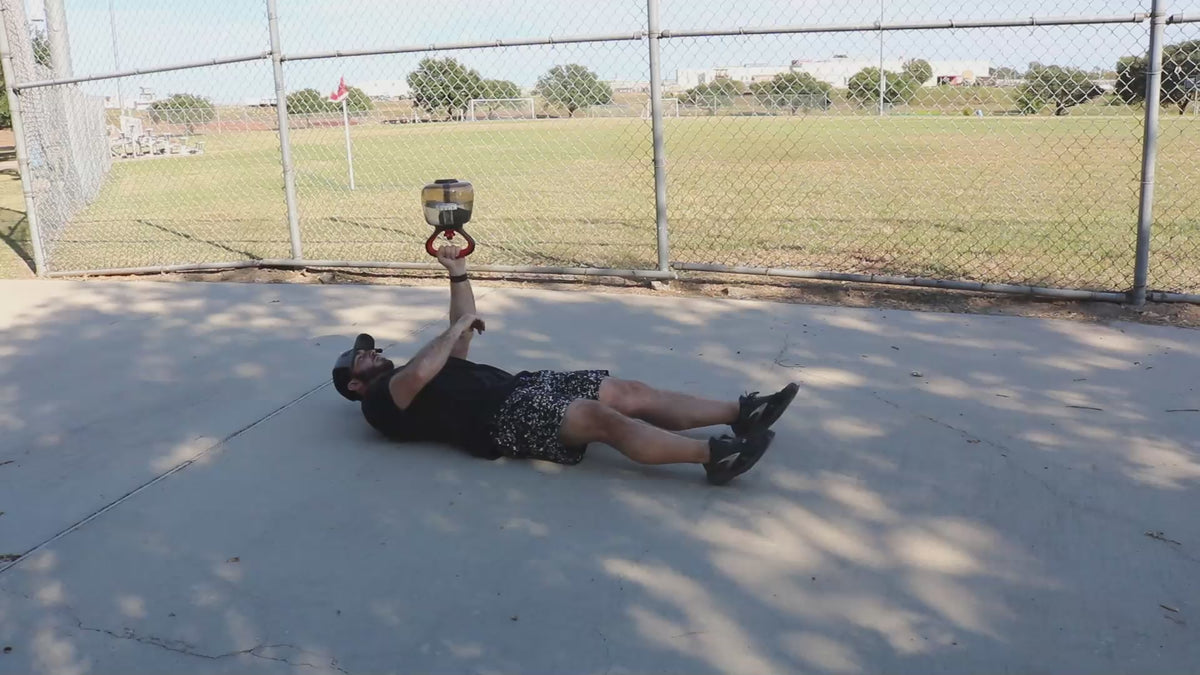
- Rigid handle for bottom-up work: A solid, ergonomic handle supports waiter’s carries, bottom-up holds, and light presses that ask the shoulder to stay organized while the water continues to move.
- Shoulder and core control: The combination of shifting water and bottom-up options increases the demand on shoulder, wrist, scapular, and trunk stabilizers during controlled carries, swings, and get-up patterns.
- Portable and travel-friendly: The Waterbell empties fully for transport, then refills quickly at the next gym, field, or hotel.
How to Use
Most coaches treat the Khaos® Waterbell as a light, instability-driven kettlebell, not a heavy strength bell. It fits well at the start or middle of a session when the athlete is fresh enough to control the shifting load.
- Start conservative: Begin with a modest amount of water so the bell has some weight and movement but still feels manageable. Add air until the bell holds its shape without becoming rigid.
- Use simple patterns first: Light swings, waiter’s carries, bottom-up holds, and slow get-up variations are usually the best starting points.
- Progress gradually: Add or remove water, adjust the water-to-air ratio, or place a small plate weight between the handle and bladder to increase total load while preserving instability.
- Keep in-season work modest: The Waterbell works best in short blocks that support shoulder control and body awareness rather than long fatigue-based circuits.
For youth athletes, use very light fills, simple patterns, and high supervision. Stop well before fatigue. If anything feels sharp or odd, stop immediately.
Why It Works
Traditional kettlebells already challenge the body because the load sits outside the hand, which changes leverage and increases demands on grip, trunk control, and shoulder positioning. The Khaos® Waterbell adds another layer by allowing the internal load to keep moving after the athlete changes direction.
That shifting water creates small perturbations at the wrist, elbow, shoulder, and trunk, which can make light carries, swings, and holds more useful for athletes who need controlled instability and better positional awareness. Because the volume is adjustable and the total weight stays in a lighter range, coaches can emphasize movement quality, neuromuscular control, and stability without relying on heavy loading.
Technical Specs
- Implement type: Water and air-filled kettlebell trainer
- Water capacity: Approximately 10–13 pounds of water, depending on fill
- Additional load option: Compatible with a small plate weight placed between the handle assembly and bladder
- Handle: Rigid, ergonomic handle for carries, holds, and controlled kettlebell patterns
- Fill system: Water plus air via integrated valve system
- Primary uses: Light swings, waiter’s carries, bottom-up holds, get-up patterns, and shoulder-focused instability work
Who This Is For
- Coaches who want a practical way to add dynamic, unstable kettlebell work without moving immediately to heavier fixed bells.
- Serious athletes who already have a basic strength foundation and are ready for more shoulder and trunk control demands.
- Traveling athletes or teams who need a portable option that empties and refills easily.
- Controlled rehab or return-to-play settings where light, adjustable instability work fits the plan.
Frequently Asked Questions
How is the Khaos® Waterbell different from a traditional kettlebell?
A traditional kettlebell has a fixed mass, so the load feels consistent through the rep. The Khaos® Waterbell uses water and air inside the bell, so the load keeps shifting as you move, which increases the demand on shoulder, wrist, and core stabilizers even at lighter weights.
What exercises work best with the Khaos® Waterbell?
Most coaches use it for light swings, waiter’s carries, bottom-up holds, Turkish get-up variations, and occasional light presses. The goal is smooth control and positional stability rather than maximal strength work.
How much water should I start with, and how do I adjust the load?
Start with a modest amount of water—enough for the bell to feel present but still easy to control. You can increase or decrease total challenge by changing the water level, adjusting the water-to-air ratio, or adding a small plate weight between the handle and bladder.
Is the Khaos® Waterbell only for advanced athletes?
No. Its adjustable loading makes it useful across a range of athletes when patterns and volume are scaled appropriately. Younger or less experienced athletes should use very light fills and close supervision.
Can the Khaos® Waterbell replace regular kettlebells?
It works best as a complement rather than a replacement. Fixed kettlebells still have a role in strength and power work, while the Waterbell adds an instability-focused option for shoulder control, core activation, and positional awareness.
Featured Products