How to Tell When Mobility Is the Problem, How to Train It With Load, and What Stretching Cannot Do
Executive Summary
Mobility is the ability to actively move a joint through its range under your own muscular control — and for baseball hitters, that definition matters more than most training programs acknowledge. Flexibility describes how far a muscle can lengthen when something external moves it. What a hitter can actually use in a swing is active control through range under the load the swing demands. Mobility is not the source of bat speed. But it is a link in the kinetic chain — and when that link is restricted, it halts the transfer of force from being applied through the legs and hips to being expelled through the bat. This article covers why bat speed is a power problem before it is a mobility problem, how to identify when a real restriction is blocking the kinetic chain, and how tools that add load to movement train mobility rather than just flexibility.
🎧 Prefer to listen? Audio version of this article:
What Mobility Actually Is — And Why It Matters for Bat Speed
Most hitting advice treats a slow swing as a mechanics problem. More cues, more reps, more coaching. But if the real problem is how the body passes power up the chain — or a restriction preventing a link from moving correctly — cueing only treats the symptom. The flaw comes back.
Bat speed is driven by power, not flexibility. The research on rotational swinging is consistent: the athletes who swing fastest are the strongest and most powerful, not the most flexible. Mobility does not generate that power. When a joint in the kinetic chain is restricted, it blocks the transfer of force that strength produces. Clear the restriction and power can move through cleanly.
This distinction matters before anything else gets addressed, because the tools and methods that follow are only useful when applied to the right problem.
Flexibility, Mobility, and Stability: Three Different Things
These three terms are often used interchangeably. They describe different qualities — and confusing them is one of the main reasons training approaches for mobility underdeliver.
Flexibility is a muscle property — specifically, the ability of a muscle and its surrounding connective tissue to lengthen when an external force is applied. It describes how far a muscle can stretch when something outside the body is doing the moving: gravity, a partner, or a band. Flexibility does not tell you what a hitter can do with that range under their own power.
Mobility is the ability to actively move a joint through its range under your own muscular control. Where flexibility and range of motion describe what is possible at rest, mobility describes what the athlete can actually use — under their own power, in real positions, at real speeds, and under load. A hitter who can passively stretch a hip into a wide range but cannot actively control that range during a rotational movement gets no performance benefit from the extra reach. The range is there. The active control under demand is not.
Stability is the ability to resist unwanted movement and maintain position while other joints are moving and force is being applied. A trunk that cannot stabilize while the hips rotate is not mobile — it is loose. Looseness without control is not a performance asset. It is a timing liability.
For coaches, the practical implication is direct. Stretching addresses flexibility. Only training that requires active muscular control through the range — with load demanding that control — addresses mobility. Stability is a separate quality that supports both: it is what keeps the rest of the chain organized while one link is moving. All three matter. They are not the same thing, and training one does not automatically train the others.
Why Training Mobility Requires Load
This is the mechanism the rest of the article is built around, and it is worth stating plainly.
When a joint is moved passively — stretched — the nervous system is not responsible for controlling the range. The external force is doing the work. That is why passive flexibility does not transfer to a swing. The nervous system learned nothing about controlling that position under demand.
When a joint is trained through its range under load — resisted by a band, weighted by an implement, or stressed by a movement that requires active muscular control — the nervous system must engage. The muscles have to produce force and control force simultaneously throughout the range. That is what trains mobility rather than flexibility. That is the difference between a hitter who can stretch into a position and one who can control it during a swing.
Research on full-range resistance training supports this directly. Training through a full range of motion improves flexibility to approximately the same degree as static stretching — while also building strength at the same time. Two adaptations for the cost of one training stimulus.
This is the argument for using bands, implements, and loaded movement patterns rather than static stretches in a mobility training context. The tools do not add range. They add the load that makes the nervous system responsible for the range — and that is what converts passive flexibility into the trained, usable mobility the swing can actually use.
The Kinetic Chain That Produces Bat Speed
A swing is not one motion. It is a sequence, and the order matters. Power starts at the ground, moves through the hips, then the trunk, then the arms, and finally the bat. Each link speeds up just after the one before it, so speed stacks link by link until the bat is moving fastest of all.
For that chain to work, each link has to slow down so the next one can speed up. When the hips slow, they hand their speed to the trunk. When the trunk slows, it hands its speed to the arms and the bat. It works like cracking a whip — the handle slows so the tip can snap.
Speed leaks when the order breaks. If a link fires out of turn, or cannot slow down in time, power is lost rather than added. When one link cannot do its job, another link picks up the slack — and that is both where the speed goes and where wear accumulates over time. A hitter whose hips cannot turn or stop in time will often spin the trunk too early, which drains power and overloads the middle of the body.
The flaw visible to the eye is almost always a power-transfer problem. Mobility matters only when a real restriction is causing it.
Which Restrictions Actually Matter
If a movement restriction is the problem, check in order — because the two main ones are not equal.
The upper to middle back is the one to check first. The upper to middle back (thoracic) — the part of the spine behind the ribs — is built to rotate. The lower back is not. It is built to bend forward and back and carries almost no rotational capacity. That anatomical difference is the key. When the thoracic spine cannot rotate enough, the body cannot quietly borrow that motion from the lower back — because the lower back does not have it to give. The restriction surfaces as a compensation — flying open early, losing coil, or excess lower back rotation. There is nowhere for the problem to hide.
Be honest about the limit, though. A stiff upper to middle back is the most defensible restriction to address, but loosening it has not been shown to add bat speed by itself. The job is clearing a block so force can transfer through the chain — not adding power to it.
The hips matter too, but it depends. The hips initiate the turn, then have to slow down to pass power upward. A hip that cannot turn, or cannot stop in time, forces the trunk to spin early — the same leak-and-overload pattern. Restricted hip internal rotation has been identified as a predictor of abdominal and oblique injury in baseball, which makes it worth checking. But the relationship between hip range and performance is not simple. In elite golfers, more hip flexibility helped male athletes and slightly hurt female athletes. The goal is not more hip range. It is ruling out a genuine restriction, then letting strength and power work through whatever range the athlete already has.
The check-first routine is simple. Ask whether the hitter can reach and hold the relevant position slowly, with no bat and no speed. If not, it may be a restriction — not a coaching problem. No cue fixes what a body cannot physically do.
Matching the Right Work to the Right Problem
Every training tool in a mobility program is doing one of three jobs — and using the wrong tool for the wrong job is the most common mistake in both training and marketing. The job is determined by what the athlete actually needs: addressing a joint that is not moving freely enough, building the strength and power to control range under load, or sharpening the timing and sequence of the chain.
Job 1 — Open a stuck joint.
The problem this solves is a real restriction at one link — most often the upper to middle back — that is forcing a workaround. The work is gentle, active range work and band-assisted joint openers, performed as part of warm-up or recovery. A long band looped to assist an upper-back rotation or a hip opener, moved slowly through range under active control. No ball, no max effort. The goal is opening a stuck door, not chasing a bigger number. A lighter TAP® Giant Flat Band is one example for this work.

The honest promise: it clears a block so the chain can work. It does not, by itself, add bat speed.
Job 2 — Build strength and power through range.
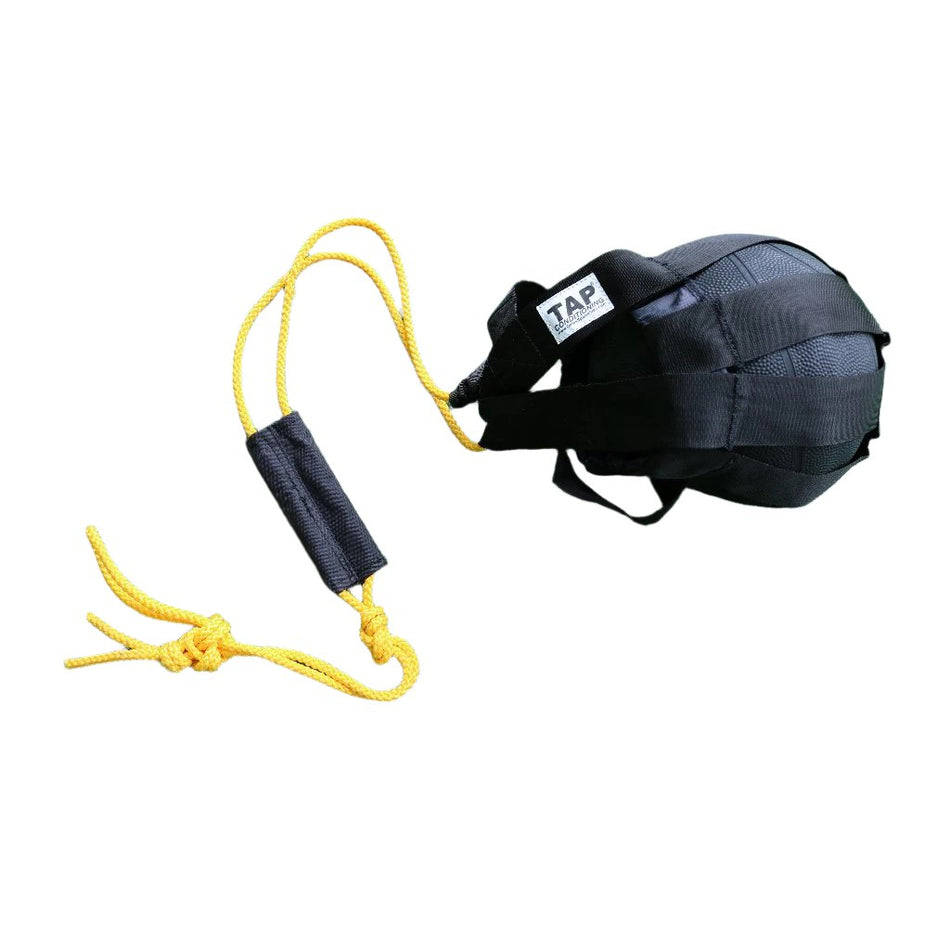
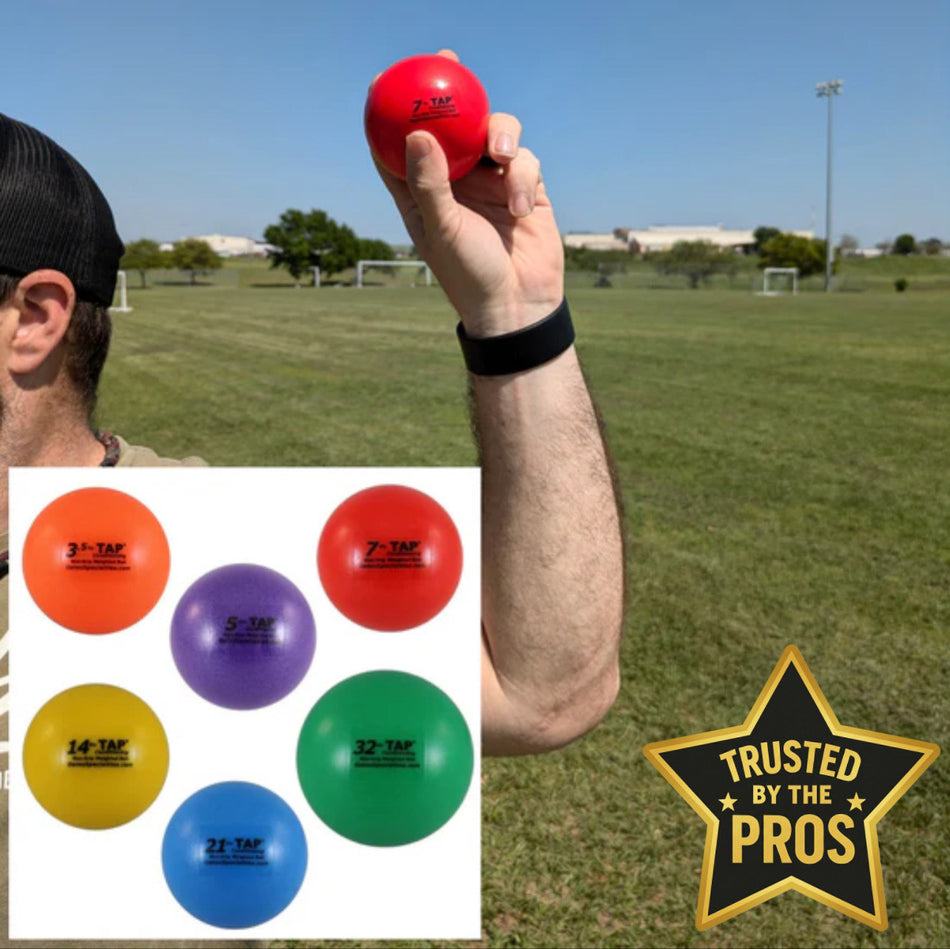
This is the primary job — the one the research supports most directly. The work has two halves. The first is loaded holds and resisted pulls where the trunk must resist being twisted out of position. This teaches the body to stay strong and organized through the range it already has. The second half is throwing — turn, drive the back hip, and project or slam a ball with full intent. This teaches the trunk to release the stored coil. A heavier TAP® Giant Flat Band handles the holding half. The TAP® Pummel Ball — a minimum-to-no-bounce, sand-and-air ball built for full-intent throws and slams in confined space — handles the throwing half. Where a softer catch is preferable for partner work, a soft medicine ball fits instead.
The honest promise: this builds the strength and power that drive bat speed. Throwing hard relates to bat speed, but it supplements strength work. It does not guarantee miles per hour on its own.
Job 3 — Sharpen the timing of the sequence.
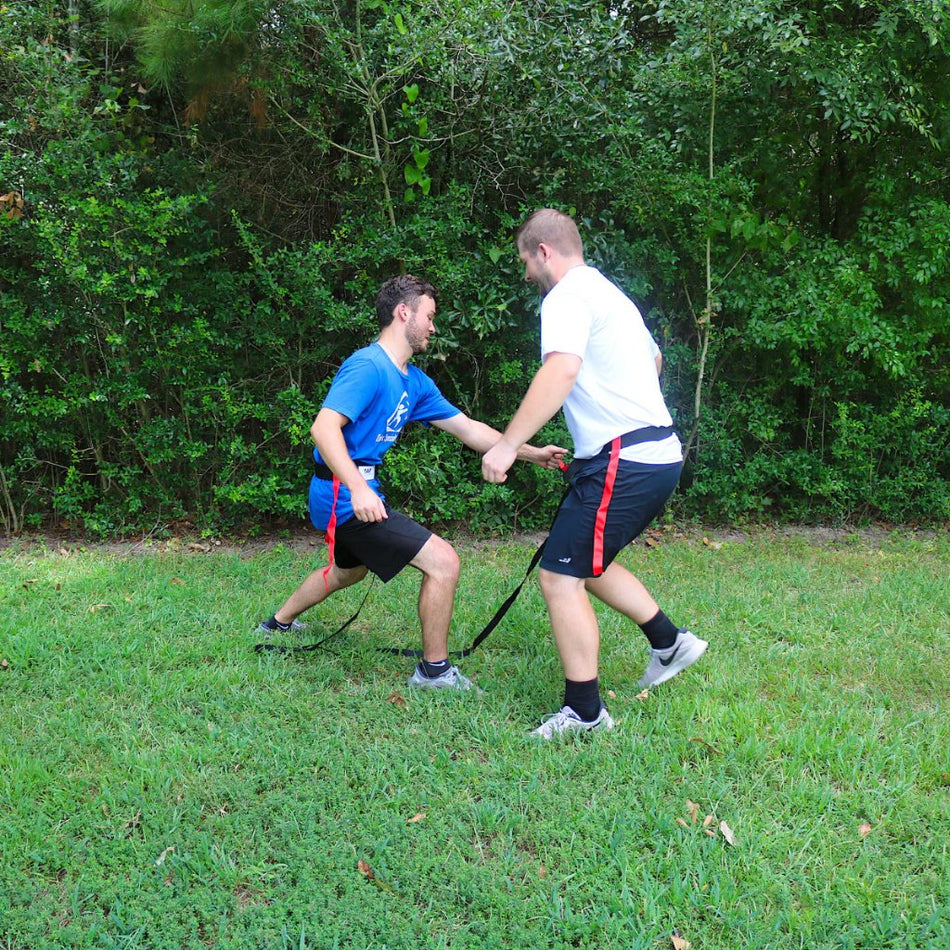
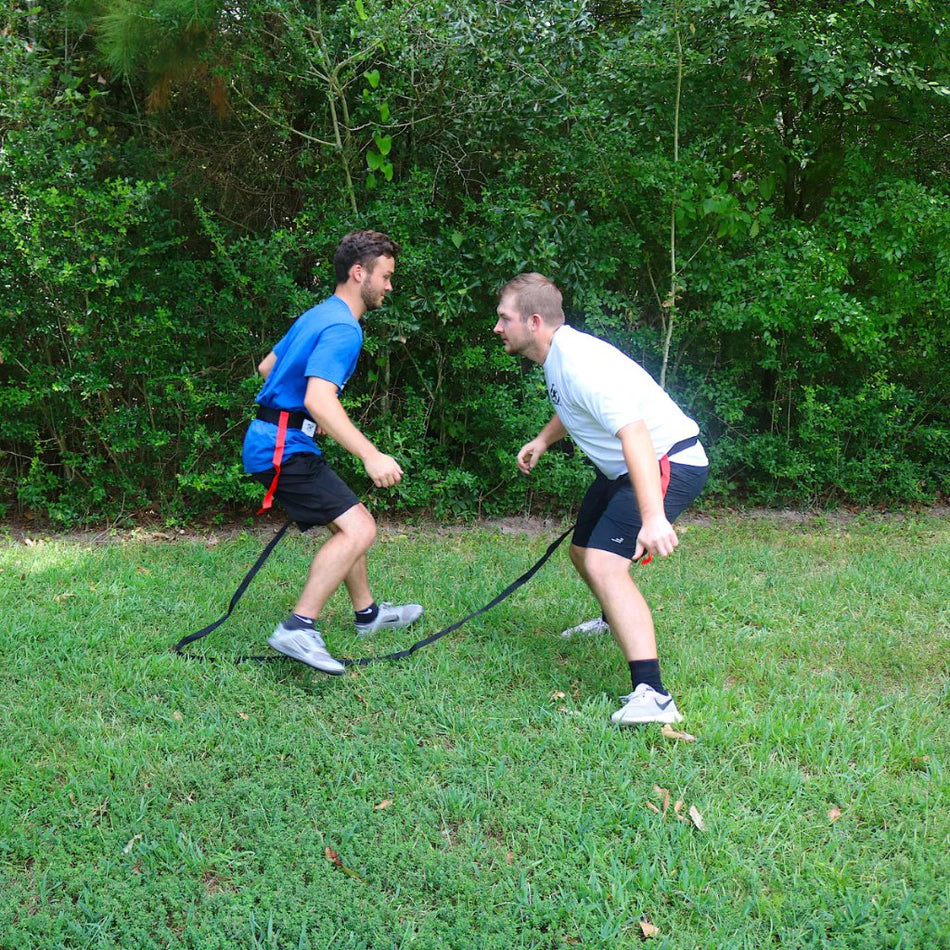
The problem this solves is the order and timing of the kinetic chain — whether the athlete fires links in the right sequence or leaks power by spinning early. The work is constraint-based — designing the task so the better movement emerges from the athlete rather than being coached piece by piece. A baseball-specific study found that a constraints-led approach to opposite-field hitting outperformed step-by-step instruction and produced better functional control of the contact point. At the hips specifically, a belt that both assists and resists pelvic rotation inside the real swing motion nudges the hips to lead and then decelerate cleanly. The Donley Hip Spin — developed by physical therapist Phil Donley — is designed for exactly this: both assisted and resisted hip rotation performed inside actual athletic movements, not isolated hip drills.

The honest promise: it builds timing the athlete can actually use, because it is learned inside the movement itself.
All exercises and training applications described in this article are general educational examples. They are not prescriptive training programs. Oates Specialties does not provide individual training instruction.
What the Evidence Will Not Support
A guide is only as trustworthy as the claims it refuses to make.
Loosening up does not add bat speed by itself. Even the thoracic spine — the most important joint to check — has not been shown to raise bat speed just by getting looser. Clearing a restriction so force can transfer through the chain is a different outcome from building the power that drives it.
Flexibility is not a speed lever. In the research on rotational swinging, flexibility did not track with swing speed. Strength and power did. That relationship should govern what gets most of the training time.
Static stretching before max-effort swings can impair output. Research on warm-up methods in golf found that static stretching before driving reduced clubhead speed, while dynamic and resistance-band warm-ups improved it. In-season, before games, a short active warm-up through the movement patterns of the swing is the right approach. Long static stretching before max-effort work is not.
Throwing builds power, but does not guarantee bat speed. Rotational medicine ball throw velocity relates to bat swing velocity in the research. But intervention evidence is not settled — one youth study found no significant transfer to bat swing speed at a low dose. Train the movement with power, and measure to see if it corresponds to the training stimulus.
Golf findings carry over with care. Golf has more published research on rotational swinging than baseball. Its strength and power findings transfer cleanly. Its skill-learning findings transfer with more care, because hitting a moving pitch introduces timing demands that a stationary golf ball does not have.
The Evidence in Summary
Mobility is not the source of bat speed. It is the gate that allows power to pass through cleanly — or blocks it when a real restriction is present. Flexibility is passive range a stretch can produce. Mobility is active, controlled range the athlete can use at speed. Stability is the ability to resist unwanted movement while force is applied. Training mobility requires load, because load is what makes the nervous system responsible for controlling the range. Without load, the nervous system learns nothing about controlling the position under swing-speed demand. The right approach checks for restrictions in order — upper to middle back first, hips second — applies the job-matched tool honestly, and reserves most of the training investment for building strength and power, which is what the research consistently identifies as the primary driver of bat speed.
Where to Go Next
This article is the third layer in the bat speed development series. The featured article — How to Increase Bat Speed: A Strength-First System for Power and Transfer — maps the full development chain and where mobility fits within it. The strength article that precedes this one built the force production capacity that mobility now needs to organize. The next article in the series covers rotational power — where the strength built in the weight room and the range organized through mobility training get combined into a swing pattern that moves fast, in the right sequence, at the right speed.
Frequently Asked Questions
Flexibility is passive range — how far a muscle or soft tissue stretches when something external is doing the moving. Mobility is active, controlled range under load — how far a hitter can move and control that range when the swing demands it. The swing can only use mobility. Adding load to a movement is what forces the nervous system to control the range, which is what converts passive flexibility into trained mobility.
Not directly. Mobility is a gate, not an engine. A real restriction — a joint that cannot move far enough — can block power from transferring through the swing. Clearing that restriction allows the engine to work cleanly. But the engine is strength and power, not mobility. Static stretching addresses flexibility. Only loaded training that forces the nervous system to actively control range builds the mobility the swing can actually use.
Because load makes the nervous system responsible for the range. When a joint is passively stretched, the external force does the work and the nervous system learns nothing about controlling that position under demand. When a joint is trained through range under load — resisted by a band or weighted by an implement — the muscles must produce and control force throughout the range simultaneously. That is what trained mobility is. Research confirms that full-range resistance training improves flexibility to approximately the same degree as static stretching, while also building strength at the same time.
The upper to middle back first, the hips second. The thoracic spine is built to rotate — the lower back is not — so a thoracic restriction has nowhere to hide and forces a compensation that shows up in the swing. Hip restriction matters because limited hip internal rotation is associated with oblique injury risk in baseball. With both, the goal is ruling out a genuine restriction, not maximizing range.
Annotated Bibliography
Associations between physical characteristics and golf clubhead speed: A systematic review with meta-analysis. PubMed Central.
https://www.ncbi.nlm.nih.gov/pmc/articles/PMC11239735/
Pooled meta-analysis tying clubhead speed to strength and power, not flexibility. Flexibility did not track with swing speed across the studies reviewed. Foundational reference for the gate-not-engine argument and the claim that strength and power are the primary performance drivers in rotational swinging.
Resistance training induces improvements in range of motion: A systematic review and meta-analysis. PubMed Central.
https://www.ncbi.nlm.nih.gov/pmc/articles/PMC9935664/
Full-range resistance training improved range of motion with no significant difference versus stretch training — meaning access and force capacity can be built simultaneously with one training stimulus. Primary support for the mechanism argument that loaded training builds mobility, not just flexibility.
Comparison of resistance training vs. static stretching on flexibility and maximal strength (RCT). PubMed Central.
https://pmc.ncbi.nlm.nih.gov/articles/PMC11212372/
Randomized controlled trial finding that full-range resistance training improved flexibility as much as static stretching while also increasing strength. Anchors the stretch-versus-usable-range distinction and the argument for training range under load.
Effects of thoracic spine mobilization on the lumbar spine rotation angle during trunk rotation. Digital Commons LMU.
https://digitalcommons.lmunet.edu/ajpt/vol1/iss2023/4/
Limited thoracic movement is associated with excess lumbar rotation and low back load. Improving thoracic rotation can reduce that compensatory load. Supports the upper-back-first check and the framing of thoracic restriction as the most defensible mobility constraint for rotational athletes.
Comparing the constraints-led approach, differential learning, and prescriptive instruction for opposite-field hitting. ScienceDirect.
https://www.sciencedirect.com/science/article/abs/pii/S1469029220303356
The constraints-led group improved most and showed greater functional control of the contact point in a baseball-specific study. Supports the timing job and the Donley Hip Spin application as a constraint device that teaches hip-to-shoulder sequencing through the movement rather than through isolated cues.
Abdominal oblique and rectus muscle injuries in major and minor league baseball players: An updated epidemiological review. PubMed Central.
https://pmc.ncbi.nlm.nih.gov/articles/PMC11565690/
Hip internal-rotation deficit identified as a predictor of abdominal and oblique injury in baseball. Supports checking the hips as part of the restriction screen and the framing of hip mobility work as injury-relevant — with the goal of ruling out restriction, not maximizing range.
Rotational medicine ball throw velocity relates to baseball bat swing, batted-ball, and pitching velocity. PubMed.
https://pubmed.ncbi.nlm.nih.gov/34570055/
Rotational ballistic output relates to bat swing velocity in college baseball players. Supports the throwing half of Job 2 and the medicine ball application in this article. Paired with the intervention evidence below as the basis for “train the power, do not promise the miles per hour.”
The effects of medicine-ball training on bat-swing velocity in youth athletes. International Journal of Exercise Science.
https://digitalcommons.wku.edu/cgi/viewcontent.cgi?article=2176&context=ijes
Found no significant transfer to bat swing velocity versus control at the dose studied. The basis for the evidence limit that ballistic throwing supplements strength training and expresses power without independently guaranteeing bat speed gains.
The X-factor and its relationship to golfing performance. ResearchGate.
https://www.researchgate.net/publication/24015642_The_X-Factor_and_Its_Relationship_to_Golfing_Performance
The dynamic increase in hip-trunk separation during the downswing — produced by sequential eccentric loading of the trunk — associates with distance. The static separation measured at the top of the backswing is contested and method-dependent. Supports the argument that trained, active coil matters more than a static flexibility number.
Donley Hip Spin. oatesspecialties.com.
https://oatesspecialties.com/products/donley-hip-spin
Developed by physical therapist Phil Donley. An assist-and-resist hip rotation belt designed to guide and load hip turn inside actual athletic movements — throwing, swinging, striking — at varying speeds. Referenced in this article as the Job 3 timing tool, supporting the constraints-led approach through direct tactile feedback on hip rotation inside the swing pattern.
TAP® Giant Flat Bands. oatesspecialties.com.
https://oatesspecialties.com/products/giant-flat-band
Continuous-loop flat bands in multiple resistance levels. Referenced in this article for both Job 1 (lighter resistance for assisted joint opening) and Job 2 (heavier resistance for loaded holds and resisted trunk work). The load they add is the mechanism that converts passive range work into trained mobility.
TAP® Pummel Ball. oatesspecialties.com.
https://oatesspecialties.com/products/taptm-pummel-ball
A no-bounce, sand-and-air slam ball for full-intent rotational throws and slams in confined space. Referenced in this article for the throwing half of Job 2 — building the rotational power capacity that the strength and mobility layers of this series are designed to express. The no-bounce design allows high-intent repetitions without rebound management.
Oates Specialties. How to Increase Bat Speed: A Strength-First System for Power and Transfer. oatesspecialties.com.
https://oatesspecialties.com/blogs/default-blog/how-to-increase-bat-speed
Establishes the full development chain this article operates within — measurement, strength, mobility, rotational power, and loaded swing work — and maps every companion article in the bat speed series. The mobility layer covered here is the third layer in that sequence, following strength and preceding rotational power.
About This Analysis
Created by the Oates Specialties team led by Robert Oates, M.Ed., Founder
Editorial oversight by Gunnar Thompson, BS, CSCS, General Manager
Certified Strength & Conditioning Specialist | Biomechanics Specialist
July 2026
Complete Credentials
ROBERT OATES, M.Ed., Founder: Founded Oates Specialties in 2003. Master of Education degree. Provides strategic direction for educational content and athlete development philosophy.
GUNNAR THOMPSON, General Manager: BS Kinesiology (Clinical Exercise Science). CSCS (NSCA), PES (NASM), CPPS certifications. Technical authority on biomechanics and performance science. Conducts review of all educational content for scientific accuracy.
Questions or corrections: gunnart@oatesspecialties.com
© 2026, Oates Specialties LLC