In-Season Arm Care for Pitchers: Low-Tech Tools to Stay Ready All Season
Once the season starts, pitchers need a simple repeatable framework that keeps the body ready to compete from the first practice through the last game. This article outlines a low-tech, evidence-aligned arm-care system built around a small set of movement patterns and training tools you can actually use on the field.
Executive Summary
This article outlines a practical, low-tech in-season arm-care framework built around three phases: Prepare, Compete, and Restore. It emphasizes whole-body dynamic warm-ups, simple elastic and oscillation tools, and small, portable "personal kits" so players can care for their arms at school, travel ball, and showcases.
The article stresses that warm-up and cool-down are non-optional parts of pitching and throwing health, explains what each tool actually does (blood flow, mobility, stability, strength endurance, and movement quality), and makes clear that most athletes only need a small core set of implements.
Coaches can use it to design team arm-care habits; players and parents can use it to understand why and how basic arm-care patterns fit into a long season.
The In-Season Problem: The Arm Never Really Resets
Once games begin, most pitchers live in a high-stress / low-recovery loop: school or work, travel, quick warm-up, game-speed pitches, then not enough restoration before the next outing. Over time, that pattern can:
- reduce shoulder and trunk range of motion
- increase fatigue
- make it harder to repeat clean patterns late in games
With the popularity of travel ball, showcases, and fall/winter work, many players move quickly from one "season" to the next. Whether or not year-round play is advisable, the reality is that a lot of throwing now happens with very few true breaks. Consistent habits around warming up, throwing, and cooling down become essential for long-term health and performance.
Key question for coaches: How do we build a simple in-season routine that keeps the entire throwing system—legs, hips, trunk, shoulder, and arm—strong, mobile, and stable without adding more stress?
The tools below support blood flow, mobility, stability, and strength endurance, and act as teaching aids that help athletes feel and repeat better movement patterns.
For parents: This article describes tools and patterns designed for coaches and committed athletes working together. If your athlete is using these tools, expect low-intensity, low-volume work supervised by a coach—not heavy training layered on top of games. Progress should feel gradual and sustainable, not rushed or painful.
For youth athletes: All work described here should be adapted to age and developmental stage. Younger pitchers need lower volume, lower intensity, and closer coach supervision. When in doubt, do less and build gradually under your coach's guidance.
Throwing Matters for Every Position
While this article often uses pitchers as the example, the basic idea applies to every player on the field. In modern baseball, almost every position demands repeated, high-intensity throws over a long season. Catchers, infielders, and outfielders all benefit from a simple habit of warming up the whole body, preparing the arm with a few focused patterns, and cooling down after heavy throwing days. The details may change by role, but the principle—that throwing warm-ups and basic arm conditioning are a normal part of playing baseball well—is the same.
Defined Terms (Used Throughout)
- Arm care: Low-intensity work that supports range of motion, strength endurance, and coordination of the shoulder, scapula, trunk, and lower body around the throwing motion.
- Deceleration: The phase after ball release where the body slows the arm; healthy deceleration spreads load through the back of the shoulder, trunk, and lower body.
- Elastic resistance: Bands or tubing that provide steady, increasing resistance as they stretch.
- Oscillation: Rapid, rhythmic back-and-forth movement that creates unstable forces the body must stabilize against.
- Self-myofascial release: Using tools like foam rollers to apply pressure to muscles and connective tissue to reduce soreness and improve movement quality.
One In-Season Pattern: Prepare, Compete, Restore
To keep this practical, you can organize everything into one pattern:
Prepare
Raise body temperature, move the whole kinetic chain, then add focused arm-care patterns before throwing.
Compete
Use very small "stay warm" movements between innings when needed.
Restore
Use simple movement and recovery work after outings and on the following day.
A key point for every pitcher: warming up before throwing and cooling down afterward are not optional add-ons. They are a normal, expected part of arm health and long-term development. The exact details can change by age and level, but some form of prepare and restore work should be present around every outing.
Each tool below fits primarily into one or two of these buckets. The goal is to support your existing throwing and training plan, not to create a second full-time program layered on top of competition.
First Step in Preparing: Whole-Body Warm-Up and Dynamic Mobility
Before any bands, oscillation, or throwing, a good warm-up should:
- Raise core body temperature slightly
- Include dynamic movements for the hips, trunk, and shoulders
- Transition into progressive catch
This whole-body preparation is a non-negotiable part of pitching. It wakes up the kinetic chain that actually drives the throw, so the arm and shoulder are not asked to do all the work cold. The tools that follow simply help refine how the upper body and arm behave inside that larger movement pattern.
Elastic vs Oscillation Tools: Simple Differentiation
A brief distinction helps coaches select the right pattern at the right time:
Elastic tools (tubing and bands):
- Provide steady resistance as they stretch
- Best for controlled pulling, pushing, and reaching patterns
- Build strength endurance and range of motion for cuff, scapula, and trunk
Think: "pull against the band smoothly, and then return with control."
Oscillation tools (long lever and compact):
- Create rapid, back-and-forth motion
- Challenge timing, reflexive stability, and "hold it together" control at the shoulder and trunk
Think: "the tool wants to shake you; you stay organized."
Both categories can be useful. Elastic tools are usually the first step; oscillation tools become more relevant once basic control is in place.
Not Every Pitcher Needs Every Tool
The tools in this article are options, not requirements. Most pitchers can build a very effective in-season arm-care plan with a small core kit such as:
- Elastic resistance
- A mini-band
- A simple throwing sock
Other implements—oscillation tools, long-loop bands, weighted forearm sleeves, compression bands, and foam rollers—are best added selectively, when a coach has a clear reason (for example, more stability work, confined-space throwing, or deceleration focus) and the time to supervise their use. Each tool is just one way to influence blood flow, mobility, stability, and strength endurance while giving the athlete clearer feedback about how their body is moving. The goal is to choose the few tools that match a pitcher's current needs, schedule, and stage of development, then use them consistently, not to collect every possible implement.
Arm Care Within Reach of Every Team and Player
Good arm care does not require a full weight room or a large budget. A small elastic band, a mini loop, and a basic throwing sock can support most of the movement patterns in this article. Mini-bands in particular are inexpensive, easy to carry, and simple to share, which means even youth and travel teams can build better throwing warm-ups and cool-downs into everyday practice. The real difference comes from consistent use and thoughtful coaching, not from the price or number of tools.
Elastic Resistance Tubing: Controlled Pulling and Reaching Patterns
What it is
Elastic resistance tubing is a length of flexible material with handles or attachment points used for shoulder and scapular patterns in standing or half-kneeling positions. Oates Specialties offers standard and sheathed tubing options designed for this kind of arm-care work.
How it supports Prepare and Restore
- Prepare: Tubing is ideal for controlled pulling and reaching patterns—external rotation, rows, and diagonal pulls—that increase local blood flow, maintain shoulder and scapular mobility, and build strength endurance in the muscles that help guide and slow the arm.
- Restore: On the same night or next day, the same patterns performed gently can help restore comfortable movement without chasing fatigue.
Movement pattern emphasis
The focus is on:
- Smooth, controlled motion rather than maximum tension
- Stable trunk and scapula while the arm moves
- Stopping well before burning fatigue
For a complete breakdown of resistance tubing patterns, movement variables, and how to layer band work into your existing arm-care routine: Read the full elastic resistance tubing article
Mini-Bands (9" Loops): Scapular and Posture Control
What they are
Mini-bands are small continuous loops of elastic placed around the wrists, forearms, or legs to create gentle outward resistance. They are compact and travel easily in a bag.
How they support Prepare and Compete
- Prepare: Mini-bands are useful for patterns where the hands gently press outward while the arms move—such as horizontal reaching and wall-slide variations—encouraging the shoulder blades to move cleanly on the ribcage and supporting better posture and shoulder-blade stability as intensity ramps up.
- Compete: Between innings, a few controlled mini-band movements can help a pitcher feel "switched on" at the shoulder without adding significant load.
Movement pattern emphasis
The focus is on:
- Long neck, relaxed upper traps
- Slow, controlled arm movement while the band provides light outward tension
- Small ranges that feel smooth, not forced
For specific wrist and ankle placement guidance, movement progressions, and how to use 9" loops for scapular control and lower-body stability: Read the full 9" exercise bands article
Long-Loop Bands (41" Giants): Whole-Body Pulling and Assisted Mobility
What they are
Long-loop bands are larger continuous loops that can be anchored or used around the body for rows, pulldowns, and assisted stretching. Oates Specialties carries giant flat bands in several resistance levels for these patterns.
How they support Prepare and Restore
- Prepare: Long loops work well for whole-body pulling patterns—standing rows, face pulls, and pulldowns that involve the hips and trunk along with the shoulders, increasing blood flow and involving more of the kinetic chain.
- Restore: They can assist gentle mobility work, such as band-assisted shoulder or trunk stretches, on low-intensity days.
Movement pattern emphasis
The focus is on:
- Using hips and trunk along with the arms
- Letting the band guide you into and out of positions smoothly
- Avoiding bouncing or aggressive stretching, especially right before throwing
For detailed movement patterns, stance variations, and how long-loop bands support whole-body pulling and assisted mobility for throwers: Read the full long-loop bands article
Oscillation Tools: Stability Under Chaotic Load
What they are
Oscillation tools vibrate or oscillate when the athlete moves them, forcing the shoulder and trunk to stabilize. Oates Specialties offers oscillation tools designed for throwing athletes.
How they support Prepare and Restore
- Prepare: Short bouts in a few arm positions (for example, arm out front or slightly in the scapular plane) challenge the shoulder and trunk to maintain stability and control against rapidly changing forces, improving neuromuscular coordination rather than raw strength.
- Restore: After throwing, low-amplitude oscillations can encourage gentle stability and circulation at low intensity.
Movement pattern emphasis
The focus is on:
- Stiff, straight arm from hand to shoulder, with soft knees and steady trunk
- Smooth rhythm rather than wild shaking
- Reducing amplitude or stopping if motion becomes jerky or uncomfortable
For long-lever oscillation training with rhythmic patterns and full arm extension—ideal when you have space in the bullpen, cage, or training room: Read the full long-lever oscillation article
For compact water-turbulence training with unpredictable fluid movement—ideal for travel, tight spaces, and portable arm care when full equipment isn't available: Read the full water-turbulence training article
Wearable Throwing Sock: Confined-Throwing and Deceleration Patterns
What it is
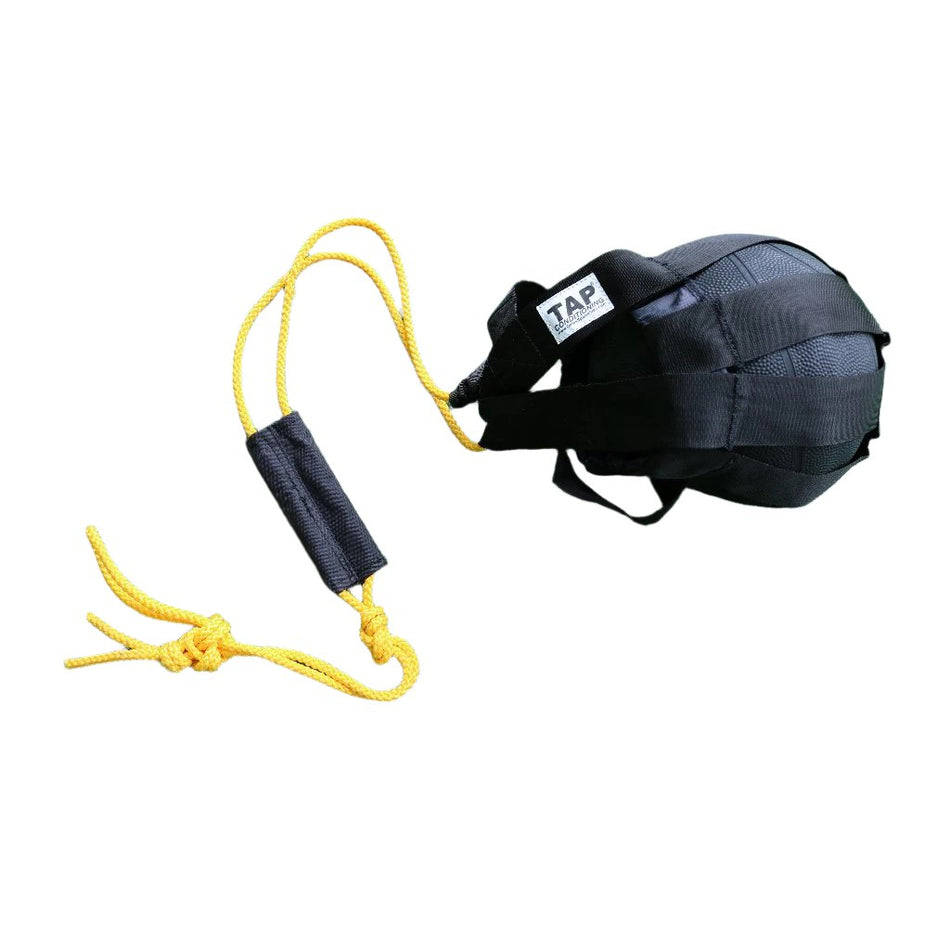
A wearable throwing sock is a fabric sleeve or pouch attached to the throwing arm that captures the ball after release. Oates Specialties offers a Baseball Training Sock designed specifically for throwing patterns.
How it supports Restore
The sock allows low-intent throws in a small space, which can be used after outings or on the following day to keep the arm moving, increase local blood flow, and highlight smooth deceleration. The intent is on motion quality, not radar readings or distance.
Movement pattern emphasis
The focus is on:
- Relaxed, continuous motion through release into a soft, controlled finish
- The body (hips, trunk, back of the shoulder) sharing the work of slowing the arm
- Stopping if the thrower starts "slamming on the brakes" or muscling the deceleration
For detailed deceleration patterns, emergency braking pattern identification, confined-space throwing protocols, speed-specific eccentric training (eRFD), and volume guidance for post-outing recovery: Read the full throwing sock article
Weighted Forearm Sleeve: Targeted Deceleration Emphasis
What it is
A weighted forearm sleeve is a garment worn on the throwing forearm that adds a small amount of mass away from the elbow. Oates Specialties offers a weighted forearm sleeve integrated into its throwing-tools lineup.
How it supports Restore (for selected athletes)
- The sleeve slightly changes how the arm feels during the finish, encouraging a softer, more flexed deceleration pattern rather than a straight, locked elbow, while adding a small stability and strength-endurance demand to the deceleration pattern.
- It is best used with older, physically mature pitchers, under coach supervision, and in low volumes focused on pattern quality.
Movement pattern emphasis
The focus is on:
- Feeling the added weight guide the forearm into a gentle bend at and after release
- Matching the motion with full-body rotation so the arm does not have to stop itself alone
- Removing the sleeve if the athlete reports sharp or odd sensations
For detailed distal forearm loading mechanics, the gradual-return four-day Restore progression, and guardrails for age and workload — including when to use the sleeve instead of the throwing sock: Read the full weighted forearm sleeve article
Foam Rolling: Self-Pressure for Soreness and Movement
What it is
Foam rolling is a form of self-myofascial release using a cylindrical roller or similar tool to apply pressure to muscles and fascia.
How it supports Restore
- After outings: Foam rolling can be used on the legs, hips, trunk, and upper back to help manage soreness, support circulation, and support movement quality.
- Next day: Similar rolling, combined with simple mobility drills, can help pitchers feel more normal before they resume throwing.
Movement pattern emphasis
The focus is on:
- Slow rolling with steady breathing
- Working within comfortable pressure levels (no gritting teeth)
- Using rolling as a lead-in to gentle mobility, not a replacement
For a complete breakdown of how foam rollers and massage balls fit into Prepare, Compete, and Restore — including what the research says about range of motion, soreness, and performance: Read the full foam rolling and massage ball article
Elastic Compression Bands (Flossing): Short-Term ROM Adjunct
What they are
Elastic compression bands are wide bands wrapped around a limb segment during controlled movement and then released. This approach is often called "tissue flossing." Oates Specialties offers compression bands for this purpose.
How they support Restore (in selected settings)
- When used carefully, compression bands can support short-term changes in range of motion and how a joint feels during movement.
- Because responses vary and protocols matter, they are best treated as an optional adjunct under guidance, not a default in-season tool for every pitcher.
Movement pattern emphasis
The focus is on:
- Comfortable snugness, never numbness or tingling
- Simple movements under the wrap, followed by re-checking motion once the band is removed
- Conservative use, especially during a dense game schedule
For a complete breakdown of how compression flossing works, what the research supports, safety setup, and a sample Restore-day protocol for pitchers: Read the full compression flossing article
Recovery Context: Beyond Tools
Arm-care tools sit inside a bigger recovery picture:
- Light movement after games: Easy walking or gentle mobility work supports circulation and recovery.
- Sleep, hydration, and basic nutrition: These are primary drivers of how the arm feels tomorrow; tools support, but do not replace, these fundamentals.
- Workload and rest: Thoughtful pitch counts, throwing days, and rest intervals matter more than any single device. Tools are there to help you make the most of a sound schedule, not to cancel out poor planning.
With year-round schedules and the popularity of travel ball, many throws now happen away from a primary team's field and outside a single coach's view. Having a simple, agreed-upon arm-care pattern and a few portable tools helps players make better decisions about warming up and cooling down, even when they are on a different field or with a different team. Just as warming up is not optional, some form of cooling down and next-day recovery work should be a standard part of every pitcher's routine.
Team Tools and Personal Kits
Many teams keep a shared set of arm-care tools—such as oscillation implements, long-loop bands, and a few throwing socks—in the bullpen or dugout for use before games and between innings. That team-centric setup is helpful, but it does not cover every situation. With the rise of travel ball, showcases, and multiple teams, players often throw when their primary coach is not present and team gear is not available.
A simple personal kit—such as one piece of elastic resistance, one mini band, and one throwing sock—gives each player a way to follow basic warm-up, arm-care, and low-intent throwing patterns wherever they are. Some programs even build this into their culture by providing or recommending a small arm-care package for each athlete so that expectations and tools match across school ball, travel ball, and individual work.
Putting It Together: A Simple In-Season Weekly Routine
Here is one example of how a coach could blend these patterns into an in-season week for a starting pitcher. This is a framework, not a prescription, and should always be adapted to age, level, and individual response.
Game Day (Start)
Prepare:
- Whole-body dynamic warm-up and progressive catch.
- Elastic patterns (tubing and/or long-loop bands) for controlled pulling and reaching.
- Mini-band patterns for scap/posture.
- Brief oscillation bouts in 1–3 arm positions.
Compete:
- If needed, a few seconds of very light mini-band or band patterns between innings to help the pitcher feel warm without adding fatigue.
Restore (later):
- Foam rolling on major muscle groups.
- Optional low-intent throwing-sock patterns and shoulder oscillations to keep the arm moving and highlight relaxed deceleration.
Day After Start
Restore:
- Foam rolling plus gentle mobility.
- Very light elastic-resistance patterns focused on range, not load.
- Gentle shoulder-oscillation patterns focused on range of motion.
- Selected throwing-sock throws (or weighted-forearm-sleeve patterns if appropriate).
- Optional, conservative compression-band use as part of ROM work under staff guidance.
Mid-Week
Prepare + Restore:
- Short elastic-resistance and mini-band patterns around any bullpen work.
- Oscillation patterns and light mobility before and/or after throwing.
This structure respects that once the season begins, the pitcher's main job is to be ready to compete. The patterns and tools above simply give coaches and athletes practical ways to support preparation, staying warm, and recovery without overwhelming the schedule.
Soft Next Step
You do not need every tool described here to have a solid in-season plan. Many players will do well with a small personal kit—often elastic resistance, a mini band, and a throwing sock—and a few simple patterns they can repeat before and after throwing, wherever they are.
If you'd like, you can use this framework to:
- Map a small core kit into Prepare / Compete / Restore slots for your staff.
- Add other tools selectively as your context, budget, and athletes warrant.
- Use the cluster articles (linked throughout this piece) for deeper dives into each tool category.
Tool Demonstration Reference
For coaches and athletes who prefer to see these tools in motion, visual demonstrations of the movement patterns highlighted in this article are available as reference materials. These include setup and movement quality examples for:
- TAP® Shoulder Tube
- Khaos® Shoulder Shaker
- TAP® Baseball Training Sock
- TAP® Weighted Forearm Sleeve
- TAP® Giant Flat Bands
- Oates Specialties Resistance Tubing
- TAP® Exercise Bands
- TAP® Rocket Wrap Compression Floss
These demonstrations offer helpful visual context for setup and movement quality, and they pair naturally with the cluster articles linked throughout this piece, which explain how each tool fits into the overall Prepare, Compete, and Restore framework.
Safety, Dosing, and Distinguishing "Arm Care"
To ensure the best outcomes and maintain the health of the athlete, please keep the following guardrails in mind if using the tools and patterns described in this article.
Universal Safety Principles
- Smooth, Not Straining: All arm-care movements should be performed with control. If a movement requires "muscling" or leads to "slamming on the brakes" during deceleration, reduce the resistance or the intensity immediately.
- The "Odd Sensation" Rule: If an athlete feels anything sharp, pinching, or "odd" during a drill, they should stop the movement immediately and consult their coach or a healthcare professional.
- Stop Before Fatigue: In-season arm care is designed to support movement quality and blood flow, not to chase a "burn." Athletes should finish their sets feeling prepared or restored, not exhausted.
Youth Athlete Guardrails
For younger pitchers (14 and under), the following rules apply:
- High Supervision: Tools should only be used under the direct eye of a coach or knowledgeable adult.
- Low Intensity: Focus entirely on the feeling of the movement (neuromuscular control) rather than the resistance level.
- Conservative Volume: When in doubt, do less. The goal for youth is to build a healthy habit, not a high-workload training program.
Dosing and Constraints
- In-Season Context: During the competitive season, these tools are for maintenance and restoration. Avoid introducing high-intensity novelty or maximum-effort loading during periods of heavy game schedules or travel.
- Equipment Care: Always inspect elastic tubing for nicks or tears before use. When using resistance tubing, do not exceed ~300% elongation to prevent equipment failure and ensure consistent tension.
Disclosures
Note to Coaches and Parents: The information provided here is for educational purposes and reflects expert-system field use and biomechanical principles. Oates Specialties does not claim that these tools "fix" mechanics, "correct" dysfunction, or "prevent" injury. Athletic development is a long-term process that requires a holistic approach to workload, sleep, and physical preparation.
Annotated Bibliography
1. Mullaney MJ, Nicholas SJ. (2021).
"Evidence Based Arm Care: The Thrower's Ten Revisited." International Journal of Sports Physical Therapy, 16(6), 1585–1592. A modern review of the Thrower's Ten program emphasizing elastic-resistance patterns for shoulder health in overhead athletes.
2. University of Florida Orthopaedics & Sports Medicine. (2023).
"Thrower's Ten Program." A practical, accessible outline of tubing-based exercises commonly used in baseball arm-care routines.
3. McIff TE, Hargreaves JS. (1995).
"On-the-Field Resistance-Tubing Exercises for Throwers." Athletic Therapy Today, 1(1), 10–13. One of the earliest descriptions of field-based tubing programs tailored to throwing athletes.
4. Bayrakci Tunay V, Akbayrak T, Bakar Y, et al. (2021).
"Effects of Scapular Stabilization Exercise Based on the Type of Elastic Band." Physical Therapy Rehabilitation Science, 10(4), 552–560. Demonstrates that elastic-band scapular programs improve shoulder function and periscapular muscle balance.
5. Pulido JP, Greenberg EM, Albright JC, et al. (2023).
"Bodyblade™ Training in Athletes with Traumatic Anterior Shoulder Instability." International Journal of Sports Physical Therapy, 18(1), 176–186. Evaluates oscillation-tool training and its effects on shoulder stability and function.
6. Beardsley C, Škarabot J. (2015).
"Effects of Self-Myofascial Release: A Systematic Review." Journal of Bodywork and Movement Therapies, 19(4), 747–758. Summarizes foam-rolling research, reporting improved ROM and reduced soreness without negative performance effects.
7. MacDonald GZ, Button DC, Drinkwater EJ, Behm DG. (2014).
"Foam Rolling as a Recovery Tool after an Intense Bout of Physical Activity." Medicine & Science in Sports & Exercise, 46(1), 131–142. Shows foam rolling can aid recovery from exercise-induced muscle damage and maintain performance.
8. Elite Baseball Performance. (2018).
"Evidence-Based Inseason Arm Care for Baseball Players." A practical overview of in-season arm-care priorities, emphasizing reduced volume and close monitoring during competition phases.
About This Analysis
Created by the Oates Specialties team led by Robert Oates, M.Ed., Founder
Editorial oversight by Gunnar Thompson, BS, CSCS, General Manager
Certified Strength & Conditioning Specialist | Biomechanics Specialist
February 2026
Complete Credentials
ROBERT OATES, M.Ed., Founder: Founded Oates Specialties in 2003. Master of Education degree. Provides strategic direction for educational content and athlete development philosophy.
GUNNAR THOMPSON, General Manager: BS Kinesiology (Clinical Exercise Science). CSCS (NSCA), PES (NASM), CPPS certifications. Technical authority on biomechanics and performance science. Conducts review of all educational content for scientific accuracy.
Questions or corrections: gunnart@oatesspecialties.com